Expanding into international markets can put your business in front of millions of new potential customers, but simply making your website available in another country does not guarantee organic visibility. A page that performs well in one market may struggle to attract search traffic somewhere else because search behavior, competition, language, purchasing habits, and user expectations can vary significantly from country to country.
This is where a well-planned international SEO strategy becomes important. Instead of treating global search as one large audience, businesses need to understand what makes each market different and build an approach around those differences. This can involve identifying the most valuable countries to target, understanding local search demand, creating relevant content, strengthening regional authority, and ensuring that the website can be crawled and understood correctly across markets.
A successful approach to global SEO is therefore less about duplicating the same website across different countries and more about creating a scalable system that combines global consistency with local relevance. The goal is to build a website that can compete in international search results while still giving users a genuinely useful experience in their own market.
This becomes particularly important as businesses expand from one market into several. Managing SEO for multiple countries introduces new challenges around keyword targeting, content localization, technical optimization, link building, and performance measurement. What works for users in the United States, for example, may not produce the same results in Germany, France, Australia, or other markets.
The good news is that international growth does not require a completely different SEO process for every country. With the right framework, businesses can establish repeatable processes for researching markets, creating localized content, optimizing international websites, monitoring performance, and identifying opportunities for further growth.
In this guide, we'll explore how to build a scalable global SEO strategy, decide which markets to prioritize, adapt your content and website for international audiences, measure results, and determine when professional international SEO services can help accelerate growth.
2. What Makes International SEO Different From Traditional SEO?
Traditional SEO usually focuses on improving visibility within a single market, where the language, search behavior, competitors, and customer expectations are relatively consistent. International SEO is more complex because every new country can introduce a different search environment. A strategy that generates strong traffic in one market may perform poorly in another if it does not account for local search intent, competition, language, and purchasing behavior.
One of the biggest differences is that global SEO requires businesses to balance consistency with localization. Your brand, technical standards, and core messaging should remain recognizable across markets, but the actual search strategy may need to change. Users in different countries can use completely different terms to find the same product or service, even when they speak the same language.
This makes international keyword research a critical part of SEO for international markets. Simply translating keywords from your existing website is rarely enough. Search volume, terminology, user intent, and competitive difficulty can vary significantly between countries. Effective research identifies how people actually search in each target market and then maps those terms to the right products, services, categories, and content.
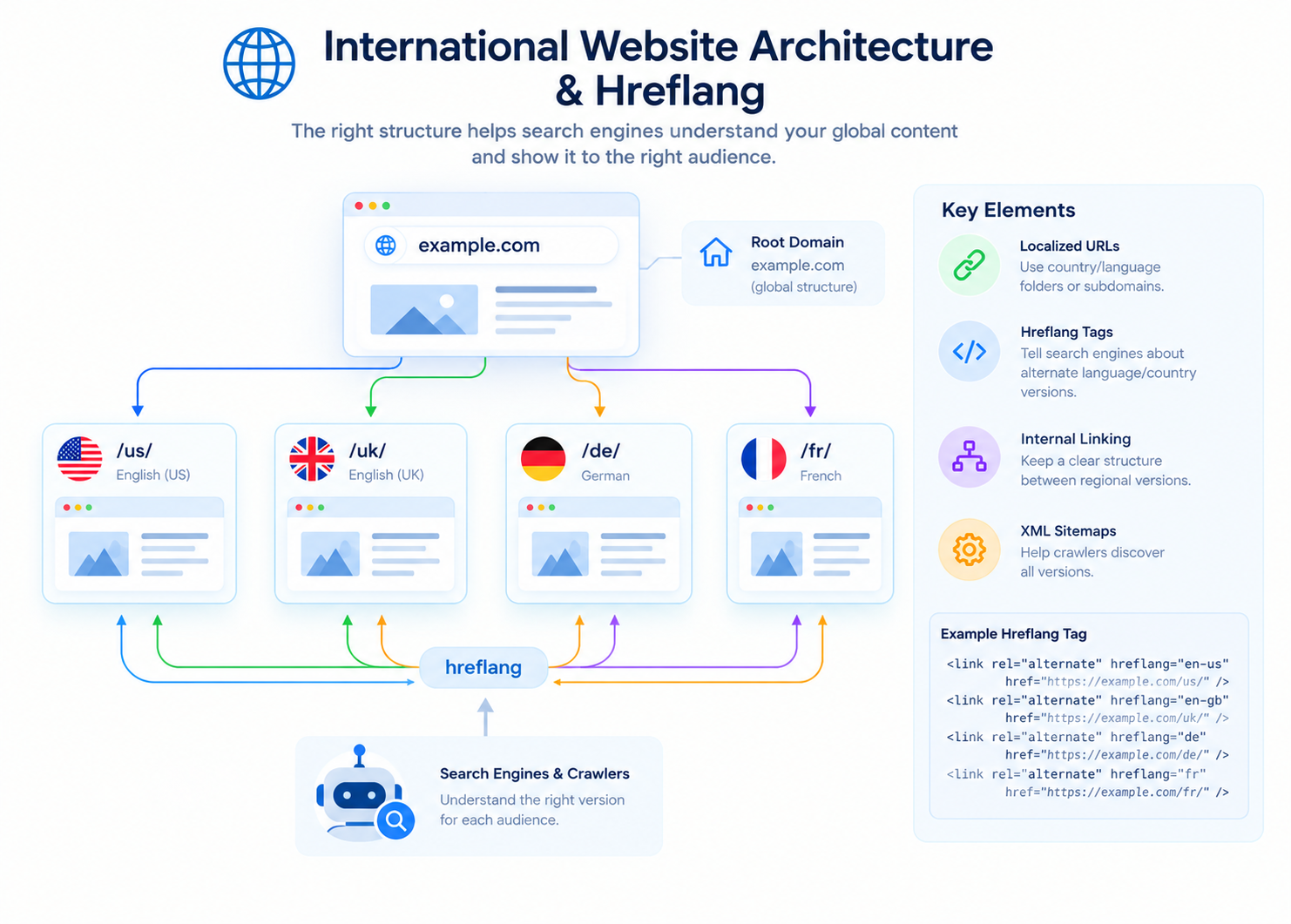
Technical considerations also become more important when managing SEO for multiple countries. Search engines need clear signals about which version of a page is intended for a particular audience. Website architecture, localized URLs, language targeting, internal linking, and hreflang implementation can all influence how international pages are discovered and interpreted.
Another major difference is authority. A website may have strong rankings and backlinks in its home market but still struggle to establish credibility in a new country. This is why international SEO strategies often include market-specific digital PR, partnerships, content promotion, and link acquisition rather than relying entirely on the authority of the original domain.
Ultimately, international search engine optimization is not about copying your domestic SEO process into different countries. It is about creating a scalable system that understands the differences between markets while maintaining a consistent overall brand strategy. Businesses that approach global search engine optimization this way are better positioned to build sustainable visibility as they expand internationally.
3. How to Build an International SEO Strategy From the Ground Up
Building an effective international SEO strategy requires more than creating translated versions of your existing website. Before entering a new country, businesses need to understand whether the market is commercially valuable, how people search, who already dominates the search results, and what resources will be required to compete.
A strong strategy connects business goals with search opportunities. Instead of targeting as many countries as possible, the objective should be to identify the markets where organic search can generate meaningful business results and then create a structured process for entering and scaling those markets.
3.1 Start With Clear International Business Goals
The first step is to determine why your business wants to enter international markets. SEO should support the broader expansion plan rather than operate as an isolated traffic-generation activity.
For example, an ecommerce business may want to increase product sales in specific countries, while a SaaS company may be looking for qualified leads from international businesses. A service provider might be interested in generating inquiries from a handful of high-value regions rather than attracting large volumes of visitors.
Your goals could include:
- Increasing organic traffic from selected countries
- Generating qualified international leads
- Increasing ecommerce revenue from overseas customers
- Building brand visibility in new markets
- Supporting the launch of localized products or services
- Reducing dependence on one domestic market
- Capturing search demand where competitors are currently stronger
These objectives should determine how you measure your global SEO strategy. For example, ranking for thousands of keywords may look impressive, but if those rankings produce visitors who cannot purchase your product or use your service, the SEO campaign is not necessarily successful.
3.2 Identify Markets With Genuine Business Potential
One of the most important decisions in SEO for international markets is deciding which countries to target first.
A common mistake is choosing countries solely because they have a large population or high overall search volume. Search demand is important, but it should be considered alongside commercial factors such as product availability, competition, average order value, local regulations, shipping capabilities, and existing brand recognition.
Create a market opportunity assessment for each potential country. Consider questions such as:
- Is there existing demand for your products or services?
- Can your business legally and practically operate there?
- Are customers willing to purchase from companies like yours?
- How strong are the existing competitors?
- What is the potential revenue from the market?
- How difficult will it be to establish organic visibility?
- Do you already have customers, partners, or brand recognition there?
- Can you provide local customer support?
- Is your website and product experience suitable for that market?
This approach prevents your international SEO strategies from becoming focused purely on rankings. A country should ideally have both search potential and commercial potential.
3.3 Prioritize Markets Instead of Targeting Everything at Once
Once potential markets have been identified, rank them according to opportunity and difficulty.
You can divide markets into categories such as:
Tier 1 — High priority:
Countries with strong demand, clear commercial potential, and realistic SEO opportunities.
Tier 2 — Growth opportunities:
Markets with promising demand but greater competition, localization requirements, or operational challenges.
Tier 3 — Future markets:
Countries worth monitoring but not yet ready for significant investment.
This prioritization is particularly important for companies implementing SEO for multiple countries. Launching ten or twenty country versions simultaneously can spread content, technical, and marketing resources too thinly.
A better approach is often to establish one or two international markets successfully, document what works, and then use that framework to expand into additional countries.
3.4 Perform International Keyword Research Before Creating Pages
Keyword research should happen before the content and website structure are finalized. Using the best keyword research tools for SEO can help you evaluate search volume, keyword difficulty, trends, search intent, and competitor opportunities across different markets.
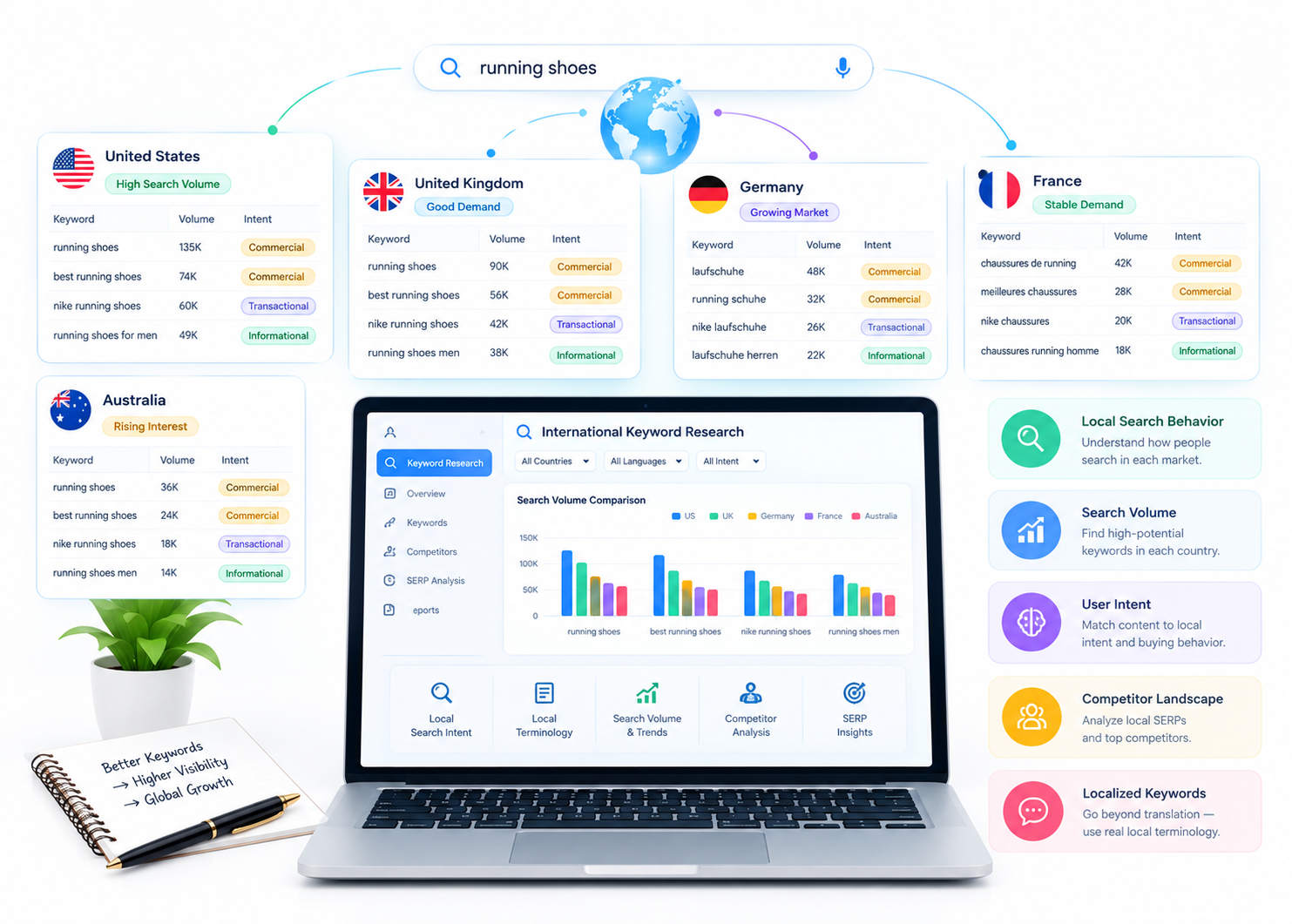
International SEO keyword research examines what users in each market actually type into search engines. This includes more than translating keywords from your original market.
For example, people in two countries that speak the same language may use different terminology for the same product. Even where the language is different, a literal translation may not reflect the way local users search.
Research should therefore consider:
- Local keyword variations
- Search intent
- Commercial and transactional terms
- Informational searches
- Long-tail queries
- Search volume by country
- Keyword difficulty
- Seasonal search patterns
- SERP features
- Local terminology
- Competitor keyword rankings
This is also where international keyword research should be connected to your product or service offering. Group keywords into categories such as informational, commercial investigation, transactional, branded, and navigational searches.
The objective is not simply to find keywords with high volume. It is to identify searches that can contribute to the customer journey and eventually produce measurable business value.
3.5 Analyze Search Intent in Every Target Market
Search intent can change between countries, even when the keyword appears to be the same.
Suppose users search for a particular software product in two different markets. In one market, the search results may be dominated by comparison articles and reviews. In another, users may primarily see product pages, pricing pages, or local service providers.
That difference tells you something important: Google is interpreting the search differently based on the market and available content.
Your international strategy should therefore examine the actual search results for important queries rather than relying entirely on keyword databases.
Look at:
- Which types of pages rank
- What information competitors provide
- Whether local businesses dominate the results
- Whether users expect pricing information
- Whether comparison content is common
- Whether informational or transactional pages perform better
- Which SERP features appear
This helps determine what type of content you need to create for each market.
3.6 Research Local Competitors
Your domestic competitors may not be your primary competitors internationally.
When entering a new country, search for the products and services you offer and identify the websites consistently appearing on the first page. These competitors can reveal what Google considers authoritative and relevant in that market.
A competitive analysis should examine more than rankings and content. Backlinks can also reveal how competing websites have built authority within a particular market and where potential link-building opportunities may exist.
- Organic visibility
- Ranking keywords
- Content depth
- Website structure
- Backlink profiles
- Local partnerships
- Product or service pages
- Pricing and offers
- User experience
- Localized content
- Brand mentions
This research can uncover opportunities that would otherwise be difficult to identify. Once relevant websites and industry relationships have been identified, businesses can also explore how to get high-quality backlinks that strengthen their authority in the target market
For example, you may discover that the largest competitor has strong domain authority but very limited content around specific customer problems. That could create an opportunity for a well-localized content strategy to gain visibility without competing directly for the most difficult commercial keywords.
3.7 Decide What Should Be Translated and What Should Be Rebuilt
Not every existing page needs to be copied into a new market. Some pages may have universal value and can be localized with relatively minor changes. Others may depend heavily on local pricing, regulations, terminology, customer expectations, or market-specific products. This is also why clear messaging matters when adapting a website for a new market, since customers need to understand the offer, value, and next step in language and terms that feel relevant to them.
Before creating international pages, classify your existing content into three groups:
Keep and localize: Content that remains relevant but needs language, terminology, examples, or cultural adjustments.
Adapt significantly: Content where the topic is useful but the examples, search intent, products, or information need substantial changes.
Create from scratch: Content addressing search demand or customer questions that do not exist in your original market.
This prevents international websites from becoming collections of mechanically translated pages. It also creates a stronger foundation for optimizing content for generative AI, where clear structure, direct answers, and useful information can make content easier for AI systems to understand.
3.8 Establish a Scalable Website Framework
Your technical structure should support the number of markets you expect to enter.
The important question is not only, “What works for one country?” but also, “Will this structure remain manageable when we have ten countries?”
Your framework should make it easy to:
- Add new country versions
- Maintain localized content
- Manage metadata
- Implement language and regional targeting
- Connect related pages
- Monitor indexing
- Manage redirects
- Track organic performance
- Prevent duplicate or conflicting URLs
This is an important part of international search engine optimization because technical complexity increases rapidly as more markets are added.
3.9 Create Market-Specific Content Priorities
Once your markets and keywords are understood, create a content roadmap for each priority country.
Rather than publishing the same number of articles everywhere, allocate resources according to opportunity.
For one country, your priority might be:
- Product pages
- Category pages
- Comparison pages
- Buying guides
- Supporting informational content
For another market, informational searches might represent a much larger opportunity, making educational content the better starting point.
This market-by-market approach makes your global SEO strategy more efficient because content investment follows actual search demand rather than an arbitrary publishing schedule.
3.10 Build Measurement Into the Strategy From Day One
International SEO should be measurable at the country level.
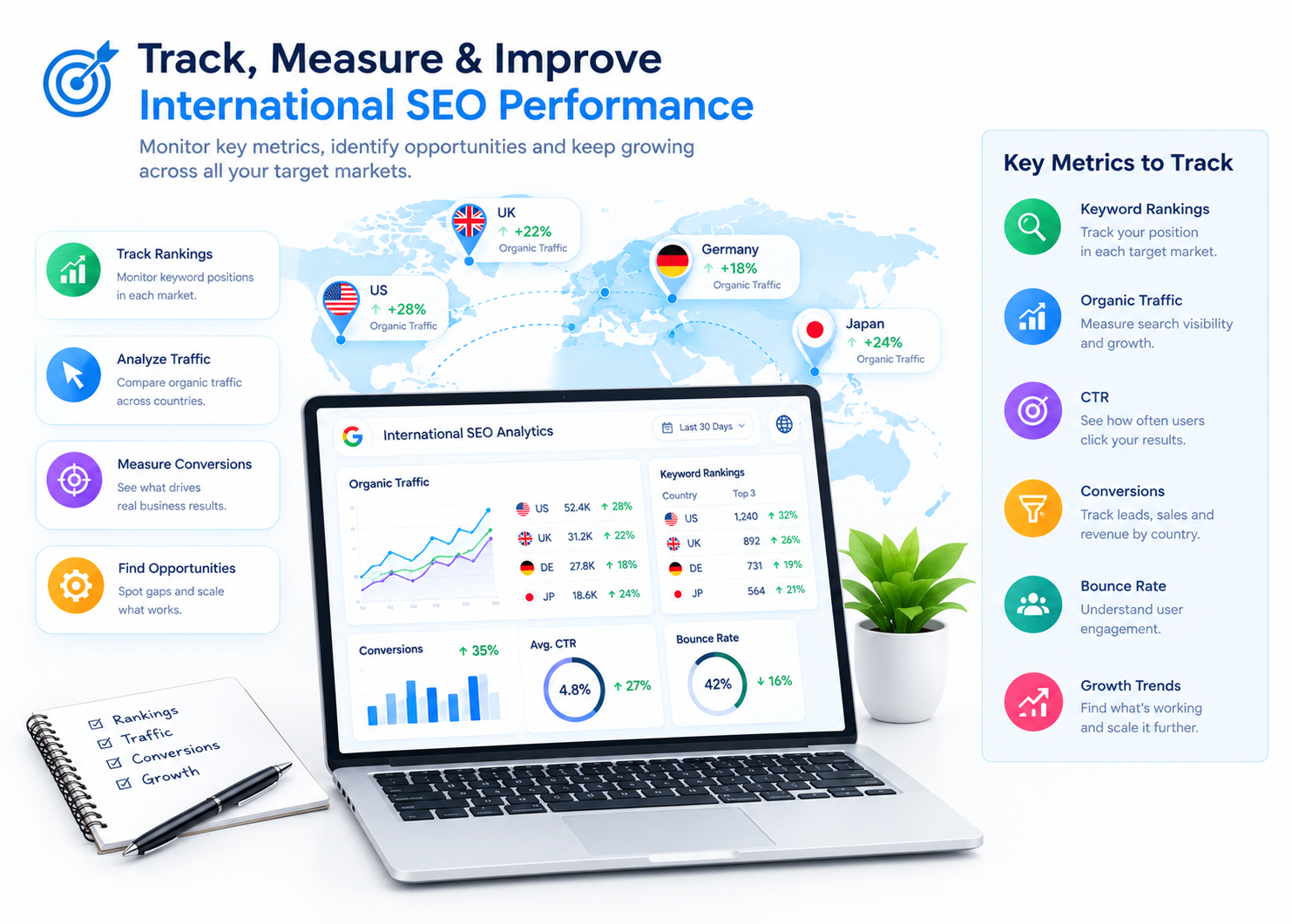
Set up international SEO tracking so you can compare markets based on meaningful KPIs such as:
- Organic clicks
- Impressions
- Rankings
- Organic conversions
- Leads
- Revenue
- Conversion rate
- Indexed pages
- Traffic by country
- Non-branded search growth
- Visibility against competitors
Separate reporting by country, language, and website section where possible. This allows you to identify whether a market is genuinely growing or whether overall international traffic is simply being driven by one successful region.
3.11 Turn the Process Into a Repeatable System
The ultimate goal of an international SEO strategy is scalability. Once your first target market is established, document the process used to research keywords, evaluate competitors, localize content, launch pages, build authority, and measure results. These processes can then become a framework for future markets.
This creates a much stronger foundation for global search engine optimization than treating every international expansion as a completely separate project.
The most effective approach is therefore to combine centralized SEO standards with local market flexibility. Your technical framework, brand guidelines, analytics, and quality standards can remain consistent, while keyword targeting, content, messaging, and authority-building activities can adapt to the needs of each market.
4. How to Choose the Right International Markets
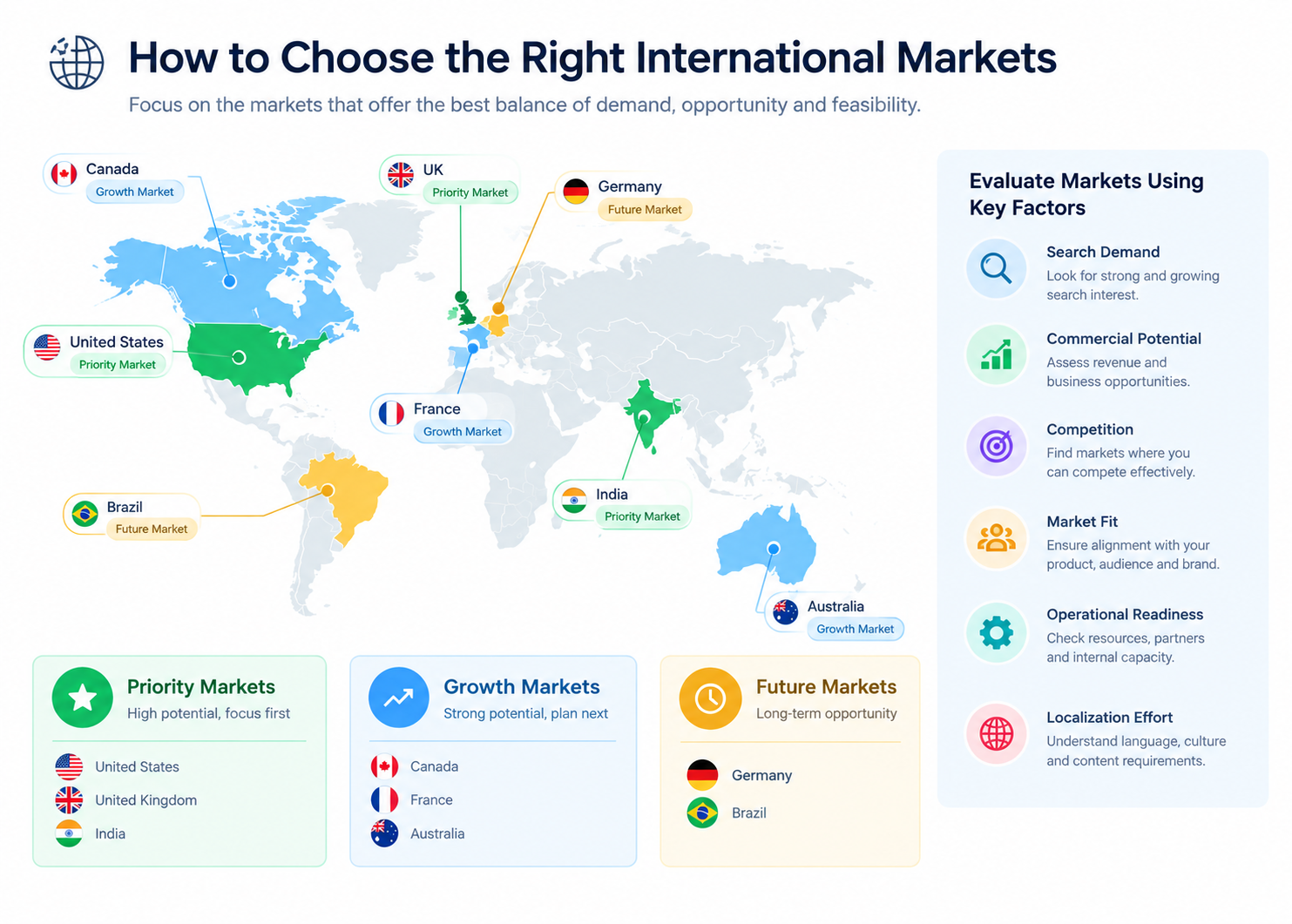
Choosing the right countries is one of the most important decisions in international SEO. Expanding into every market at once may increase your website's footprint, but it can also spread your content, technical, and marketing resources too thin. A better approach is to identify markets where search demand, commercial opportunity, and your ability to compete overlap.
4.1 Look Beyond Search Volume
High search volume does not automatically mean a market is valuable. A country may generate millions of searches for your target keywords but have low purchasing intent, strong competition, or operational barriers that make it difficult to convert visitors into customers.
When evaluating a market, consider:
- Search demand for your products or services
- Commercial intent behind important keywords
- Potential customer value
- Existing competitors
- Cost of localization
- Local purchasing behavior
- Product or service availability
- Shipping or service limitations
- Local regulations
- Existing brand awareness
This gives you a more realistic picture of the opportunity for SEO for international markets.
4.2 Evaluate Keyword Demand by Country
Your existing keyword research can reveal which markets deserve further investigation. Use country-specific search data to identify where people are actively searching for the solutions you provide.
For example, if a service has substantial search demand in five countries but meaningful commercial intent in only three, those three markets may deserve priority. This is where international keyword research becomes a market-selection tool rather than simply a content-planning exercise.
Look at both broad and long-tail searches. Understanding how to find long-tail keywords can help you uncover more specific queries with clearer search intent and identify opportunities that broader terms may overlook. High-volume terms can indicate overall demand, while specific commercial queries can reveal whether users are actually looking for products or services like yours.
4.3 Measure Competition Before Entering
Competition should be evaluated at the market level, not just at the global domain level.
A website may rank easily for important terms in one country but face established local businesses, publishers, marketplaces, and highly authoritative domains in another. Analyze the first page of Google for your priority keywords and identify how difficult it would be to gain visibility.
Pay particular attention to:
- Domain authority of ranking websites
- Number and quality of competing pages
- Local brands occupying top positions
- Content quality
- Backlink strength
- SERP features
- Search intent
- Presence of major marketplaces or aggregators
This analysis can help your global SEO strategy focus on markets where there is a realistic path to organic growth.
4.4 Consider Your Existing International Presence
You may already have signals that a particular market is worth targeting. Check your current analytics and search performance for organic visitors coming from countries you have not actively optimized for.
Unexpected international traffic can indicate existing demand for your brand, products, or content.
Also look for:
- International conversions
- Returning visitors from specific countries
- Branded searches
- Existing backlinks from local websites
- International brand mentions
- Enquiries from overseas customers
- Products already being purchased internationally
These signals can help identify low-friction opportunities for your international SEO strategy.
4.5 Create a Market Prioritization Score
To make the decision more objective, assign each potential market a score based on factors such as search demand, business value, competition, operational readiness, and localization requirements.
For example:
Factor | What to Evaluate |
Search demand | How many relevant searches exist? |
Commercial potential | Can traffic generate revenue or leads? |
Competition | How difficult are the current SERPs? |
Market fit | Is your offering relevant locally? |
Operational readiness | Can you sell or provide services there? |
Localization effort | How much content adaptation is required? |
Existing presence | Do you already have customers or visibility? |
A country with moderate search demand but excellent market fit may deserve a higher priority than a country with enormous search volume and extremely difficult competition.
4.6 Start Small and Scale What Works
One of the most practical international SEO best practices is to avoid treating global expansion as an all-at-once project.
Select a limited number of priority markets, establish your localized website experience, publish content around validated search opportunities, and monitor the results. Once the process produces consistent organic growth, use what you have learned to enter additional countries.
This creates a more sustainable global SEO strategy because each successful market can provide data, processes, and insights that improve the next expansion.
The right market is therefore not necessarily the country with the most searches. It is the market where search demand, business opportunity, competitive conditions, and operational capability come together, giving your SEO investment a realistic chance of producing long-term growth.
5. International Keyword Research: Finding What People Search in Each Market
Keyword research becomes significantly more important when a business targets multiple countries. In domestic SEO, you may already understand the terminology your customers use. With international SEO keyword research, however, assumptions can quickly lead to the wrong keywords, incorrect content, and poor-quality traffic.
The goal is not to translate your existing keyword list into another language. It is to understand how people in each market describe their problems, compare solutions, and search for products or services. This allows your international SEO strategy to target genuine local search demand instead of simply creating translated versions of existing pages.
5.1 Don't Treat Translation as Keyword Research
A direct translation may be grammatically correct but still have little search value.
People often use different words, abbreviations, product names, or industry terminology depending on where they live. Even countries sharing the same language can have substantial differences in search behavior.
For example, a business targeting English-speaking markets may discover that users in the United States, United Kingdom, and Australia use different terms for certain products or services. The same principle applies when moving between completely different languages.
This is why international keyword research should begin with local search behavior rather than a translated spreadsheet of keywords.
5.2 Research Keywords Separately for Every Priority Market
Create a dedicated keyword set for each country or language market you intend to target.
For each market, investigate:
- Primary product and service terms
- Commercial keywords
- Informational queries
- Comparison searches
- Problem-based searches
- Long-tail keywords
- Branded searches
- Local terminology
- Questions customers commonly ask
- Seasonal search patterns
You can then compare the results across markets to identify similarities and differences.
Some keywords may translate almost directly and have similar intent everywhere. Others may require completely different content because local users search for the topic in another way.
5.3 Analyze Search Intent, Not Just Search Volume
Search volume is useful, but it should not be the only metric guiding your decisions.
A keyword with 20,000 monthly searches may be less valuable than a keyword with 1,000 searches if the smaller keyword has significantly stronger purchase intent.
For SEO for international sites, classify keywords according to their intent:
Informational: Users are looking for explanations, guides, or answers.
Commercial: Users are researching products, services, brands, or solutions.
Transactional: Users are ready to purchase, book, subscribe, or contact a provider.
Navigational: Users are looking for a particular company, website, or product.
This classification helps determine whether a keyword belongs on a blog article, service page, product page, category page, comparison page, or another type of landing page.
5.4 Study the Local SERPs
One of the most effective international SEO best practices is to examine the search results in the actual target market.
The SERP can tell you what search engines believe users want.
For your most important keywords, examine:
- Which websites rank
- What type of pages appear
- Whether local companies dominate
- Whether marketplaces appear
- How competitors structure their content
- Which questions appear in search features
- Whether videos, maps, images, or other SERP features appear
- What topics ranking pages cover
If the results in one country are dominated by product pages while another market shows mostly educational guides, that difference should influence your content strategy.
5.5 Identify Local Search Trends and Seasonal Demand
Search behavior can also change according to local events, holidays, seasons, regulations, and consumer habits.
A product might have strong demand during a particular season in one country but a completely different demand cycle elsewhere. Similarly, certain services may become popular around local events or specific periods of the year.
Understanding these patterns allows businesses to build a more responsive global SEO strategy instead of publishing the same content calendar across every market.
5.6 Build Country-Specific Keyword Clusters
Once the research is complete, organize keywords into logical groups rather than creating one enormous international keyword list.
A useful structure might include:
Keyword Group | Purpose |
Core terms | Main products or services |
Commercial terms | Users comparing solutions |
Transactional terms | Users ready to convert |
Informational terms | Educational searches |
Long-tail terms | Specific customer needs |
Local terms | Market-specific terminology |
Brand terms | Searches related to your business |
These clusters can then be mapped to specific URLs and content types. This approach helps prevent multiple international pages from competing for the same search terms and makes it easier to identify content gaps in individual markets.
5.7 Use Competitor Keywords to Find Opportunities
Competitor research can uncover searches your business has not yet considered.
Identify the keywords generating organic visibility for leading websites in each target country. Then compare those terms with your existing content.
You may discover opportunities such as:
- High-intent keywords competitors rank for but you don't
- Informational topics missing from your website
- Local terminology you have overlooked
- Product categories with strong demand
- Comparison searches that could attract buyers
- Long-tail queries with relatively low competition
This makes international keyword research useful not only for creating new content but also for improving existing international pages.
5.8 Build One Keyword Strategy With Local Variations
The strongest approach to global SEO is neither completely centralized nor completely fragmented.
Your business should maintain a common keyword framework covering its main products, services, and customer journeys. Individual markets can then adapt that framework according to local terminology, search demand, and intent.
This creates consistency while still allowing each country to compete on the searches that actually matter to its audience.
Ultimately, effective international search engine optimization depends on understanding that search behavior is local even when your business is global. Researching each market independently gives you the information needed to create relevant pages, prioritize content opportunities, and build an SEO strategy that can scale without treating every country as a copy of your home market.
6. Create a Country-Specific Content Strategy
Once you understand the search behavior in each market, the next step is turning that research into a content strategy. A common mistake in international SEO is assuming that every country should receive the same articles, landing pages, and publishing schedule. While your overall content framework can remain consistent, the topics, messaging, examples, and page priorities should reflect the needs of each market.
A strong country-specific content strategy combines global SEO consistency with local relevance. The objective is to create content that feels useful to people in the target market rather than content that simply looks like a translated version of your original website.
6.1 Start With the Customer Journey
Before deciding what content to publish, map the searches your audience makes at different stages of the buying journey.
Someone discovering your business for the first time may search for educational information, while a potential customer who already understands the problem may search for comparisons, pricing, reviews, or specific solutions.
Your content can therefore include:
- Educational blog posts
- Product and service pages
- Category pages
- Comparison guides
- Buying guides
- Case studies
- FAQs
- Industry-specific landing pages
- Product documentation
- Local market guides
The exact mix should depend on the search behavior identified through international keyword research.
6.2 Localize Content Instead of Simply Translating It
Translation changes the language. Localization changes the experience. For SEO for international websites, localized content may need adjustments to:
- Currency
- Measurements
- Spelling
- Examples
- Pricing
- Regulations
- Cultural references
- Product availability
- Customer expectations
- Local terminology
- Calls to action
For example, a guide explaining a service may need completely different examples for customers in different countries. A pricing page may need local currencies and payment methods, while an industry article may need references to local regulations.
These details can make a page significantly more relevant to its intended audience.
6.3 Build Content Around Local Search Intent
A topic that performs well in one market may not have the same value elsewhere.
Suppose your original website has a successful article targeting a broad informational keyword. Before reproducing it for another country, check whether users in that market search for the same topic and whether the search results show similar intent.
If the local SERP favors product pages instead of blog posts, creating another long-form article may not be the best strategy.
This is an important part of international SEO best practices: let local search results influence the type of content you create.
6.4 Identify Content Gaps in Each Market
Your international content strategy should also look for topics that are missing from your existing website.
Compare your content against local competitors and identify:
- Topics competitors cover that you do not
- Questions frequently searched by local users
- Product or service categories missing from your website
- Local problems requiring specialized information
- Commercial searches with weak competition
- Industry topics relevant to the target market
These gaps can provide some of the quickest opportunities for expanding SEO for international markets.
6.5 Create Localized Landing Pages Where They Add Value
Not every location needs its own page. Creating dozens of nearly identical country or city pages simply to increase the number of indexed URLs can create a poor user experience and provide little additional search value.
Instead, create a localized landing page when the market has genuinely different:
- Products or services
- Pricing
- Customer requirements
- Regulations
- Availability
- Search intent
- Competitor landscape
- Business operations
Each page should provide information that is genuinely useful to people in that market.
6.6 Adapt Your Content Calendar by Market
Your publishing schedule does not need to be identical across countries. One market might have strong demand for informational content, while another may provide greater opportunities through commercial landing pages. Similarly, seasonal topics may become important at different times depending on the country's climate, holidays, or purchasing cycles.
A scalable global SEO strategy can therefore maintain shared content themes while allowing individual markets to choose their own priorities.
For example:
Global Content Theme | Market A | Market B | Market C |
Product education | High priority | Medium priority | High priority |
Comparison content | High priority | High priority | Low priority |
Local guides | Medium priority | High priority | High priority |
Case studies | High priority | Medium priority | High priority |
Seasonal content | Medium priority | High priority | Medium priority |
This approach prevents your international teams from producing content simply because the global editorial calendar says they should.
6.7 Maintain Brand Consistency Across Markets
Localization should not mean creating a completely different brand in every country.
Your visual identity, core positioning, brand values, and fundamental messaging should remain recognizable. What changes is how those elements are communicated to meet local expectations.
A useful model is:
Global framework + local execution = scalable international content
The central team can establish content quality standards, SEO guidelines, brand rules, and templates, while local teams or specialists adapt the content for their audiences.
6.8 Use Local Expertise Where Necessary
For markets where cultural context or technical terminology is especially important, involving native speakers or local subject-matter experts can significantly improve content quality.
A translator may produce grammatically accurate text, but a local expert can identify whether the wording actually sounds natural, whether an example makes sense, and whether the content addresses the concerns of local customers.
This becomes particularly valuable for businesses investing heavily in international SEO services, where content quality needs to scale without sacrificing local relevance.
6.9 Measure Content Performance by Country
After publishing localized content, monitor its performance separately for each market.
Track metrics such as:
- Organic impressions
- Clicks
- Keyword rankings
- Organic conversions
- Engagement
- Leads or sales
- Revenue
- Indexed pages
- Non-branded traffic
This international SEO tracking helps determine which content formats and topics are actually working in each market.
Over time, the data can guide your next round of content creation. Pages that perform well can become templates for similar opportunities, while underperforming content can be improved, consolidated, or replaced.
The ultimate goal of a country-specific content strategy is not to produce more pages. It is to produce more relevant pages, content that matches local search intent, addresses genuine customer needs, and contributes to measurable growth. When this process is combined with a scalable technical foundation, businesses can expand their international SEO strategies without turning every new market into an entirely separate SEO operation.
7. Build a Scalable SEO Structure for Multiple Countries
A strong website structure is the foundation of SEO for multiple countries. As your business expands, adding new markets can quickly create hundreds or thousands of localized URLs. Without a clear structure, search engines may struggle to understand which pages belong to which country or language, while users may have difficulty finding the version intended for them.
The goal is to create an international website architecture that is easy to crawl, easy to manage, and flexible enough to support future expansion.
7.1 Choose a Structure That Can Scale
Businesses generally use one of three approaches when creating international websites:
- Country-code top-level domains (ccTLDs): example.de, example.fr
- Subdomains: de.example.com, fr.example.com
- Subdirectories: example.com/de/, example.com/fr/
Each approach can work, but the right choice depends on your business model, technical resources, branding requirements, and the number of markets you expect to target.
For many businesses, subdirectories can provide a practical centralized structure because all country sections remain within the main domain. However, companies with independent operations, strong local branding, or separate technical teams may have reasons to use separate domains or subdomains.
The important consideration is not choosing the option that sounds most international. It is choosing a structure your organization can maintain consistently as the number of markets grows.
7.2 Keep Country and Language Signals Clear
Search engines need clear signals about which version of a page is intended for a particular audience.
For example, if your website targets English-speaking users in the United States and United Kingdom, simply creating two pages with the same English content may not provide enough differentiation if the markets have different products, pricing, spelling, or search intent.
Your international structure should make relationships between equivalent pages clear and support appropriate language and regional targeting.
This is where hreflang becomes particularly useful.
If you're wondering how hreflang tags work in international SEO, they help search engines understand the language and regional alternatives of a page. For example, a website might indicate that one URL is intended for English-speaking users in the United States while another is intended for English-speaking users in the United Kingdom.
7.3 Create a Logical URL System
Your URLs should make the international structure easy to understand.
For example:
example.com/us/
example.com/uk/
example.com/de/
example.com/fr/
Individual pages can then follow the same organizational pattern within each market.
The exact URL structure will depend on your website, but consistency is essential. Avoid creating a mixture of country codes, language codes, subdomains, and unrelated URL patterns unless there is a genuine business reason for doing so.
A predictable structure makes it easier for SEO teams, developers, content managers, and analytics platforms to manage international sections.
7.4 Avoid Automatically Redirecting Users by IP
Automatic country-based redirects can create problems for both users and search engines.
For example, automatically sending every visitor with a particular IP address to a specific country version may prevent users from accessing other versions of your website. It can also make crawling and indexing more complicated.
Instead, provide clear ways for users to select their preferred country or language when appropriate.
Location information can be used to improve the experience, but it should not unnecessarily prevent users or search engines from accessing other localized versions.
7.5 Connect Equivalent Pages Properly
When the same product, service, or content exists across multiple markets, make the relationship between those pages clear.
Suppose you have a service page available for the United States, Canada, and the United Kingdom. The pages may share the same core purpose but have different currencies, terminology, pricing, or local information.
Your international SEO setup should clearly establish which pages are regional alternatives. This helps search engines understand that these URLs serve different audiences rather than assuming that one is simply duplicate content.
This is an important technical consideration when learning how to implement international SEO across a growing website.
7.6 Build Internal Links Between Relevant International Pages
Internal linking should also support your international structure.
A country-specific page should primarily connect users to relevant pages within that market where appropriate. For example, a German service page should naturally lead users toward relevant German product, pricing, support, and informational pages.
At the same time, users should have an easy way to switch markets when necessary.
A well-planned internal linking system helps distribute authority throughout your international website while making navigation easier for users.
7.7 Prevent Duplicate and Thin Country Pages
Creating a new URL for every country does not automatically create SEO value. If ten country pages contain almost identical content with only the country name changed, they may provide little additional value to users. This can make international expansion unnecessarily complex and may result in a large number of low-value pages.
Before launching a localized page, ask:
Does this page provide something specifically useful to users in this market?
That could include local pricing, availability, regulations, examples, case studies, products, customer support information, or market-specific search intent.
If the answer is no, creating a separate page may not be necessary.
7.8 Design the Architecture for Future Expansion
Your website may begin with two or three markets but eventually expand into ten, twenty, or more.
Therefore, your international SEO strategy should account for future growth from the beginning.
Establish consistent processes for:
- Creating new country sections
- Assigning URLs
- Managing localized metadata
- Implementing hreflang
- Building internal links
- Handling redirects
- Monitoring indexing
- Managing sitemaps
- Tracking country-level performance
- Updating localized content
This reduces technical debt and makes future expansion considerably easier.
7.9 Make the Structure Easy for Teams to Manage
Scalability is not only a technical issue. Your content and SEO teams also need a system they can work with efficiently.
A centralized framework can define global standards for URL naming, metadata, internal linking, technical SEO, and content quality. Local teams can then adapt pages where market-specific requirements exist.
This balance is especially important for an international SEO company or enterprise managing numerous regions. Without standardized processes, different teams may create inconsistent URLs, duplicate pages, incorrect hreflang implementations, or conflicting localization rules.
7.10 Treat Website Architecture as a Long-Term Investment
A scalable structure makes every later stage of global SEO easier. It supports content expansion, technical maintenance, international SEO tracking, and market-level reporting while reducing the risk of structural problems as the website grows.
The best architecture is therefore not simply the one that works for your current number of countries. It is the one that allows you to add future markets without rebuilding the website every time.
A well-organized international website gives search engines clear regional signals, gives users a relevant experience, and gives your SEO team a manageable framework for long-term global search engine optimization.
Technical SEO becomes more complicated as a website expands into multiple countries. A single-market website may have hundreds of pages to manage, while an international website can quickly grow to thousands of URLs across different languages, regions, and versions. Without the right technical foundation, even high-quality localized content may struggle to appear in the correct search results.
Following international SEO best practices helps search engines crawl, understand, index, and serve the appropriate version of your website to users in different markets.
8.1 Implement Hreflang Correctly
Hreflang is one of the most important technical elements of international SEO when you have different language or regional versions of similar pages.
For example, you may have separate versions of a page for:
- English users in the United States
- English users in the United Kingdom
- French users in France
- German users in Germany
Hreflang annotations help search engines understand the relationship between these versions and determine which version is appropriate for a particular audience.
If you're researching how to use hreflang tags for international SEO, remember that implementation needs to be consistent. Incorrect country or language codes, missing reciprocal references, or pointing tags toward the wrong URLs can reduce their effectiveness.
Canonical tags tell search engines which URL should generally be considered the preferred version of similar or duplicate pages.
For international websites, canonicalization needs to be handled carefully. Country-specific pages should not automatically canonicalize to the homepage or to another country's version simply because the content is similar.
For example, if you have separate pages designed specifically for Germany and France, each page should generally have a canonical setup that reflects its intended URL rather than unnecessarily consolidating everything into one market.
International targeting works best when canonical tags and hreflang signals support the same overall architecture.
8.3 Make Every Important Market Accessible to Search Engines
Search engines need to be able to discover and crawl your international pages. Avoid creating country versions that are accessible only through complicated navigation, JavaScript interactions, or automatic redirects. Important localized URLs should be discoverable through normal crawlable links and included in appropriate XML sitemaps where necessary.
Check regularly for:
- Blocked country pages
- Incorrect robots.txt rules
- Noindex directives
- Broken internal links
- Redirect chains
- Incorrect canonical tags
- Orphaned localized pages
- Crawl errors
These technical issues can prevent otherwise valuable international content from being properly indexed.
8.4 Use Country-Specific XML Sitemaps When Helpful
Large international websites can benefit from organizing XML sitemaps by country, language, or website section.
For example, a large website might maintain separate sitemap groups for its US, UK, German, and French sections.
This can make technical monitoring easier and help SEO teams identify indexing problems within specific markets.
It is particularly useful when implementing SEO for international sites at enterprise scale, where thousands of URLs can make it difficult to identify problems from a single consolidated sitemap.
8.5 Optimize Page Speed Across Markets
Website performance matters regardless of location, but international websites can face additional performance challenges.
Your users may be accessing your website from countries far away from your primary hosting infrastructure. Heavy images, unnecessary scripts, third-party resources, and inefficient code can increase loading times.
Review your site's performance across important markets rather than testing only from your home country.
Pay attention to:
- Core Web Vitals
- Mobile performance
- Image optimization
- JavaScript execution
- Server response times
- Content delivery
- Caching
- Third-party scripts
A technically strong global SEO setup should provide a fast experience regardless of where the visitor is located.
8.6 Optimize for Mobile Users
Mobile behavior can vary considerably between markets, but mobile usability should be treated as a core requirement for international websites.
Ensure that localized pages:
- Work properly on smaller screens
- Have readable text
- Use accessible navigation
- Load efficiently
- Keep important information visible
- Make forms and checkout processes easy to complete
- Provide appropriate localized calls to action
Creating a desktop-friendly international website and assuming the mobile experience will automatically work is a common mistake.
8.7 Manage Redirects Carefully
Redirects can become complicated when websites have multiple country and language versions.
For example, changing your international URL structure may require hundreds or thousands of redirects. Incorrect rules can send users from one country to another or create redirect loops.
Before making structural changes, map old URLs to their appropriate new equivalents and test the implementation thoroughly.
Avoid redirecting every international URL to a single global homepage simply because the original page no longer exists. Where possible, users should be directed to the most relevant replacement.
8.8 Use Structured Data Consistently
Structured data can help search engines understand important information about your pages.
Depending on the business, this might include information related to:
- Products
- Organizations
- Services
- Articles
- FAQs
- Events
- Reviews
For international websites, make sure structured data reflects the information displayed on the specific localized page. Prices, currencies, availability, business details, and other market-specific information should not conflict with the visible content.
8.9 Maintain Consistent Technical Standards
As the number of countries increases, technical inconsistencies become a major risk.
One market might use the correct URL structure while another uses a different format. One country might have properly implemented hreflang while another has missing or conflicting tags.
Create a technical framework covering:
Technical Area | International Standard |
URLs | Consistent country/language structure |
Hreflang | Correct reciprocal implementation |
Canonicals | Appropriate regional URLs |
Sitemaps | Accurate localized URLs |
Internal links | Relevant market connections |
Robots.txt | No accidental blocking |
Redirects | Correct market-to-market mapping |
Schema | Accurate localized information |
Performance | Strong experience across markets |
This standardization is one of the most useful international SEO best practices for organizations managing multiple teams or markets.
8.10 Regularly Audit the International Setup
Technical issues can appear after website redesigns, CMS updates, content migrations, or the launch of new markets. A successful implementation should therefore be monitored continuously rather than checked only at launch.
Conduct an international SEO audit periodically to identify problems with crawling, indexing, hreflang, canonicalization, redirects, internal links, performance, and localized URLs.
The technical side of international search engine optimization should ultimately make your website easier, not harder, for search engines to understand. When the architecture, regional signals, performance, and indexing systems work together, your localized content has a much stronger technical foundation from which to compete in international search results.
9. How to Build Authority in International Markets
Ranking in a new country is not only about having the right keywords and technically correct pages. Search engines also need evidence that your website is a credible source within that particular market. This makes authority building an important part of international SEO and one of the areas where a domestic SEO strategy often needs to be adapted for international growth.
A website can have strong domain authority in its home country and still find it difficult to compete in another market. Local competitors may have years of relationships with regional publications, industry organizations, businesses, and customers. Building international authority therefore requires a combination of strong content, relevant mentions, local relationships, and market-specific digital promotion.
9.1 Build Links From Relevant Local Websites
Backlinks remain an important component of SEO, but international campaigns should focus on relevance and quality, not simply the number of links acquired.
A link from a respected website within your target country or industry can provide stronger contextual relevance than dozens of unrelated websites from different regions.
Potential sources include:
- Local industry publications
- Regional business websites
- Professional associations
- Local news organizations
- Industry-specific blogs
- Business directories
- Universities and research organizations
- Local partners and suppliers
- Relevant community organizations
The objective should be to earn links because your business, research, expertise, or content is genuinely useful to that audience.
9.2 Create Content Worth Mentioning Locally
One of the strongest international SEO strategies for earning authority is to create assets that are genuinely useful within a specific market.
Instead of producing another generic article that could apply anywhere, consider creating:
- Local market research
- Industry statistics
- Original surveys
- Regional trend reports
- Country-specific guides
- Local case studies
- Expert interviews
- Industry benchmarks
- Original data and research
For example, a company entering the German market could publish research specifically examining trends within its German industry. Local publications and businesses have a much stronger reason to reference that resource than a generic global article.
9.3 Use Digital PR to Establish Regional Visibility
Digital PR can support global SEO by generating brand mentions and links from relevant publications.
International digital PR campaigns can be built around newsworthy research, company announcements, expert commentary, industry trends, or original data.
However, the campaign should be adapted to each market. A story that attracts attention in one country may have little relevance elsewhere.
Local journalists and publishers are more likely to engage with content that includes:
- Regional data
- Local trends
- Market-specific insights
- Relevant experts
- Local customer stories
- Country-specific business developments
This makes localization important even when the underlying PR campaign is centrally managed.
9.4 Develop Local Partnerships
Partnerships can provide both commercial and SEO value.
Depending on your industry, consider working with local:
- Distributors
- Suppliers
- Business partners
- Industry associations
- Professional communities
- Events
- Educational organizations
- Complementary businesses
These relationships may naturally generate relevant mentions, interviews, case studies, event pages, or resource links.
They can also strengthen your overall presence in the market, which supports the broader objectives of international SEO marketing.
9.5 Build Local Brand Recognition
Authority is not limited to backlinks.
When people in a target country begin searching for your brand, mentioning it in industry discussions, or interacting with your content, you are building recognition that can support long-term organic growth.
Your international marketing efforts should therefore work together rather than treating SEO as a completely separate channel.
For example, paid campaigns, social media, PR, events, partnerships, and content marketing can introduce your brand to a new market. SEO can then capture users who search for your brand, products, services, and related topics.
This integrated approach makes international SEO marketing more effective than relying exclusively on link acquisition.
9.6 Avoid Low-Quality International Link Building
Expanding internationally can tempt businesses to purchase large numbers of links from websites simply because they have a country-specific domain.
That is not a sustainable authority-building strategy.
Avoid tactics such as:
- Bulk link packages
- Irrelevant directory submissions
- Private blog networks
- Automated link generation
- Spammy guest-post networks
- Links from unrelated foreign websites
A website being located in your target country does not automatically make its backlink valuable.
The strongest links are relevant to your industry, useful to the audience, and acquired through legitimate relationships or valuable content.
9.7 Use Local Case Studies and Customer Stories
Customer stories can be particularly effective for building credibility in a new market.
A localized case study can demonstrate that your business understands the needs of customers in that country. It can also provide opportunities for the customer's website, industry publication, or professional network to mention the story.
For SEO for international markets, this creates a useful combination of content, trust, and potential authority signals.
Where appropriate, include market-specific details such as:
- The customer's business environment
- Local challenges
- Regional requirements
- Results achieved
- Relevant industry conditions
- Local terminology
9.8 Coordinate International Link Building With Content
Link building should not operate independently from your content strategy.
Before launching an outreach campaign, identify which pages you actually want to strengthen. These might include important service pages, research reports, industry guides, or localized resources.
Then create supporting content that gives publishers a legitimate reason to reference your website.
This creates a stronger system:
Localized content → outreach/PR → relevant mentions → stronger authority → improved organic visibility
The process is particularly useful when expanding into markets where your domain has limited existing recognition.
9.9 Track Authority Growth by Market
Your international SEO tracking should include authority-building activity at the country level.
Monitor metrics such as:
- New referring domains
- Relevant local backlinks
- Brand mentions
- Referral traffic
- Organic visibility
- Rankings for priority keywords
- Leads and conversions from referred and organic traffic
This allows you to determine whether your investment is actually improving visibility in the target market.
Ultimately, building authority internationally is a long-term process. A strong global SEO strategy should not attempt to manufacture authority through large volumes of low-quality links. Instead, it should establish genuine relevance within each market through useful content, local relationships, credible publications, digital PR, and consistent brand activity.
That combination gives an international website a stronger foundation for competing against established local businesses and turning international search visibility into sustainable growth.
10. International SEO Marketing: Combining Organic Search With Broader Digital Marketing
International SEO marketing works best when organic search is treated as part of a broader international growth strategy rather than as an isolated channel. When entering a new country, SEO can help capture existing search demand, but other marketing activities can create the brand awareness, trust, and demand that make organic performance stronger over time.
This is particularly important for businesses entering markets where they have little or no existing brand recognition. A technically optimized website may be able to rank for some queries, but building a recognizable presence often requires multiple channels working together.
10.1 Align SEO With Your Market Entry Strategy
Before launching SEO campaigns in a new country, understand how the business plans to enter that market.
For example, the company may already have:
- A local sales team
- Paid advertising campaigns
- Distribution partners
- Social media activity
- Local events
- PR campaigns
- Influencer relationships
- Existing customers
- Retail or business partnerships
These activities can provide valuable information for your international SEO strategy.
Sales teams may know the questions customers frequently ask. Paid search data can reveal high-converting keywords. Customer support can identify common problems. PR campaigns can reveal topics that attract local attention.
SEO teams can use these insights to create content and landing pages that reflect actual market demand.
10.2 Use Paid Search Data to Support Organic SEO
Paid search and organic search can complement each other when entering a new market.
Before investing months in ranking for competitive keywords, paid campaigns can provide relatively quick data about:
- Keyword performance
- Conversion rates
- Customer interests
- Ad messaging
- Commercial intent
- Landing-page effectiveness
If a particular keyword generates qualified leads through paid search, it may be a strong candidate for an organic SEO campaign.
This does not mean every paid keyword should automatically become an SEO target. Instead, PPC data can help prioritize opportunities within your global SEO strategy.
10.3 Connect Content Marketing With International SEO
Content marketing and SEO should work from the same market research.
Rather than producing generic content for every country, identify the topics that matter to customers in each region and develop content around those needs.
For example, an international software company might create:
- Local industry guides
- Country-specific implementation guides
- Regional case studies
- Comparison content
- Local market reports
- Expert interviews
- Educational resources
These assets can generate organic traffic while also supporting social media, email marketing, PR, sales outreach, and other channels.
This makes content a central asset within global SEO marketing, rather than simply a way to publish more blog posts.
Social media does not replace SEO, but it can help introduce a brand to an unfamiliar audience.
Market-specific social campaigns can increase awareness of localized content, research, product launches, and company expertise. When people become familiar with a brand through other channels, they may later search for that brand or its products organically.
Social platforms can also help identify topics that resonate with local audiences.
For example, if a particular question repeatedly generates engagement in one market, it may indicate an opportunity for a detailed SEO resource addressing that question.
10.5 Integrate PR With Your SEO Campaign
Public relations can support international SEO by increasing visibility and creating opportunities for relevant mentions and links.
A localized PR campaign might focus on:
- Original research
- Industry statistics
- New product launches
- Market reports
- Expert commentary
- Local business developments
- Customer success stories
When PR and SEO teams collaborate, they can identify which stories have both news value and search value.
This can strengthen your authority-building efforts while increasing awareness in a new market.
10.6 Localize Email and Conversion Campaigns
Driving international visitors to your website is only part of the process. You also need to convert those visitors.
Your email campaigns, forms, offers, and calls to action should reflect the target market where appropriate.
Consider factors such as:
- Local currency
- Language
- Time zones
- Payment preferences
- Shipping information
- Customer support availability
- Local contact details
- Market-specific offers
A page can rank well but still produce poor business results if the conversion experience feels foreign or inconvenient.
Therefore, SEO for international markets should ultimately be connected to the entire customer journey.
10.7 Use Local Marketing Insights to Improve SEO
International marketing creates a continuous feedback loop.
Suppose your sales team discovers that customers in one country repeatedly ask about a particular feature. That information can be turned into an FAQ, service page, comparison article, or detailed guide.
Similarly, if a paid campaign reveals strong interest in a particular product category, the SEO team can investigate related keywords and develop organic landing pages.
This creates a cycle:
Marketing data → SEO insights → localized content → organic traffic → conversion data → better marketing decisions
This type of integration makes international SEO strategies more responsive and commercially focused.
10.8 Maintain a Consistent Global Brand
Localization should not result in completely disconnected marketing campaigns.
Your international marketing should maintain a recognizable global brand while adapting the execution to local audiences.
Central teams can establish:
- Brand guidelines
- Core messaging
- SEO standards
- Content quality requirements
- Analytics frameworks
- Conversion principles
Local teams can then adapt:
- Language
- Examples
- Offers
- Campaign messaging
- Cultural references
- Local channels
- Customer communications
This balance allows a global SEO company or internal international team to maintain consistency without ignoring local market differences.
10.9 Measure the Combined Impact
Finally, evaluate SEO alongside your other marketing channels.
International SEO tracking should show not only how much traffic a country receives but also how SEO contributes to the wider marketing funnel.
Track:
- Organic traffic
- Organic conversions
- Revenue
- Assisted conversions
- Branded search growth
- Paid and organic keyword performance
- Referral traffic
- Backlinks and mentions
- Lead quality
- Customer acquisition
This gives you a clearer understanding of whether your international investment is creating actual business growth.
The strongest international SEO marketing programs therefore do not operate in isolation. SEO, paid search, content marketing, PR, social media, email, sales, and partnerships can all provide data and opportunities that improve one another. When these channels work from the same market research and business objectives, companies can build stronger visibility while creating a more recognizable and trusted presence in international markets.
11. How to Measure, Audit, and Scale Your International SEO Strategy
Once your international SEO foundation is in place, the focus shifts from launching pages to measuring performance, identifying technical and content problems, deciding when professional support is needed, and scaling successful processes into additional markets. These activities should work together rather than being treated as separate tasks.
A business that targets multiple countries needs a clear system for understanding what is working in each market, where performance is being held back, and what should be improved before investing in another country.
International SEO tracking should go beyond measuring total organic traffic. Overall traffic can hide significant differences between countries, languages, and website sections.
For each target market, monitor metrics such as:
- Organic clicks and impressions
- Keyword rankings
- Organic conversion rate
- Leads or sales
- Organic revenue
- Non-branded traffic
- Indexed pages
- Click-through rate
- Backlinks and referring domains
- Traffic growth by country
- Visibility against local competitors
For example, if your international website receives 50,000 additional organic visitors but almost all of that growth comes from one country, your global expansion may not be progressing evenly.
Country-level reporting makes it easier to identify which markets are growing, which are stagnating, and where additional investment may be justified.
11.2 Measure Business Results, Not Just Rankings
Rankings are useful indicators, but they should not be the final measure of success.
A keyword ranking in position three is valuable only if the search attracts the right audience and contributes to a business objective. For this reason, your global SEO strategy should connect organic visibility with conversions and revenue wherever possible.
Compare markets based on:
Organic visibility → relevant traffic → conversions → revenue
This can reveal important differences between countries. One market may generate substantial traffic but few conversions, while another may generate less traffic but significantly more qualified leads.
Those insights can influence where you invest in content, technical improvements, link building, and additional international SEO services.
11.3 Conduct an International SEO Audit Regularly
An international SEO audit evaluates whether your website is technically and strategically prepared to perform across different markets.
It should examine the entire international setup rather than focusing only on individual pages.
A comprehensive audit can review:
Technical SEO: Check crawling, indexing, redirects, XML sitemaps, page speed, mobile usability, broken links, and other technical issues.
International targeting: Review country and language signals, URL structures, hreflang implementation, and relationships between localized pages.
Content: Determine whether content is genuinely localized, matches local search intent, and provides enough value to users in each market.
Keyword targeting: Compare your existing pages against local search demand and identify important keywords or topics that are missing.
Authority: Review backlinks, referring domains, local brand mentions, and competitor authority within each target country.
Performance: Compare organic traffic, rankings, conversions, and revenue across markets.
An audit should ultimately answer a practical question: What is preventing this market from growing organically?
That makes the audit much more useful than simply generating a list of technical errors.
11.4 Know When to Hire an International SEO Consultant or Company
Managing one international market may be possible with an experienced internal SEO team. However, complexity increases as you add languages, countries, domains, content teams, and regional competitors.
An international SEO consultant can be particularly useful when you need strategic expertise for questions such as:
- Which countries should we target first?
- Why is our website ranking in one market but not another?
- Should we change our international website structure?
- How should our country and language targeting work?
- Which international keywords should we prioritize?
- How should we localize existing content?
- Why are localized pages not being indexed?
- How can we compete with established local websites?
A larger international SEO company may be more appropriate when you need ongoing execution across several markets, particularly if your business requires technical SEO, content production, localization, digital PR, link building, and reporting at scale.
The decision should depend on the complexity of the project rather than simply the number of countries involved.
11.5 Understand What International SEO Services Should Include
Not all international SEO services provide the same level of support. Before hiring an agency or international SEO firm, make sure its services cover the areas that actually affect your international growth.
A comprehensive service may include:
Service | Purpose |
Market research | Identify valuable countries and opportunities |
International keyword research | Find local search demand |
Technical SEO | Ensure international pages can be crawled and indexed |
Hreflang implementation | Connect appropriate language and regional versions |
Content localization | Adapt content to local users and search intent |
On-page SEO | Optimize localized pages |
International link building | Build relevant authority in target markets |
Digital PR | Increase regional visibility and mentions |
Competitor analysis | Understand local SERP competition |
International SEO audit | Identify technical and strategic weaknesses |
SEO tracking | Measure performance by country |
Reporting | Connect SEO activity with business results |
Be cautious of agencies that offer the same SEO process for every country without researching local search behavior. SEO for international websites requires both a centralized framework and market-specific decision-making.
11.6 Choose Between an Internal Team, Consultant, or Agency
There is no single solution for every business.
An internal team may be suitable when you already have SEO specialists, developers, writers, translators, and regional marketing teams.
An international SEO consultant can provide specialized strategy or help solve complex problems without requiring a large permanent team.
An agency can be useful when you need ongoing execution across several markets and do not have the internal resources to manage the entire process.
Consider:
- Number of target markets
- Number of languages
- Website size
- Technical complexity
- Internal SEO expertise
- Content requirements
- Localization requirements
- Available budget
- Speed of expansion
The right choice is the one that fills your actual capability gaps rather than simply adding another SEO provider.
11.7 Scale From One Successful Market to Multiple Countries
Once one international market begins producing consistent results, you can use what you have learned to expand.
Do not simply duplicate every page and process. First identify what made the initial market successful.
Document:
- Market research methods
- Keyword research process
- Content localization workflow
- Technical requirements
- Internal linking standards
- Link-building processes
- Reporting structure
- Conversion insights
- Common implementation problems
This becomes your international expansion framework.
You can then apply the framework to a second market while adapting it to that country's search behavior and business requirements.
11.8 Create a Market Expansion Cycle
A repeatable expansion process might look like this:
Research → Prioritize → Localize → Launch → Measure → Optimize → Scale
First, research the market and determine whether it has sufficient potential. Then prioritize the keywords, pages, and products most likely to produce results. Build the localized experience, launch it properly, and monitor performance.
Once the data becomes available, optimize underperforming pages and invest more heavily in the areas showing strong potential.
Only after the process becomes repeatable should you move aggressively into additional markets.
11.9 Avoid Scaling Problems Along With Success
Scaling international SEO strategies does not mean multiplying every activity by the number of countries.
If a process is inefficient in one market, duplicating it across ten markets will simply create ten times the problem.
Before expanding, standardize the areas that can be standardized:
- Technical SEO requirements
- URL conventions
- Metadata processes
- Content quality standards
- Reporting
- SEO workflows
- QA procedures
- International targeting rules
At the same time, keep room for local adaptation in areas such as keywords, content, messaging, competitors, and customer behavior.
This balance allows a global SEO company or internal team to expand efficiently without turning every country into an isolated SEO project.
Your existing markets can also help determine which country you should target next.
If one market produces strong conversion rates, high-value customers, and sustainable organic growth, look for other markets with similar characteristics.
For example, you might compare countries based on:
- Search demand
- Conversion rate
- Revenue potential
- Competition
- Cost of localization
- Existing brand recognition
- Organic growth rate
This turns international expansion into a data-driven process rather than a series of assumptions.
Ultimately, successful international SEO is an ongoing cycle rather than a one-time website launch. Track each market, audit the technical and strategic setup, bring in an international SEO expert when internal capabilities are limited, and build repeatable systems before expanding further. This approach allows businesses to move from successfully ranking in one foreign market to developing a scalable worldwide SEO operation without sacrificing local relevance.
Conclusion
A successful international SEO strategy is not about publishing the same website in different languages and hoping rankings follow. It requires understanding each market, identifying real search opportunities, localizing content, building regional authority, and maintaining a technical structure that can scale. The strongest global SEO programs combine centralized processes with market-specific insights, allowing businesses to stay consistent while remaining relevant to local audiences. Regular international SEO tracking and audits help identify problems before they limit growth, while the right international SEO services can provide expertise when expansion becomes more complex. With a structured approach, businesses can turn international search visibility into sustainable traffic, leads, and revenue across multiple markets.
Read more blogs on