Within the scope of ecommerce business, marketing is frequently used as a blanket term. More visits required? That's marketing. New product launch? Again, marketing. Suffering from a revenue slump? Still marketing, it seems.
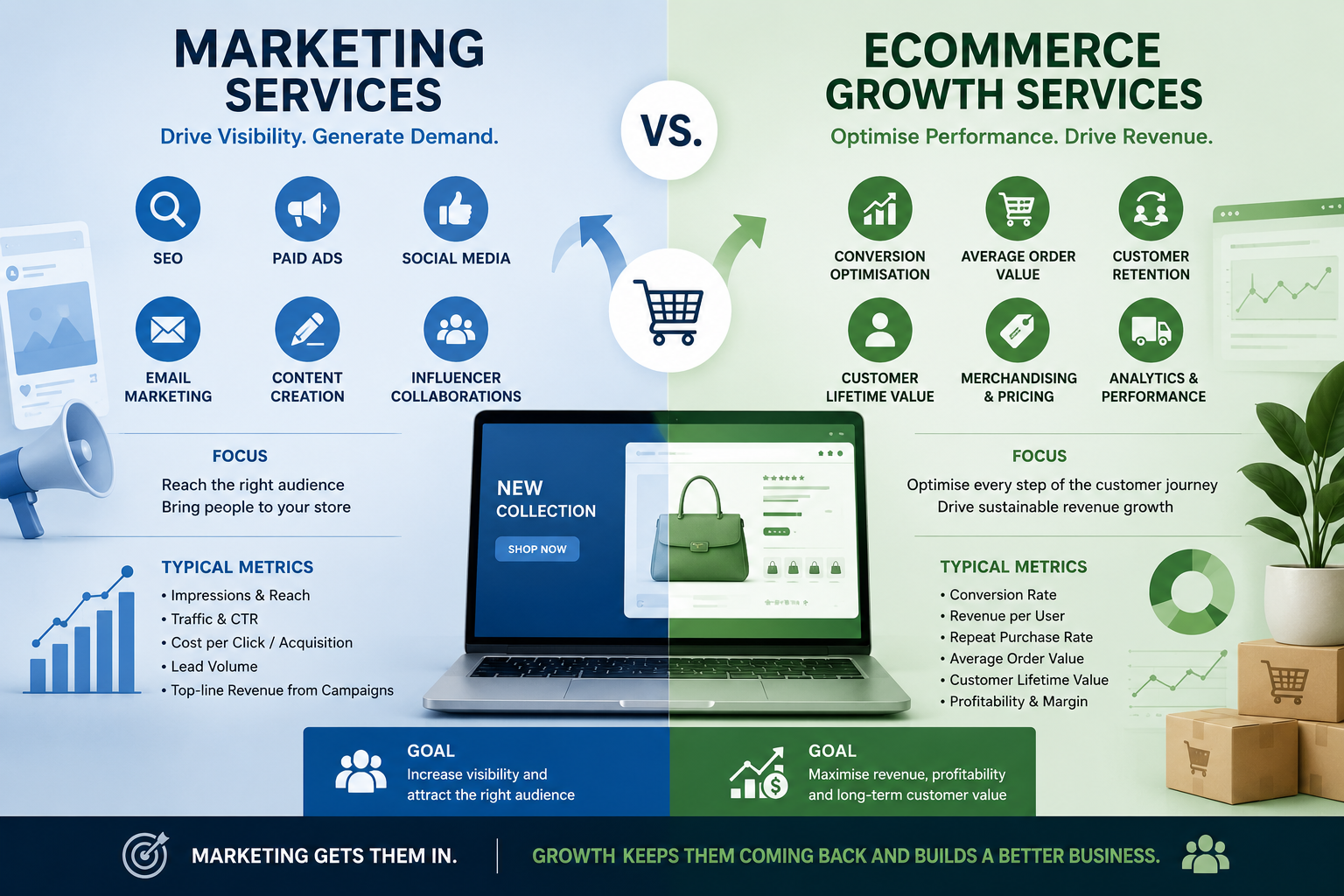
And yet, there is a crucial differentiation to be made between the two. Marketing services and ecommerce development services are not interchangeable. While there is a great deal of overlap regarding tools employed by both kinds of services, marketing will typically focus on gaining visibility and increasing demand. Ecommerce growth, meanwhile, will revolve around optimization of the performance of your online store. Why is it so significant? Well, simply put, you may find yourself paying more and getting nothing out of it because of the lack of differentiation.
Marketing Services: Driving Visibility and Demand
The best marketing services provide for exposure to the right audiences through things like paid search, SEO, social media, email, influencer collaborations, content creation, and creative production. It’s not hard to understand what they are supposed to achieve, which includes making people aware and expanding reach by getting them in the funnel. Marketing plays an essential role, and there’s no disputing its significance. Exposure is a critical step because any business that is unknown is unable to grow.
Where marketing services tend to focus
Most marketing engagements are channel-led. In practice, that means success is often measured through metrics such as:
- impressions and reach
- traffic and click-through rate
- cost per click or cost per acquisition
- lead volume or top-line revenue from campaigns
Those metrics are useful, but they do not always tell the whole story. A paid social campaign can look efficient on paper while driving low-intent visitors. SEO can increase sessions without improving revenue per user. Email can lift open rates while doing little for repeat purchase behaviour. This is where the conversation starts to shift.
Ecommerce Growth Services: Optimising the Entire Revenue Engine
Growth services for ecommerce take a more holistic approach. Rather than considering the question, “How can we attract more visitors?” they consider the question, “How can we generate growth through revenue in acquisition, conversion, retention, and average order value?”
That seems like a subtle shift, but it represents a big strategic shift. Growth-focused service providers don’t just consider media buys and content production. They relate marketing effectiveness to on-site experience, customer behavior, merchandising, lifecycle management, and margin. Or in other words, they treat growth as a business system, not a schedule of campaigns.
If you want a sense of how the market increasingly blurs these categories, resources like ecommerce marketing agencies reflect how closely ecommerce marketing and ecommerce growth are now linked in practice. For an idea of how that category confusion is reflected in the marketplace, check out . But the point to be made here is that the difference is not in the name. It is in the business approach itself.
What growth teams typically examine
A genuine ecommerce growth function will usually look at questions like these:
- Are we attracting the right customers, or just the cheapest clicks?
- Which landing pages convert poorly, and why?
- Is checkout friction suppressing conversion rate?
- Are repeat customers increasing, or are we constantly rebuying our customer base?
- Is average order value improving through bundling, upsells, or smarter merchandising?
- Are returns, discounting, or fulfilment costs quietly eroding profitability?
That is a different mindset from pure campaign management. It is less about isolated channel performance and more about how the whole machine works together.
The Biggest Strategic Difference: Accountability
If there is one practical difference between marketing services and ecommerce growth services, it is accountability. Marketing services are often accountable for activity and channel outcomes. Growth services are accountable for business outcomes. That means a growth partner cannot stop at saying, “Traffic was up 28%.” They have to explain whether that traffic converted, whether those customers came back, whether the margin was healthy, and what should happen next.
A simple example
Now picture the scenario of an online store investing a lot into paid search. The agency provides good reports about CTRs, steady traffic increases and good revenue from ads. On the surface, the campaign looks like a success. However, there is a catch here. The cost of acquiring new customers is growing. The landing pages for the products do not convert well in mobile. Customers who purchased the product once never come back. The company is forced to offer too many discounts just to keep the numbers up.
While marketing services could keep on optimising the campaign, ecommerce growth service will take a bigger perspective. For example, it could test various product pages, optimise the process of check-out, set up email campaigns after the purchase, rethink the offer strategy, segment customers based on their lifetime value, and find out which products can bring back business.
When Marketing Services Are Enough
Not every ecommerce brand needs a full growth engagement from day one. If the main problem is simple visibility, specialist marketing support can be exactly the right fit. That is often true when:
The brand is still building awareness
Newer businesses frequently need reach before they need sophistication. If people do not know you exist, acquisition is the obvious priority.
Sometimes the issue is tactical. Perhaps SEO has been neglected, paid search structure is poor, or email campaigns are inconsistent. In those cases, focused marketing support can unlock quick wins.
When Ecommerce Growth Services Become Essential
Growth services become more valuable when revenue has plateaued or the numbers stop making sense.
Common signs a growth approach is needed
You are likely facing a growth problem, not just a marketing problem, if:
- traffic is rising but conversion rate is flat
- acquisition costs are increasing faster than revenue
- repeat purchase rate is weak
- discounts are doing too much of the heavy lifting
- different teams optimise in silos with no shared commercial view
These are not channel issues alone. They are structural issues.
Why the Best Ecommerce Strategies Combine Both
It is not really an issue of whether one approach is better than the other. Growth and marketing need to be aligned. The most successful ecommerce companies are those who leverage marketing for creating demand and the growth mindset for converting it into repeatable revenue. Alignment becomes especially crucial amidst a challenging trading environment where media spends continue to fluctuate, customers make more comparisons prior to purchase decisions, and it has become increasingly difficult to retain them. In such a scenario, growth depends more on precision than promotion alone. Brands can’t keep spending more and hope things work themselves out eventually. They have to know everything about the customer experience journey.
Final Thoughts
The strategic distinction between marketing and e-commerce growth can be made based on the extent of scope, responsibility and commerciality involved. Marketing is focused on helping brands become visible. Growth is focused on helping brands grow in a manner that is measurable, sustainable and commercially viable. In case you are faced with an issue of visibility, the know-how of the particular channel may be enough. But if you have started wondering about conversion rates, retention, lifetime value and margins, then you have surpassed the level of marketing. Growth has now become more relevant to your situation than marketing.