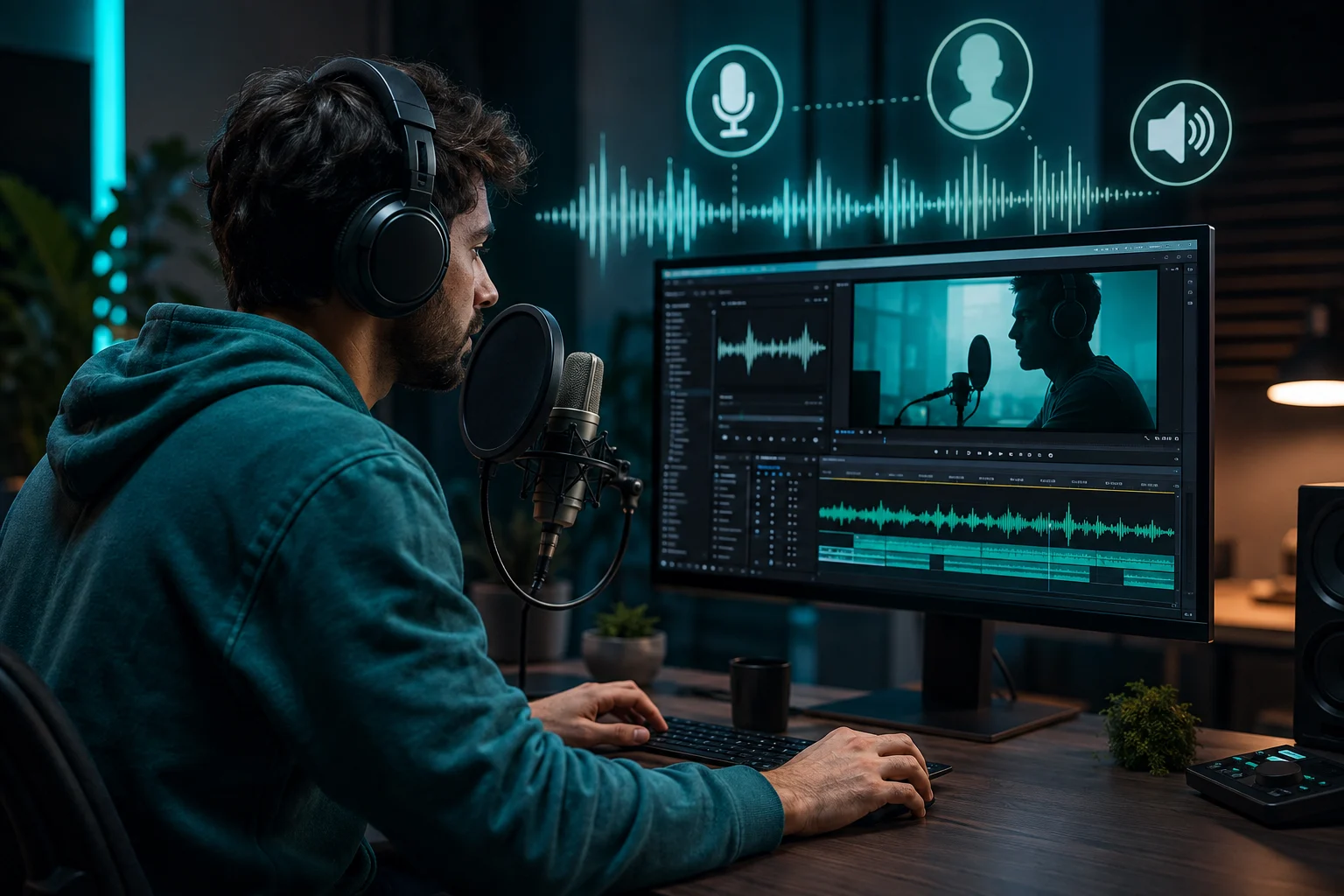
Voice and audio consistency is the ability of an AI tool to keep a narrator, character, or brand voice sounding like the same person, at the same tone and pacing, across every scene in a project, rather than subtly shifting timbre, accent, or delivery each time a new clip is generated. It's a quieter problem than visual drift, but arguably a more jarring one: a viewer will forgive a slightly different background, but a voice that suddenly sounds like someone else mid-series breaks the illusion instantly. The tools below take genuinely different approaches to holding a voice steady, from a full video-production platform that treats audio as one part of a larger consistency system, to specialist voice-cloning engines built to solve nothing else. This roundup covers eight of them.
Comparison Table
Tool | Best for | Key audio-consistency feature | Starting price |
invideo agent | A locked voice held consistent across scenes, sessions, and translated language versions of a project | Persistent context engine plus voice cloning for cross-language consistency | $17/month; team and enterprise options available |
ElevenLabs | The highest-fidelity voice clone for recurring, professional-grade narration | Professional Voice Cloning holding up across extended narration | $5/month |
Resemble AI | Enterprise voice consistency with built-in authentication and watermarking | Speech-to-speech conversion preserving performance while swapping voice identity | Pay-as-you-go from $0; $0.0005/second |
LOVO AI | Multi-scene video projects needing one cloned voice across every clip in the timeline | Voice cloning from 1 minute of audio, reused across unlimited projects | $24/month |
Descript | Fixing narration mistakes without re-recording, inside a text-based editor | Overdub voice cloning tied directly to transcript editing | $12/month (annual) |
WellSaid Labs | A single proprietary brand voice deployed consistently across enterprise content | Custom voice avatar built and licensed specifically for one brand | ~$50/month |
Murf AI | Teams that need a broad voice library with consistent delivery, without self-serve cloning | 200+ voices with consistent studio-quality delivery across long scripts | $19/month (annual) |
Fish Audio | Budget-conscious, high-volume narration needing a fast, consistent clone | Zero-shot voice cloning from 10 seconds of reference audio | $11/month |
1. invideo agent
Most voice tools solve consistency within a single narration pass, but lose that same voice the moment a project moves to a new scene, a new session, or a translated version. invideo agent treats voice and audio as part of the same persistent context engine that holds characters, products, and style consistent across a project: once a voice is established, sound and music work happen inside the platform's Post & Finishing stage, which covers timeline editing, voiceover, and voice cloning together, rather than as a bolted-on afterthought once picture lock is done.
The clearest test of this is localization. When a project needs to reach a new market, invideo agent doesn't just translate the script, it plans what has to change versus what has to stay the same, auto-translates the dialogue, generates lip-sync voiceover, and uses voice cloning to keep the same voice consistent across every language version, so a brand's spokesperson sounds like the same person in Spanish as they do in English. That same persistent memory is what carries a locked voice across scenes and sessions within one language, too, rather than requiring the voice to be re-established with every new clip.
Best for: brands and filmmakers who need one voice held consistent not just within a project, but across scenes, sessions, and translated language versions of the same content.
Where it falls short: because voice sits inside a broader project-level consistency system rather than a single-purpose tool, a creator who only needs a quick, isolated voiceover clip may find a dedicated voice tool faster to set up for that narrow task.
Pricing: plans start at $17/month, with team and enterprise options also available.
2. ElevenLabs
ElevenLabs is widely regarded as the benchmark for voice cloning quality, and its Professional Voice Cloning mode is specifically built for the consistency problem: rather than the faster Instant Voice Cloning mode, which can drift slightly on unusual phrases in long passages, Professional Voice Cloning uses longer training samples to produce a more stable replica that holds up across extended narration, the kind needed for a recurring video series or an audiobook. Cross-language cloning preserves the same speaker identity across 70+ languages.
Best for: creators and studios who need the highest-fidelity, most stable voice clone for recurring or long-form narration.
Where it falls short: Professional Voice Cloning is gated behind the Creator plan and above, and the credit system, tied to character counts across multiple models, is widely reported as confusing to budget against actual usage.
Pricing: Starter plan from $5/month; Professional Voice Cloning requires Creator at $22/month.
3. Resemble AI
Resemble AI approaches consistency from a different angle: its speech-to-speech engine converts a performance recorded in one voice into a different target voice in real time, preserving the intent, pacing, and emotional delivery of the original performance rather than generating flat narration from text. That matters for consistency because the emotional register of a scene carries through the conversion, rather than needing to be re-specified for every clip. Every generated voice is watermarked and detectable by Resemble's own verification model, and the platform holds SOC 2 compliance automation , GDPR, and HIPAA compliance.
Best for: enterprises and regulated industries that need voice consistency paired with authentication and provenance tracking.
Where it falls short: pricing is metered per second of audio output rather than a flat monthly rate, which makes total cost harder to predict for high-volume use, and reviewers note the speech-to-speech feature specifically still has room to improve.
Pricing: Flex plan starts at $0, pay-as-you-go at $0.0005 per second of audio output.
4. LOVO AI
LOVO's Genny platform clones a voice from just one minute of audio and lets that cloned voice be reused across unlimited future projects, which is the core mechanic for holding a consistent voice across a multi-scene video built inside its own timeline editor. Because voice generation, video editing, and auto-captioning live in one interface, a locked voice can be dropped into every scene of a project without exporting to a separate tool.
Best for: creators who want one cloned voice reused across every scene of a video project without leaving a single editing interface.
Where it falls short: reviewers consistently note that LOVO's voice cloning quality sits below ElevenLabs, and the platform has drawn user complaints about billing continuing after cancellation.
Pricing: Basic plan from $24/month (annual billing).
5. Descript
Descript's Overdub feature clones a creator's own voice specifically so that narration mistakes can be fixed by editing text rather than re-recording, which keeps a voice consistent across a project by construction, since every correction comes from the same trained voice model rather than a fresh take that might sound subtly different. Because Overdub is tied directly to Descript's transcript-based editor, fixing a misspoken word is a text edit, not a new audio session.
Best for: podcasters and video creators who need to patch narration errors without re-recording and introducing a slightly different take.
Where it falls short: reviewers note voice consistency can vary across longer projects, and unlimited Overdub access is gated to the Creator plan and above rather than available on the entry tier.
Pricing: Hobbyist plan from $12/month (annual billing).
6. WellSaid Labs
WellSaid Labs is built specifically around one enterprise use case: a single proprietary brand voice that stays identical across every piece of corporate content, from e-learning modules to marketing videos, licensed and consented from a real voice talent rather than assembled from scraped audio. Because the voice is custom-built and exclusively licensed to one organization, there's no risk of the same underlying voice showing up in a competitor's content.
Best for: enterprises that need one exclusive, legally licensed brand voice held identical across every piece of corporate content.
Where it falls short: it's priced and positioned for enterprise budgets rather than individual creators, multilingual support is limited on standard tiers, and a custom brand voice can add $10,000 or more to an annual contract.
Pricing: Creative plan from roughly $50/month; custom voice development is quoted separately.
7. Murf AI
Murf's strength is breadth and studio polish rather than cloning: 200+ voices across 30+ languages, deliverable through a browser-based editor with emphasis and pronunciation controls, so a long script keeps the same measured, professional delivery style from the first line to the last. That consistency of delivery style, rather than a cloned individual voice, is what most Murf customers are actually buying.
Best for: teams producing e-learning or marketing narration who need consistent, professional delivery from a broad voice library rather than a cloned personal voice.
Where it falls short: voice cloning is locked entirely behind the Enterprise tier, so a creator who specifically needs a custom cloned voice on a self-serve budget will need to look elsewhere.
Pricing: Creator plan from $19/month (annual billing).
8. Fish Audio
Fish Audio's S2 model clones a voice from as little as 10 seconds of reference audio and holds up across 80+ languages, at API pricing reported to run roughly 11 times cheaper than ElevenLabs' equivalent tier for comparable volume. Its open-weight models mean a team with the infrastructure to self-host isn't locked into any single vendor's pricing changes down the line.
Best for: budget-conscious creators and developers running high-volume narration who need a fast, consistent clone without ElevenLabs-level spend.
Where it falls short: the newest S2 model removed LoRA fine-tuning support, limiting customization to inference-only workflows, and self-hosting requires 12–24GB of GPU VRAM, which puts it out of reach for smaller setups without dedicated hardware.
Pricing: Plus plan from $11/month.
Which one should you use
- A voice locked across scenes, sessions, and translated language versions of a project → invideo agent
- The most stable, highest-fidelity clone for long-form or recurring narration → ElevenLabs
- Voice consistency paired with authentication and compliance → Resemble AI
- One cloned voice reused across every scene in a single timeline editor → LOVO AI
- Fixing narration mistakes without re-recording → Descript
- One exclusive, licensed brand voice across enterprise content → WellSaid Labs
- A broad voice library with consistent professional delivery → Murf AI
- Fast, budget-friendly cloning at high volume → Fish Audio