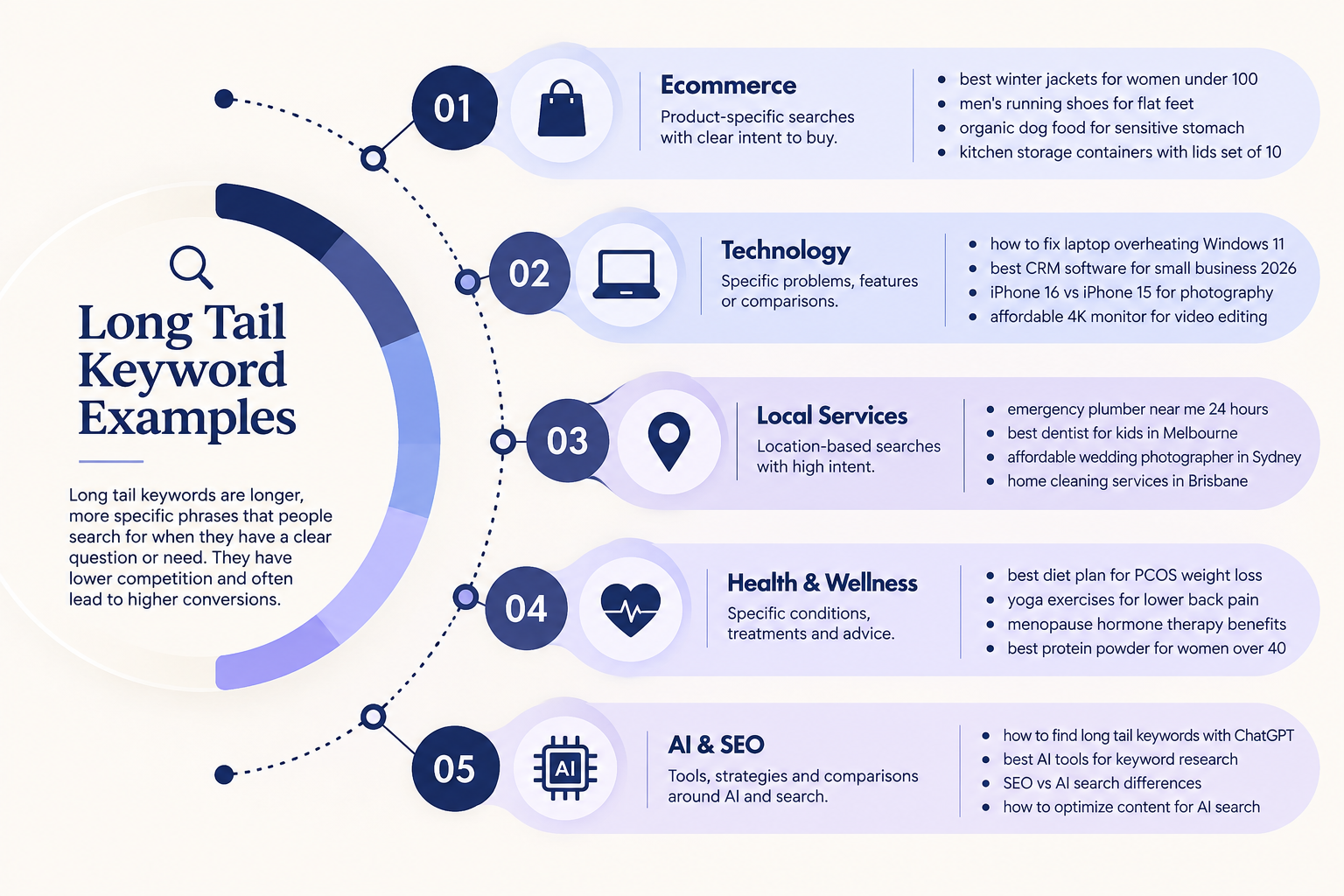
Every search begins with a need, but not every search explains that need clearly. Someone may type coffee while casually exploring. Another person may search for best low-acid coffee beans for cold brew because they already know the taste, brewing method and product they want. For marketers, business owners and content creators, this difference is important. The more clearly a search expresses a person’s problem, preference or goal, the easier it becomes to create a page that genuinely helps them.
Here are a few examples:
Broad Keyword | Long-Tail Keyword |
coffee | best low-acid coffee beans for cold brew |
CRM | affordable CRM for a five-person sales team |
travel insurance | travel insurance for seniors visiting Europe |
muesli | wheat-free muesli with nuts and no added sugar |
The final example reflects a real product offered by Urbana Superfoods. Instead of targeting everyone searching for muesli, the more specific phrase focuses on people looking for particular dietary and ingredient preferences. This is what makes long-tail keyword research useful: it helps connect a precise search with a genuinely relevant page.
However, long-tail keywords are not simply phrases containing three, four or five words. They are better understood through their specificity and relative search demand compared with broader keywords in the same topic. A long query can still be highly popular, while a short niche term may have very little search demand.
In this guide, you will find 100+ long-tail keyword examples organized by search intent and industry. You will also learn how to:
- Recognize genuine long-tail keyword opportunities
- Evaluate relevance, intent, competition and business value
- Group similar keywords without creating repetitive pages
- Use long-tail keywords naturally in SEO content
- Find opportunities for traditional and AI-powered search
Quick Answer: Long-tail keywords are specific search queries with lower relative demand than broader terms in the same topic. They often reveal a clearer audience, problem, feature, location, budget or goal. They are not defined by word count alone.
What Are Long-Tail Keywords?
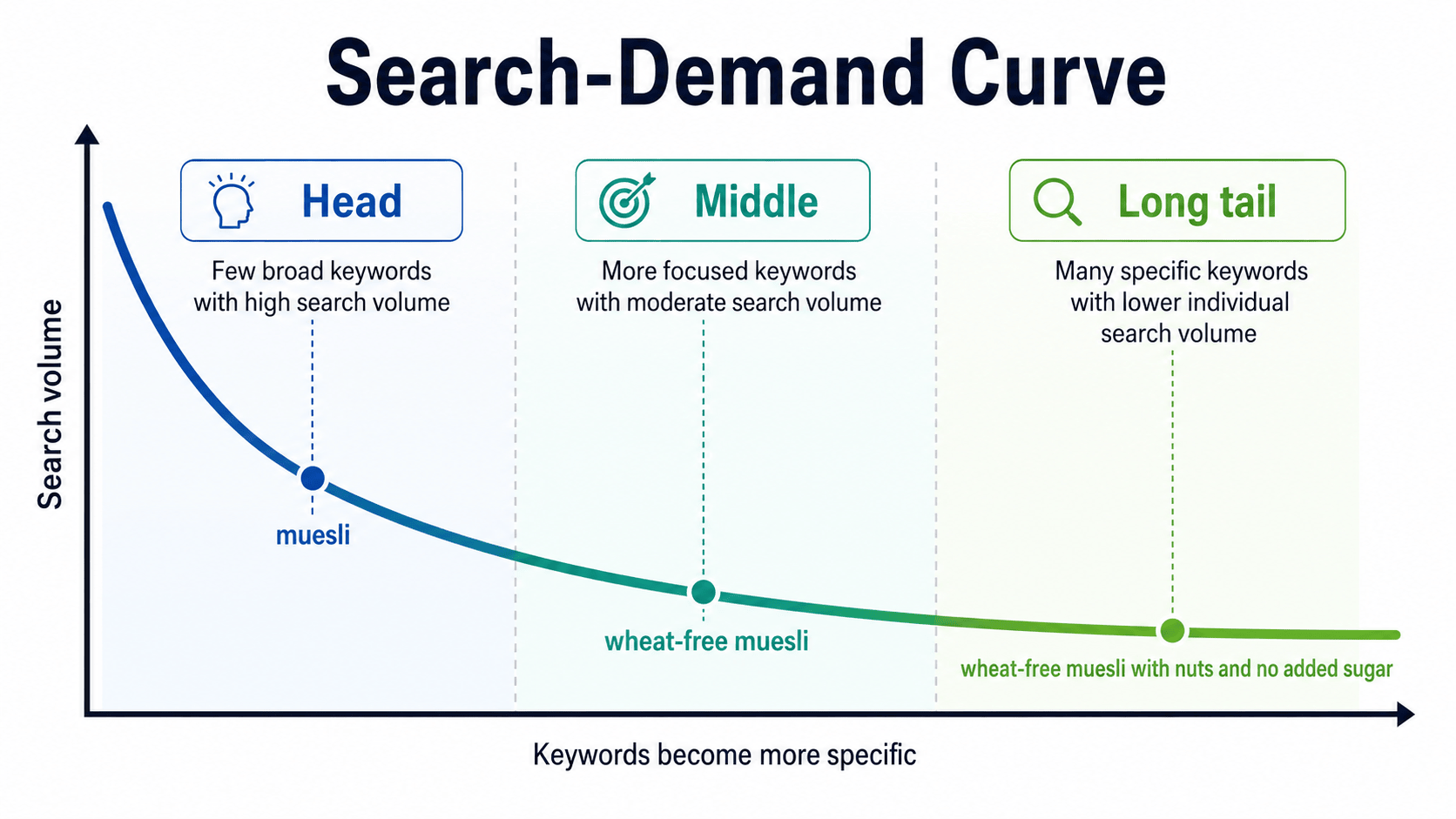
Long-tail keywords are specific search queries with relatively low search demand compared with broader keywords on the same topic. They usually reveal a clearer need, preference or goal.
For example:
Keyword | What It Reveals |
muesli | The searcher’s purpose is unclear |
wheat-free muesli | A dietary preference is visible |
wheat-free muesli with nuts and no added sugar | Several specific product preferences are clear |
Figure 1: Search-Demand Curve
Quick Facts About Long-Tail Keywords
- They are defined mainly by relative search demand, not word count.
- They usually describe a more specific need or question.
- Their search intent is often easier to understand.
- They may face less competition, but this is not guaranteed.
- Each keyword may attract limited traffic individually.
- Related long-tail keywords can generate meaningful traffic collectively.
- Several variations with the same intent can often be covered on one page.
- Low search volume does not automatically mean low business value.
Pro Tip: Compare a potential long-tail keyword with broader searches in the same topic. Then examine its search results before deciding what type of page it needs.
Are Long-Tail Keywords Always Longer?
No. Long-tail keywords often contain several words because specific searches usually require more detail, but word count alone does not make a keyword long-tail. Compare the query with broader searches in the same topic and look at its relative demand and intent.
Short-Tail vs Long-Tail Keyword Examples
Short-Tail Keyword | Long-Tail Keyword | What Becomes Clear |
Running shoes | Waterproof running shoes for women with flat feet | Feature + audience + problem |
CRM | Affordable CRM for a five-person sales team | Budget + team size |
Coffee | Best low-acid coffee beans for cold brew | Product preference + use case |
Travel insurance | Travel insurance for seniors visiting Europe | Audience + destination |
Dentist | Emergency dentist near me open Sunday | Urgency + local intent |
SEO tools | Free SEO tools for small ecommerce websites | Price + audience |
Office chairs | Ergonomic office chairs for tall people under $300 | Audience + budget |
Curtains | Blackout curtains for west-facing bedroom windows | Feature + room condition |
Quick Test: If the extra words do not add a real audience, need, constraint, feature, location, comparison or action, the phrase may simply be longer - not more useful.
Benefits of Long-Tail Keywords
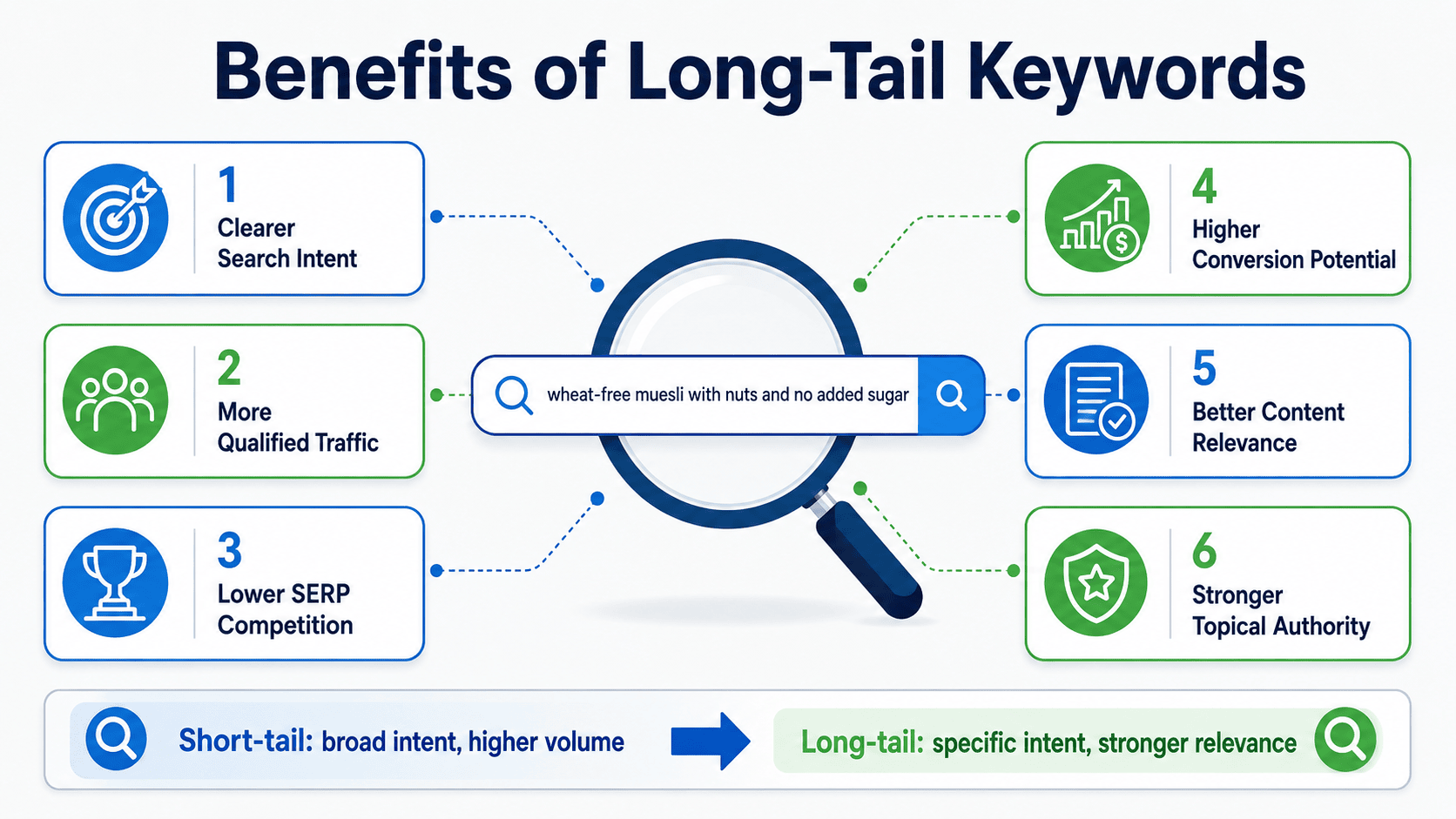
Long-tail keywords for short businesses are valuable as they target specific search intent instead of broad search demand. Compared with short-tail keywords, they usually have lower individual search volume, but they often attract users who are easier to understand, easier to serve and closer to taking a specific action.
A broad keyword like muesli gives limited SEO direction. The searcher may want a definition, recipe, brand, product, comparison or health information. But a query like wheat-free muesli with nuts and no added sugar gives much clearer context. It includes product type, dietary preference and ingredient requirements. That extra specificity is where the SEO value comes from.
1. Clearer Search Intent
Short-tail keywords often havemixed intent. A keyword like coffee could be informational, commercial, transactional, or local. Long-tail keywords usually make the intent easier to identify.
Broad Keyword | Long-Tail Keyword | Likely Intent |
coffee | best low-acid coffee beans for cold brew | Commercial |
CRM | affordable CRM software for small agencies | Commercial |
muesli | buy wheat-free muesli with no added sugar | Transactional |
SEO | how to find long-tail keywords in Search Console | Informational |
dentist | emergency dentist near me open Sunday | Local transactional |
Clearer intent helps you choose the right page type, content angle, CTA and internal linking strategy.
2. More Qualified Organic Traffic
Long-tail keywords may not bring the highest traffic volume individually, but they can bring more qualified organic traffic. For example, someone searching CRM may only be exploring the topic. Someone searching affordable CRM software for a five-person sales team has already defined the product category, budget concern and team size. That type of visitor is usually more relevant because the search query already contains useful business context.
3. Lower SERP Competition in Many Cases
Broad keywords are often dominated by high-authority domains, large brands, marketplaces, directories and broad category pages. Long-tail keywords can be more achievable because the SERP is narrower and the content requirement is more specific. This can create ranking opportunities for newer websites, niche brands and specialist pages. However, long-tail does not always mean easy. A query can still be competitive if it has strong commercial value or is targeted by authoritative sites. Always check the live SERP before selecting the keyword.
4. Higher Conversion Potential
Long-tail queries often include conversion modifiers, such as product features, audience, location, budget, urgency or comparison language.
Modifier Type | Example |
Feature | caffeine-free herbal tea before sleep |
Audience | CRM software for small agencies |
Problem | running shoes for flat feet |
Budget | standing desk under $300 |
Location | SEO agency in Hyderabad |
Urgency | dentist open Sunday near me |
Comparison | muesli vs granola for breakfast |
These modifiers help you understand what the user needs before they arrive on the page. When the page matches that need closely, the chance of conversion is often stronger.
5. Better Content Relevance
Long-tail keywords help you create more focused content. Instead of writing a generic article around muesli, you can build specific pages or sections around queries like:
Long-Tail Keyword | Content Angle |
how to eat muesli for breakfast | How-to guide |
muesli vs granola for weight loss | Comparison article |
best muesli without added sugar | Product/category guide |
wheat-free muesli with nuts | Product page or collection page |
This improves content relevance because the page is built around a defined user need, not a vague topic.
6. Stronger Topical Authority
Long-tail keywords help build topical authority by covering the specific subtopics around a broader subject. For example, a website about healthy breakfast foods could cover:
Main Topic | Supporting Long-Tail Topics |
muesli | how to eat muesli |
muesli | best muesli without added sugar |
muesli | muesli vs granola |
muesli | wheat-free muesli with nuts |
muesli | healthy muesli for breakfast |
Together, these pages create a stronger topical cluster. They help search engines understand the site’s depth around the subject.
7. Better Fit for AI and Conversational Search
Many searches are now written in natural, question-based language. Users often search the way they speak.
Example: what is the best muesli with no added sugar for daily breakfast
This type of query is specific, conversational and intent-rich. Long-tail keyword research helps you identify these patterns and answer them clearly within your content.
Pro Tip: The main benefit of long-tail keywords is not just lower competition. Their real SEO value comes from clearer intent, better relevance, stronger topical coverage and higher conversion potential.
Figure 2: Benefits of Long-Tail Keywords
Types of Long-Tail Keywords by Search Intent
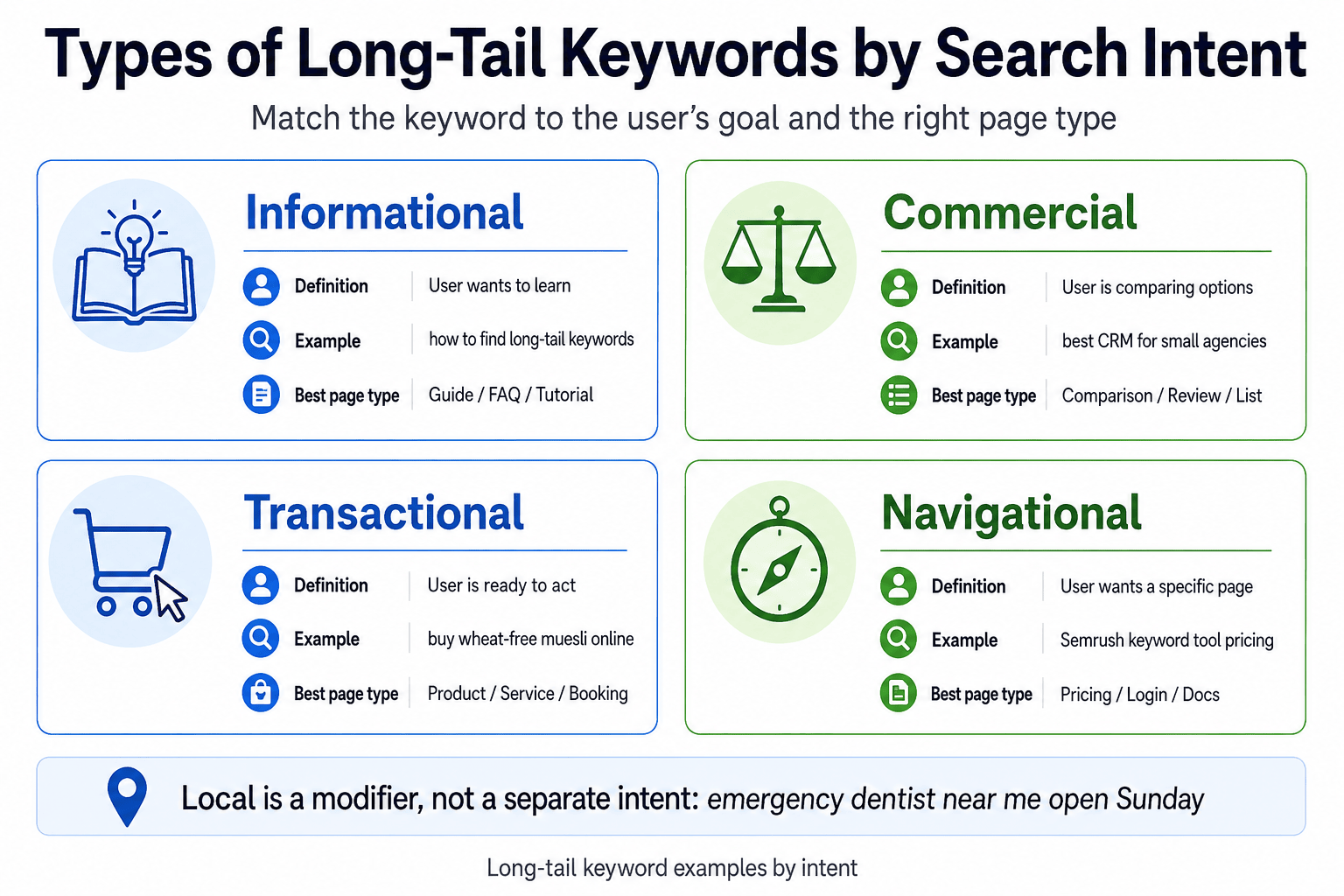
Long-tail keywords can be classified by what the searcher wants to accomplish. This purpose is known as search intent.
Figure 3: Types of Long-Tail Keywords by Search Intent
Consider four searches related to muesli:
- how to prepare muesli for breakfast
- best wheat-free muesli with no added sugar
- buy wheat-free muesli online
- Urbana Superfoods wheat-free muesli
They share the same broad topic, but each represents a different goal and therefore requires a different type of page.
Four Primary Types of Search Intent
Search Intent | Searcher’s Purpose | Example | Suitable Page |
Informational | Learn or solve a problem | how to prepare muesli for breakfast | Guide or tutorial |
Commercial | Compare options before deciding | best wheat-free muesli with no added sugar | Buying guide or category page |
Transactional | Purchase or complete an action | buy wheat-free muesli online | Product page |
Navigational | Reach a known brand or page | Urbana Superfoods wheat-free muesli | Branded product page |
Understanding intent prevents a common SEO mistake: creating the wrong page for a keyword. For example, a product page may not satisfy someone seeking instructions, while an educational article may frustrate someone ready to buy.
Where Does Local Search Intent Fit?
Local is usually a modifier rather than a separate primary intent. It tells you where the searcher wants the result, while informational, commercial, transactional and navigational intent describe what the person wants to accomplish.
Local Search Query | Primary Intent |
How much does curtain installation cost in Hyderabad | Informational |
Best Italian restaurant in Kondapur | Commercial |
Book a gynecologist appointment in Henderson | Transactional |
CurTales Hyderabad store address | Navigational |
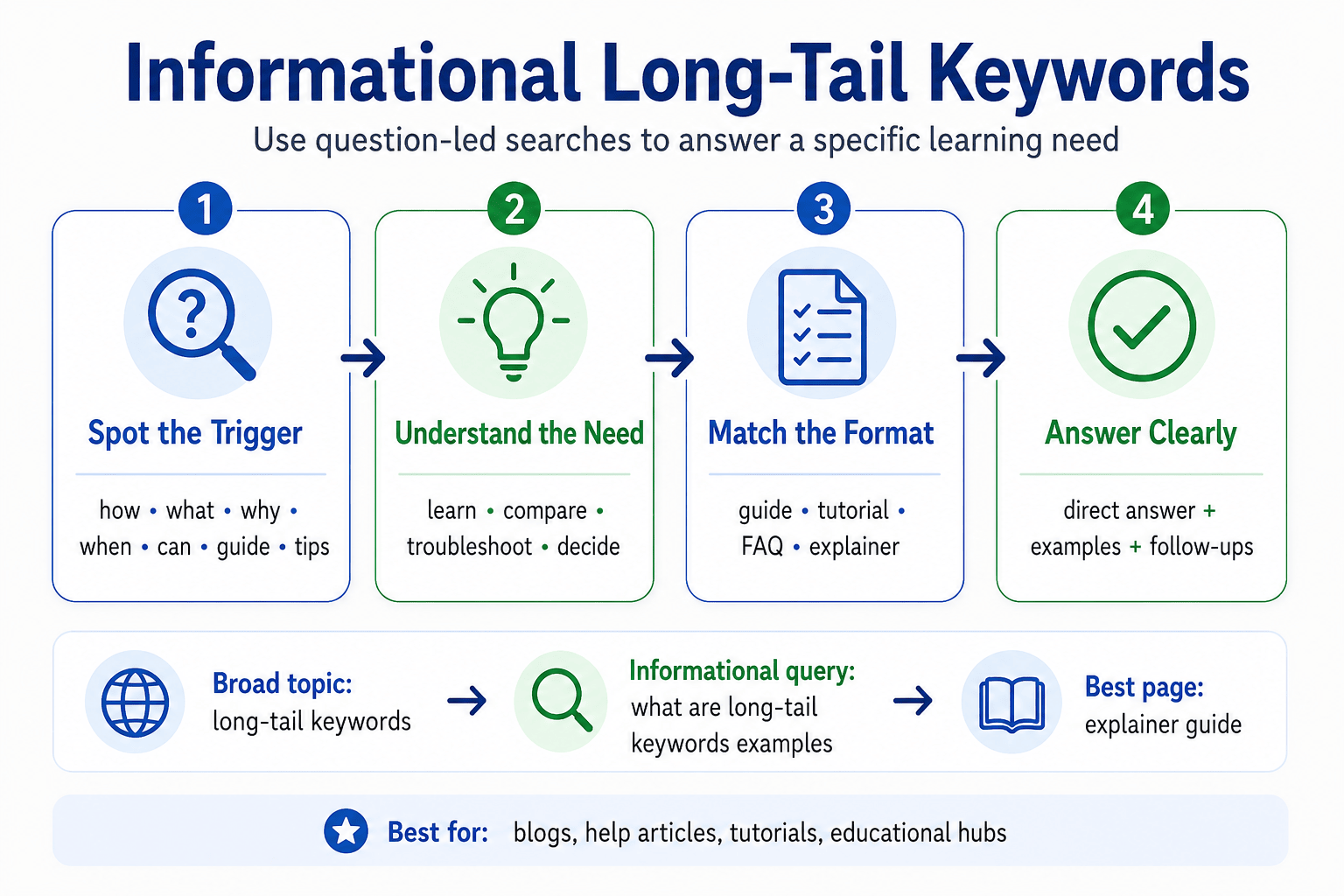
Informational long-tail keywords are specific searches used when someone wants to learn, understand or solve a problem.
They often contain words such as:
- how
- what
- why
- when
- can
- guide
- tips
Types of Informational Searches
Category | Purpose | Keyword Example | Ideal Page Type |
Definition | Understand a concept | what are long-tail keywords in SEO | Explainer |
Instructions | Complete a task | how to make black coffee without a machine | How-to guide |
Comparison | Understand a difference | what is the difference between muesli and granola | Comparison article |
Troubleshooting | Diagnose a problem | why did my website traffic suddenly decrease | Troubleshooting guide |
Timing | Know when to act | when should a small business start using CRM | Advisory article |
Possibility | Check whether something can be done | can muesli be eaten without milk | FAQ or short guide |
Advice | Receive practical recommendations | tips for choosing curtains for a small bedroom | Tips article |
Learning | Explore a subject systematically | beginner guide to keyword research for SEO | Comprehensive guide |
Purpose of Informational Content
A page targeting an informational keyword should:
- Answer the central question early
- Explain the subject in clear language
- Provide practical steps or examples where useful
- Cover relevant follow-up questions
- Satisfy the query before introducing products or services
Pro Tip: A specific question does not always require a long article. The content should be only as detailed as the searcher’s problem requires.
2. Commercial Long-Tail Keywords
Commercial long-tail keywords are specific searches used when someone is researching or comparing options before making a decision. The searcher understands their need but has not yet chosen a particular product, service or solution.
These searches often contain terms such as:
- best
- top
- reviews
- alternatives
- versus or vs
- comparison
- for small businesses
- under a specific budget
Types of Commercial Searches
Category | Purpose | Keyword Example | Ideal Page Type |
Best option | Find the most suitable choice | best CRM software for small agencies | Buying guide |
Product shortlist | Explore leading options | top noise-cancelling headphones for remote work | List-based comparison |
Reviews | Evaluate a particular product | Surfer SEO reviews for freelance writers | Product review |
Alternatives | Find substitutes for a known option | affordable HubSpot alternatives for small teams | Alternatives page |
Direct comparison | Choose between two options | Mailchimp vs ActiveCampaign for ecommerce | Comparison page |
Audience-specific | Find a solution for a particular user | best accounting software for nonprofit organizations | Audience-focused guide |
Feature-specific | Find options with a required feature | CRM software with WhatsApp integration | Comparison or category page |
Budget-specific | Compare options within a price range | best website builders under $20 per month | Budget buying guide |
What Should Commercial Content Do?
A page targeting commercial intent should:
- Establish clear comparison criteria
- Explain who each option is best suited for
- Present meaningful advantages and limitations
- Include current features, prices and conditions
- Avoid declaring one universal winner when needs differ
- Help the reader confidently narrow their choices
Commercial intent does not always mean the user is ready to buy immediately. For example, someone searching best CRM software for small agencies may still need to compare features, pricing and ease of use before choosing a platform.
Pro Tip: Do not use words such as best merely to attract clicks. Explain what “best” means for the audience, budget and use case covered by the page.
3. Transactional Long-Tail Keywords
Transactional long-tail keywords indicate that someone is ready, or nearly ready, to complete a specific action. This could mean purchasing a product, booking a service, requesting a quote, downloading a resource or starting a free trial.
They often include terms such as:
- buy
- order
- book
- hire
- price
- discount
- download
- request a quote
- free trial
Types of Transactional Searches
Category | Intended Action | Keyword Example | Ideal Page Type |
Purchase | Buy a specific product | buy medium-roast Arabica coffee beans online | Product page |
Order | Place an order | order wheat-free muesli with no added sugar | Product page |
Price check | Review costs before acting | CRM software price for five users | Pricing page |
Booking | Reserve a service or appointment | book an online mathematics tutor for grade 10 | Booking page |
Hiring | Engage a professional | hire a Shopify developer for checkout customization | Service page |
Quote request | Obtain a tailored estimate | request a quote for office cleaning services | Quote landing page |
Trial | Test a product before subscribing | email automation software free trial for Shopify | Trial page |
Download | Obtain a digital resource | download monthly expense tracker Excel template | Resource landing page |
What Should Transactional Content Do?
A page targeting transactional intent should:
- Clearly confirm the product, service or resource offered
- Provide accurate pricing or explain how pricing is calculated
- Include essential specifications, features and limitations
- Make availability, delivery or service conditions clear
- Reduce uncertainty with relevant trust signals
- Provide a visible and straightforward next step
Not every specific keyword has transactional intent. For example, how is Arabica coffee roasted is detailed but informational, while buy medium-roast Arabica coffee beans online clearly expresses an intention to purchase.
Pro Tip: Match the call to action with the query. A user searching for a price needs accessible pricing information, while someone requesting a quote needs a short and relevant enquiry form.
4. Navigational Long-Tail Keywords
Navigational long-tail keywords are specific searches used when someone already knows the brand, website, product or online destination they want to reach. The search engine is being used as a shortcut.
They often combine a brand or product name with terms such as:
- login
- pricing
- support
- documentation
- dashboard
- contact
- A particular product or feature name
Types of Navigational Searches
Category | Intended Destination | Keyword Example | Ideal Page Type |
Account access | Open an existing account | Google Search Console login page | Login page |
Pricing | Reach a known brand’s pricing | HubSpot CRM pricing for small teams | Pricing page |
Support | Find official assistance | Shopify payment support contact page | Support page |
Documentation | Access technical instructions | Stripe payment links API documentation | Documentation page |
Tool | Open a known tool | Semrush Keyword Magic Tool | Tool page |
Feature | Find information about a known feature | Salesforce AI lead scoring feature | Feature page |
Product | Reach a branded product | Urbana Superfoods wheat-free muesli | Product page |
Location or contact | Find a known business | CurTales Hyderabad store address | Contact or location page |
What Should Navigational Content Do?
Pages serving navigational searches should:
- Use clear and consistent brand, product and feature names
- Make important destinations easy to find
- Use descriptive page titles and URLs
- Keep pricing, contact and support information current
- Avoid creating multiple pages that compete for the same branded query
- Help users reach the intended destination quickly
Navigational intent can overlap with another intent. For example, Urbana Superfoods muesli reviews includes a known brand, but the user is also evaluating the product, giving the query commercial intent.
Pro Tip: When intent appears mixed, inspect the search results. The pages Google prioritizes can help reveal whether users mainly want a destination, comparison, explanation or action.
100+ Long-Tail Keyword Examples Across Industries
The live article already contains examples throughout the intent, evaluation and implementation sections. The industry library below makes those patterns easier to scan. Combined with the examples elsewhere on the page, the guide now clearly delivers on the 100+ examples promise.
Important: Treat these as illustrative keyword patterns, not guaranteed traffic opportunities. Validate the exact query, country, SERP and business fit before building a page.
Industry | Long-Tail Keyword Example | Intent | Best Page Type |
SEO & Marketing | How to find long-tail keywords for a new website | Informational | Guide |
SEO & Marketing | Technical SEO checklist for ecommerce websites | Informational | Checklist guide |
SEO & Marketing | Best SEO tools for small business owners | Commercial | Comparison page |
SEO & Marketing | Affordable local SEO services for small businesses | Commercial | Service page |
SaaS & B2B | Affordable CRM for a five-person sales team | Commercial | Use-case page |
SaaS & B2B | Best project management software for remote design teams | Commercial | Buying guide |
SaaS & B2B | Mailchimp alternatives for ecommerce automation | Commercial | Alternatives page |
SaaS & B2B | Help desk software with WhatsApp integration | Commercial | Comparison page |
Ecommerce | Waterproof running shoes for beginners with flat feet | Commercial | Buying guide |
Ecommerce | Fragrance-free moisturizer for sensitive oily skin | Commercial | Product/category page |
Ecommerce | Standing desk under $300 for home office | Commercial | Buying guide |
Ecommerce | Buy medium-roast Arabica coffee beans online | Transactional | Product page |
Local Business | Emergency dentist near me open Sunday | Transactional | Local service page |
Local Business | Curtain store in Hyderabad with home installation | Transactional | Location/service page |
Local Business | Same-day home cleaning service in Gurgaon | Transactional | Service page |
Local Business | Newborn photographer in Mumbai with home shoot | Commercial | Service page |
Travel | Seven-day Italy itinerary for first-time visitors | Informational | Itinerary guide |
Travel | Travel insurance for seniors visiting Europe | Commercial | Comparison page |
Travel | Dubai itinerary for families with kids for five days | Informational | Itinerary guide |
Travel | Best beach resorts in Goa for couples under ₹10,000 | Commercial | Hotel comparison |
Industry | Long-Tail Keyword Example | Intent | Best Page Type |
Education | How to learn Python without coding experience | Informational | Beginner guide |
Education | Book an online mathematics tutor for Grade 10 | Transactional | Booking page |
Education | IELTS speaking practice questions for beginners | Informational | Practice resource |
Education | Best online MBA programs for working professionals | Commercial | Comparison page |
Finance | How to create a monthly budget on irregular income | Informational | Guide |
Finance | Credit cards with lounge access and no annual fee | Commercial | Comparison page |
Finance | Tax filing checklist for freelancers in India | Informational | Checklist guide |
Finance | Download GST invoice template for freelancers | Transactional | Resource page |
Real Estate | Pet-friendly rental apartments near central Austin | Commercial | Filtered listing page |
Real Estate | Houses for sale in Hyderabad under ₹1 crore | Transactional | Listing page |
Real Estate | Coworking office space in Hitech City for startups | Commercial | Listing/category page |
Real Estate | How to pay property tax online in Telangana | Informational | Step-by-step guide |
Healthcare | Female gynecologist in Henderson accepting new patients | Commercial/local | Practitioner page |
Healthcare | Book menopause specialist appointment in Henderson | Transactional | Appointment page |
Healthcare | Nutritionist for insulin resistance in women | Commercial | Service page |
Healthcare | Where to get thyroid blood test near me | Transactional/local | Local diagnostic page |
Home & Decor | How to choose curtains for a small bedroom | Informational | Guide |
Home & Decor | Curtain fabric for west-facing windows in summer | Commercial | Buying guide |
Home & Decor | Motorized blinds for large living room windows | Commercial | Product/category page |
Home & Decor | Affordable interior designer for 2BHK apartment in Hyderabad | Commercial/local | Service page |
Long-Tail Keywords in the US, UK and India
Long-tail phrasing changes by market because vocabulary, currency, locations, delivery expectations and product terminology differ. Do not copy a keyword list from one country and assume it represents how another market searches.
Market | Broad Topic | Long-Tail Keyword Example | Useful Modifier |
US | Health insurance | Affordable health insurance for self-employed adults in Texas | Audience + location |
US | Accountant | Small business accountant near Austin | Audience + location |
US | Hotels | Family-friendly hotels near Disneyland with breakfast | Audience + amenity |
UK | Trainers | Waterproof trail running trainers for wide feet | Feature + problem |
UK | Sofa | Small corner sofa with next-day delivery | Size + delivery |
UK | Accountant | Accountant for freelancers in Manchester | Audience + location |
India | Digital marketing course | Online digital marketing course with placement support | Mode + outcome |
India | Coworking space | Coworking space in Hyderabad with private cabins | Location + feature |
India | Dentist | Emergency dentist open Sunday in Bangalore | Urgency + location |
Market Rule: Use the vocabulary your audience actually uses, then validate it with country-specific SERPs and keyword data. Editorial capitalization in this document does not change the underlying search meaning.
How to Find Long-Tail Keywords
Once you understand what a useful long-tail keyword looks like, the next step is finding relevant opportunities for your own website. You can uncover them through Google suggestions, People Also Ask, Search Console, keyword research tools, customer questions and online communities.
Rather than repeat the full discovery process here, use our complete guide to finding long-tail keywords. It covers Google, Search Console, Semrush, Ahrefs, competitor research and other methods in detail.
How to Choose the Best Long-Tail Keywords
Finding a specific keyword does not automatically make it worth targeting. The best long-tail keywords combine audience relevance, clear intent, realistic ranking potential and meaningful value for your website.
Evaluate each keyword using these factors:
- Audience relevance
- Search intent
- Keyword-cluster potential
- Search demand
- Ranking difficulty
- Current search results
- Business value
- Existing website coverage
- Original-value potential
- Overall priority score
1. Check Audience Relevance
Start by asking: Does this keyword reflect a genuine need of the audience our website serves? A phrase may be related to your industry without being relevant to your customers.
For Example:
Keyword | Relevance to a Muesli Brand |
wheat-free muesli with nuts and no added sugar | High |
how to prepare muesli for breakfast | High |
muesli manufacturing machine price | Low |
wholesale cereal packaging equipment | Low |
The first two searches relate to people who may use or purchase muesli. The other searches come from manufacturers or industrial buyers and would attract the wrong audience.
Before keeping a keyword, confirm that:
- Its searcher resembles your intended customer or reader.
- The need connects naturally with your product, service or expertise.
- Your website can provide a useful and accurate answer.
- The resulting traffic would support the website’s purpose.
A low-volume keyword with close audience relevance is usually more valuable than a high-volume phrase that attracts people your website cannot help.
Pro Tip: Remove irrelevant keywords before examining volume and difficulty. Strong metrics should not persuade you to target the wrong audience.
2. Confirm Search Intent
Search intent is the purpose behind a query. Before selecting a long-tail keyword, confirm what the user expects to find after searching it. Search the keyword in Google and review the dominant type of results.
Keyword | Search Intent | Expected Page |
how to eat muesli | Informational | How-to guide |
best wheat-free muesli | Commercial | Buying guide or category page |
buy wheat-free muesli online | Transactional | Product page |
Urbana Superfoods muesli | Navigational | Branded product page |
Your planned page should match that expectation. An educational article is unlikely to satisfy someone ready to purchase, while a product page may not fully answer someone looking for preparation instructions.
Also check whether the results show:
- Articles or guides
- Product and category pages
- Comparisons and reviews
- Videos
- Local listings
- Tools or documentation
If several content types appear, the query may have mixed intent. In that case, identify which need is most relevant to your website and whether your proposed page can compete within the dominant result format.
Pro Tip: Do not rely entirely on the intent label shown by an SEO tool. Inspect the current search results because they provide stronger evidence of what users are likely to expect.
3. Evaluate the Complete Keyword Cluster
Do not judge a long-tail keyword only by its individual search volume. Several closely related searches may express the same underlying need and can often be targeted through one comprehensive page.
For example, a page focused on how to eat muesli may also answer:
- ways to eat muesli
- how to prepare muesli
- can muesli be eaten without milk
- should muesli be soaked overnight
Individually, these keywords may have modest search volumes. Together, however, they can represent a valuable topic with meaningful collective demand.
When reviewing a cluster, confirm that:
- The keywords share the same or closely related intent.
- Users expect a similar type of page.
- One page can answer the variations naturally.
- The current search results contain many of the same ranking pages.
- Separate pages would not provide enough independent value.
Choose one phrase as the primary keyword and use the remaining variations as secondary topics, headings or supporting questions.
If the intent changes, separate the keywords. For example, how to eat muesli and buy muesli online concern the same product but require different pages.
Pro Tip: Evaluate the traffic potential of the whole topic, not only the monthly volume of one exact phrase.
Supporting vs Topical Long-Tail Keywords
A useful clustering decision is to separate supporting variations from long-tail topics that represent a genuinely different search need.
Type | Example | Best Decision |
Supporting variation | Long-tail keyword examples / Examples of long-tail keywords | Cover on one comprehensive page |
Supporting question | How to eat muesli / Ways to eat muesli | Answer together when the SERP and intent overlap |
Distinct topical query | Muesli vs granola for weight loss | Consider a separate comparison page |
Different action | How to eat muesli / Buy muesli online | Use separate informational and transactional pages |
4. Review Search Demand
Search volume estimates how often people search for a keyword within a particular market and period. It can help indicate demand, but it should not be used as the only reason to select or reject a long-tail keyword.
Interpret volume in relation to:
- The size of your niche
- The target country
- The value of one visitor or conversion
- Seasonal changes in demand
- The combined volume of related keywords
- Evidence from customers and Search Console
For example, a specialized B2B query with 20 monthly searches may be valuable if a single lead is commercially important. The same volume may offer little value to a large consumer publisher.
Do not automatically dismiss a keyword showing zero volume. Keyword databases may miss new, local, highly specific or conversational searches. Such a query may still be worth covering when it appears in:
- Search Console impressions
- Customer enquiries
- Sales or support conversations
- People Also Ask
- Relevant community discussions
At the same time, low volume should not be treated as proof that a keyword is easier or more valuable. Confirm its relevance, intent and place within a broader cluster.
Pro Tip: Compare demand across the entire topic. A group of closely related low-volume searches can create a stronger opportunity than one keyword’s number suggests.
5. Assess Ranking Difficulty
Keyword difficulty estimates how challenging it may be to rank on the first page for a query. SEO tools usually calculate it using factors such as the authority and backlink profiles of pages already ranking.
Compare the difficulty score with your website’s:
- Topical authority
- Existing rankings in the subject
- Relevant backlinks
- Content quality
- First-hand expertise
- Ability to create the expected page type
Do not treat the score as a final verdict. Different tools calculate difficulty differently, and a low score does not guarantee an easy ranking.
A keyword may still be difficult when:
- Well-known brands dominate the results.
- The ranking pages closely satisfy the search intent.
- Shopping results, local packs or videos occupy significant space.
- The topic requires expertise your website cannot demonstrate.
- Strong pages have held their positions for a long time.
A higher-difficulty keyword may still be worth pursuing when it is highly relevant and your website can provide stronger expertise, evidence or practical value.
Pro Tip: Use keyword difficulty to compare opportunities within the same tool. Always inspect the actual results before making the final decision.
6. Inspect the Current Search Results
Keyword metrics cannot fully explain what it takes to rank. Search the long-tail keyword in Google and review the first page to understand the actual competition and the content users are being shown.
Check:
- Which page types dominate: guides, products, categories, comparisons or videos
- Whether the results closely match the keyword’s intent
- The authority and relevance of ranking websites
- How thoroughly the existing pages answer the query
- Whether the information is accurate and current
- Which SERP features appear, such as AI Overviews, featured snippets, shopping results or local packs
- Whether smaller specialist websites are ranking
Look for genuine opportunities rather than superficial omissions. Existing pages may lack:
- Clear examples
- First-hand experience
- Original screenshots
- Current information
- Guidance for a specific audience
- Honest limitations
- A useful template, tool or checklist
If the results already satisfy the query exceptionally well and your website cannot contribute anything distinctive, another keyword may be a better investment.
Pro Tip: Analyse the top-ranking pages as a group. One weak result does not necessarily mean the overall SERP is easy to compete with.
7. Consider Business Value
A long-tail keyword may bring relevant traffic but still contribute little to your website’s goals. Consider what a visitor could realistically do after reaching the page.
The keyword might support:
- Product discovery
- Sales or bookings
- Qualified enquiries
- Email subscriptions
- Resource downloads
- Brand authority
- Customer education
- Fewer support questions
For example, buy wheat-free muesli online has direct purchase potential. By contrast, what is muesli is mainly educational but may introduce new users to the product category and support discovery earlier in their journey.
Neither keyword is automatically better. Their value depends on the purpose of the page and your wider content strategy.
You can rate business value using a simple scale:
Score | Business Value |
1 | Little connection to the website’s goals |
2 | Relevant topic but limited strategic value |
3 | Supports awareness or customer education |
4 | Can contribute to qualified leads or product discovery |
5 | Strong potential to support a purchase, booking or another priority action |
Pro Tip: Do not judge every informational keyword by immediate sales. Some searches create value by building trust, introducing a solution or answering questions that prevent a future conversion.
8. Check Existing Website Coverage
Before creating a new page, confirm whether your website already has content serving the same search intent. Also review Google Search Console to see which pages already receive impressions for the keyword or its close variations.
If a relevant page already exists, consider improving it by:
- Adding a missing section
- Answering related questions
- Updating outdated information
- Including practical examples or visuals
- Improving the title and meta description
- Strengthening internal links
- Clarifying the page’s primary purpose
Create a new page only when the keyword represents a distinct need that the existing content cannot satisfy properly.
For example, how to eat muesli and ways to eat muesli can usually be handled by one guide. However, how to eat muesli and muesli vs granola may deserve separate pages because one requires preparation guidance and the other requires a comparison.
Checking existing coverage helps prevent repetitive content and keyword cannibalization.
Pro Tip: Updating a relevant page that already has authority and impressions is often more efficient than publishing another page targeting a slightly different phrase.
9. Identify Your Original Value
Before selecting a long-tail keyword, ask what your page can contribute beyond the information already ranking.
Original value may come from:
- First-hand experience
- Expert commentary
- Original screenshots or photographs
- Current data
- Real customer questions
- Better practical examples
- A downloadable worksheet or template
- Clear comparison criteria
- Honest limitations
- Industry-specific guidance
For example, an article about long-tail keyword examples becomes more useful when it provides examples organized by search intent and industry, explains the ideal page type, and includes a downloadable keyword library.
Original value does not mean every page requires new research or proprietary data. It means the content should offer a clearer, more accurate or more practical answer than a generic summary of existing pages.
If you cannot identify a useful reason for someone to choose your page over the current results, reconsider the keyword or strengthen the content plan.
Pro Tip: Define the page’s unique contribution before writing. “More words than competitors” is not an original value proposition.
10. Calculate the Priority Score
After reviewing relevance, intent, demand and competition, give each long-tail keyword a simple priority score. This helps you compare opportunities instead of choosing keywords only because they have low difficulty or attractive search volume.
Score each factor from 1 to 5, where 1 = weak and 5 = strong.
Factor | What to Check | Score |
Audience relevance | Does this keyword match the people you want to reach? | 1-5 |
Search intent clarity | Is it clear what the searcher wants? | 1-5 |
Page fit | Can you create the type of page Google is already rewarding? | 1-5 |
Search demand | Is there enough individual or collective demand? | 1-5 |
Ranking potential | Can your site realistically compete? | 1-5 |
Business value | Can this keyword support leads, sales, signups or authority? | 1-5 |
Original value | Can your page add something better than existing results? | 1-5 |
Maximum Score | | 35 |
Use the total score to decide what to do next.
Total Score | Decision |
29-35 | High-priority keyword. Build or improve a dedicated page. |
22-28 | Good opportunity. Target it if it fits your content plan. |
15-21 | Use as a supporting keyword or validate further. |
7-14 | Usually avoid unless it supports a very specific business goal. |
A keyword can still be rejected even with a decent score if it is misleading, too far from your offer, duplicates an existing page or requires claims you cannot honestly support.
Pro Tip: Score the full keyword cluster, not every tiny wording variation. For example, long tail keywords examples, examples of long-tail keywords and what are long tail keywords examples can usually be evaluated together because they share the same intent.
How to Use Long-Tail Keywords in SEO Content
Finding long-tail keywords is only half the work. To rank for them, you need to place them naturally inside content that matches the searcher’s intent, answers the full query and gives Google a clear reason to understand your page.
Use long-tail keywords in these key areas:
- Page topic and search intent
- SEO title and H1
- Introduction
- Subheadings
- Body content
- Examples, tables and visuals
- URL, meta description and image alt text
- Internal links
- FAQs
- Supporting keyword clusters
1. Match the Keyword With the Right Page Type
Before using a long-tail keyword, decide what kind of page the searcher expects.
Long-Tail Keyword | Search Intent | Best Page Type |
how to find long-tail keywords | Informational | Blog guide |
best CRM for small agencies | Commercial | Comparison page |
buy organic muesli with no added sugar | Transactional | Product or category page |
Semrush keyword magic tool pricing | Navigational/commercial | Pricing or tool page |
emergency dentist near me open Sunday | Local transactional | Local service page |
This matters as even a well-written article may not rank if the query clearly needs a product page, service page, comparison page or local landing page.
Pro Tip: Do not force every long-tail keyword into a blog post. The page format should match the intent behind the query.
2. Use One Primary Long-Tail Keyword
Choose one main long-tail keyword for the page. This becomes the central topic, not just a phrase to repeat.
For example, if your target keyword is:
long tail keywords examples
The page should clearly focus on examples, not only on the definition of long-tail keywords. That means the article should include tables, categories, use cases, comparison examples and practical explanations.
You can still include close variations naturally, such as:
- examples of long-tail keywords
- what are long tail keywords examples
- long-tail keywords examples
- long tail keywords seo examples
- short-tail and long-tail keywords examples
These do not need separate pages if the intent is the same.
3. Place the Keyword Naturally in Important Areas
Use the primary keyword where it helps both users and search engines understand the page.
Page Element | Example |
SEO Title | Long-Tail Keywords Examples: 100+ SEO Examples by Intent |
H1 | Long-Tail Keywords Examples |
Introduction | This guide explains long-tail keywords with practical examples by search intent and industry. |
H2 | Short-Tail and Long-Tail Keyword Examples |
Meta Description | Learn what long-tail keywords are with 100+ examples by intent, industry and page type. |
The goal is clarity, not repetition. If the keyword sounds awkward, rewrite the sentence.
4. Answer the Query Early
Long-tail searches are usually specific. Give the reader a direct answer near the beginning before expanding into details.
Example:
Long-tail keywords are specific search queries with lower individual search volume but clearer intent. For example, coffee is broad, while best low-acid coffee beans for cold brew is a long-tail keyword because it reveals the product type, use case and user preference. This helps readers quickly understand the topic and gives search engines a clear answer to extract.
Related long-tail keywords should guide your subheadings and examples. For this article, supporting sections can include:
Supporting Keyword | Possible Section |
short tail and long tail keywords examples | Short-Tail vs Long-Tail Examples |
buying content intent long tail keywords examples | Buying-Intent Long-Tail Keyword Examples |
long-tail keywords for travel industry examples | Industry-Specific Examples |
long tail focus keywords examples | How to Choose a Focus Keyword |
seo long tail keywords examples list | 100+ Examples Table |
This structure helps the page cover the full topic without creating thin, separate articles for every keyword variation.
6. Add Examples, Screenshots and Practical Assets
For an examples-based keyword, plain explanation is not enough. The page should prove the concept visually and practically. Useful assets include:
Asset | Purpose |
Short-tail vs long-tail comparison table | Helps beginners understand the difference quickly |
Google Autocomplete screenshot | Shows real search phrasing |
People Also Ask screenshot | Shows related user questions |
Search Console query screenshot | Shows long-tail keywords already driving impressions |
Product page screenshot | Shows how page attributes can inspire long-tail terms |
Downloadable keyword list | Adds practical value beyond the blog post |
For example, a product page for wheat-free or no-added-sugar muesli can support long-tail keyword research when the product details match real user needs. The screenshot should highlight actual product attributes, not invented keyword phrases.
7. Avoid Keyword Stuffing
Do not repeat the exact same keyword unnaturally.
Weak version: Long tail keywords examples help you understand long tail keywords examples because long tail keywords examples are useful for SEO.
Better version: Examples make long-tail keywords easier to understand as they show how search queries become more specific by audience, need, location, product feature or intent.
Google and readers both prefer natural, useful content over repeated exact-match phrasing.
8. Use Long-Tail Keywords in Internal Links
Internal links help search engines understand how your content is connected. Use descriptive anchor text when linking between related pages.
Examples:
Weak Anchor Text | Better Anchor Text |
click here | keyword research guide |
read more | SEO content strategy |
this article | search intent in SEO |
learn more | ecommerce keyword research |
Internal links should feel useful to the reader. Do not add them only for SEO.
9. Add FAQs for Specific Long-Tail Questions
FAQs are useful when the keyword cluster includes question-based searches. For example:
What are long-tail keywords?
Long-tail keywords are specific search queries that usually have lower individual search volume but clearer search intent than broad keywords.
How many words are in a long-tail keyword?
There is no fixed word count. A long-tail keyword is defined more by specific intent and lower relative search demand than by length alone.
Use FAQs to answer real follow-up questions, not to repeat the same keyword in different forms.
10. Keep the Content Focused on User Intent
The best way to use long-tail keywords is to build the page around the problem behind the search. If someone searches “best CRM for a five-person sales team,” they do not only need a definition of CRM. They likely need pricing, team size fit, ease of setup, features, limitations and comparisons. That is the standard to follow: use the long-tail keyword as the starting point, then create the page the searcher was actually hoping to find.
Common Long-Tail Keyword Mistakes to Avoid
Long-tail keywords are useful only when they reflect real search intent. Many websites target them incorrectly by chasing phrase length, tool metrics or small keyword variations instead of focusing on what the searcher actually needs.
1. Thinking Every Long Phrase Is a Long-Tail Keyword
A keyword is not long-tail just because it has many words. Long-tail keywords are usually more specific and have lower relative search demand. For example, how to use Google Search Console for keyword research is specific. But a long phrase with no clear search behavior or user need may not be a valuable keyword at all.
2. Adding Random Modifiers to Make Keywords Longer
Do not turn muesli into best healthy organic premium breakfast muesli online unless those modifiers reflect real demand and the page can honestly support them. Every modifier should add useful meaning, such as audience, location, problem, feature, price range or intent.
3. Creating Separate Pages for Every Variation
Keywords like long tail keyword examples, examples of long-tail keywords and what are long tail keywords examples usually belong on one page. Creating separate pages for each variation can lead to thin content and keyword cannibalization.
4. Ignoring Search Intent
A long-tail keyword with buying intent needs a product, category, service or comparison page. An informational keyword needs a helpful guide. If the page type does not match the intent, the keyword will be harder to rank for.
5. Choosing Keywords Only Because Difficulty Is Low
Low keyword difficulty does not automatically mean a keyword is worth targeting. Check whether the keyword is relevant, has business value and can support a useful page.
6. Forcing Exact-Match Keywords Into the Content
Exact-match repetition makes content sound unnatural. Use the primary keyword clearly, then include variations and related phrases only where they fit.
7. Ignoring Zero-Volume Keywords Completely
Some long-tail keywords show little or no volume in SEO tools but still bring qualified traffic, especially in niche, B2B, local and product-led searches. Validate them through Search Console, customer questions, sales calls and live SERP results.
8. Copying Competitor Keywords Without Checking Fit
A competitor ranking for a keyword does not mean your site should target it. The keyword must match your audience, offer, content depth and ability to add something better than the current results.
Pro Tip: The best long-tail keywords are not just easier keywords. They are clearer keywords. They tell you who the searcher is, what they need and what kind of page is most likely to satisfy them.
Conclusion
Long-tail keyword research is not about making phrases longer. It is about understanding searchers more precisely. The strongest opportunities usually reveal something useful about the person behind the query - their problem, audience, budget, location, preferred feature, comparison or intended action.
Start with the search need, confirm the SERP and page type, then decide whether your website can provide a more useful answer. A lower-volume query can be strategically valuable when it reaches the right audience and fits a meaningful topic cluster.
Final Check: Before targeting a long-tail keyword, ask: Who is searching, what do they want, what page type do they expect, and what can we add that the current results do not?
References for the 2026 Update