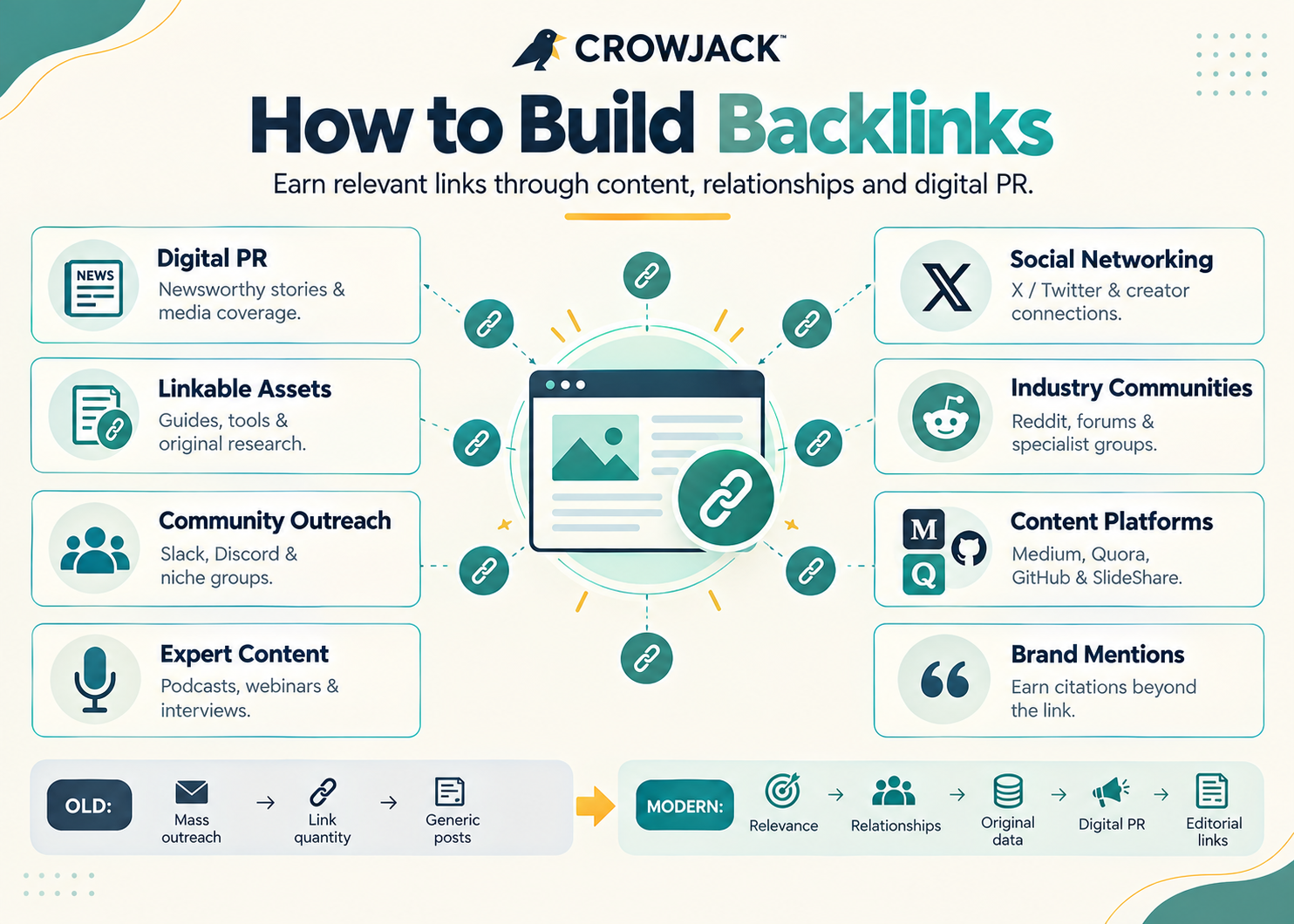
Backlinks have been part of the web since its earliest days, helping websites connect useful resources while giving search engines additional context about relevance, authority, and trust. But as search has evolved, so has link building. Modern SEO link building is no longer simply about collecting as many links as possible; it is about earning relevant references from credible websites, communities, and platforms that can strengthen a brand’s overall online presence.
Traditional backlink building often focused on do-follow links acquired through guest posting, directories, link exchanges, and cold email outreach. While these tactics can still have a place when used appropriately, relying on them alone is not a sustainable link building strategy. AI-generated spam has also made large-scale cold outreach increasingly difficult, with crowded inboxes making it harder for genuine requests to reach editors, publishers, and decision-makers.
Today, link building for SEO takes a broader approach. A strong SEO link building strategy can include editorial backlinks, relevant brand mentions, citations, no-follow links, community references, and other forms of online recognition. These signals can help search engines and AI-powered search systems understand a brand, its expertise, its relationships, and the sources that reference it. In this context, SEO links are not valuable simply because they pass traditional link equity; their relevance, context, source quality, and relationship to the brand also matter.
So, what is link building in SEO, and what is SEO link building in practice? At its core, it is the process of creating opportunities for other relevant websites and platforms to reference your content, products, research, expertise, or brand. Building backlinks is one part of that process, but modern linkbuilding also involves building relationships and creating content that people genuinely have a reason to reference.
This shift means that building links for SEO is increasingly connected with digital PR, expert participation, useful resources, industry communities, and genuine conversations. Rather than trying to manufacture links at scale, marketers can build links by contributing valuable insights on platforms such as LinkedIn, X, Reddit, Medium, Discord, and relevant industry communities. These activities can create opportunities for direct backlinks while also generating brand mentions, citations, and referral traffic.
The goal, therefore, is not simply to get backlinks, but to earn high quality backlinks and other relevant references from sources that make sense for your industry and audience. A smaller number of relevant, trustworthy references can be more meaningful than a large collection of unrelated links. When evaluating a backlink URL, for example, consider where it comes from, why the page is linking to you, whether the surrounding content is relevant, and whether the reference provides genuine value to users.
Modern link building strategies should also include competitor research. Using backlink tools, marketers can conduct a backlinks search, review a competitor's referring domains, identify useful backlink sites, and understand which types of content attract links within their industry. Learning how to find competitors' backlinks or how to find backlinks of a website can reveal opportunities for creating stronger resources, pursuing relevant publications, or identifying communities where industry conversations are already taking place.
Ultimately, link building in SEO has moved from a volume-focused activity toward a relationship- and relevance-driven process. Whether you call it link-building, link building SEO, SEO linkbuilding, or backlink building, the principle remains the same: create something worth referencing, participate where your audience and industry already have meaningful conversations, and earn relevant links and mentions naturally. The strongest approach combines quality content, credible relationships, useful web backlinks, and consistent brand visibility rather than relying on a single tactic or chasing every possible link.
Why You Need to Change Your Link-Building Strategy in 2026
SEO and AI search are evolving quickly, and so are the methods used to build links. A few years ago, cold email outreach was one of the most common link building strategies. SEO professionals would identify relevant websites, find contact details, and send outreach emails requesting guest posts, link placements, resource-page mentions, or collaborations. While outreach remains part of modern SEO link building, mass cold emailing has become less effective because of crowded inboxes, generic pitches, stricter spam controls, and growing resistance to unsolicited link requests.
At the same time, the role of backlinks has expanded. The old approach of simply collecting do-follow links is no longer enough for effective link building for SEO. A modern strategy can involve relevant editorial links, no-follow links, brand mentions, citations, and references across trusted websites and communities. The focus is increasingly on earning quality backlinks from sources that are relevant to your industry and audience rather than accumulating links without considering their context.
AI-powered search is also changing how online authority can be understood. Search engines and AI systems increasingly connect brands with relevant topics, entities, authors, trusted sources, and real-time conversations across the web. This makes it important to think beyond individual SEO links and consider how your brand is referenced across different platforms. A backlink can be valuable as part of a broader pattern of relevant mentions, useful resources, expert contributions, and credible third-party references.
So, modern backlink building is not about abandoning outreach; it is about moving beyond outdated mass-email tactics. Personalized outreach, relationship building, digital PR, community participation, expert contributions, and genuinely useful content can all create opportunities to get backlinks and strengthen brand visibility. The tactics below explain how to approach link building in SEO in 2026, while pairing these efforts with the right keyword research tools can help you identify topics worth creating and promoting based on what your audience is actually searching for.
Traditional cold email outreach was once a common way to build backlinks. SEO professionals could send hundreds of outreach emails to website owners, editors, and bloggers asking for guest posts, link placements, or content collaborations. But in 2026, this approach has become much less effective. Crowded inboxes, spam filters, automated outreach, generic pitches, and increasing skepticism toward unsolicited link requests make it harder to get meaningful responses.
That does not mean outreach is dead. It means the way you build relationships has changed. Instead of relying only on cold emails, you can now connect directly with content creators, SEO professionals, founders, journalists, editors, and website owners through platforms where REAL-TIME CONVERSATIONS are already happening.
Platforms such as Reddit, LinkedIn, X, Quora, industry-specific communities, forums, and relevant online groups can help you discover people, participate in discussions, build relationships, and identify genuine opportunities for mentions and editorial links. Not every conversation will result in a backlink, and it should not. The goal is to become visible and useful within the right communities so that your expertise and content can naturally become worth referencing.
If you are searching for “how to build backlinks” or “how to get backlinks,” these platforms give you practical places to start. The key is not to join every platform and promote your website. Choose platforms where your target audience and industry conversations already exist, contribute genuinely, and share your resources only when they directly add value to the discussion.
1. LinkedIn
LinkedIn is one of the most useful platforms for modern SEO link building, allowing you to identify content managers, SEO professionals, editors, founders, and other decision-makers who can create opportunities for relevant backlinks, brand mentions, collaborations, and industry relationships.
How to earn backlinks from LinkedIn:
Start by searching for people who are directly involved in backlink building and off-page SEO, rather than limiting your search to general content or marketing roles. Look for profiles such as:
- Backlink Specialists / Link Builders
- Off-Page SEO Specialists
- SEO Link-Building Specialists
- SEO Managers
- SEO Executives
- Digital PR Specialists
- Content Managers
- Content Editors
- Head of Content
- Marketing Managers
Filter these people according to your industry or niche. For example, if you work in eCommerce SEO, search for content managers working at eCommerce brands, SaaS companies, marketing agencies, and industry publications. If you work with a SaaS company, connecting with a saas link building agency can also help you identify relevant content opportunities and build relationships within your industry.
Don't immediately send a message asking for a backlink. First, check their recent activity. Look at the articles they publish, the topics they discuss, and the type of content they share. Engage with their posts for a few days by leaving useful comments or adding an original perspective.
After building some familiarity, send a personalized connection request. Once they accept, start a natural conversation around their content or your shared area of expertise. If you have original research, statistics, expert insights, tools, or a genuinely useful guide, introduce it as a resource rather than pitching it as "please give me a backlink."
You can also connect with other SEO professionals and content creators who regularly work with websites in your niche. These relationships can create opportunities for content collaboration, expert contributions, resource mentions, and relevant editorial references.
Example:
Suppose you have published original research on eCommerce conversion rates.
You find a Head of Content at an eCommerce publication on LinkedIn. Instead of sending:
"Hi, can you give me a backlink? Or can we do link collaboration?"
You engage with their posts, discuss their content, and eventually mention your research when the topic naturally comes up.
If they are preparing an article about eCommerce conversion optimization, your original research could become a useful source they reference in the article.
X is particularly useful for link building and digital outreach, helping you discover journalists, writers, bloggers, SEO professionals, founders, and independent content creators who can provide opportunities for relevant SEO links, brand mentions, collaborations, and quality backlinks.
Many writers use X to find sources, discover statistics, promote their articles, and connect with experts.
How to earn backlinks from X:
Start by identifying people who regularly publish content in your niche.
Follow them and monitor what they post. Pay particular attention to posts where they:
- Ask for expert opinions
- Request statistics
- Ask for sources
- Share a new article
- Discuss a topic you have researched
- Ask questions related to your expertise
When you see an opportunity, respond publicly with something useful.
Don't immediately paste your URL.
Instead, provide the information first. If the person shows interest, you can continue the conversation through DMs and share the relevant resource.
This works particularly well when you have original research, surveys, case studies, statistics, or expert commentary.
Example:
Imagine a journalist posts:
"Looking for recent statistics about AI adoption in marketing."
If you have conducted original research on AI marketing adoption, you can reply with one relevant statistic and explain where the data came from.
If the journalist needs more information, you can then share the complete research. If they use your data in their article, your research may earn a citation and backlink.
3. Discord
Discord has become a valuable channel for link building and backlink building in industries such as technology, gaming, SaaS, development, design, Web3, and creator communities, where active discussions can create opportunities for relevant references, brand mentions, and quality backlinks.
The biggest mistake is joining a Discord server and immediately posting links.
Most communities consider this spam. To earn backlinks you should follow below steps:
How to earn backlinks from Discord:
First, find communities related to your niche. Look for servers that have channels such as:
- #marketing
- #seo
- #resources
- #networking
- #collaboration
- #content
- #partnerships
Join the relevant communities and spend time understanding how the members communicate.
Answer questions, participate in discussions, share useful insights, and help other members solve problems.
Over time, people begin to recognize your expertise. This creates opportunities for collaboration and content recommendations.
Discord is also useful for discovering website owners, creators, developers, and marketers who may have their own websites or communities outside Discord.
Example:
Suppose you work in technical SEO and join a SaaS-focused Discord community.
Someone asks how to diagnose JavaScript rendering problems.
You provide a detailed explanation and, if appropriate, share your technical SEO guide as an additional resource.
Another member may find the guide useful and later reference it in their website content or recommend it to their audience.
Example: Discord communities such as exotica backlink provide a place where SEO professionals, website owners, marketers, and content creators can interact in real-time, exchange ideas, discuss link-building opportunities, and build industry relationships.
4. Slack Communities
Slack communities can support modern SEO link building by connecting you with SEO professionals, content marketers, founders, publishers, and website owners who are already open to networking and collaboration. Relevant Slack groups may also offer dedicated channels for sharing resources, websites, partnerships, and content opportunities, creating natural opportunities to earn backlinks, brand mentions, and industry connections.
How to earn backlinks from Slack:
Start by finding Slack communities relevant to your niche. You can search on Google or LinkedIn using terms such as “Slack communities for backlinks,” “SEO Slack communities,” “link-building Slack groups,” “SEO networking Slack,” or “marketing Slack communities.” Once you join a relevant community, look for channels such as #introductions, #promotion, #collaboration, #marketing, #seo, #resources, or #networking where website sharing and professional collaboration are allowed.
Once you join, don't start promoting your website.
Instead:
- Introduce yourself properly.
- Follow relevant conversations.
- Answer questions.
- Share useful industry information.
- Participate in discussions.
- Identify people working on similar topics.
- Look for genuine collaboration opportunities.
After that, identify members who run websites or create content in your niche. Engage with their work and start a direct conversation about content collaboration, expert contributions, resource sharing, or relevant publishing opportunities.
Rather than immediately asking, “Can you give me a backlink?”, explain what your website covers and explore whether there is a relevant opportunity to collaborate.
Example:
Suppose you run an SEO website and join a professional SEO Slack community. You share your latest International SEO Guide in the appropriate resource channel. You then notice another member runs a marketing blog covering international SEO.
You can DM them, discuss the topic, and ask whether they are interested in collaborating on relevant content or including your guide as a resource where it genuinely fits.
This makes Slack useful not just for sharing your website, but for finding people who may have relevant backlink and content collaboration opportunities.
Example: freelinkexchange.slack.com — A community focused on link-exchange opportunities where SEO professionals can connect with other website owners and discuss potential link placements.
5. Digital PR
Digital PR is a powerful link building strategy for earning authoritative and high quality backlinks because it focuses on creating newsworthy, useful, or original content that publishers genuinely want to reference. Instead of directly requesting a link, you create stories, research, data, or insights that naturally attract backlinks, brand mentions, citations, and relevant SEO links from trusted sources.
How to earn backlinks through Digital PR
Start by identifying topics that are currently receiving attention in your industry. Then create a strong PR angle around your expertise, such as an industry trend, expert prediction, new study, unique statistic, or data-driven story.
You can then identify relevant journalists, publishers, and industry publications that regularly cover your topic. Reach out with a short, personalized pitch explaining why your story is relevant to their audience.
If a publisher uses your research, expert quote, or story, they may reference your website as the original source.
Example:
Suppose you publish a report titled “The State of AI Search for eCommerce Websites in 2026.” You find journalists writing about AI search and send them a few interesting findings from your research. If they use your statistics in their article, they can cite your original report and link back to it.
6. Podcasts & Webinars
Podcasts and webinars can create valuable SEO link-building opportunities while strengthening personal and brand authority. Many hosts and organizers publish dedicated episode or speaker pages that can naturally generate backlinks, brand mentions, citations, and relevant SEO links. Participating in industry-focused podcasts and webinars can therefore support both relationship building and long-term backlink building.
How to earn backlinks through Podcasts & Webinars
Find podcasts, webinars, online events, and industry shows relevant to your expertise. Look for hosts who regularly interview experts in your niche.
Instead of pitching yourself simply because you want a backlink, identify a topic where you can provide genuine expertise.
Once selected as a guest, provide useful insights, examples, statistics, or original research during the discussion. After the episode is published, the host may include your website, company profile, social profiles, or resources in the episode page.
You can also suggest useful resources from your website when they are genuinely relevant to the discussion.
Example:
If you are an SEO specialist, you could appear on a podcast discussing “How AI Search Is Changing SEO in 2026.” During the conversation, you discuss your original research on AI search and the host links to your research from the episode page.
7. Linkable Assets
A linkable asset is a valuable resource designed to naturally attract backlinks and SEO links because it offers original information, useful data, expert insights, or functionality that other websites find difficult to reproduce. These assets can support backlink building by giving publishers, bloggers, and industry sources a strong reason to reference your content.
Instead of creating content and then desperately looking for places to put its link, you create something that gives other publishers a reason to link to you.
How to earn backlinks with Linkable Assets
Start by identifying information that people in your industry frequently search for or reference.
You can create:
- Original statistics
- Industry reports
- Free tools and calculators
- Templates
- Checklists
- Detailed guides
- Visual resources
- Glossaries
- Research databases
- Case studies
Once published, find websites, journalists, bloggers, and creators already discussing the same subject.
Reach out to them and explain how your resource can add value to their existing content. You can also promote the asset through LinkedIn, X, communities, and relevant industry networks.
Example:
You create a Free International SEO Checklist covering hreflang, country targeting, localized content, technical SEO, and international keyword research.
A marketing agency writing about international SEO discovers your checklist and references it in its guide. You earn a relevant editorial backlink because your resource genuinely supports their content.
8. Original Research & Data
Original research is particularly valuable for backlink building because it provides fresh statistics, unique data, and credible insights that publishers can reference in their content. By producing reliable research, surveys, studies, or industry data, you can naturally earn high quality backlinks, citations, brand mentions, and relevant SEO links from websites looking for authoritative sources.
When you create your own data instead of repeating statistics that already exist online, your website can become the original source that other publishers reference.
How to earn backlinks through Original Research
Start with a question that your industry wants answered.
You can collect data through:
- Surveys
- Customer research
- Industry studies
- Website data
- Experiments
- Internal business data
- Market analysis
Turn the findings into a detailed report containing clear statistics, charts, insights, and methodology.
After publishing the research, identify journalists, bloggers, researchers, and content creators who cover the topic. Share the most interesting findings with them and explain that the complete data is available in your original report.
The key is to promote the findings, not simply ask for a backlink.
Example:
Suppose you survey 500 businesses about their use of AI search and discover that 68% have changed their content strategy because of AI-powered search.
You publish the methodology, findings, and complete data on your website. When journalists and SEO publications write about AI search trends, they can use your statistics as a source and link back to your original research.
The important difference
Linkable assets give people something worth linking to. Original research gives them data they need to cite. Digital PR gives them a story worth covering. Podcasts and webinars give you opportunities to build expertise and earn references.
Together, these tactics move your strategy away from asking for backlinks and toward creating reasons for people to link to you.
No-Follow Links: Why They Still Matter for SEO in 2026
Now that we have covered practical ways to build do-follow backlinks, it is important not to overlook no-follow links. In modern SEO link building, a no-follow link can still contribute to brand visibility, referral traffic, credibility, and online authority, even though it does not pass traditional link equity in the same way as a do-follow link.
No-follow links can also form part of a broader backlink strategy by helping search engines and AI-powered systems understand connections between brands, websites, people, topics, and trusted sources. Consistent mentions across relevant and authoritative platforms can strengthen your digital presence, even when those references do not include a traditional do-follow backlink.
For this reason, effective backlink building should not focus exclusively on do-follow links. A natural link profile can include do-follow and no-follow links alongside brand mentions, citations, and relevant references from authoritative websites and communities.
In the next section, we’ll explore practical platforms and link building strategies for earning no-follow links, generating brand mentions, and strengthening your online authority in the AI search era.
Now that we understand the role of no-follow links and brand mentions in modern SEO, let’s look at the platforms where you can practically build them and increase your brand’s visibility across the web.
1. Reddit
Reddit can be useful for building brand visibility, no-follow links, referral traffic, and authority, but it requires a different approach from traditional link building. Reddit communities have strict rules around self-promotion, and many subreddits remove posts or comments that exist primarily to promote a website.
How to build links and mentions on Reddit:
Start by finding subreddits where your target audience is already discussing topics related to your expertise. Before posting anything, read the community rules carefully. Check whether links are allowed, whether self-promotion is restricted, and whether the subreddit has specific promotional or contribution requirements.
Next, become a genuine contributor. Answer questions, participate in discussions, share practical experiences, and provide useful information without trying to insert your website into every conversation.
When a discussion directly relates to something you have published, only share your link if:
- The subreddit rules allow it.
- The content genuinely answers the question.
- You provide useful information in the comment itself.
- You are not repeatedly promoting the same website or page.
- The link is relevant rather than promotional.
A good approach is to give the answer first and use your link only as supporting material.
Example:
Someone asks:
“How can I implement hreflang for a website targeting five countries?”
Instead of replying:
“Here is my guide: [URL]”
Write a useful explanation covering the basic implementation, common mistakes, and validation process. Then, mention your brand name like I have read an article on “your website name” which helped me understand this.
This approach follows the core principle of Reddit link building: contribute to the conversation first; promote your content only when it genuinely adds value.
Also, don't create multiple accounts to promote your website, manipulate votes, repeatedly post the same links, or disguise promotional content as independent recommendations. Those tactics can damage your reputation and may violate subreddit or Reddit-wide rules.
2. Medium
Medium can help you create additional brand visibility while placing your expertise in front of another audience.
How to build links and mentions:
Don't simply copy your existing blog posts. Instead, create supporting or complementary content around your main topics.
For example, if your website has a complete guide about AI SEO, publish a Medium article discussing a specific part of the subject, such as “How AI Search Is Changing Content Discovery.”
Within the article, you can naturally reference your more comprehensive resource when it provides additional information.
You should also engage with relevant Medium writers and publications. Follow authors in your niche, contribute meaningful responses, and look for publications where your expertise fits.
Example:
You publish an article about AI search on Medium and discuss how entity authority is becoming more important. You then reference your detailed AI SEO guide for readers who want to explore the topic further.
3. Quora
Quora is particularly useful for building topic relevance and brand visibility because its questions are directly connected to what people want to know.
How to build links and mentions:
Search for questions related to your products, services, expertise, and content topics.
Choose questions where you can provide a genuinely useful answer. Write the complete answer first and then decide whether your website has a resource that adds further value.
Don't make every answer promotional. Build a history of useful contributions so that your profile becomes associated with your area of expertise.
Example:
Someone asks, “What is international SEO?”
You explain country targeting, language targeting, hreflang, localized content, and technical SEO. At the end, you can reference your complete international SEO guide as a deeper resource.
4. Industry Forums & Niche Communities
Forums can still be useful, particularly when they are highly relevant to your industry.
Instead of looking for general forums with thousands of random members, focus on communities where your potential customers, professionals, and industry experts actively discuss problems.
How to build links and mentions:
Search for forums using combinations such as:
- [your niche] forum
- [your industry] community
- [your topic] discussion forum
- [your product] user community
Create a profile, participate in discussions, answer questions, and share useful resources.
When someone asks a question that your content answers, reference your website naturally.
Example:
A SaaS community is discussing how to improve organic traffic. You contribute several practical SEO recommendations and reference a relevant case study from your website. Other members can visit the case study, discuss it, and potentially reference it elsewhere.
5. Product Hunt
If you have a tool, SaaS product, AI product, extension, or digital product, Product Hunt can be useful for generating brand visibility and product discovery.
How to build mentions:
Launch your product with a detailed description, useful visuals, and links to your website. Encourage genuine users and industry professionals to discuss the product rather than simply asking for promotional activity.
You can also participate in discussions around similar products and contribute useful insights.
Example:
You launch an AI-powered SEO tool on Product Hunt. Your product page introduces your company and links users to your website. People discovering the tool may discuss it on other websites, communities, newsletters, or social platforms, creating additional brand mentions.
6. GitHub
If your business works in technology, development, APIs, open-source software, AI, or developer tools, GitHub can be particularly valuable for building technical authority.
How to build links and mentions:
Create genuinely useful open-source resources, documentation, templates, scripts, datasets, or tools.
For example, if you create an SEO automation script, publish it on GitHub with proper documentation and reference your website for the complete guide or supporting resources.
Example:
You publish an open-source technical SEO auditing script on GitHub. Developers discover it, use it, and potentially reference your documentation or website when discussing the tool.
Presentation platforms can provide another way to distribute your expertise and create additional branded references.
Turn your existing research, guides, or reports into useful presentations instead of simply copying your blog content.
Example:
You have a detailed report about AI Search and SEO in 2026. You convert the key findings into a presentation and publish it on a presentation-sharing platform. The presentation references your original report, giving users another pathway to discover your website.
The Goal Is Not Just More Links
The purpose of these platforms is not to manufacture hundreds of no-follow backlinks. It is to make your brand, expertise, content, and resources visible in the places where your audience and industry actually interact.
Google itself notes that links can help users and search engines discover and understand relevant resources, while user-generated platforms such as forums commonly use nofollow or similar link annotations.
So, in 2026, think beyond “How many backlinks did I build?”
Instead, ask:
“How many relevant places are mentioning, discussing, referencing, and discovering my brand?”
That broader approach is what makes no-follow links and brand mentions valuable alongside your traditional do-follow backlink strategy.
Conclusion
Backlink building in 2026 is no longer about collecting as many links as possible. Backlinks still matter, but the way you earn and evaluate them has evolved. Traditional do-follow links remain an important part of SEO, while no-follow links, brand mentions, citations, and relevant references can contribute to visibility, credibility, referral traffic, and broader online authority.
A strong backlink strategy should therefore combine multiple approaches. Use LinkedIn, X, Discord, and Slack to build relationships and uncover relevant collaboration opportunities. Use Digital PR, original research, linkable assets, podcasts, and webinars to give authoritative websites genuine reasons to reference your content. Communities such as Reddit, Medium, Quora, forums, and industry platforms can also support brand visibility and generate relevant mentions and no-follow links.
Most importantly, modern SEO link building is not simply about asking for links. Create resources worth referencing, contribute valuable insights to relevant conversations, build genuine relationships, and make your brand visible across the platforms where your audience and industry already engage.
In the AI search era, effective backlink building is ultimately about more than any single link type. It is about developing a credible, relevant, and recognizable digital presence through quality content, trusted relationships, meaningful references, and consistent brand visibility. When these elements work together, your link-building efforts can support stronger SEO performance and help your brand remain discoverable across both traditional and AI-powered search.