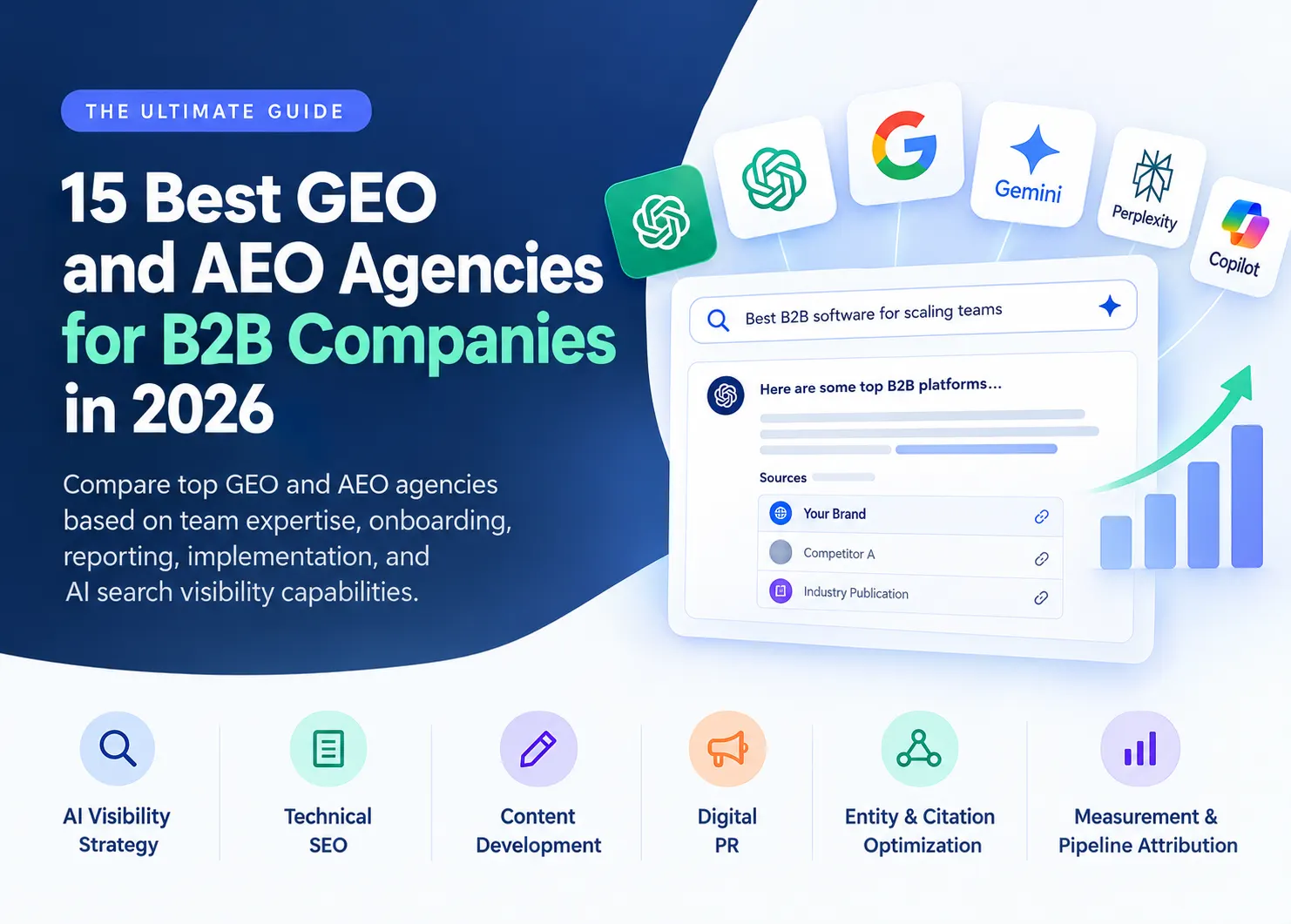
GEO went from buzzword to agency homepage headline almost overnight. Suddenly, every SEO firm claims it can get your brand recommended by ChatGPT, Gemini, Perplexity, and Google AI Overviews. Adding FAQ schema and tracking a few prompts doesn’t make an agency qualified to manage AI search.
B2B companies need more. Their buyers ask detailed questions about pricing, integrations, implementation, security, and competing products. A good agency knows how AI platforms retrieve those answers, which outside sources shape them, and how to tie citations to qualified pipelines.
We reviewed 15 agencies that meet that bar. Each profile covers the team, onboarding, reporting, and implementation, so you can compare them side by side and walk into sales calls with sharper questions.
NEWMEDIA takes a broader approach than most agencies on this list. Their team connects GEO and SEO with technical implementation, content, digital PR, analytics, development, and conversion work in one place.
They are best suited for B2B companies whose visibility problems go beyond copy, since they can work on the website itself and the acquisition journey in the same engagement.
Who you'll work with: Clients get a project or account manager supported by SEO specialists, content writers, analysts, designers, and developers. The team size depends on whether the engagement is marketing-only or includes wider website work.
Team structure: NEWMEDIA.COM runs a full-service model. Search, content, analytics, UX, and development sit under one account, so the client doesn't have to coordinate several vendors.
How onboarding works: Their SEO engagements typically start with a technical audit covering crawlability, indexation, architecture, speed, content, structured data, competitors, and conversion paths before they set priorities.
Reporting and communication: Clients get regular reporting through an account manager, and enterprise reporting can include rankings, site health, traffic, conversions, revenue attribution, and business-unit performance.
Who handles implementation: This is one of the more implementation-heavy options on the list. NEWMEDIA.COM can fix technical problems, update site architecture, write content, implement schema, improve Core Web Vitals, and support development work directly.
Best fit for this working style: B2B, SaaS, healthcare, ecommerce, and enterprise companies that need marketing and technical work handled together, especially when several parts of the website or funnel need attention at once.
Omniscient Digital
Omniscient Digital works with B2B software companies that need more than an AI visibility report. Their programs combine SEO, GEO, content production, digital PR, analytics, and technical work, and the agency connects organic performance back to conversions and pipeline.
Who you'll work with: Clients work with an account manager and senior specialists across SEO, content, technical search, analytics, and off-page authority. Their leadership team includes former HubSpot, Shopify, and Workato marketers.
Team structure: Omniscient Digital builds a team around the engagement rather than assigning one generalist. An account manager keeps things organized while specialists handle research, strategy, writing, technical SEO, and measurement.
How onboarding works: The opening phase covers research, goals, audience intelligence, competitive visibility, and strategy. Their team may review sales calls or talk to internal subject-matter experts before locking in the roadmap.
Reporting and communication: The agency tracks search performance alongside AI citations, conversions, and pipeline. Dashboards get built around whatever metrics the client's leadership team already looks at.
Who handles implementation: Omniscient Digital can write content and handle some CMS work directly. For deeper development changes, they work with the client's engineers and turn recommendations into prioritized tickets.
Best fit for this working style: B2B software companies that want an embedded organic growth team and are willing to support a real research phase upfront. This isn't the right pick for a company that wants a quick GEO audit with no follow-through.
B2BSEO.io
B2BSEO.io is a founder-led B2B SEO agency helping companies build visibility in Google and AI answer experiences. The agency’s GEO/AEO work starts with the questions buyers ask, the pages that should answer them, and the signals that help people and answer engines understand a brand.
The aim is to turn that visibility into a stronger path to qualified demand.
Who you’ll work with: You’ll work directly with founder Ashot Nanayan on strategy and key decisions. He gets close to the details that shape a B2B search campaign: what you sell, who evaluates it, how long the sales cycle runs, and what makes a lead worth pursuing.
Team structure: B2BSEO.io has a small, hands-on core team. Ashot leads strategy and stays involved in the work. The people involved can vary with the scope, while strategy stays close to the founder.
How onboarding works: Onboarding begins with the business: your offer, target accounts, markets, sales process, and definition of a qualified lead. The team then reviews your website, search data, content, technical setup, and existing authority.
From there, you agree on priorities and a practical 90-day action plan, so everyone knows what’s being worked on and why.
Reporting and communication: Updates cover the work completed, changes in search visibility, and the next priorities. Depending on your tracking setup, reporting can also include organic traffic and lead activity, alongside page performance, outreach, and technical progress.
Who handles implementation: B2BSEO.io can handle agreed SEO work such as on-page improvements, content planning, internal linking, outreach, and link-building.
Best fit for this working style: B2BSEO.io suits B2B companies that want senior involvement, clear priorities, and a close working relationship with the person leading their SEO. It can work especially well for SaaS, industrial, healthcare, fintech, and B2B service firms that want one strategy connecting traditional search with their visibility in AI answer experiences.
iPullRank
iPullRank’s team covers technical SEO, content engineering, audience research, digital PR, information retrieval, and GEO. The agency calls this broader discipline "Relevance Engineering," which sounds academic, but the goal is simple: help complex brands become retrievable, understandable, and recommendable across search systems.
Who you'll work with: Clients get an account or client-services lead plus specialists in SEO, data analytics, content strategy, audience research, engineering, and AI search. Senior leadership can join enterprise strategy work when needed.
Team structure: The agency brings several technical and creative disciplines into one program, with experienced operations, account management, SEO, data, and content leaders rather than one generalist handling everything.
How onboarding works: iPullRank asks for audience data, customer research, analytics access, technical context, and internal business information upfront, then assesses current visibility and builds a roadmap around the company's AI-search maturity.
Reporting and communication: Monthly reporting covers performance trends and implementation impact. Larger programs can include executive reporting tied to revenue, with different views for technical teams and leadership.
Who handles implementation: Their team handles research, strategy, content engineering, and parts of execution, plus detailed implementation plans for internal engineers. Worth writing ownership into the scope, since enterprise technical work often ends up shared between both sides.
Best fit for this working style: Enterprise B2B companies with complicated websites, strict approval processes, several business units, or real technical debt. Smaller companies may find the operating model heavier than they need.
Siege Media treats GEO as the whole citation ecosystem, not a formatting exercise. Their team combines SEO content, digital PR, affiliate placements, Reddit, design, and publisher outreach, working both the owned content and the outside sources AI systems pull from when they validate a recommendation.
Who you'll work with: Clients get an account manager supported by content strategists, writers, designers, digital PR specialists, and outreach teams, plus a dedicated GEO measurement function.
Team structure: Siege Media organizes delivery around content and authority building. Strategy, production, design, promotion, community work, and affiliate relationships all feed the same roadmap.
How onboarding works: The first one or two months cover market analysis, prompt-level citation mapping, content freshness, a starting share-of-voice number, and roadmap development. Execution ramps up during months two through four.
Reporting and communication: From month four on, they report monthly on citations, LLM share of voice, AI referral traffic, branded search, organic KPIs, and revenue, with quarterly reviews to revisit the roadmap.
Who handles implementation: Their team owns content creation, design, digital PR, outreach, Reddit, and most on-page changes. Clients will still need their own development team for platform-level technical work.
Best fit for this working style: SaaS, fintech, ecommerce, cybersecurity, education, and travel brands that already invest in content and want to build third-party citation authority.
Directive
Directive builds GEO and AEO programs specifically for B2B companies, covering AI citations, semantic content, schema, long-tail queries, technical structure, and measurement.
They also place AI visibility inside a wider customer-generation program, which helps when a client needs search work connected to demand generation, analytics, paid media, and revenue operations.
Who you'll work with: A senior account strategist usually leads the relationship, with SEO, content, GEO, analytics, paid media, and revenue-operations specialists joining based on scope.
Team structure: Directive runs a cross-functional model for B2B accounts, where the strategist coordinates specialist teams instead of trying to cover search, content, analytics, and conversion work solo.
How onboarding works: The agency needs access to the company's website, analytics, content, product positioning, and revenue data first, then maps the questions buyers ask and the pages or entities AI systems might retrieve.
Reporting and communication: Reporting runs through custom dashboards. Clients should expect visibility into AI engagement and citations alongside traditional search and business outcomes like demos, opportunities, and pipeline.
Who handles implementation: Directive can execute content and many search optimizations directly. Development-heavy changes may need the client's own engineers unless website development is part of the agreed scope.
Best fit for this working style: B2B SaaS and technology companies that want GEO connected to demand generation and revenue measurement. Directive isn't the right pick for a team that just wants a small content refresh.
Animalz
Animalz is still a content-first agency, but their work now covers SEO and AEO for B2B SaaS and technology companies too. Their real strength is pulling useful ideas out of internal experts and turning them into content people trust.
They aren't the agency to call for a crawl-budget emergency, but they're worth a look once generic content has stopped working.
Who you'll work with: Clients work with content strategists, editors, writers, and account leads, and the team may talk directly to people in product, sales, support, and leadership when a topic needs first-hand knowledge.
Team structure: Animals can function like an external content department, with strategy, production, editing, optimization, and performance monitoring all inside the same relationship instead of split across freelancers.
How onboarding works: Onboarding is deliberately thorough. It can include a questionnaire, calls, a strategy presentation, audience research, and deeper conversations about the product and market before the publishing calendar starts.
Reporting and communication: The agency monitors content performance and uses it to adjust strategy. Their public material talks about traffic, rankings, sign-ups, and conversions, so it's worth confirming upfront which AI visibility metrics show up in your reports.
Who handles implementation: Animalz handles research, writing, editing, content updates, and some AI-content workflows. Clients stay responsible for major CMS, schema, rendering, and engineering changes.
Best fit for this working style: B2B SaaS companies with internal experts but limited editorial bandwidth. Works best when the client is willing to share knowledge and review drafts instead of expecting the agency to know a technical category cold with no access.
Graphite
Graphite is a research-driven growth agency with a serious SEO and AEO practice. Their team studies how AI systems retrieve information instead of repeating industry assumptions.
Who you'll work with: Clients work with SEO and AEO growth leads supported by editorial specialists, data professionals, and technical experts. Graphite's research group includes a chief AI officer and senior data specialists.
Team structure: The agency reports more than 120 people across over 15 countries. Account, editorial, research, and technical functions all support the engagement rather than one strategist producing everything.
How onboarding works: Graphite doesn't publish a fixed onboarding calendar, but their early work centers on opportunity research, technical review, content gaps where they're real, AI visibility, and the metrics that connect search activity to revenue.
Reporting and communication: Their reporting focuses on qualified sessions, brand growth, pipeline, and AI-influenced conversions. Graphite also recommends self-reported attribution, since standard last-touch analytics miss a lot of conversions influenced by LLMs.
Who handles implementation: Content support ranges from URL-level recommendations to full writing. Graphite gives technical guidance, but the client's engineering team usually implements schema, architecture, Core Web Vitals, and other development changes.
Best fit for this working style: B2B technology companies with internal marketing and engineering resources that view organic growth as a long-term program.
Go Fish Digital
Go Fish Digital treats GEO as semantic content, entity authority, technical SEO, structured data, digital PR, and brand citations combined. That's the right level of breadth, since AI systems form answers from multiple sources, not just a company's own website.
Who you'll work with: Their public GEO page doesn't lay out the account structure in detail. Clients can expect access to strategists and specialists across SEO, content, digital PR, analytics, and reputation management.
Team structure: Go Fish Digital runs a cross-functional service model. Enterprise projects may pull in product teams, engineers, editorial teams, UX people, and agency specialists working the same priorities.
How onboarding works: Work starts with an audit of current AI visibility and the brand's wider semantic footprint, then moves into content, entities, structured data, third-party citations, competitors, and conversion paths.
Reporting and communication: Public pages mention analytics, visibility, citations, and conversions, but there's no stated standard reporting cadence for GEO work. Worth confirming the meeting schedule and dashboard access before signing.
Who handles implementation: Their team can execute content, on-page optimization, digital PR, and off-site authority work.
Best fit for this working style: B2B and enterprise brands that need owned content, technical SEO, digital PR, and reputation work coordinated in one program, particularly useful when inaccurate third-party information is affecting AI answers.
Foundation Marketing
Foundation Marketing focuses on B2B SaaS and technology companies, and their GEO work goes beyond owned content into Reddit, YouTube, LinkedIn, earned media, digital PR, and technical search. They work to influence the sources that shape the shortlist before a buyer ever requests a demo.
Who you'll work with: Clients may work with a strategy manager and specialists in GEO, content, technical SEO, distribution, Reddit, YouTube, social media, and earned media.
Team structure: Strategy managers provide senior oversight while channel specialists handle execution, so one account lead isn't expected to write, optimize, distribute, and measure every piece alone.
How onboarding works: The public process starts with research and content analysis, reviewing existing visibility, audience intent, competitors, content quality, off-site sources, and whatever's keeping AI platforms from recognizing the brand.
Reporting and communication: Foundation Marketing tracks AI visibility, citations, sentiment, and the business effect of GEO activity. Attribution won't always be clean, so expect a mix of platform data, referral traffic, CRM evidence, and directional signals.
Who handles implementation: Their team develops and implements content, distribution, earned-media, and GEO strategy. Clients may still need internal developers for complex technical changes unless implementation is written into the scope.
Best fit for this working style: B2B SaaS and technology companies with useful expertise but no distribution engine to make that expertise visible across AI search and third-party sources.
NoGood
NoGood treats AEO as part of a wider growth system, covering prompt research, content, technical infrastructure, digital PR, citations, social authority, monitoring, and conversion measurement. The agency also runs Goodie AI for visibility tracking.
Who you'll work with: NoGood builds a custom growth squad for each account, which may include a growth lead, AEO strategist, AI search engineer, content specialist, analyst, creative professional, and channel experts.
Team structure: The agency doesn't force every client into the same department structure. Squads form around the growth problem and can expand past AEO when another channel affects performance.
How onboarding works: Their team audits existing content, organic performance, brand authority, technical infrastructure, and visibility across the major AI systems.
Reporting and communication: Goodie AI supports prompt monitoring, citations, traffic, and conversion tracking. The squad model can also connect AEO activity to the analytics and revenue metrics used across other marketing channels.
Who handles implementation: NoGood provides end-to-end AEO across content, earned media, digital PR, technical optimization, copy changes, and monitoring. Complex website development may still need coordination with the client's engineering team.
Best fit for this working style: Startups, scaleups, and enterprise brands that want AEO inside a wider growth engagement. A company looking for a narrow technical audit may end up paying for more than it needs.
Webcazador
Webcazador is a full-service digital agency covering SEO, AEO, GEO, content, outreach, reputation management, paid media, and development, working across several industries rather than B2B alone.
The broader service range could help smaller companies that want one partner, but ask for GEO work examples rather than general SEO claims before signing.
Who you'll work with: Webcazador describes a team of marketers, content creators, analysts, designers, and developers. Their public site doesn't clearly state which senior person owns a GEO account after the sale.
Team structure: The agency combines marketing and development services in one engagement, which should cut down on handoffs when content or technical recommendations require website changes.
How onboarding works: Their stated process starts by learning the business, audience, goals, and market, then builds a strategy and refines the work through ongoing analysis.
Reporting and communication: Webcazador promotes transparent reporting across rankings, traffic, backlinks, conversions, and campaign progress, though there's no published standard meeting or reporting cadence for GEO clients.
Who handles implementation: Their in-house marketing and development capabilities suggest they can execute content and website changes. Worth asking for a written responsibility matrix before work starts regardless.
Best fit for this working style: Small and mid-sized B2B companies that prefer one vendor for search, content, development, and wider digital marketing. Enterprise buyers should look closely at team seniority and relevant GEO work before signing.
NP Digital
NP Digital brings enterprise scale to GEO and AEO, covering entity optimization, technical foundations, content, authority signals, digital PR, prompt visibility, and conversion measurement.
Who you'll work with: Clients work with an account team supported by SEO, content, analytics, digital PR, and technical specialists. The roster depends on the market, service mix, and size of the engagement.
Team structure: NP Digital operates as a large global agency, giving clients access to specialist departments and international resources. Worth confirming which named people stay involved after onboarding.
How onboarding works: The agency starts with an audit of how the brand appears across ChatGPT, Gemini, Perplexity, and Google's AI experiences, plus content gaps, technical SEO, backlinks, and brand mentions.
Reporting and communication: Ongoing reporting shows where visibility is improving, where competitors are gaining ground, and how platform changes affect performance, with content, technical, and digital PR tactics adjusted from there.
Who handles implementation: NP Digital can execute content, earned-media, and optimization work directly. Development ownership depends on scope and the client's tech environment, so get this written into the proposal.
Best fit for this working style: Enterprise and global B2B companies that need AI search connected to a larger marketing operation. Smaller firms may find the team structure heavier than necessary.
Ten Speed
Ten Speed is a B2B organic growth agency that runs SEO and AEO as one program, connecting technical SEO, content, original research, digital PR, and AI visibility.
They understand that B2B buyers ask about pricing, implementation, integrations, and alternatives before ever contacting sales, so their content strategy reaches past high-volume informational keywords.
Who you'll work with: Clients get an account manager and work with strategists, writers, editors, SEO specialists, and digital PR professionals.
Team structure: Account management keeps the relationship organized while organic growth specialists handle research and execution. Founder Nate Turner has more than 12 years of SEO experience and previously helped grow Sprout Social from zero to $100 million in revenue.
How onboarding works: Ten Speed runs a deep product and audience onboarding process, gathering information from leadership, sales, marketing, and subject-matter experts into a living source-of-truth document for future content.
Reporting and communication: Their reporting splits into weekly health checks, monthly performance reviews, and quarterly ROI discussions. AEO reporting can include citation share, AI referral traffic, and pipeline influence.
Who handles implementation: Ten Speed handles strategy, content production, optimization, digital PR, and parts of technical SEO. Code-heavy recommendations may still need the client's own developers.
Best fit for this working style: B2B SaaS, fintech, cybersecurity, healthcare technology, and professional-services companies with lean internal teams.
Intero Digital
Intero Digital combines GEO with technical SEO, content, digital PR, analytics, development, paid media, and creative work. Their GEO service covers AI visibility audits, entity strengthening, structured data, content retrievability, citation building, and ongoing measurements.
Who you'll work with: An account team leads the relationship, with technical SEO specialists, content strategists, digital PR professionals, analysts, and developers joining based on scope.
Team structure: Intero Digital runs an integrated delivery model, where SEO, GEO, content, PR, creative, paid media, and development teams work off one client strategy instead of operating as separate agencies.
How onboarding works: Their GEO process starts with a diagnostic across ChatGPT, Gemini, Perplexity, Copilot, and Google's AI experiences, identifying competitors, trusted sources, content gaps, entity weaknesses, and technical barriers.
Reporting and communication: Clients get reporting on AI visibility growth, competitor movement, referrals, engagement, and traditional search performance.
Who handles implementation: Intero Digital can implement technical SEO, schema, content, digital PR, and website changes directly, which cuts out one of the most common delays in agency relationships: recommendations sitting in an internal dev queue.
Best fit for this working style: Mid-market and enterprise B2B companies that need GEO execution across several channels.
When Is It Time to Hire a GEO/AEO Agency?
The best time to hire is when AI search starts affecting your pipeline and your team can’t fix it fast enough on its own. We look for a few signals:
- Competitors get named in AI answers for your core buying questions, and you don’t.
- Organic traffic looks healthy, but demo requests and pipeline have stalled.
- AI platforms describe your product with outdated or wrong information.
- Your team has no one who can handle technical SEO, schema, and content work together.
- A site rebuild, rebrand, or product launch is coming, and you want search handled from day one.
Hiring too early can waste budget. If your positioning is still shifting or your site has basic crawl and indexing problems, fix those first. Most GEO work builds on a solid SEO foundation, and an agency can’t do much with pages Google can’t read.
Agency, Consultant, or In-House Team: Which Is Right for You?
Each option works well in the right situation. The choice comes down to budget, speed, and how much of the work your team can own.
When an Agency Makes Sense
An agency gives you a full team under one contract: strategy, content, technical SEO, digital PR, and reporting. This fits companies that need execution, not just advice, and want results within months instead of waiting to hire.
The trade-off is cost, and the quality of your experience depends on which people get assigned to your account.
When a Consultant Makes Sense
A consultant gives you senior thinking at a lower price. This works when you already have writers and developers and need someone to set the direction, audit your visibility, and review the work. The limit is capacity. A consultant can guide the plan, but you or your team still have to carry it out.
When an In-House Team Makes Sense
An in-house team gives you full control and deep product knowledge. It pays off once AI search is a long-term priority and you can fund several roles, since one hire rarely covers strategy, content, technical work, and PR. Hiring takes time, and a new team needs months to get moving.
How to Narrow Down Your Options
First, match the agency to your business. A company with a technical product and a long sales cycle needs a team that has worked in that kind of market. Check their case studies for clients similar to you in size, industry, and buyer type.
Second, look at who does the work. Ask which senior people will stay on your account after the sale, and how much of the work goes to junior staff or outside freelancers.
Third, test their AI search knowledge. Ask how they track citations, brand mentions, and referral traffic across ChatGPT, Gemini, Perplexity, and Google’s AI experiences. Walk away from anyone who guarantees AI visibility, because no agency controls what these platforms say.
Finally, check how they tie results to revenue. Rankings and citations matter, but the agency should also connect that work to leads, demos, and pipeline.
What to Agree on Before Work Begins
A clear written agreement prevents most disputes later. Before you sign, get these points on paper:
- Scope and deliverables: What the agency will produce each month, such as pages, articles, audits, and outreach.
- Who does the work: Named team members, their roles, and how often you will meet with them.
- Implementation ownership: Who makes changes to your site, including schema, redirects, and page speed fixes, and what happens if your developers are slow to respond.
- Reporting schedule: How often you get reports, what they include, and whether you have direct access to the dashboards.
- Contract terms: The minimum commitment, the notice period, and what you keep if the relationship ends.
Read More Blogs On: