Ranking on Google has become increasingly competitive. Broad search terms often have high search volume, but they are usually dominated by authoritative websites that have spent years building their online presence. For newer websites and growing businesses, competing for these terms can be challenging.
At the same time, search behavior is evolving in 2026. With the rise of AI-powered search experiences such as Google's AI Overviews and AI search assistants, users are asking more detailed, conversational questions rather than typing short keywords. Instead of searching for "SEO tools," users may search for "what are the best SEO tools for a small business with a limited budget?" This shift has increased the importance of targeting specific search queries that closely match user intent.
This is where long-tail keywords become valuable. So, the first question that comes is, what are long-tail keywords? They are highly specific search phrases, typically containing three or more words, that target a particular search intent. Unlike broad or head keywords, long-tail terms focus on what users are actually searching for, making them an important part of any SEO strategy.
For example:
- Short-tail keyword: SEO tools
- Long-tail keyword: best SEO tools for small businesses, free SEO tools for keyword research
As these searches are more specific, they often attract users who are closer to taking action, whether that's making a purchase, requesting a service, or finding a solution to a problem.
Long-tail keywords have become even more important in the age of AI search. AI systems rely heavily on context and intent to generate answers, making detailed and topic-focused content more likely to appear in AI-generated responses, AI Overviews, and conversational search results. By targeting long-tail queries, websites can improve both traditional search rankings and their chances of being cited in AI-driven search experiences. Much like a strong backlink profile improves your standing in traditional search.
Understanding what is a long tail keyword in SEO is essential since these search terms can help you attract targeted traffic, improve conversions, and build topical authority within your niche. While a single long-tail keyword may generate less traffic than a broad term, the combined impact of multiple SEO long-tail keywords can significantly increase your organic visibility and using reliable keyword research tools makes it much easier to uncover these opportunities.
In this guide, you'll learn how to find long tail keywords, identify valuable opportunities, evaluate keyword competition, and use them effectively to grow your search traffic. Whether you're a blogger, marketer, business owner, or SEO professional, you'll discover practical methods for finding keywords that align with your audience's needs and search behavior in both traditional and AI-powered search environments.
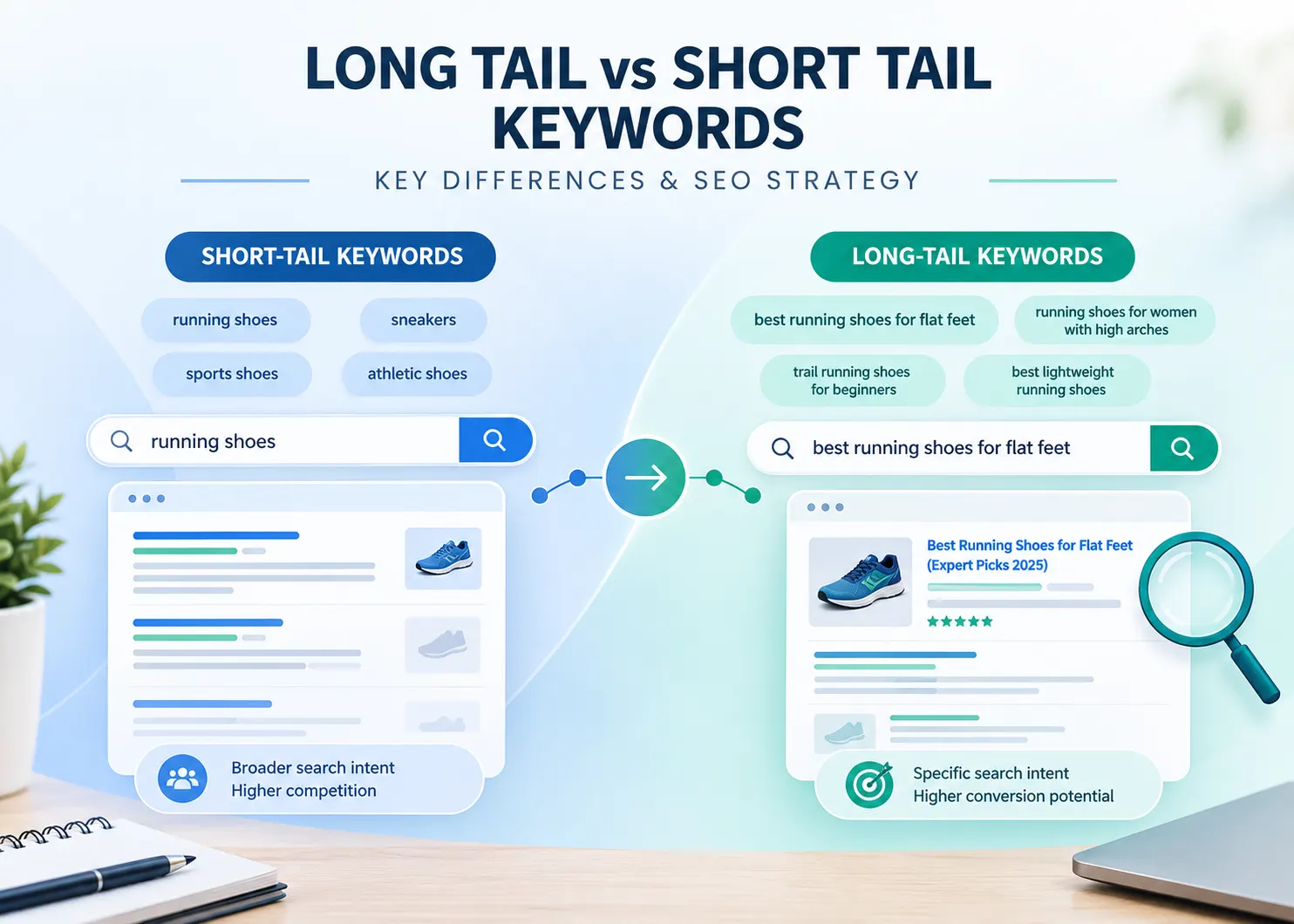
A. Long Tail Keywords vs. Short Tail Keywords
As already discussed in the previous blog on what are long-tail keywords, it is also important to understand the difference between long-tail and short-tail keywords. One of the easiest ways to grasp the concept is to compare them side by side. This distinction has become even more important with the rise of AI-powered search experiences and Google's AI Overviews, which increasingly prioritize content that answers specific, intent-driven queries. While short-tail keywords help target broad topics, long-tail keywords align more closely with the detailed and conversational searches users perform today, making them valuable for both traditional SEO and AI search visibility. You can see this play out in these long-tail keyword examples across different industries.
Factor | Short-Tail Keywords | Long-Tail Keywords |
Length | 1–2 words | 3+ words |
Search Volume | High | Lower |
Competition | High | Lower |
Search Intent | Broad | Specific |
Conversion Potential | Moderate | High |
Example | Running Shoes | Best running shoes for flat feet |
This comparison highlights the key difference between long tail vs short tail keywords. While short-tail terms attract a larger audience, long-tail phrases often generate more qualified traffic because they match a specific search need.
B. Search Volume and Search Intent: Understanding the Search Demand Curve
A common misconception in SEO is that the best keywords are always the ones with the highest search volume. In reality, search demand is distributed across millions of different queries, and most searches happen in the long tail.
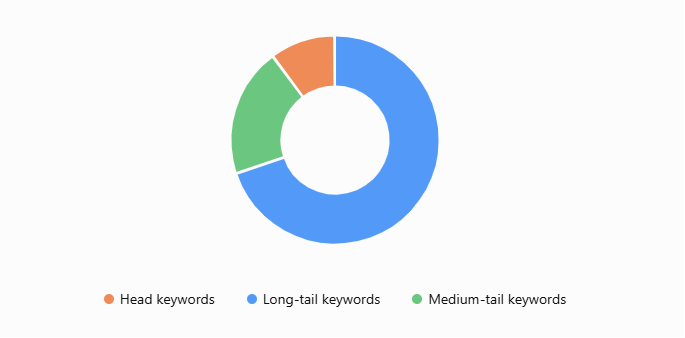
This pattern is known as the search demand curve. At the "head" of the curve are a small number of broad keywords that receive thousands or even millions of searches every month. Examples include terms such as "SEO," "insurance," or "laptop."
As you move further along the curve, search volume decreases, but the number of keyword variations increases dramatically. Queries such as "best laptop for architecture students under $1,000" or "SEO checklist for local businesses" may receive fewer searches individually, yet collectively they represent a significant share of total search demand.
This trend has become even more pronounced with the growth of AI-powered search experiences. Users are increasingly searching with detailed, conversational queries that resemble natural language questions. Instead of searching for "laptop," they may ask, "What is the best laptop for architecture students who need 3D rendering software?" These highly specific searches often fall into the long-tail category and provide clearer signals about user intent.
According to Ahrefs, the vast majority of search queries receive relatively low monthly search volumes. This means that relying solely on popular head keywords can cause you to overlook thousands of valuable opportunities hidden within long-tail keywords.
Additionally, Google's AI Overviews and other AI search engines like ChatGPT, Claude, and others are designed to understand context and intent rather than simply matching exact keywords. As a result, content optimized around relevant long-tail topics is often better positioned to appear in AI-generated answers because it addresses specific user questions in greater depth.
The key takeaway is simple: don't judge a keyword only by its search volume. A keyword with 50 monthly searches may be more valuable than one with 5,000 if it closely matches your audience's needs. When conducting long-tail keyword research, look for topics that demonstrate clear intent, relevance, and topical depth rather than chasing volume alone. This approach can improve your visibility in both traditional search results and emerging AI-driven search experiences.
Fig: Illustrative view of how search demand is distributed across head, medium-tail, and long-tail keywords.
C. Top 7 Proven Methods to Find Long-Tail Keywords
Now that you understand what long-tail keywords are and why they matter, let's explore practical ways to find them. The following methods can help you discover keyword opportunities with strong intent, lower competition, and real ranking potential.
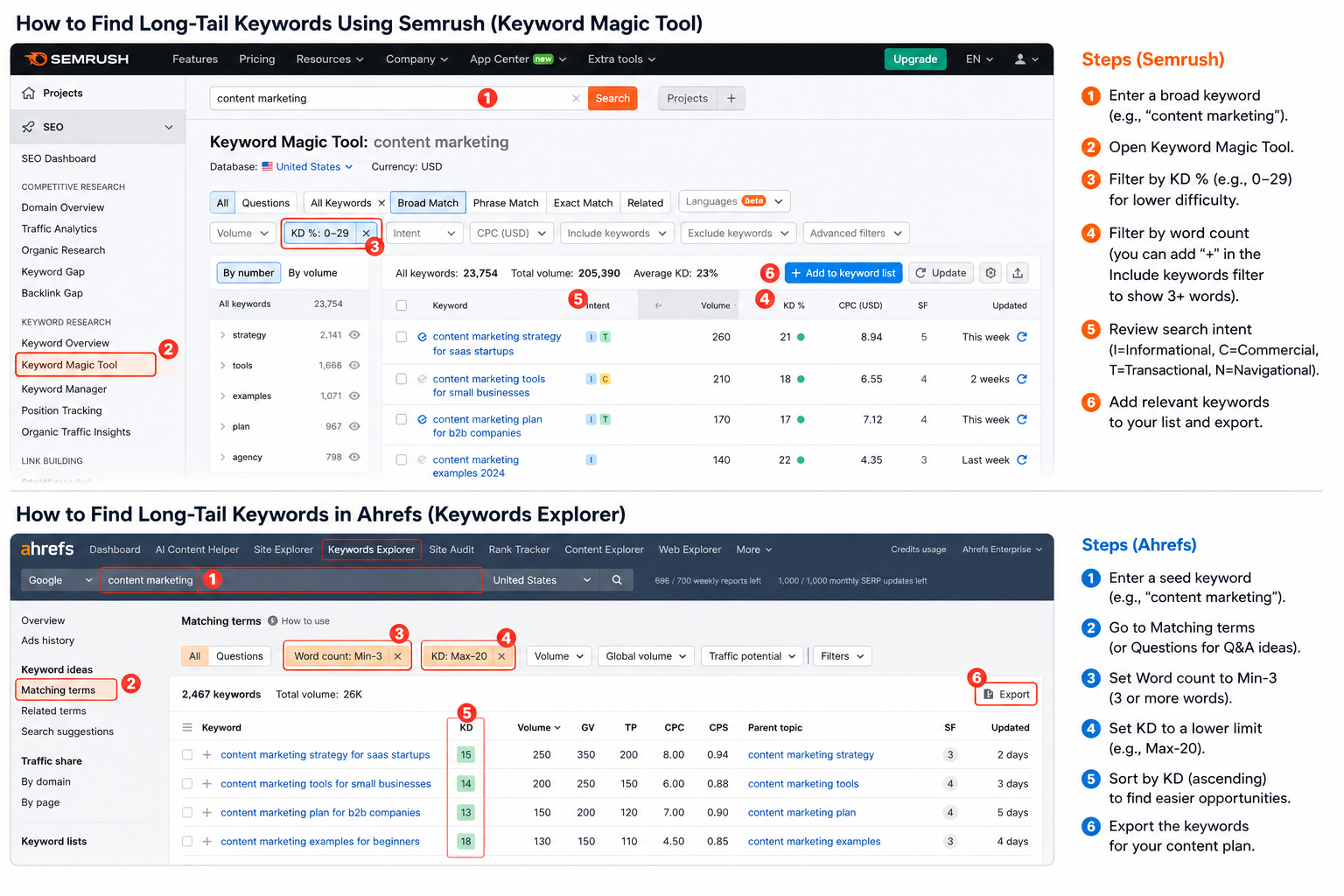
Professional SEO platforms are among the fastest ways to find long-tail keywords at scale. Tools such as Semrush and Ahrefs provide valuable data, including search volume, keyword difficulty, search intent, traffic potential, and related keyword suggestions. They can also help identify question-based and conversational queries that are increasingly important in AI-powered search experiences and Google's AI Overviews. If you're wondering how to find the best long-tail keywords, these tools should be one of your first resources, as they reveal both traditional search opportunities and emerging AI search trends that align with user intent.
How to find long tail keywords using Semrush
- Open the Keyword Magic Tool in Semrush.
- Enter a broad keyword, such as "content marketing."
- Click Search to generate keyword ideas.
- Apply a word count filter (3–4+ words).
- Sort keywords by lower Keyword Difficulty (KD).
- Review search intent and search volume.
- Save relevant keywords to your keyword list.
For example, instead of targeting "content marketing," Semrush may reveal opportunities such as:
- Content marketing strategy for SaaS startups
- Content marketing tools for small businesses
- Content marketing plan for B2B companies
In addition to traditional keyword metrics, pay attention to Semrush's question-based keyword suggestions and related search terms. These often reflect the conversational queries people use in AI-powered search engines and Google's AI Overviews. Targeting such phrases can help your content answer specific user questions, increasing its chances of appearing in both organic search results and AI-generated summaries.
How to find long tail keywords in Ahrefs
For those searching for how to find long tail keywords Ahrefs, the process is equally straightforward:
- Open Keywords Explorer in Ahrefs.
- Enter a seed keyword related to your niche.
- Navigate to the Matching Terms or Questions report.
- Filter keywords by word count (3+ words).
- Set a maximum Keyword Difficulty score to uncover easier opportunities.
- Analyze the SERP overview to assess competition.
- Export the most relevant keywords for content planning.
The Questions report in Ahrefs is particularly useful for discovering AI-friendly long-tail keywords. Since users increasingly interact with search engines using complete questions and natural language prompts, these keywords can reveal valuable content opportunities that align with modern search behavior and AI-driven search experiences.
A useful tip is to focus on long-tail keywords with low competition rather than simply choosing the highest-volume terms. Keywords with moderate search volume and lower difficulty often provide a better chance of ranking, especially for newer websites. They also tend to match the detailed, intent-driven queries commonly used in AI search platforms.
By combining search volume, keyword difficulty, search intent, question-based queries, and topical relevance, Semrush and Ahrefs make it easier to conduct long-tail keyword research, discover high-quality keywords, and identify opportunities that can drive targeted organic traffic. This approach can improve your visibility in traditional search results while also increasing your chances of being featured in AI Overviews and other AI-generated search experiences.
If you're looking for a free way to find long-tail keywords, Google remains one of the most valuable resources. Features like Google Autocomplete and Related Searches reveal real user search patterns, including the conversational and question-based queries that are increasingly common in AI-powered search experiences and Google's AI Overviews.
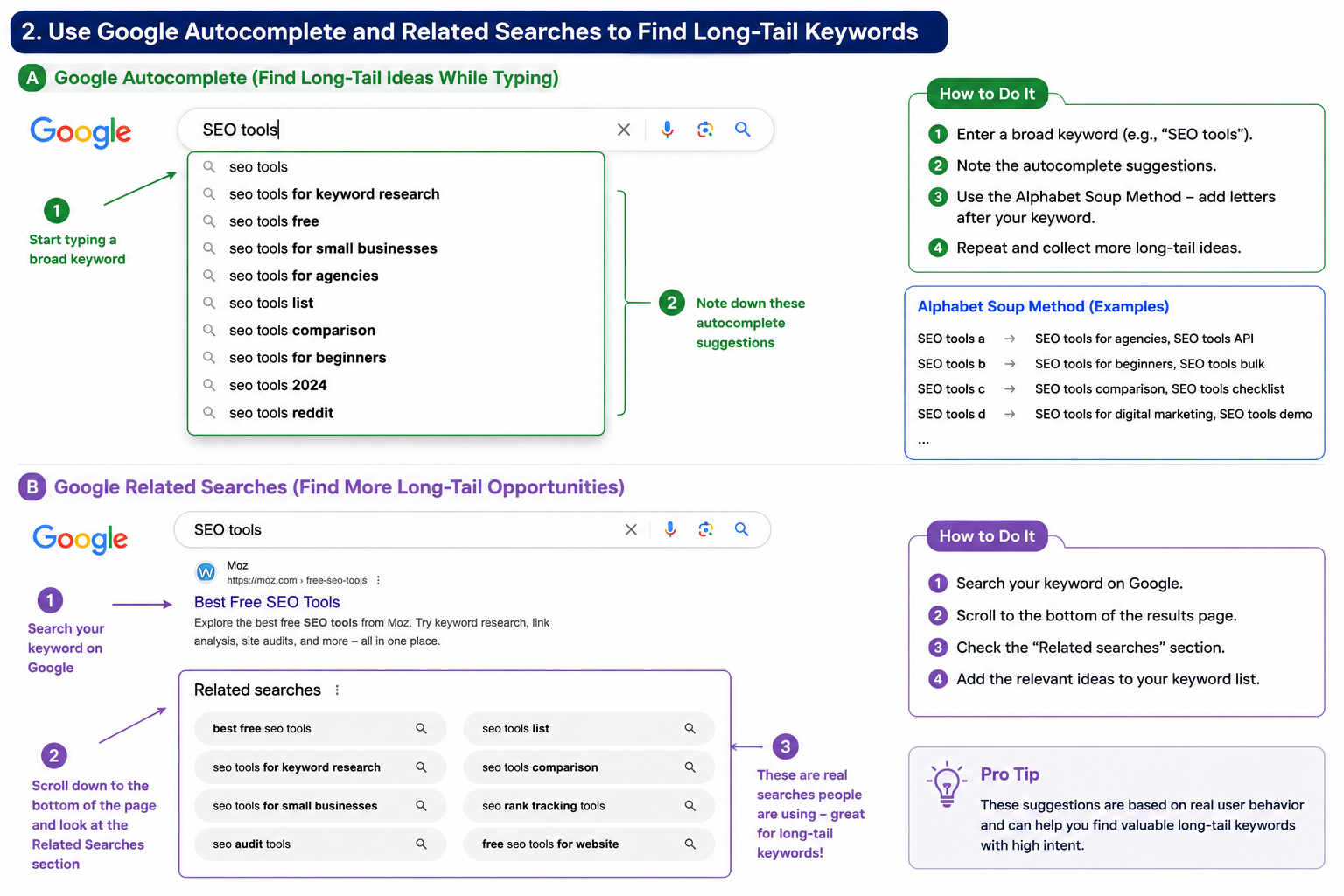
How to find long tail keywords using Google Autocomplete
Google Autocomplete is one of the easiest ways to discover long-tail keyword opportunities for free. The suggestions that appear in the search bar are based on real user searches, making them valuable for identifying topics your audience is actively interested in. These suggestions can also reveal conversational queries that align with modern AI-powered search behavior and Google's AI Overviews.
Follow these steps:
- Open Google Search.
- Enter a broad keyword related to your niche, such as "SEO tools."
- Review the keyword suggestions that appear in the Autocomplete dropdown.
- Note down relevant long-tail keyword ideas.
- Repeat the process using different keyword variations and modifiers.
A popular technique is the Alphabet Soup Method, where you add letters of the alphabet after your seed keyword to uncover additional keyword opportunities.
Examples:
- SEO tools a
- SEO tools b
- SEO tools c
This method may reveal keywords such as:
- SEO tools for agencies
- SEO tools for beginners
- SEO tools comparison chart
- SEO tools checklist
You can also add words before or after your main keyword to generate more targeted long-tail phrases.
Examples:
- Best SEO tools for...
- SEO tools for small businesses...
- How to use SEO tools for...
- What are the best SEO tools for...
Question-based suggestions are particularly valuable because they often reflect the natural-language searches users submit to AI search engines and voice assistants.
Use Google's Related Searches
Another effective way to find long-tail keywords is through Google's Related Searches section.
After searching for a keyword, scroll to the bottom of the search results page and review the related search suggestions. These recommendations are generated from real search behavior and often reveal topics users commonly explore after their initial search.
For example, a search for "SEO tools" may display related searches such as:
These suggestions can help you identify supporting topics, content clusters, and long-tail keyword opportunities that match user intent. They can also provide insight into the types of detailed queries Google considers relevant enough to surface in AI-generated search experiences.
This method is especially useful for marketers looking for alternatives to paid keyword research tools. Although Google Autocomplete and Related Searches do not provide search volume metrics, they remain among the fastest and most reliable ways to discover long-tail keywords based on real user searches. Combined with AI-focused content optimization, these keyword ideas can help improve visibility in both traditional search results and AI-powered search features.
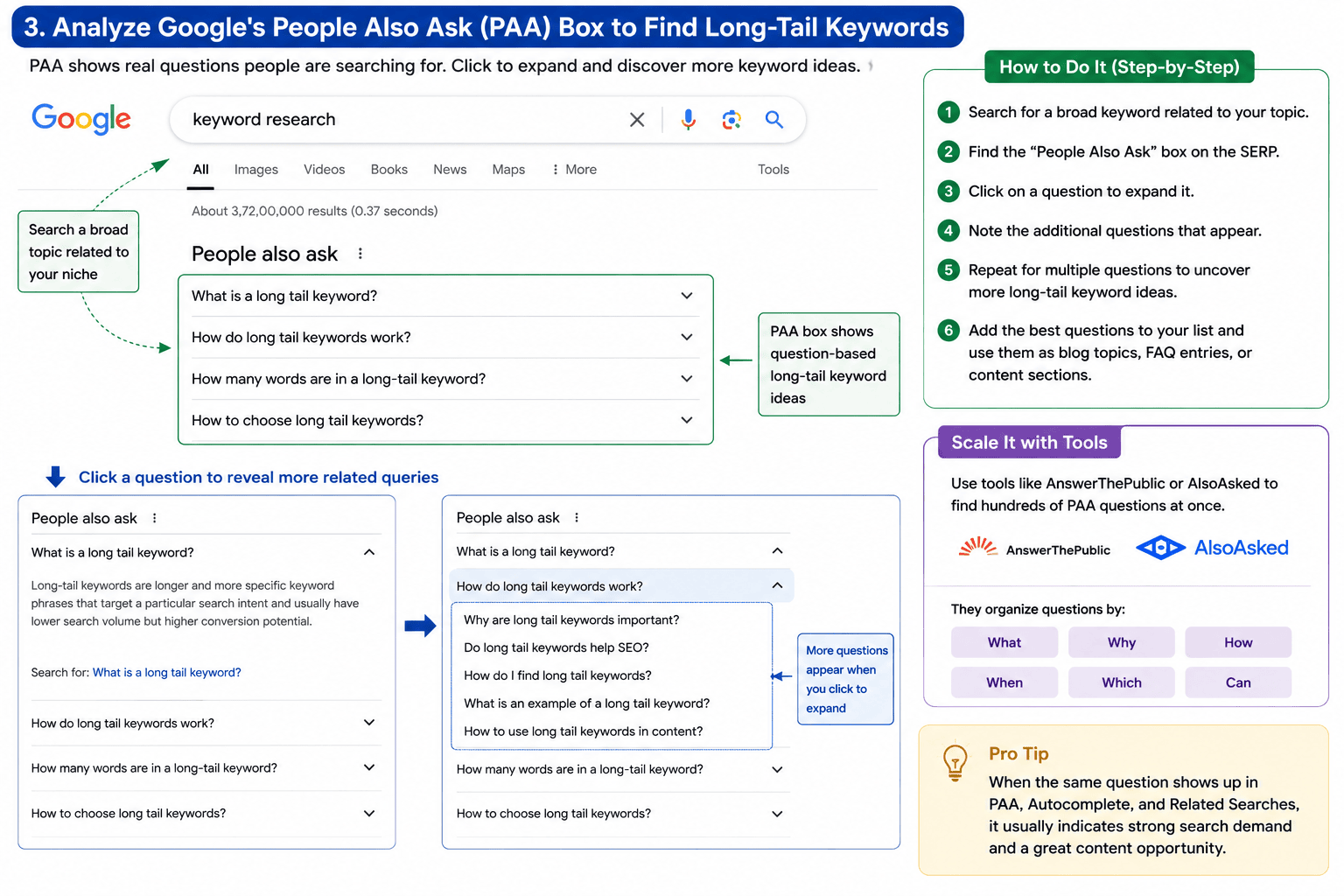
3. Analyze Google's People Also Ask (PAA) Box
Google's People Also Ask (PAA) section is one of the easiest ways to uncover question-based long-tail keywords directly from search results. Since these questions are generated from real user searches, they can reveal topics your audience is actively looking for. They are also highly valuable in the age of AI-powered search, as many of these questions reflect the conversational queries users ask search engines and AI assistants.
How to find long tail keywords using People Also Ask
- Search for a broad topic related to your niche.
- Locate the People Also Ask box in the search results.
- Open several questions by clicking on them.
- As you expand questions, Google generates additional related queries.
- Record relevant questions in a spreadsheet or keyword list.
- Group similar questions together to create blog topics, FAQs, or content clusters.
For example, if you search for "keyword research," Google may display questions such as:
- What is a long-tail keyword?
- How do long-tail keywords work?
- What is long-tail keyword research?
- How to choose long-tail keywords?
- How to find low-competition long-tail keywords?
Each of these questions can become a dedicated article section or even an entirely new blog post. Since they directly address user intent, they are also excellent candidates for featured snippets, AI Overviews, and AI-generated search responses.
Scale the Process with AnswerThePublic
If you want to uncover hundreds of question-based keywords at once, tools like AnswerThePublic and AlsoAsked can help. These platforms collect data from Google's question-based searches and organize them into categories such as:
This makes it easier to identify long-tail keyword phrases, discover content gaps, and build topical authority around a subject. These tools are particularly useful for finding conversational search queries that mirror how users interact with AI search engines and voice assistants.
Why PAA Keywords Matter for AI Search
Google's AI Overviews and other AI-powered search experiences are designed to answer specific user questions. As a result, content that directly addresses People Also Ask queries is often better aligned with the types of information AI systems seek when generating responses. By creating clear, comprehensive answers around PAA questions, you can improve your chances of appearing in both traditional search results and AI-generated search features.
A useful strategy is to combine PAA research with Google Autocomplete and Related Searches. When multiple sources surface the same question, it often indicates strong user interest, content potential, and a greater likelihood of visibility across both traditional and AI-driven search experiences.
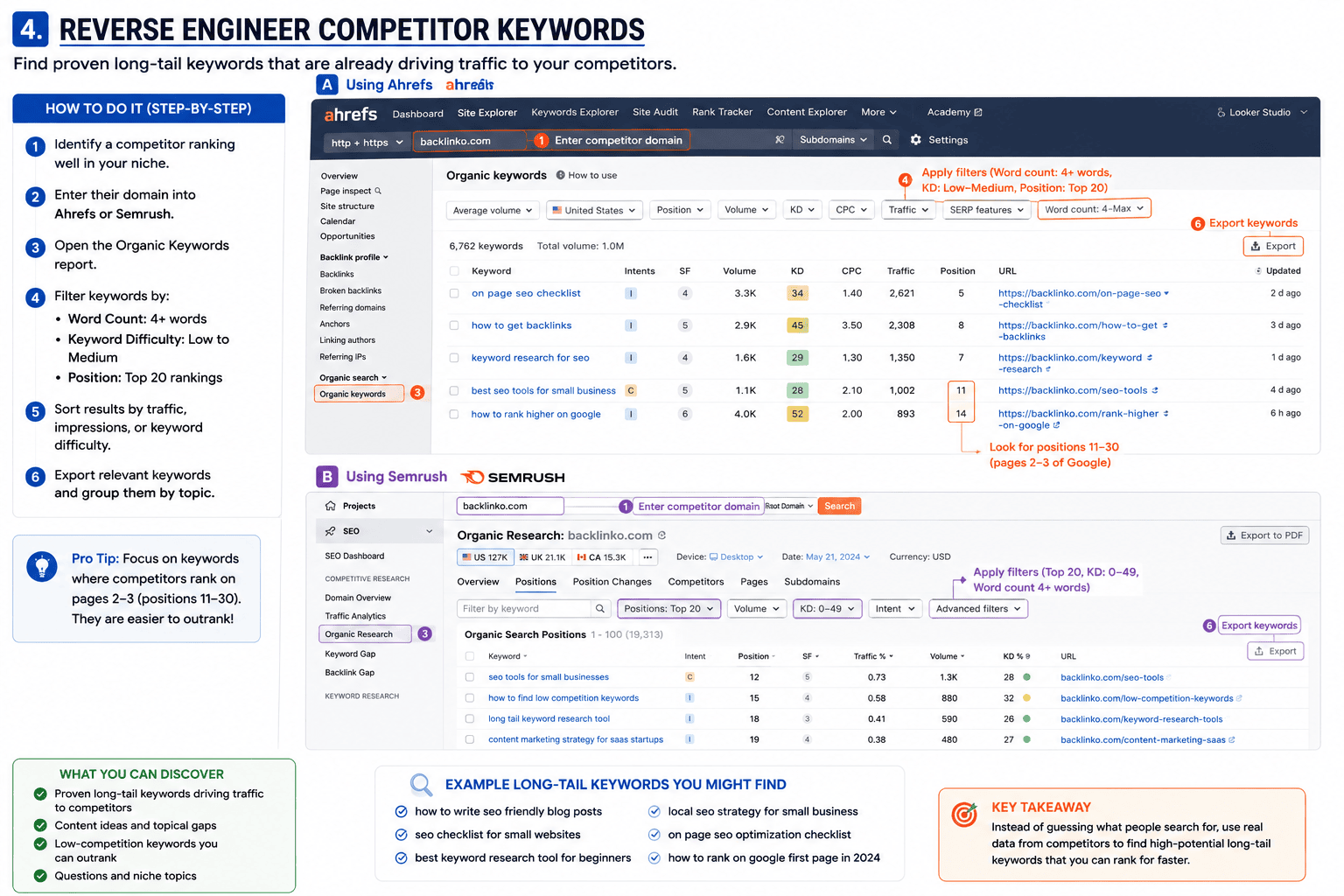
4. Reverse Engineer Competitor Keywords
Why spend hours brainstorming keyword ideas when your competitors have already done much of the research for you?
One of the fastest ways to find long-tail keywords for SEO is by analyzing the keywords that are already driving traffic to competing websites in your niche. By studying their rankings, you can uncover proven topics, identify content gaps, and discover keyword opportunities that may not appear in traditional keyword research tools. This approach is especially valuable today as websites increasingly optimize for both traditional search results and AI-powered search experiences.
How to find long tail keywords from Competitors
Using Ahrefs or Semrush:
- Identify a competitor that ranks well for topics related to your business.
- Enter their domain into Ahrefs Site Explorer or Semrush Organic Research.
- Open the Organic Keywords report.
- Filter keywords by:
- Word Count: 4+ words
- Keyword Difficulty: Low to Medium
- Position: Top 20 rankings
- Sort results by traffic, impressions, or keyword difficulty.
- Export relevant keywords and group them by topic.
For example, if you run a digital marketing blog and analyze a competing website, you may discover keywords such as:
- How to find low-competition long-tail keywords
- Best long-tail keyword research tool
- Long-tail SEO strategy for beginners
- How to rank for long-tail keywords
These are proven keyword opportunities because search engines are already sending traffic to similar content. They can also reveal the types of detailed, intent-driven queries that users commonly ask in AI search platforms and conversational search environments.
Look for "Easy-Win" Keywords
A particularly effective strategy is to identify keywords where competitors rank between positions 11 and 30 (pages two and three of Google).
Why?
These keywords have already demonstrated ranking potential, but the existing content may not fully satisfy search intent. By creating a more comprehensive, updated, or better-optimized article, you may be able to outrank them.
When evaluating these opportunities, pay attention to whether the top-ranking pages answer related questions thoroughly. Content that provides complete answers, examples, FAQs, and supporting information is often better positioned to appear in featured snippets and AI-generated search responses.
Find Content Gaps
Both Ahrefs and Semrush offer Content Gap or Keyword Gap reports that compare your website against competitors.
These reports help you discover:
- Keywords competitors rank for that you don't
- Missing content topics
- Untapped long-tail keyword phrases
- New opportunities to expand your topical authority
- Question-based queries that can support AI search visibility
Many content gap reports also reveal clusters of related keywords and user questions. These insights can help you build comprehensive topic coverage that aligns with how modern search engines and AI systems understand content relationships.
Why Competitor Research Matters for AI Search
Competitor analysis is no longer just about finding ranking keywords. It can also help you identify the types of content that Google considers authoritative enough to surface in AI Overviews and other AI-generated search features. By analyzing pages that consistently rank for detailed, conversational queries, you can better understand how to structure content, answer user questions, and build topical authority.
Instead of guessing what users are searching for, competitor analysis allows you to make data-driven decisions based on real search performance. This makes it one of the most reliable methods for finding long-tail keywords, uncovering AI-friendly content opportunities, and building a stronger SEO strategy that performs across both traditional and AI-powered search experiences.
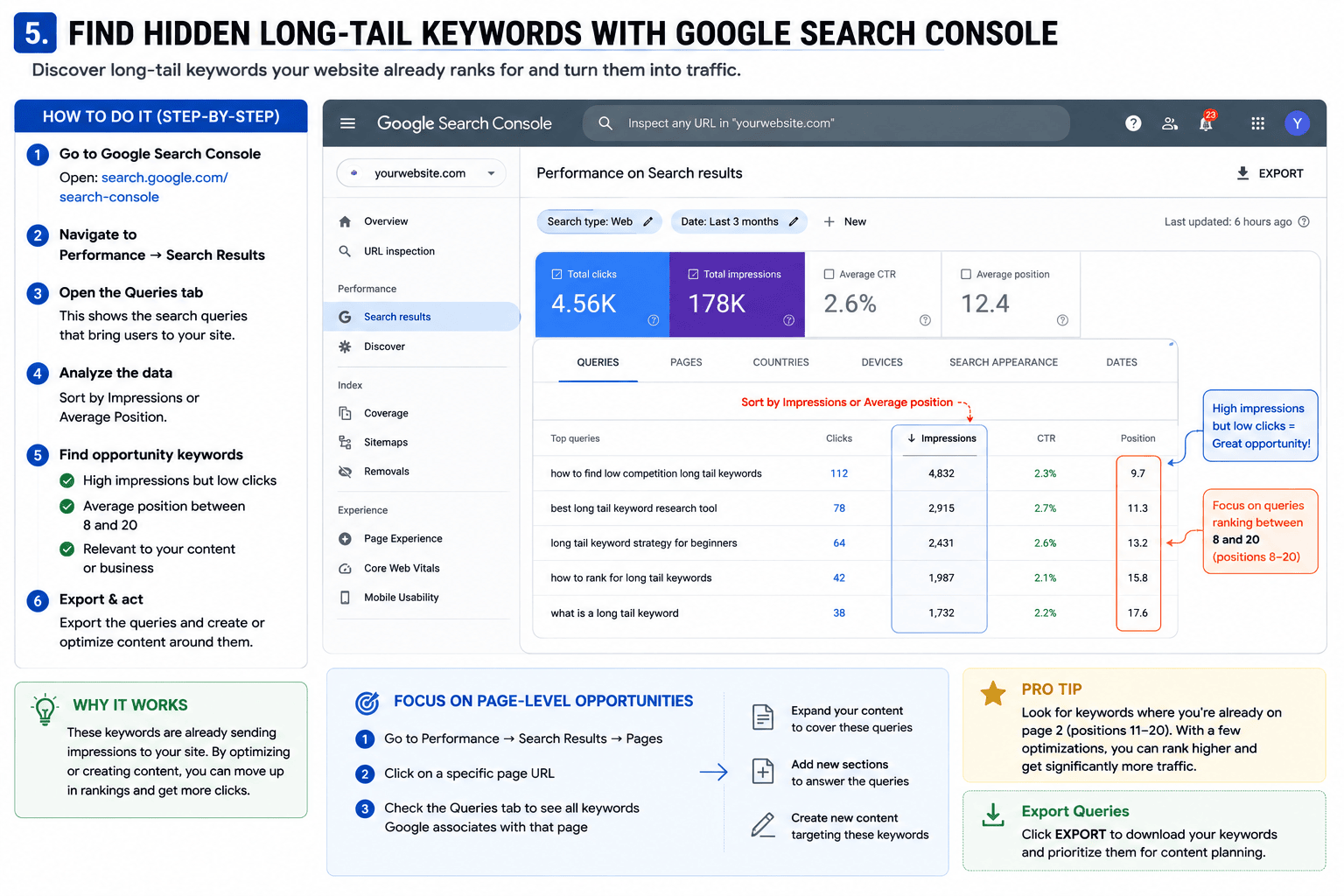
5. Find Hidden Long-Tail Keywords with Google Search Console
Most websites already rank for dozens, or even hundreds, of long-tail keywords without the owner realizing it. Google Search Console helps you uncover these hidden opportunities by showing the exact search queries that generate impressions and clicks for your site.
Unlike traditional keyword research tools, Search Console provides data directly from Google, making it one of the most reliable ways to discover long-tail keyword phrases that are already relevant to your content. It can also reveal the conversational and intent-driven searches that are becoming increasingly important in AI-powered search experiences and Google's AI Overviews.
How to find long tail keywords in Google Search Console
- Log in to Google Search Console.
- Navigate to Performance → Search Results.
- Open the Queries tab.
- Sort queries by impressions or average position.
- Look for keywords that:
- Receive high impressions but few clicks.
- Rank between positions 8 and 20.
- Closely relate to your products, services, or content topics.
- Export promising keywords for further analysis.
When reviewing query data, pay special attention to question-based and highly specific search terms. These often indicate strong user intent and may align closely with the types of searches that trigger AI-generated answers.
Focus on Page-Level Opportunities
A powerful strategy is to filter results by a specific page.
For example:
Performance → Search Results → Pages → Select a URL → Queries
This report shows all the search terms Google already associates with that page. You may discover related long-tail searches that aren't fully covered in your content but are generating impressions.
If multiple users are finding your page through a particular query, consider:
- Expanding the content to cover that topic in more detail.
- Adding a dedicated section that answers the query.
- Creating an FAQ around related questions.
- Publishing a new article targeting the keyword directly.
These improvements can help strengthen topical relevance while increasing the likelihood of your content being used in featured snippets, AI Overviews, and other AI-driven search features.
Identify Queries with AI Search Potential
Search Console can also help uncover keywords that indicate informational intent, such as:
- How to...
- What is...
- Best way to...
- Why does...
- Which tool is...
These queries are frequently used in conversational searches and AI assistants. If your content already receives impressions for such terms, expanding your coverage can improve visibility across both traditional search results and AI-generated responses.
Why This Method Works
Instead of starting your long-tail keyword research from scratch, you're leveraging keywords that Google already considers relevant to your website. These opportunities often require less effort to rank for because your site has already established some level of authority and relevance.
For many websites, Google Search Console uncovers valuable SEO long-tail keywords that never appear in keyword databases, making it one of the most effective free methods for finding long-tail keywords and growing organic traffic. It also provides direct insight into the real queries users are searching for, helping you optimize content for both traditional rankings and the evolving landscape of AI-powered search.
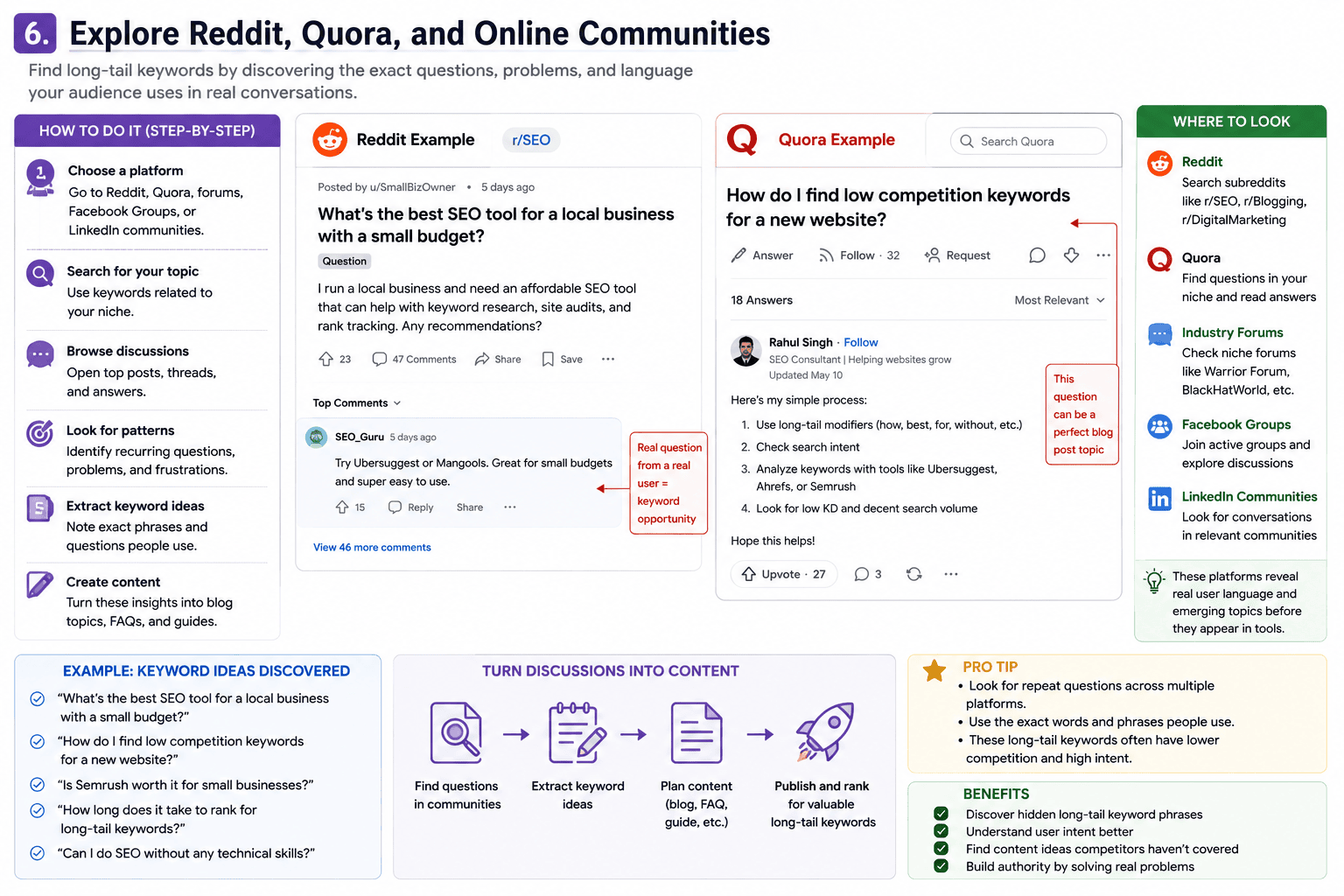
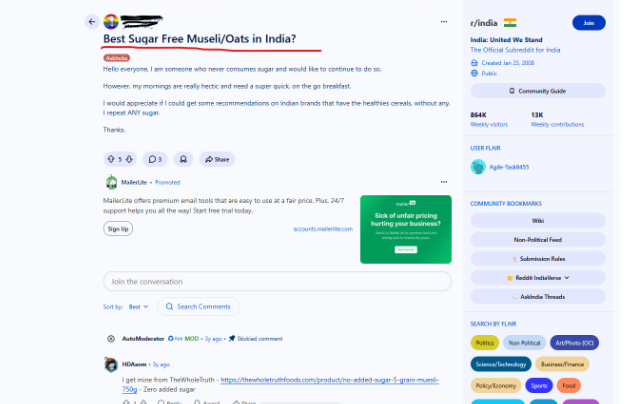
6. Explore Reddit, Quora, and Online Communities
Some of the best long-tail keywords don't come from SEO tools; they come directly from your target audience. Platforms such as Reddit, Quora, industry forums, Facebook Groups, and LinkedIn communities contain real questions, discussions, and pain points that people are actively talking about. These conversations can help you uncover long-tail keyword phrases that may not yet appear in traditional keyword databases.
Community research has become even more valuable with the rise of AI-powered search. Since users increasingly search using natural language and conversational questions, the discussions found in online communities often mirror the exact types of queries that appear in AI search engines and Google's AI Overviews.
How to find long tail keywords from Online Communities
- Search for your topic on Reddit, Quora, or niche forums.
- Browse popular discussions, questions, and comment threads.
- Look for recurring questions, challenges, and pain points.
- Note the exact language people use when describing their problems.
- Convert those discussions into keyword ideas and content topics.
For example, if you're researching SEO-related topics, you might come across questions such as:
- What's the best SEO tool for a local business with a small budget?
- How do I find low-competition keywords for a new website?
- Is Semrush worth it for small businesses?
- How long does it take to rank for long-tail keywords?
Each of these questions represents a potential long-tail search term that reflects real user intent. They can also serve as excellent content ideas for articles, FAQs, guides, and comparison pages.
Focus on Repeated Questions
A useful rule is simple: if the same question appears multiple times across different platforms, it's likely a topic worth targeting.
For example, if you notice dozens of Reddit threads and Quora discussions asking about how to find low-competition long-tail keywords, that signals genuine demand and a strong content opportunity.
Repeated questions often indicate topics that users actively seek answers to but may not be fully addressed by existing content. These are precisely the types of queries that search engines and AI systems aim to satisfy.
Traditional keyword tools typically rely on historical search data, which means they can be slow to surface emerging trends. Online communities, on the other hand, reveal what people are discussing right now.
This makes community-driven research an excellent way to discover:
- Emerging topics before competitors
- Question-based keywords
- Content ideas for blogs and FAQs
- Untapped long-tail keywords
- Audience language you can use in your content
- Conversational queries relevant to AI search
One advantage of community research is that it exposes the exact wording real people use when asking questions. This can help you create content that aligns more closely with conversational search behavior and AI-generated search experiences.
For example, rather than targeting a generic keyword like "keyword research," you might uncover a more specific query such as "how do I find low-competition keywords for a new website with no authority?" These detailed searches often carry a stronger intent and provide more context for AI systems to understand and reference.
By combining community insights with traditional long-tail keyword research, you can uncover keyword opportunities that are highly relevant, intent-driven, and often less competitive than mainstream search terms. This approach not only improves your chances of ranking in organic search but can also increase your visibility in AI Overviews and other AI-powered search experiences.
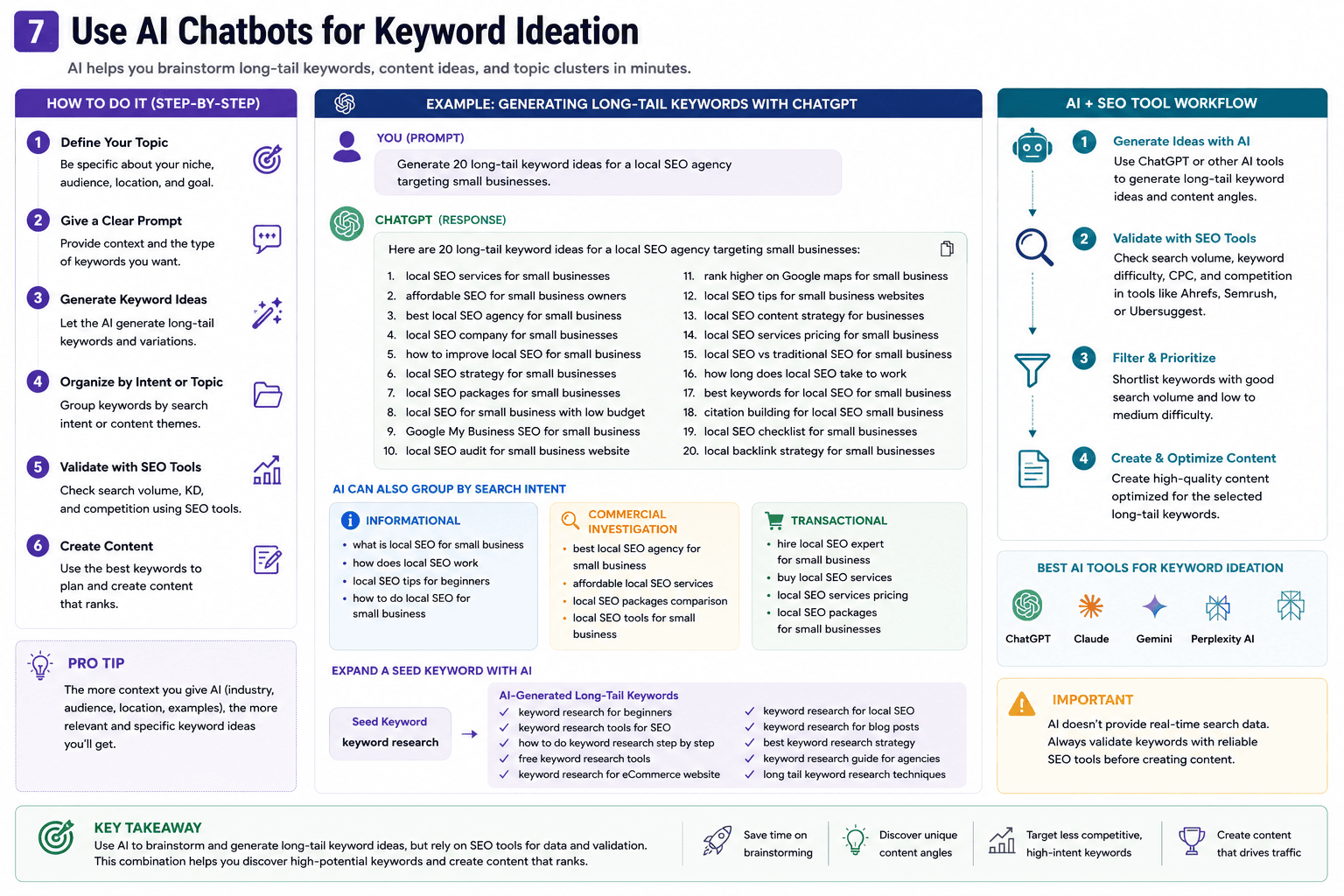
7. Use AI Chatbots for Keyword Ideation
AI chatbots such as ChatGPT, Claude, and Gemini can significantly speed up the process of finding long-tail keywords. While these tools don't provide search volume or keyword difficulty data, they excel at generating keyword variations, content angles, topic clusters, and question-based queries that can support your long-tail keyword research.
As AI-powered search continues to evolve, these tools can also help you identify the conversational and intent-driven queries that users increasingly submit to AI search engines and virtual assistants. This makes them valuable for brainstorming topics that can perform well in both traditional search results and AI-generated search experiences.
How to find long tail keywords using AI
Start by providing the AI with a clear topic, audience, and goal.
For example:
Prompt 1: Generate 50 long-tail keyword ideas for a local SEO agency targeting small businesses.
Prompt 2: Suggest informational, commercial, and transactional long-tail keywords related to project management software.
Prompt 3: Create a list of question-based long-tail keyword phrases about email marketing for beginners.
The more context you provide, the more relevant and targeted the keyword suggestions will be.
Use AI to Expand Existing Keywords
AI can also help you discover related keyword variations around a seed topic.
For example, if your target keyword is "keyword research," you can ask:
Generate long-tail keywords for beginners, agencies, eCommerce stores, SaaS companies, and local businesses related to keyword research.
This approach can quickly produce dozens of SEO long-tail keywords that you can organize into content clusters, supporting articles, FAQs, and topic hubs.
AI is particularly useful for uncovering conversational phrases and detailed user questions that may be overlooked by traditional keyword tools.
Create Keywords by Search Intent
One of AI's biggest advantages is its ability to group keywords by intent.
Ask it to generate:
- Informational keywords
- Commercial investigation keywords
- Transactional keywords
- Local SEO keywords
- Question-based keywords
This helps ensure you're targeting users at different stages of the customer journey rather than focusing on a single keyword type.
Generate AI-Friendly Search Queries
Another effective strategy is to ask AI tools to generate natural-language search queries based on your topic.
For example:
How would a beginner search for information about local SEO?
What questions might a small business owner ask before buying SEO software?
The results often resemble the conversational searches users perform in AI-powered search engines and voice assistants. These longer, more detailed queries can provide valuable insights for content creation and keyword targeting.
Always Validate AI-Generated Keywords
While AI is excellent for brainstorming, it doesn't have access to real-time search volume, keyword difficulty, or competition metrics. Before targeting any keyword, verify it using a reliable long-tail keyword tool such as Ahrefs, Semrush, or Google Search Console.
AI-generated suggestions should be treated as hypotheses rather than confirmed opportunities. Validation helps ensure that the keywords you target have genuine search demand and ranking potential.
Why AI Keyword Research Matters for AI Search
As search engines increasingly rely on AI to understand and answer user queries, content that addresses specific questions and intent-driven topics is becoming more valuable. AI chatbots can help you uncover these opportunities by generating the kinds of detailed queries users are likely to ask in conversational search environments.
Think of AI as a keyword ideation and content-planning tool rather than a keyword validation platform. The most effective workflow is to use AI to generate ideas, expand topic coverage, and identify user questions, then use SEO tools to validate search demand and competition. This combination can help you build content that performs well in traditional search results while also improving your chances of appearing in AI Overviews and other AI-generated search experiences.
D. Practical Examples: How Long-Tail Keywords Drive Organic Traffic
Understanding how to find long tail keywords is important, but seeing them in action makes the concept much easier to apply. The examples below show how a single piece of content can rank for multiple related long-tail keywords and generate significantly more traffic than its primary keyword alone.
Ahrefs publishes a comprehensive guide about long-tail keywords that targets the primary topic "long-tail keywords." However, the page also ranks for numerous related keyword variations because it covers the topic in depth.
Examples of Long-Tail Keywords the Topic Can Capture
Primary Topic | Related Long-Tail Keywords |
Long-tail keywords | what are long tail keywords |
Long-tail keywords | long tail keywords examples |
Long-tail keywords | long tail keyword research |
Long-tail keywords | how to find long tail keywords |
Long-tail keywords | long tail keywords vs short tail keywords |
Instead of creating separate articles for every variation, a well-structured guide can rank for many related searches simultaneously.
Imagine a local SEO agency publishes a guide titled:
"How to Improve Local SEO for Small Businesses"
The page may target a primary keyword such as:
- local SEO for small businesses
But Google can also associate the page with related long-tail searches, including:
- affordable local SEO services for small businesses
- local SEO tips for beginners
- Google Business Profile SEO checklist
- How to improve local SEO rankings
- local SEO strategy for service businesses
Example Traffic Potential
Keyword | Monthly Searches* | Intent |
local SEO for small businesses | 700 | Informational |
local SEO tips for beginners | 300 | Informational |
Google Business Profile SEO checklist | 250 | Informational |
local SEO strategy for service businesses | 150 | Commercial |
affordable local SEO services | 400 | Transactional |
*Illustrative search volumes for demonstration purposes.
Although each keyword has modest volume individually, together they create a much larger traffic opportunity.
Case Study 3: Project Management Software Blog
A good real-world example comes from ClickUp's guide on project management software for remote teams. Rather than targeting only one keyword, the article covers multiple aspects of remote collaboration, team communication, project tracking, and workflow management.
As a result, the page can potentially rank for a variety of related long-tail keyword phrases, including:
Long-Tail Keyword | Search Intent |
best project management software for remote teams | Commercial |
project management software for distributed teams | Commercial |
collaboration software for remote employees | Commercial |
project tracking software for startups | Commercial |
affordable project management software for small teams | Transactional |
The article addresses different user needs within the same topic, allowing it to capture traffic from multiple related searches rather than relying on a single keyword.
This illustrates an important principle of longtail SEO: a comprehensive piece of content can rank for dozens of related keyword variations when it fully satisfies search intent and covers the topic in depth.
E. Conclusion
Understanding how to find long tail keywords is no longer just an SEO best practice; it's essential for succeeding in today's search landscape. As search engines become more sophisticated and AI-powered experiences such as Google AI Overviews continue to grow, targeting specific, intent-driven queries has become more important than ever.
Rather than focusing solely on high-volume keywords, successful marketers identify the detailed questions, problems, and search phrases their audience is actively using. Whether you use keyword research tools like Semrush and Ahrefs, Google's Autocomplete and People Also Ask features, Google Search Console, competitor analysis, online communities, or AI chatbots, each method can help uncover valuable long-tail keyword opportunities.
The most effective strategy is to combine multiple research methods, validate opportunities with real search data, and create content that thoroughly addresses user intent. By doing so, you can attract more qualified traffic, improve conversion rates, build topical authority, and increase your visibility across both traditional search results and AI-driven search experiences.
Start applying these techniques today, and you'll discover that even low-volume long-tail keywords can become powerful drivers of sustainable organic growth.
.webp)




.webp)
.webp)