Table of Content
- Jessica Robinson
- Aug 24,2026
AI can get you from a blank page to a full draft surprisingly quickly. Give it a topic and a few instructions, and you'll often have an outline and several paragraphs before you've had time to think through the details yourself.
The problem usually starts after that.
A draft can look finished and still have a wrong number, an outdated source, or a sentence that sounds convincing but doesn't actually say much. It can also miss the reason someone searched for the topic in the first place.
So don't treat the first draft as something that's ready to publish. Treat it as material to work with.
Before the article goes live, read it the way you would read any other article you're responsible for. Check the facts. Cut the parts that go nowhere. Fix anything that sounds strange. Add information that comes from actual experience.
These are the areas I'd check first.
Generative AI models are capable of producing plausible text, even when presenting factual inaccuracies. This phenomenon arises from their underlying mechanism, which involves predicting probable word sequences rather than conducting independent fact-checking as a human researcher would.
Particular scrutiny is warranted for statements pertaining to statistics, dates, research outcomes, regulatory frameworks, pricing information, product specifications, and contemporary events. Even a solitary factual error can significantly undermine the credibility of an otherwise informative piece.
The initial step in verification involves identifying all factual assertions that might impact a reader's comprehension or judgment. These identified statements should then be cross-referenced with authoritative primary sources, official organizational websites, scholarly research, established publications, or primary data repositories.
It is important to refrain from assuming that confident pronouncements equate to factual accuracy. AI-generated content can project an authoritative tone irrespective of whether the information presented is sound.e. AI-generated text can sound authoritative even when the underlying information needs correction.
For important claims, ask three simple questions:
If you cannot answer these questions, the claim deserves another review before publication.
Even when grammatically sound, content may fail to address the core query if it does not align with the reader's underlying question. Artificial intelligence can sometimes generate verbose yet practically unhelpful explanations.
Prior to publication, it is advisable to evaluate the content against the search intent associated with the target topic. This involves considering what information a user would anticipate gaining from a search on that subject and verifying whether the article provides that information with sufficient clarity.
For instance, a user searching for "AI content quality" is probably seeking a functional method for assessing AI-generated text. An article that merely defines artificial intelligence would not fulfill the primary objective of such a search.
The introductory section should promptly articulate the problem. Each subsequent section should offer valuable insights toward its resolution.
Omit paragraphs that reiterate information without introducing novel explanations, examples, data, or recommendations. The quality of content is not solely determined by its length.
One of the significant issues with unedited AI content is its unnatural writing pattern. Repetitive phrasing, generic transitions, summary statements, and formulaic language all contribute to a fabricated feel.
If the text sounds formal, generic, or non-human, you might need to humanize AI text by rephrasing generic phrases and adding more specific details and opinions.
You can do this by reading through the draft out loud or at least through from start to finish, noticing sentences that sound unnatural, generic, or removed from your intended tone. One effective strategy for humanizing AI writing is to change generic statements into specific ones.
Rather than stating that one thing or idea ‘plays an important role,’ define the role and explain why the subject is essential or relevant. Human editing also brings out the voice in your writing, so that the text will have a distinct authorial presence. This is especially crucial for organizations aiming to convey a professional image to clients while retaining their unique communication style.
Readers rarely read texts from online sources from start to finish, so it is important to help them skim-read your content. This can be achieved by using subheadings to segment the information, keeping paragraphs short, using bullet points and tables where appropriate and breaking up large walls of text.
Before publishing an article, have the headings been created in a way that makes sense? Has the content been segmented into sections that make sense? Has an effort been made to keep paragraphs to a sensible length?
If a paragraph covers a range of different topics, it should be broken up. Bullet points and numbered lists can be used extensively for content that involves steps, features, pros and cons, and similar types of information.
A simple readability review can include:
Element | What to Check |
Introduction | Does it explain the topic quickly? |
Headings | Do they clearly describe each section? |
Paragraphs | Are they short and focused? |
Lists | Are complex points easier to scan? |
Sentences | Are they clear and reasonably concise? |
Conclusion | Does it reinforce the main lesson? |
Good formatting does not replace good information. It simply makes useful information easier for readers to find and understand.
A draft can contain plenty of information and still feel shallow. That's often what happens when the content relies too heavily on summaries. Readers may already know the basic definition; what they need is the context around it.
Think about what someone who works in the field would add. Maybe it's a mistake they see regularly, a shortcut that actually saves time, a situation where the usual advice doesn't work, or a comparison that helps readers choose between two options.
For example, an SEO specialist might explain how AI-generated content changes an editorial workflow rather than simply describing what AI content is. A teacher might point out the types of explanations that AI tools tend to get wrong or where students are most likely to misunderstand them.
These details are difficult to replace with generic information because they come from experience.
Look for places where you can add your own observations, examples, processes, or professional judgment. That's often what turns an otherwise competent article into something readers couldn't get from a dozen similar pages.
AI can help with the initial draft. The expertise should shape what stays in the final one.
Some of the most convincing mistakes are the ones that look completely reasonable.
An AI tool can produce a statistic that sounds credible, refer to a study that doesn't exist, attribute a quote to the wrong person, or mention a company or report that was never real. Because the wording may sound confident, these errors are easy to overlook during a quick edit.
Check every important claim against its original source. Don't stop at confirming that a link exists. Open it and make sure the source actually supports the statement you've made.
The same applies to studies, statistics, expert quotes, company information, reports, and other specific references. If you can't verify a claim, either find a reliable source or remove the claim.
This matters for any article, but the consequences are much greater in areas such as medicine, finance, law, science, and technical subjects. A small factual mistake in a casual article may be harmless; the same mistake in professional advice can lead readers to make a genuinely bad decision.
When in doubt, verify it rather than trusting how convincing the sentence sounds.
Even a well-researched draft can contain sentences that don't sound quite right.
Read the article as you would read someone else's writing, rather than simply looking for obvious spelling mistakes. Some sentences may be grammatically correct but too long, too formal, or packed with several ideas at once. Others may use the same word repeatedly or switch between terms that should remain consistent.
Check grammar, punctuation, spelling, and word choice, but pay attention to rhythm as well. A paragraph where every sentence follows the same structure can feel mechanical even when there are no actual errors.
A grammar checker can be useful for catching simple problems during the first pass. Just don't accept every suggestion automatically. An editing tool doesn't know your audience or the tone you're trying to achieve, and sometimes its “improvement” makes a perfectly natural sentence sound stiff.
Read the final version out loud if you can. Awkward phrasing tends to stand out much faster when you hear it.
The simplest test is also one of the most useful: Would a real person actually say or write this this way?
If not, change it.
One of the easiest ways to improve an article is to cut anything that has already been said.
AI-assisted drafts often circle back to the same idea several times. A definition may appear in the introduction and then show up again in slightly different words a few paragraphs later. The same thing can happen with conclusions: instead of adding a new point, a paragraph simply repeats what the reader already knows.
Read through each section and ask yourself: Does this paragraph actually add something? If two paragraphs make essentially the same point, keep the stronger one and remove or combine the other.
The same applies to vague statements. Phrases like “technology is changing the world” or “businesses need to adapt” don't tell the reader much on their own. What technology? What is changing? And what should a business actually do about it?
Be specific. Replace broad observations with a fact, example, explanation, or practical recommendation. If a sentence is useful but awkward, rewrite it without changing the underlying point.
The goal isn't to make every sentence sound impressive. It's to make sure every sentence earns its place.
Before publishing, take a few minutes to check the links and examples throughout the article.
An external link should lead to the page you intended to reference and actually support the statement around it. If the source no longer exists, has changed significantly, or doesn't provide the information you're citing, replace it.
Internal links need the same level of attention. Adding a link just because there is an opportunity to do so can make an article feel cluttered. Link to another page when it gives the reader useful context or helps them explore the subject in more detail.
Examples should also be clear about what they are. If you're using a hypothetical scenario, say so. If you're referring to a real company, study, statistic, or case, make sure there is a reliable source behind it.
A few well-chosen sources and examples are usually more useful than a long list of links that don't add much.
At the end of the editing process, forget about word count for a moment and look at the article from the reader's perspective.
Did they learn something they didn't know before? Do they understand the problem more clearly? Can they do something differently after reading it?
Those questions matter more than how quickly the article was produced.
AI tools can help with research, drafting, and editing, but publishing more content isn't the same as publishing better content. The finished article still needs someone to check the facts, question weak points, remove unnecessary sections, and add context that a generic draft is likely to miss.
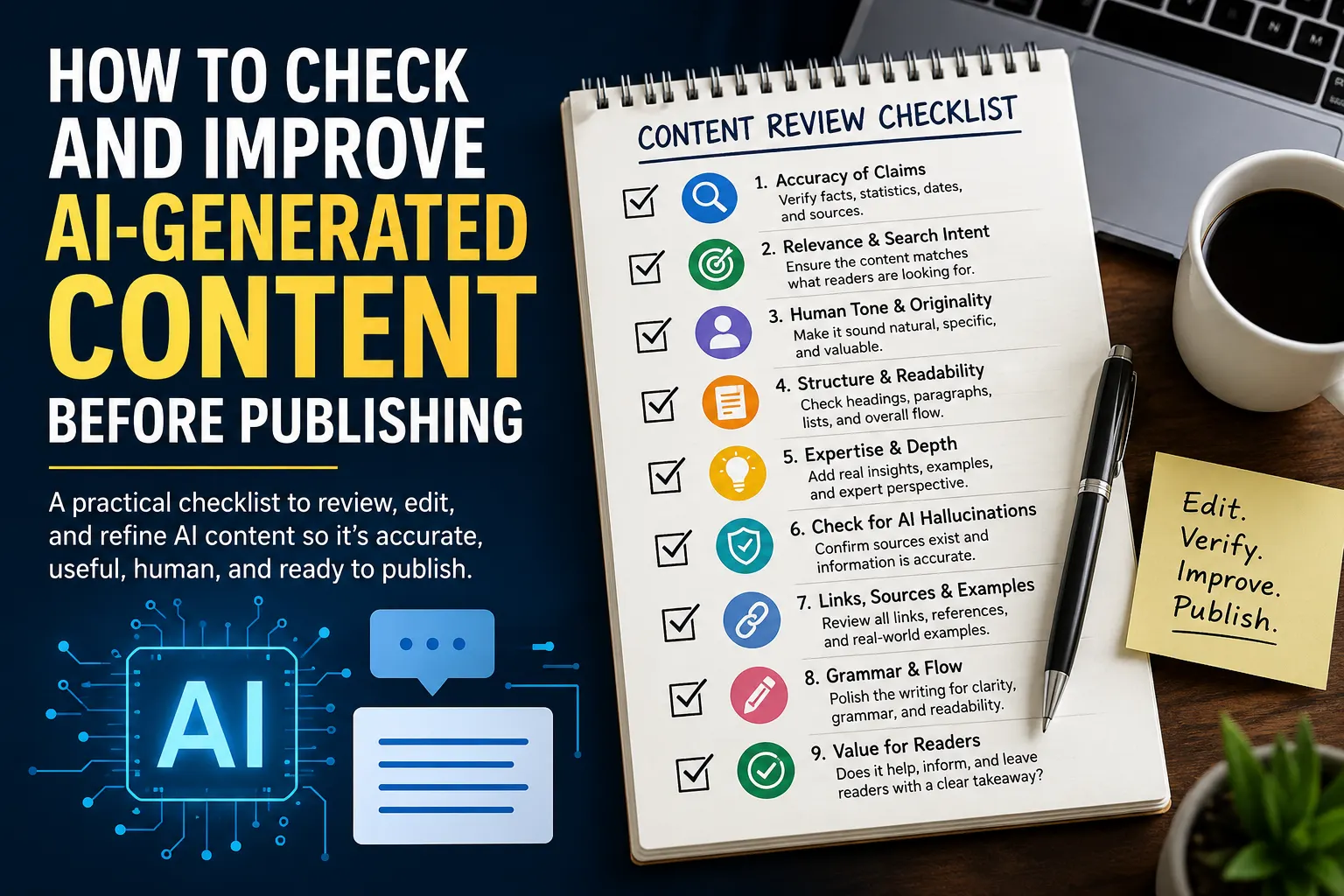
Before publishing, run through the following:
AI can play a significant role in reducing the time needed to produce a first draft. It can help organize thoughts, research a topic, summarize, and overcome writer’s block, for instance. However, the initial version of an article should not be published merely because it was created by an AI.
The quality of the final work depends substantially on post-generative editing, fact-checking, reorganization, citation of sources, and human judgment.
The best approach is to treat AI as an assistant rather than the final editor. Review every important claim, remove unnecessary repetition, strengthen weak explanations, and make sure the finished article genuinely helps the reader.
A few minutes of careful editing can turn a generic AI draft into content that is accurate, useful, readable, and ready for publication.
No. AI-generated content should be reviewed and edited before publication. Fact-checking, source verification, relevance, readability, originality, and human expertise should all be considered before the content goes live.
Start with important factual claims. Check statistics, dates, research findings, regulations, pricing, product information, and other details that could affect a reader's understanding or decision.
AI hallucinations are inaccurate or fabricated information generated by an AI system. They can include false statistics, nonexistent studies, incorrect quotations, outdated information, or inaccurate references that may sound convincing.
Replace generic statements with specific explanations, examples, opinions, and real-world experiences. Reading the article aloud can also help identify repetitive or unnatural phrasing that needs rewriting.
Search intent helps determine what the reader actually wants from a query. Content may be grammatically correct but still fail if it does not answer the user's main question or provide useful information.
.webp)
Choosing an SEO agency is a significant investment, and the wrong partner can cost a business months of progress, valuable rankings, and marketing budget. This guide highlights nine SEO agency red flags to watch for before signing a contract, from guaranteed rankings and vague deliverables to hidden account ownership, unexplained link building, poor reporting, and unrealistically low pricing. It also explains how to identify a reliable SEO partner by evaluating transparency, measurable KPIs, specialist expertise, data ownership, review processes, and relevant experience. These checks can help businesses make a more informed SEO agency decision.
Read More.webp)
SaaS SEO requires a different approach because software buyers often research problems, compare products, read reviews, and test solutions before becoming customers. This guide explains eight marketing strategies that work differently for SaaS businesses, including customer-journey content, product-led SEO, long-tail keywords, comparison pages, niche link building, conversion-focused landing pages, topical authority, and AI search optimization. It also explains how to measure SaaS SEO success beyond traffic by tracking trials, demos, conversions, customer acquisition costs, and customer lifetime value. These strategies can help SaaS companies attract qualified visitors and turn organic search into sustainable growth.
Read MoreGet into details now? View all posts