Digital transformation is no longer simply about moving business processes online or replacing outdated software. In 2026, enterprises are rethinking how they operate, make decisions, serve customers, manage data, and respond to changing markets. This shift has made digital transformation strategies a core business priority rather than an initiative limited to the IT department.
The latest digital transformation strategies 2026 are increasingly shaped by artificial intelligence, automation, connected data, cloud platforms, cybersecurity, and increasingly autonomous AI systems. For a deeper look at how AI is being applied across modern organizations, explore AI in Business. However, adopting new technology alone does not guarantee a successful transformation. Enterprises can invest heavily in digital tools and still struggle with fragmented systems, inefficient processes, poor data quality, employee resistance, and unclear returns on investment.
That is why today's enterprise digital transformation requires a more comprehensive approach. Organizations need to redesign business processes before automating them, build infrastructure that can support AI, establish appropriate governance, prepare employees for human-AI collaboration, and connect technology investments to measurable business outcomes.
In other words, successful strategies for digital transformation should answer a bigger question: How can technology fundamentally improve the way an enterprise creates and delivers value?
This guide explores 10 practical digital transformation strategies 2026 that address that question. Rather than focusing only on popular technologies, we'll examine the business, operational, technological, and workforce changes enterprises need to make to build a more intelligent, adaptable, and resilient organization.
If we talk about enterprise digital transformation in 2026, the definition goes beyond simply adopting new technologies. Enterprise digital transformation in 2026 goes beyond adopting new technologies. It involves rethinking how people, processes, data, technology, and AI work together to create faster, smarter, and more adaptable operations. While earlier transformation efforts focused on digitizing documents, moving to the cloud, or adopting enterprise software, today’s approach is increasingly centered on business reinvention and intelligent operations.
The evolution can be viewed as:
Digitization → Digitalization → Digital Transformation → Intelligent Enterprise
Digitization converts information into digital formats, while digitalization improves existing processes with technology. Digital transformation redesigns processes, capabilities, and operating models around digital technologies. The emerging intelligent-enterprise model adds AI systems that can generate insights, support decisions, automate workflows, and perform increasingly complex tasks.
In 2026, successful transformation strategies focus on:
- AI and agentic automation to improve and automate workflows.
- Connected, governed data to support analytics and AI.
- Modern architecture using cloud, APIs, and integrated applications.
- Cybersecurity and governance to manage AI, access, and operational risks.
- Workforce transformation to help employees work effectively with AI.
- Business outcomes such as productivity, agility, cost efficiency, customer experience, and resilience.
The key shift is from “What technology should we adopt?” to “What business capability should we improve?” A company should redesign an inefficient process before automating it and determine where AI can act independently and where human oversight is necessary.
Ultimately, enterprise digital transformation in 2026 is not about implementing more technology. It is about building a more connected, intelligent, and adaptable business.
A strong digital transformation strategy needs more than a collection of technologies. Enterprises may adopt AI, migrate to the cloud, or implement new business software, but transformation will remain limited if their data, processes, people, and governance are not aligned with those investments.
The key pillars of enterprise digital transformation provide the foundation on which individual initiatives can be built and scaled. In 2026, these pillars are becoming increasingly interconnected because technologies such as AI and automation affect multiple parts of an organization at once.
Here are the six core pillars enterprises should consider when developing their digital transformation plan.
1. Business Strategy and Leadership
Digital transformation should begin with business objectives rather than technology selection. Leadership teams need to establish what the organization wants to improve, whether that means reducing operating costs, increasing revenue, improving customer experience, accelerating decision-making, or creating new digital products.
Strong digital transformation leadership strategies also require executives to establish clear ownership. Transformation cannot remain solely an IT responsibility when it affects finance, operations, HR, sales, customer service, and other business functions.
Leaders should therefore connect transformation initiatives to measurable business priorities and create a governance structure for deciding which projects receive investment, which should be redesigned, and which should be stopped.
2. Data and Technology Foundation
Data is the foundation of modern enterprise digital transformation. AI systems, analytics platforms, automation tools, and digital applications all depend on reliable and accessible information.
This pillar includes:
- Data quality and governance
- Cloud and hybrid infrastructure
- APIs and system integration
- Enterprise applications
- Data security and accessibility
- Modern application architecture
- Interoperability between platforms
Enterprises do not necessarily need to replace every legacy system. A more practical approach is to connect valuable existing systems with modern platforms while gradually retiring technology that creates unnecessary complexity.
3. Process and Operating Model
Technology cannot compensate for fundamentally inefficient business processes. One of the most important strategies for digital transformation is therefore to examine how work is currently performed before deciding what to automate.
Enterprises should identify unnecessary approvals, duplicate data entry, disconnected workflows, manual handoffs, and activities that no longer create value.
The objective is to move from:
Existing process → automation
to:
Existing process → redesign → simplify → automate or augment
This pillar is particularly important as AI moves into enterprise workflows. When organizations redesign processes around human-AI collaboration instead of simply inserting AI into existing workflows, they can achieve much larger operational improvements.
4. AI, Automation, and Intelligence
AI has become a central component of modern digital transformation strategies 2026, with AI automation helping enterprises automate workflows, analyze information, and support increasingly complex business processes. However, successful adoption requires more than deploying individual AI tools.
Enterprises need to determine where AI should:
- Generate insights
- Assist employees
- Make recommendations
- Automate repetitive activities
- Coordinate multiple workflow steps
- Execute low-risk actions
- Escalate complex decisions to humans
This creates a progression from traditional automation toward intelligent and increasingly autonomous workflows.
An AI-driven digital transformation strategy should also consider model selection, AI agents, monitoring, human oversight, security, and the cost of running AI at scale.
5. People, Skills, and Organizational Change
Digital transformation ultimately changes how people work. Employees may need to use new platforms, collaborate with AI systems, manage automated workflows, or develop entirely new skills.
For this reason, employee training should not be treated as a final step after technology implementation.
Enterprises should identify the skills required for their future operating model, determine where existing capabilities fall short, and create continuous learning programs around areas such as AI literacy, data analysis, cybersecurity, digital collaboration, and technology management.
The goal is not to replace employees with technology. It is to determine which activities should be handled by technology and where human judgment, creativity, relationships, and strategic decision-making create greater value.
6. Governance, Security, and Measurement
The final pillar brings transformation under control. As enterprises become increasingly dependent on connected systems and AI, they need clear policies for data access, cybersecurity, privacy, AI usage, compliance, model monitoring, and automated decision-making.
Governance is particularly important when AI systems can interact with enterprise applications or perform actions independently. Organizations need to establish clear boundaries around what an AI system can access and what it can do without human approval.
Measurement is equally important. Instead of judging transformation by the number of applications implemented or AI pilots launched, enterprises should track business outcomes such as process cycle time, cost per transaction, employee adoption, customer satisfaction, revenue impact, automation success rates, and AI-related operating costs.
Together, these six pillars create the foundation for successful digital transformation strategies. They also provide a useful framework for evaluating whether an enterprise is ready to move from isolated digital initiatives toward a connected, intelligent, and continuously evolving operating model.
The next step is turning these pillars into actionable strategies that enterprises can implement in 2026.
The right digital transformation strategies for an enterprise should do more than introduce new software or technologies. They should help the organization improve its capabilities, simplify operations, manage emerging risks, and continuously create measurable business value.
The following digital transformation strategies 2026 focus on the areas that matter most as enterprises move toward AI-enabled and increasingly connected operating models.
1. Start With Business Capabilities, Not Technology
One of the biggest mistakes enterprises make when developing a digital transformation strategy is starting with technology. A new AI platform, cloud service, automation tool, or enterprise application may look promising, but adopting it without a clearly defined business objective can create another disconnected system rather than meaningful transformation.
A better approach is to start with the business capabilities the organization needs to strengthen.
Understanding these capabilities can also help leadership teams make more structured decisions about where technology investments can create meaningful business value. This could include forecasting demand, managing customer relationships, processing claims, developing products, onboarding employees, detecting fraud, managing inventory, or delivering personalized services.
Instead of asking, "Where can we use AI?", enterprise leaders should ask:
"Which business capability is preventing us from achieving our strategic goals, and how can digital technology improve it?"
This shift is important because technology should support the transformation rather than become the transformation itself.
Why This Matters in 2026?
The rapid development of AI has made technology-first transformation even more tempting. Enterprises can now experiment with generative AI, AI agents, predictive analytics, intelligent automation, and other capabilities without necessarily understanding where they will create the most value.
This can lead to what is sometimes called a pilot graveyard, an organization with many successful technology demonstrations but very few solutions producing measurable business results.
The latest digital transformation strategies 2026 therefore need to connect technology investments to specific business capabilities and measurable outcomes.
For example, suppose an insurance company wants to reduce the time required to process claims.
A technology-first approach might be:
"Let's implement an AI claims assistant."
A capability-first approach would first examine the complete claims capability:
Claim submission → document collection → information extraction → fraud assessment → eligibility verification → approval → settlement → customer communication
The organization can then determine which parts of the capability create delays, where employees spend unnecessary time, where data is fragmented, and where AI or automation can safely improve the workflow.
The result may involve AI, but it may also require process redesign, system integration, better data, employee training, or changes to approval policies.
How to Apply a Capability-First Approach
Step 1: Identify strategic business outcomes
Start with the organization's most important objectives. These might include:
- Increasing revenue
- Reducing operating costs
- Improving customer retention
- Accelerating product development
- Improving employee productivity
- Reducing operational risk
- Increasing supply-chain resilience
Every major transformation initiative should be connected to at least one measurable business outcome.
Step 2: Map the capabilities behind those outcomes
Once the outcome is clear, identify the capabilities required to achieve it.
For example, an enterprise trying to improve customer retention may need stronger capabilities in:
- Customer intelligence
- Personalized marketing
- Customer support
- Churn prediction
- Product feedback analysis
- Customer engagement
This creates a much clearer starting point for transformation.
Step 3: Assess the current state
Evaluate each capability based on:
- Process efficiency
- Technology maturity
- Data availability
- Employee skills
- Customer experience
- Automation level
- Integration
- Security and compliance
- Cost
This assessment reveals where the largest gaps exist.
Step 4: Prioritize transformation opportunities
Not every capability needs to be transformed at the same time.
Enterprises should prioritize opportunities based on factors such as:
Business value + strategic importance + feasibility − risk
A process with high business impact, readily available data, manageable implementation complexity, and a clear path to adoption may be a better candidate than an ambitious AI project requiring major infrastructure changes.
Step 5: Select technology around the capability
Only after the business need is established should the organization determine whether it needs AI, automation, cloud infrastructure, analytics, new software, APIs, or another technology.
This prevents technology decisions from driving business priorities.
Build a Capability Heat Map
A capability heat map can make this approach easier for enterprise leadership teams.
Business capability | Current maturity | Business impact | Transformation priority |
Customer support | Medium | High | High |
Demand forecasting | Low | High | High |
Employee onboarding | Medium | Medium | Medium |
Financial reporting | High | Medium | Low |
Product development | Low | High | High |
This type of assessment gives leaders a portfolio-level view of where digital transformation strategies can create the greatest impact.
Enterprise Example
Consider a large retailer struggling with inventory availability.
A conventional approach might focus on purchasing a new inventory-management platform.
A capability-first digital business transformation strategy would first examine the complete inventory capability:
Demand forecasting → purchasing → supplier coordination → warehouse management → stock allocation → store replenishment → customer demand
The assessment might reveal that the biggest problem is not the inventory system itself. Instead, demand data may arrive too slowly, supplier information may be fragmented, and regional teams may use different forecasting methods.
The enterprise could then combine real-time data integration, AI-assisted forecasting, automated replenishment rules, and redesigned decision processes.
The technology becomes an enabler of the transformation rather than the starting point.
How to Know Whether the Strategy Is Working
Enterprises should measure improvements at the capability level rather than simply tracking technology deployment.
Useful metrics may include:
- Process cycle time
- Cost per transaction
- Error rate
- Revenue generated
- Customer retention
- Forecast accuracy
- Employee productivity
- Automation rate
- Customer-resolution time
For example, if an enterprise introduces an AI system to improve customer service, "number of AI responses generated" is not a meaningful transformation KPI by itself.
A better measurement would be:
Average resolution time before vs. after transformation
or
Cost per successfully resolved customer case
This keeps the focus on business value.
The Key Takeaway
The strongest successful digital transformation strategies do not begin with a list of technologies. They begin with an understanding of what the organization needs to do better.
Technology changes quickly. Business capabilities tend to remain strategically important for much longer.
By identifying the capabilities that matter most, assessing their weaknesses, redesigning how they operate, and then selecting technology to strengthen them, enterprises can create a digital transformation strategy that is more focused, measurable, and adaptable to future technology changes.
Many enterprises want to move quickly with AI, automation, cloud platforms, and connected applications. But there is often an overlooked problem underneath these initiatives: transformation debt.
Transformation debt is the accumulated complexity created when an organization keeps adding new digital tools without simplifying the systems, processes, data, and workflows already in place. It can include outdated applications, duplicate software, disconnected databases, manual workarounds, overlapping SaaS platforms, isolated AI pilots, and fragile integrations.
This is different from traditional technical debt. Technical debt usually refers to compromises made within software development. Transformation debt is broader. It affects the entire operating model and can prevent an enterprise from getting value from new technology.
For enterprises developing their digital transformation strategies 2026 plans, reducing this debt should happen before aggressively scaling new AI initiatives.
Why Transformation Debt Matters in 2026
AI can make an inefficient digital environment more complicated rather than fixing it.
For example, imagine an enterprise where customer information exists across five different systems. Employees manually move information between applications, reporting teams spend hours reconciling data, and several departments use different definitions of the same customer metric.
Adding an AI assistant to this environment does not automatically solve the underlying problem. The AI may have limited access to reliable information, produce inconsistent results, or require additional integrations to work effectively.
The result is another digital layer added to an already complicated environment.
This is why modern business strategies in digital transformation need to consider simplification as seriously as innovation. This type of review is closely connected to broader business technology solutions, where organizations need to connect systems, data, and workflows rather than continuously adding disconnected tools:
- What systems are already performing this function?
- Which applications are no longer delivering enough value?
- Where are employees still relying on manual workarounds?
- Which data sources contain conflicting information?
- Which AI pilots have no clear path to production?
- Which integrations are expensive or difficult to maintain?
- Which processes contain unnecessary approvals or handoffs?
Answering these questions can reveal transformation debt that is slowing down the entire organization.
How to Identify Transformation Debt
The first step is to create a clear inventory of the organization's current digital environment. This should go beyond an IT application list.
Review five major areas:
Applications: Identify duplicate, outdated, underused, and overlapping applications. Two departments may be paying for different tools that perform almost the same function.
Data: Map where important business data is stored and how it moves between systems. Look for duplicate customer records, disconnected databases, inconsistent definitions, and manual data reconciliation.
Integrations: Document critical integrations and determine which ones are reliable, expensive, fragile, or difficult to modify. Point-to-point integrations can become particularly difficult to manage as the enterprise grows.
Automation: Review existing automation scripts, bots, workflows, and AI experiments. Some may still create more maintenance work than business value.
Processes: Technology may not be the real problem. An inefficient approval process can remain inefficient even after it is digitized. Identify unnecessary handoffs, repetitive approvals, and manual decision points before automating them.
How to Reduce Transformation Debt
Once the debt has been identified, enterprises should prioritize it instead of attempting to fix everything simultaneously.
Step 1: Rank debt by business impact
Not every outdated system needs immediate replacement. Prioritize issues that affect revenue, customer experience, employee productivity, compliance, security, or the ability to launch new digital capabilities.
Step 2: Consolidate overlapping tools
If multiple platforms perform similar functions, evaluate whether they can be consolidated. Fewer platforms can reduce licensing costs, integration requirements, training needs, and operational complexity.
Step 3: Create a reliable data foundation
Establish clear ownership for important data and standardize how critical information is defined and managed. AI-driven digital transformation strategies depend heavily on having accessible and trustworthy data.
Step 4: Modernize legacy systems selectively
Legacy modernization does not always mean replacing an entire system. In some cases, APIs, integration layers, modular services, or targeted modernization can expose useful legacy functionality without requiring a complete rebuild.
Step 5: Review AI pilots
Every AI experiment should have a defined decision point: scale, redesign, integrate, or stop. An AI pilot that has demonstrated value but cannot be integrated into enterprise workflows should not remain in experimentation indefinitely. Similarly, pilots that cannot demonstrate meaningful business value should not continue consuming resources simply because they use emerging technology. This approach also aligns with the broader need for effective change management processes, particularly when organizations are replacing existing workflows, systems, or operating practices.
Step 6: Simplify before adding
Before approving another digital platform, determine whether an existing system can meet the requirement with configuration, integration, or process improvement.
This simple discipline can prevent new transformation debt from accumulating.
A Practical Transformation Debt Assessment
Area | Common Problem | Business Impact | Recommended Action |
Applications | Duplicate platforms | High operating cost | Consolidate |
Data | Conflicting records | Poor decisions | Establish data governance |
Integrations | Fragile connections | Slow change | Modernize integration architecture |
Automation | Outdated workflows | Maintenance burden | Rebuild or retire |
AI pilots | No production pathway | Wasted investment | Scale, redesign, or stop |
Processes | Excessive approvals | Slow operations | Simplify workflows |
This type of assessment can become part of an enterprise's broader digital transformation plan rather than being treated as a one-time IT cleanup exercise.
Enterprise Example: A Global Financial Services Company
Consider a financial services enterprise that has introduced AI-powered customer service, automated document processing, cloud applications, and several analytics platforms.
At first, these initiatives appeared successful. However, employees still need to move customer information between systems manually because different departments maintain separate records.
Instead of launching another AI project, the organization first addresses its transformation debt.
It consolidates redundant applications, improves customer data integration, standardizes key data definitions, and creates reusable APIs for important legacy capabilities.
Only after this foundation is improved does the company scale its AI initiatives.
The benefit is not simply a cleaner technology environment. New digital capabilities can be deployed faster because teams no longer have to solve the same integration and data problems for every project.
Measure the Reduction, Not Just the Cleanup
Transformation debt should be measurable. Enterprises can track:
- Number of applications retired
- Reduction in duplicate platforms
- Number of manual data handoffs eliminated
- Reduction in integration points
- Data reconciliation time
- Technology operating costs
- Percentage of AI pilots moved to production
- Number of redundant workflows removed
- Time required to launch new digital capabilities
- Employee time saved through process simplification
These metrics help connect transformation cleanup with actual business outcomes.
The goal is not to have the newest technology stack. The goal is to create an environment where new technology can produce value without constantly fighting old complexity.
Key Takeaway
The strongest strategies for digital transformation do not focus only on what an enterprise should add. They also ask what it should remove, simplify, consolidate, or redesign.
Before scaling AI, automation, or other emerging technologies, enterprises should reduce transformation debt across applications, data, integrations, processes, and existing digital initiatives. A simpler and more connected foundation makes future digital strategies for business transformation faster to implement, easier to govern, and more likely to deliver measurable results.
3. Build an AI-Ready Data and Integration Foundation
AI cannot transform an enterprise if its data is fragmented, inaccessible, outdated, or difficult to trust.
As organizations adopt AI assistants, predictive analytics, automation, and AI agents, the quality of the underlying data and integration architecture becomes increasingly important. An enterprise may have powerful AI models, but if those models cannot securely access the right business information, their value will remain limited.
That makes data and integration one of the most important digital transformation strategies 2026 for large organizations.
The objective is not simply to collect more data. Enterprises need to create a connected foundation where the right data can reach the right applications, employees, and AI systems at the right time.
Why Data and Integration Matter in 2026
Traditional enterprise environments often contain information spread across ERP systems, CRM platforms, HR software, finance applications, data warehouses, SaaS tools, and legacy databases.
Each system may work reasonably well on its own, but problems appear when the organization needs information to move between them.
For example, a sales team may have one version of a customer's information, the finance department another, and the customer support team a third. An AI system working with incomplete or conflicting information may generate recommendations that look intelligent but are not reliable.
This is why successful digital transformation strategies increasingly depend on data quality, interoperability, integration, and governance rather than technology adoption alone.
Enterprises should therefore treat data as an operational foundation for transformation rather than simply an analytics resource.
What an AI-Ready Data Foundation Looks Like
An AI-ready data environment should provide five basic capabilities:
- Accessible data: Authorized systems and teams should be able to access the information they need without relying on manual exports or repeated data preparation.
- Reliable data: Critical business information should be accurate, current, complete, and consistently maintained.
- Connected data: Important information should be able to move between applications and platforms through well-designed integration mechanisms.
- Governed data: Organizations need clear rules around ownership, access, privacy, retention, quality, and usage.
- Context-rich data: AI systems need more than raw records. They often require business context, relationships, definitions, historical information, and metadata to produce useful results.
How to Build the Foundation
Building an AI-ready foundation does not necessarily mean replacing every existing system. Enterprises can improve their current environment through a structured approach.
Step 1: Identify critical data domains
Start with the information that directly supports strategic business capabilities.
Depending on the enterprise, this could include:
- Customer data
- Product information
- Financial data
- Employee information
- Supplier data
- Operational data
- Sales and marketing data
- Risk and compliance information
Identify who owns each domain and which systems are considered authoritative.
Step 2: Map how data moves
Create a data-flow map showing where information originates, where it is stored, where it is transformed, and which applications consume it.
This can expose duplicated pipelines, manual transfers, disconnected systems, and unnecessary integration complexity.
Step 3: Establish common definitions
A surprisingly common transformation problem is that different departments use different definitions for the same business term.
For example, "active customer," "qualified lead," or "completed transaction" may mean different things across departments.
Creating common definitions gives analytics and AI systems a consistent business context.
Step 4: Modernize integration architecture
Enterprises should move away from creating a new custom connection for every new application.
Reusable APIs, event-driven integration, integration platforms, and modular architectures can make it easier to connect new digital capabilities without rebuilding the entire environment.
Step 5: Improve data quality at the source
Do not rely entirely on downstream teams to clean bad data.
Where possible, introduce validation, standardization, duplicate detection, and quality controls when information enters the system.
Step 6: Make governance part of the architecture
Data governance should not become a separate process that appears after a project has already been built.
Access controls, auditability, privacy requirements, retention policies, and data ownership should be considered while designing the solution.
Build for AI Agents, Not Just Dashboards
One major difference in 2026 is that enterprise data architecture increasingly needs to support AI agents, not just human users.
A dashboard may need to show information to an employee. An AI agent may need to retrieve information, interpret it, trigger an action, and then update another system.
That creates additional requirements around permissions, data access, system interoperability, and traceability.
For example, an AI-powered procurement agent might need to:
- Check current inventory.
- Review supplier information.
- Analyze purchasing history.
- Compare approved suppliers.
- Check spending limits.
- Recommend or initiate a purchase.
- Record the transaction.
This workflow requires multiple systems to communicate reliably.
Simply connecting an AI model to one database is therefore not enough. Enterprises need an architecture that allows AI systems to interact with business applications within clearly defined boundaries.
Enterprise Example: A Global Retailer
Imagine a retailer operating hundreds of stores and an online channel.
Its sales, inventory, customer, supplier, and logistics information exists across multiple platforms. The organization wants to introduce AI-powered demand forecasting and automated replenishment.
A technology-first approach might begin by purchasing an AI forecasting platform.
A stronger digital business transformation strategy begins with the data foundation.
The retailer first establishes which inventory and sales data sources are authoritative, connects relevant systems, improves product and location data quality, and creates reliable data pipelines.
The AI forecasting system can then work with more complete information.
The same foundation can later support other use cases, including personalized recommendations, supply-chain optimization, customer service automation, and pricing analytics.
One well-designed foundation therefore supports multiple transformation initiatives instead of creating another isolated technology project.
A Practical Data and Integration Checklist
Area | Question to Ask |
Data ownership | Who is responsible for this data? |
Data quality | Can the organization trust it? |
Accessibility | Can authorized systems access it efficiently? |
Integration | How does information move between systems? |
Governance | Who can access, change, or use it? |
Interoperability | Can new platforms connect without major rework? |
AI readiness | Can AI systems access the necessary context securely? |
Monitoring | Can data quality and integration failures be detected? |
This checklist can become part of the enterprise's digital transformation plan when evaluating new initiatives.
KPIs to Track
Enterprises should measure whether their data foundation is actually improving transformation performance.
Useful metrics include:
- Data quality error rate
- Percentage of critical data with clear ownership
- Number of duplicate data sources
- Data reconciliation time
- API or integration reliability
- Time required to connect a new application
- Percentage of critical workflows supported by integrated data
- AI data-access success rate
- Number of manual data transfers eliminated
- Time required to prepare data for AI use cases
These measures help demonstrate whether investments in digital transformation IT strategies are creating a stronger foundation for future initiatives.
Key Takeaway
AI, automation, analytics, and connected applications are only as effective as the data and integration environment supporting them.
For enterprises adopting ai driven digital transformation strategies, the priority should not simply be acquiring more AI tools. It should be creating a trusted, connected, governed, and interoperable data foundation that allows those technologies to work across the organization.
A strong data and integration architecture turns individual digital projects into a connected transformation ecosystem, and gives future transformation initiatives a foundation they can build on instead of another layer of complexity.
4. Redesign Processes Before Automating Them
One of the most common mistakes in enterprise transformation is automating a process simply because it already exists.
If a process contains unnecessary approvals, repetitive data entry, duplicate checks, or confusing handoffs, putting software or AI on top of it does not make the process better. It only makes the existing inefficiency happen faster.
This is why modern digital transformation strategies should treat process redesign as a step that comes before automation.
The goal is not to automate every task. It is to determine whether the task needs to exist in its current form at all.
Why Process Redesign Matters in 2026
Enterprise automation has become significantly more powerful. Organizations can now combine workflow automation, AI assistants, intelligent document processing, predictive analytics, and AI agents to handle increasingly complex activities.
That creates a temptation to automate processes exactly as they are.
However, automation can amplify bad process design.
For example, consider an employee expense process that requires:
Employee submission → manager approval → department approval → finance review → document verification → payment approval → reimbursement.
An organization could automate each step individually and still leave employees waiting several days for reimbursement.
A better approach is to first ask:
- Why are there multiple approval levels?
- Which information can be validated automatically?
- Which decisions actually require human judgment?
- Can duplicate reviews be removed?
- Can employees receive immediate feedback when submitting incomplete information?
- Can low-risk expenses follow a simpler workflow?
The result may be a shorter process that requires less automation because unnecessary work has already been removed.
Map the Process Before Changing It
Before introducing automation, document how the process actually works, not how the organization believes it works.
A process map should identify:
- Inputs – What information or documents start the process?
- Activities – What tasks are performed?
- Decisions – Where are approvals or judgments required?
- Handoffs – Where does responsibility move between people or teams?
- Systems – Which applications are involved?
- Exceptions – What happens when something does not follow the standard path?
- Outputs – What result should the process produce?
This exercise often reveals that employees have created unofficial workarounds to compensate for limitations in the formal workflow.
Those workarounds are important because they show where the real operational problems exist.
Use the Eliminate, Simplify, Automate Framework
A practical way to redesign enterprise processes is to work through three stages.
- Eliminate: Remove activities that do not contribute meaningful business value. Examples include duplicate data entry, unnecessary reports, redundant approvals, and manual checks that can be reliably replaced by system validation.
- Simplify: For activities that still matter, reduce the number of steps required. A process might be shortened by combining approvals, standardizing forms, creating reusable information, or changing the sequence of activities.
- Automate: Only after unnecessary and inefficient activities have been addressed should automation be introduced. Automation can then focus on work where it provides measurable benefits, such as reducing processing time, improving accuracy, handling repetitive tasks, or supporting employees with better information.
This approach makes adopting digital transformation strategies more disciplined because technology becomes a tool for improving the process rather than the objective itself.
Design Different Paths for Different Risk Levels
Not every transaction needs the same workflow.
Enterprises can often improve efficiency by creating risk-based process paths.
For example:
- Low-risk transactions: Straight-through processing with minimal human involvement.
- Medium-risk transactions: Automated checks followed by employee review.
- High-risk transactions: Additional verification and human approval.
This approach can be especially useful in finance, insurance, healthcare administration, procurement, customer onboarding, and compliance operations.
Instead of making every customer or transaction pass through the slowest workflow, the organization applies controls according to actual risk.
Design for Exceptions, Not Just the Happy Path
Automation projects often focus on what happens when everything goes correctly.
Real businesses are not that simple.
A customer may provide incomplete information. A supplier may submit an unusual invoice. A fraud detection model may produce an uncertain result. A system integration may fail.
The redesigned process should define what happens in these situations.
For AI-enabled workflows, this becomes even more important. Employees should know when an AI system can act independently, when it should request human review, and what happens when its confidence is low.
A good transformation process therefore includes:
Normal path → automated action → exception detection → human intervention → resolution → feedback
The feedback from exceptions can then be used to improve the process over time.
Enterprise Example: Insurance Claims
Consider an insurance company processing claims.
A traditional workflow may require employees to manually collect documents, enter information into multiple systems, verify policy details, assess the claim, request additional information, and obtain approval.
Instead of simply automating each existing task, the insurer could redesign the entire process.
Customers could submit documents digitally. Document-processing technology could extract relevant information. Policy data could be retrieved automatically. AI could identify straightforward claims that meet predefined criteria, while complex or suspicious cases could be routed to specialists.
The transformation is therefore not simply "AI-powered claims processing."
It is a redesigned claims capability where technology, employees, data, and decision rules work together more efficiently.
This is the kind of approach that makes successful digital transformation strategies sustainable rather than dependent on isolated automation projects.
Process Redesign Checklist
Before automating an enterprise workflow, ask:
Question | Purpose |
Does this step create business value? | Identify unnecessary work |
Can this activity be eliminated? | Reduce process complexity |
Can multiple steps be combined? | Improve efficiency |
Does every transaction need the same workflow? | Introduce risk-based processing |
Where are the biggest delays? | Prioritize improvement |
Where do employees use workarounds? | Identify hidden problems |
Which decisions require human judgment? | Define automation boundaries |
What happens when automation fails? | Build exception handling |
How will the process be measured? | Connect redesign to outcomes |
KPIs to Track
The effectiveness of process redesign should be measured through business outcomes, not simply the number of automated tasks.
Useful metrics include:
- Process cycle time
- Cost per transaction
- Number of process steps
- Number of manual handoffs
- First-time completion rate
- Error rate
- Exception rate
- Employee processing time
- Customer wait time
- Straight-through processing rate
- Percentage of decisions requiring human intervention
These measures help enterprises understand whether a transformation initiative is actually improving the operation.
Key Takeaway
Automation should be the result of good process design, not a substitute for it.
One of the most effective strategies for digital transformation in 2026 is to eliminate unnecessary work, simplify complex workflows, define appropriate human involvement, and then automate the activities that genuinely benefit from technology.
When enterprises redesign processes before automating them, they avoid digitizing inefficiency and create a stronger foundation for AI, automation, and broader digital strategies for business transformation.
5. Build an Enterprise Control Plane for AI Agents
AI agents are changing enterprise automation from systems that simply respond to instructions into systems that can plan, make decisions, use business applications, and complete multi-step tasks.
That creates a new challenge for enterprises.
When an AI agent can access a CRM, retrieve customer information, send messages, create records, approve requests, or trigger workflows, the organization needs much more than an AI model. It needs a reliable way to control what the agent can access, what it is allowed to do, when it needs human approval, and how its actions are monitored.
This is why an enterprise control plane should become an important part of modern ai driven digital transformation strategies.
The idea is simple: instead of allowing every AI agent to operate independently, enterprises create a common layer of policies, permissions, monitoring, orchestration, and governance around their AI systems.
Why an AI Control Plane Matters in 2026
Traditional enterprise software generally operates according to predefined permissions.
A user logs into an application, receives certain access rights, and performs specific actions.
AI agents introduce a more dynamic model.
An agent may interpret a request, decide which tools it needs, retrieve information from several systems, perform an action, and potentially trigger another workflow.
For example, an AI procurement agent could:
- Review an inventory request.
- Check current stock levels.
- Search approved suppliers.
- Compare prices.
- Check purchasing policies.
- Prepare a purchase order.
- Request approval.
- Submit the order after approval.
- Update the procurement system.
Each step may involve a different system and different level of authority.
Without centralized controls, enterprises can end up with agent sprawl, inconsistent permissions, limited visibility, and unclear accountability.
The challenge is therefore no longer simply deciding which AI model to use. Enterprises must determine how AI systems will operate safely within the business.
What an Enterprise AI Control Plane Should Manage
A useful control plane should bring several capabilities together.
1. Agent Identity
Every AI agent should have a clearly identifiable identity.
The organization should be able to answer:
- Which agent performed this action?
- Which application did it access?
- Which user or workflow initiated it?
- What permissions did it have?
- Which version of the agent was running?
This creates accountability and makes investigation easier when something goes wrong.
2. Permissions
Agents should receive only the access required to perform their assigned tasks.
An agent responsible for preparing customer reports, for example, should not automatically have permission to delete customer records.
Permissions should follow the principle of least privilege, with access determined by the agent's role and the specific task it is performing.
3. Tool Access
AI agents often rely on tools such as APIs, databases, search systems, enterprise applications, and workflow platforms.
Organizations should maintain a controlled inventory of these tools and define which agents are allowed to use them.
This prevents an agent from discovering or accessing capabilities simply because a technical connection happens to exist.
4. Human Approval
Not every action should be fully autonomous.
Enterprises should define thresholds for human intervention.
For example:
- Reading public information → autonomous
- Creating an internal draft → autonomous
- Updating a low-risk record → potentially autonomous
- Sending an external communication → approval may be required
- Approving a large financial transaction → human approval required
- Changing sensitive customer or employee information → controlled approval
The exact boundaries will vary by organization and risk level.
5. Monitoring and Audit Trails
Every important agent action should be traceable.
The organization should be able to reconstruct what happened:
Request → reasoning/context → tool used → action → result → follow-up action
Enterprises do not necessarily need to expose private model reasoning. What they need is an operational audit trail showing the inputs, authorized tools, actions taken, approvals, and outcomes necessary for accountability.
Create an Agent Permission Matrix
A practical way to introduce control is to create an agent permission matrix.
Agent | Data Access | Allowed Actions | Approval Required |
Customer Support Agent | Customer profile, order data | Draft responses, update tickets | For sensitive changes |
Finance Agent | Financial records | Prepare reports, identify anomalies | For financial transactions |
HR Agent | Employee records | Answer policy questions, prepare documents | For employee-data changes |
Procurement Agent | Supplier and inventory data | Prepare purchase requests | For high-value purchases |
Sales Agent | CRM and product data | Update leads, prepare follow-ups | For selected external actions |
This approach turns AI governance into something operational rather than simply creating a high-level policy document.
Design for Agent-to-Agent Collaboration
As enterprises deploy multiple agents, another challenge appears: agents may need to work together.
For example, a sales agent could request information from a pricing agent, which could then ask an inventory agent for product availability.
This creates an agent-to-agent communication chain.
Enterprises should therefore establish rules around:
- Which agents can communicate
- What information can be exchanged
- Which agent is responsible for the final action
- How permissions are inherited or restricted
- How interactions are logged
- What happens when agents disagree
- When a human must intervene
Without these controls, a seemingly harmless workflow could become difficult to understand once several autonomous systems are involved.
Start With Controlled Use Cases
Enterprises should not begin by giving AI agents broad access across the entire organization.
Start with clearly defined workflows where:
- The objective is measurable.
- The data requirements are understood.
- The available tools are controlled.
- The risk is manageable.
- Human escalation is clearly defined.
- Success and failure can be measured.
Once the organization understands how the agent behaves in production, its scope can gradually expand.
This approach is more sustainable than attempting to create unrestricted autonomy from day one.
Enterprise Example: Customer Service
Consider a large enterprise with an AI customer service agent.
The agent can retrieve order information, check delivery status, create support tickets, and draft responses.
Instead of giving the agent unrestricted access to the CRM, the organization creates specific permissions.
The agent can read order information but cannot permanently delete records. It can create a support ticket but cannot change sensitive customer information without approval. It can draft a refund recommendation, but larger refunds require a human decision.
Every action is logged.
If the agent attempts an action outside its permitted scope, the control layer blocks the request and routes it for appropriate handling.
This gives the enterprise a way to scale automation while maintaining operational control.
An AI control plane should not exist as an isolated security project.
It should connect with the organization's broader digital transformation IT strategies, including identity management, cybersecurity, data governance, application integration, compliance, and monitoring.
This allows AI governance to become part of the same architecture used to manage the rest of the enterprise.
The objective is to create a consistent operating environment where new agents can be introduced without rebuilding governance from scratch every time.
KPIs to Track
Enterprises can measure the effectiveness of their AI control plane using metrics such as:
- Number of AI agents in production
- Percentage of agents with defined identities
- Percentage of agents using least-privilege permissions
- Number of unauthorized actions blocked
- Percentage of agent actions with audit records
- Human approval rate
- Agent exception rate
- Average time to investigate an agent-related incident
- Number of agents connected to approved enterprise tools
- Time required to onboard a new AI agent
These metrics help organizations understand whether their AI environment is becoming more controlled as it grows.
Key Takeaway
AI agents can become powerful components of enterprise digital transformation, but autonomy without control can create new operational and security risks.
A strong digital transformation strategy for 2026 should therefore include an enterprise control plane that manages agent identity, permissions, tool access, human approvals, monitoring, and accountability.
The goal is not to prevent AI agents from acting. It is to make sure they can act within clearly defined boundaries, so enterprises can scale autonomous systems with confidence rather than creating another layer of uncontrolled digital complexity.
6. Create Identity, Security and Governance for Autonomous Systems
As enterprises move from traditional automation toward AI-powered and autonomous systems, security can no longer focus only on human users and conventional applications.
An AI agent may access several systems, retrieve sensitive information, make recommendations, trigger workflows, and potentially take actions without a person manually approving every step. This changes the enterprise security model.
A strong digital transformation strategy in 2026 therefore needs to answer a critical question:
How do we give intelligent systems enough access to be useful without giving them more authority than they should have?
The answer requires a combination of identity management, security controls, governance, monitoring, and clearly defined accountability.
Why Autonomous Systems Need a Different Security Model
Traditional enterprise security is largely built around known users, applications, devices, and network connections.
Autonomous systems introduce additional variables. This makes identity, authorization, and risk management central components of modern digital transformation IT strategies.
An AI agent can operate on behalf of an employee, interact with multiple applications, use external tools, process large volumes of information, and make decisions based on changing context.
This creates risks that may not exist in the same form with conventional software.
For example, an employee might legitimately have access to customer information. But that does not necessarily mean an AI agent acting on that employee's behalf should have unrestricted access to every customer record.
Similarly, an AI system that can create a purchase request does not necessarily need permission to approve or pay for that purchase.
This makes identity and authorization central components of modern digital transformation IT strategies.
Give Every Autonomous System a Clear Identity
Every production AI agent, automated workflow, and autonomous service should have an identifiable digital identity.
The organization should know:
- What the system is
- Who owns it
- What business purpose it serves
- Which applications it can access
- Which data it can use
- What actions it can perform
- Which policies apply to it
- When its permissions were last reviewed
This creates accountability.
If an unusual transaction occurs, security teams should not have to determine which unknown automated process caused it. The action should be traceable to a specific system identity and workflow.
Apply Least-Privilege Access
One of the most important principles for autonomous systems is least privilege.
An AI agent should receive the minimum permissions required for its specific function.
For example, an HR policy assistant may need to retrieve company policies and answer employee questions. It does not necessarily need permission to modify payroll records.
Similarly, a sales agent might need to read product information and update CRM leads, but it may not need access to financial reporting systems.
Permissions can also be temporary.
An agent may receive access to a particular system only while completing an approved task, after which that access expires.
This reduces the potential impact of mistakes, compromised credentials, or unintended agent behavior.
Separate Read, Recommend, and Act Permissions
Not every AI capability should have the same level of authority.
A useful enterprise model is to divide permissions into three levels:
Read
The system can retrieve information but cannot change anything.
Recommend
The system can analyze information and suggest an action, but a person or another authorized workflow must approve it.
Act
The system can execute a predefined action independently.
This creates a gradual path toward autonomy.
For example, an AI finance system could initially operate in recommendation mode. Once its performance has been validated, selected low-risk actions could be moved into controlled autonomous execution.
This approach supports adopting digital transformation strategies without forcing enterprises to choose between complete automation and no automation.
Build Governance Into the Development Lifecycle
AI governance should begin before an autonomous system reaches production.
Every AI initiative should have a defined lifecycle:
Design → Risk assessment → Testing → Approval → Deployment → Monitoring → Review → Retirement
At the design stage, teams should identify the system's intended purpose, data requirements, potential risks, and permitted actions.
During testing, they should evaluate not only whether the system produces useful outputs but also how it behaves when information is incomplete, contradictory, malicious, or unexpected.
After deployment, monitoring should continue because the operating environment can change.
A model that performs well today may encounter new customer behavior, new regulations, new data patterns, or new business processes later.
Create Clear Governance Responsibilities
AI governance becomes ineffective when everyone assumes someone else is responsible. Clear ownership also supports good decision-making by ensuring that business, technology, security, data, and risk teams understand their respective responsibilities.
Enterprises should clearly define ownership across several roles.
Responsibility | Primary Focus |
Business owner | Business purpose and outcomes |
Technology team | Architecture and reliability |
Security team | Access, threats, and controls |
Data team | Data quality and governance |
Legal/compliance | Regulatory and policy requirements |
Risk team | Enterprise risk assessment |
End users | Feedback and operational oversight |
For high-impact systems, these responsibilities should be documented before deployment.
This is particularly important when an AI system influences financial decisions, employee processes, customer outcomes, or other sensitive operations.
Monitor AI Systems Continuously
Traditional software monitoring often focuses on uptime, performance, and technical errors.
Autonomous systems require additional monitoring.
Enterprises should track:
- What data the system accesses
- Which tools it uses
- Which actions it performs
- How frequently it requires human intervention
- Which requests it refuses or escalates
- Whether its behavior changes over time
- Whether unusual activity occurs
- Whether it operates within approved policies
Security teams should also be able to detect abnormal behavior.
For example, if an agent normally accesses a small set of customer records but suddenly attempts to retrieve thousands, that behavior should trigger investigation or automated controls.
AI systems can be exposed to threats that traditional applications do not experience in exactly the same way.
An attacker may attempt to manipulate an AI system through malicious instructions, untrusted documents, compromised data, or connected tools.
The risk becomes greater when the AI has permission to perform real-world actions.
For this reason, enterprises should treat external content and tool outputs as potentially untrusted inputs.
Important controls can include:
- Input validation
- Output validation
- Tool allowlists
- Permission boundaries
- Sensitive-data filtering
- Action confirmation for high-risk operations
- Continuous monitoring
- Strong authentication
- Detailed audit logs
Security should therefore be incorporated into the architecture instead of being added after the AI system is already deployed.
Enterprise Example: Automated Procurement
Imagine an enterprise deploying an AI procurement agent.
The agent can review inventory requirements, compare approved suppliers, prepare purchase orders, and communicate with procurement systems.
Without appropriate governance, a compromised or poorly configured agent could potentially place unauthorized orders.
A controlled implementation would establish specific boundaries.
The agent could access approved supplier information and inventory data. It could prepare purchase orders automatically but could only submit orders below a defined threshold. Higher-value purchases would require human approval.
Every action would be recorded against the agent's identity, and unusual purchasing behavior would trigger an alert.
This allows the enterprise to gain the efficiency benefits of autonomous procurement while maintaining appropriate controls.
Review Permissions Regularly
AI environments change quickly.
New agents are introduced, existing agents gain additional capabilities, employees change roles, and applications are replaced.
Permissions that were appropriate six months ago may no longer be necessary.
Enterprises should therefore schedule regular access reviews.
A useful review can ask:
- Does this agent still need this data?
- Does it still need this application?
- Are its permissions broader than necessary?
- Has its business purpose changed?
- Are all connected tools still approved?
- Does the agent still meet its performance and risk requirements?
Unused agents and unnecessary permissions should be removed rather than left active indefinitely.
KPIs to Track
Security and governance should be measurable components of the broader digital transformation plan.
Useful metrics include:
- Percentage of autonomous systems with documented owners
- Percentage using least-privilege access
- Number of unauthorized actions blocked
- Number of high-risk actions requiring approval
- Percentage of AI systems with audit logging
- Time required to revoke agent access
- Number of unresolved security exceptions
- Frequency of access reviews
- Number of inactive agents retired
- AI-related security incidents
- Mean time to detect and respond to abnormal agent behavior
These metrics show whether governance is keeping pace with the organization's adoption of autonomous technologies.
Key Takeaway
Enterprise AI cannot scale safely through technology alone.
As autonomous systems become more capable, organizations need a security model built around identity, least privilege, authorization, monitoring, governance, and accountability.
Creating these controls early allows enterprises to expand AI and automation without creating uncontrolled access or unnecessary operational risk. In 2026, this is a critical part of effective digital transformation strategies, because the question is no longer simply what AI can do, it is what AI should be allowed to do, under which conditions, and with whose authority.
7. Design a Human-AI Operating Model
The next stage of enterprise digital transformation is not about replacing employees with AI. It is about deciding which work should be performed by people, which work should be handled by AI, and where both should work together.
As AI assistants, automation tools, and autonomous agents become part of everyday business operations, enterprises need to rethink how work is divided. Simply introducing AI into an existing job or department is unlikely to deliver the full value of the technology.
A stronger digital transformation strategy treats AI as a change to the operating model. This makes change management an important part of introducing AI-enabled workflows and helping employees adapt to redesigned responsibilities.
This means redesigning responsibilities, decision-making, workflows, skills, performance measures, and employee experiences around the capabilities of both humans and intelligent systems.
Why Human-AI Collaboration Matters in 2026
Traditional automation generally focused on repetitive, predictable tasks.
AI can now support activities that involve language, analysis, recommendations, content creation, research, customer interaction, and decision support.
That creates a different relationship between technology and employees.
For example, a customer service employee may no longer need to search several systems to understand a customer's problem. An AI assistant can summarize the customer's history, identify relevant policies, suggest a response, and highlight possible next actions.
The employee still owns the customer interaction, but the nature of the job has changed.
This is why digital transformation leadership strategies need to focus not only on technology adoption but also on how work itself is redesigned.
Start With Tasks, Not Job Titles
One mistake enterprises can make is asking:
"Which jobs can AI replace?"
A more useful question is:
"Which tasks within each role can AI perform, assist with, or improve?"
Most jobs consist of multiple types of work.
For example, a marketing manager may spend time on:
- Market research
- Data analysis
- Campaign planning
- Content review
- Reporting
- Team coordination
- Customer insights
- Strategic decision-making
AI may be highly effective at summarizing research and identifying patterns in campaign data, while strategic decisions and stakeholder management may still benefit heavily from human judgment.
Breaking jobs into individual tasks allows enterprises to create more realistic and productive AI adoption plans.
Create Three Categories of Work
A practical human-AI operating model can divide activities into three broad categories.
1. AI-Led Work
These are tasks where AI can perform most of the work with limited human involvement.
Examples may include:
- Document classification
- Data summarization
- Routine reporting
- Basic information retrieval
- Standardized data processing
- Low-risk workflow actions
Human oversight remains important, but employees do not need to perform every individual step.
2. AI-Assisted Work
Here, AI supports employees while humans remain responsible for the final activity.
Examples include:
- Customer service recommendations
- Financial analysis
- Legal research
- Marketing analysis
- Software development assistance
- Sales preparation
- Employee support
This category is likely to be particularly important for enterprises because it combines machine speed with human context and judgment.
3. Human-Led Work
Some activities should remain primarily human-led because they require complex judgment, accountability, empathy, negotiation, leadership, or relationship management.
Examples can include:
- Strategic leadership
- Sensitive employee decisions
- Complex negotiations
- High-impact business decisions
- Relationship management
- Ethical judgment
- Crisis management
The objective is not to maximize the percentage of work performed by AI. It is to determine the best division of responsibility.
Redesign Roles Around AI Capabilities
Once tasks have been categorized, organizations can rethink job responsibilities.
Consider a financial analyst.
Traditionally, the analyst may spend significant time collecting data, preparing spreadsheets, checking calculations, and creating reports.
With AI support, some of these activities can become automated or AI-assisted.
The analyst can spend more time interpreting trends, evaluating business scenarios, communicating insights, and supporting strategic decisions.
The job has not simply become "automated."
It has been reconfigured around higher-value activities.
This distinction is important because successful business strategies in digital transformation should aim to increase organizational capability rather than simply reduce headcount.
Establish Clear Human-in-the-Loop Rules
Human involvement should not be left to individual employees to determine.
Enterprises should define where human review is required.
For example:
AI Action | Suggested Control |
Summarize internal information | AI-led |
Draft customer communication | AI-assisted |
Update low-risk records | Controlled automation |
Recommend financial action | Human review |
Approve high-value transaction | Human decision |
Make sensitive employee decision | Human-led |
Handle unusual or ambiguous case | Human escalation |
The exact rules will depend on the industry, risk level, and business process.
The important point is that employees should know when they can trust the AI to act and when they are expected to intervene.
Train Employees for the New Workflow
AI adoption can fail even when the technology performs well.
Employees may not understand how to use the system, may distrust its recommendations, or may continue following old processes after new workflows are introduced.
Training should therefore focus on actual work rather than generic AI awareness.
Employees should understand:
- What the AI system is designed to do
- What information it can access
- How to review its outputs
- When its recommendations should be challenged
- What types of errors to look for
- When human escalation is required
- How to report problems
- How the new workflow changes their responsibilities
This makes employee enablement an important part of adopting digital transformation strategies.
Measure Adoption, Not Just Availability
An enterprise can deploy an AI assistant to thousands of employees and still receive limited value if employees rarely use it.
Therefore, AI adoption should be measured as an operational outcome.
Useful indicators include:
- Percentage of eligible employees actively using the system
- Frequency of AI-assisted tasks
- Time saved per workflow
- Employee acceptance rate of AI recommendations
- Percentage of AI outputs requiring correction
- Human escalation rate
- Employee satisfaction
- Productivity improvement
- Training completion
- Workflow adoption rate
These measures help identify whether the organization has actually changed how work is performed.
Give Employees a Way to Challenge AI
Human oversight should not mean employees simply approve whatever the AI recommends.
Employees should have a clear way to:
- Reject an AI recommendation
- Correct inaccurate information
- Escalate uncertain cases
- Report harmful or inappropriate outputs
- Provide feedback
- Request additional context
This creates a feedback loop between employees and AI systems.
Over time, that feedback can help improve workflows, policies, prompts, models, and training.
It also reinforces an important principle: AI should support accountable decision-making rather than remove accountability from the organization.
Enterprise Example: Customer Support
Imagine an enterprise with a large customer service operation.
Instead of replacing support employees with an autonomous chatbot, the company redesigns the entire support workflow.
AI handles initial information gathering, summarizes customer history, identifies likely solutions, and recommends responses.
The employee reviews the recommendation and manages complex conversations.
Routine issues can eventually be handled through more automated workflows, while unusual, sensitive, or high-value cases are escalated to experienced employees.
The organization therefore creates a tiered support model:
AI handles routine work → employees handle complexity → specialists handle high-risk cases.
This can improve response times while preserving human judgment where it matters most.
Prepare for New Skills
Human-AI collaboration also changes the skills enterprises need.
Employees may increasingly require capabilities in:
- AI-assisted analysis
- Data interpretation
- AI output evaluation
- Workflow design
- Digital problem-solving
- Critical thinking
- Cybersecurity awareness
- Domain-specific AI usage
- Collaboration with autonomous systems
At the same time, human capabilities such as communication, judgment, creativity, leadership, and relationship management can become even more important.
This means workforce planning should become part of the broader transformation strategy, rather than being treated as a separate HR initiative.
KPIs to Track
Enterprises should measure whether human-AI collaboration is improving actual business performance.
Useful KPIs include:
- Employee productivity
- Time saved per task
- AI adoption rate
- AI-assisted workflow completion rate
- Error and rework rate
- Human escalation rate
- Customer satisfaction
- Employee satisfaction
- Training completion
- Percentage of employees using approved AI tools
- Revenue or cost impact per AI-enabled workflow
The most important measure is not how many employees are using AI. It is whether AI is helping those employees produce better outcomes.
Key Takeaway
The most effective digital transformation strategies 2026 will not treat AI as a standalone technology deployment. They will redesign work around the complementary strengths of humans and intelligent systems.
Enterprises should break jobs into tasks, determine where AI can lead or assist, define clear human oversight, train employees for redesigned workflows, and measure actual adoption and business impact.
The goal is a workforce where AI handles what machines do best and people focus more heavily on judgment, creativity, relationships, and decisions that require human accountability.
Enterprise digital transformation rarely consists of one large project. It usually involves dozens or even hundreds of initiatives running across departments.
One team may be modernizing the ERP system. Another may be implementing AI for customer service. The finance department may be automating reporting, while HR is deploying new workforce technology and the IT team is migrating workloads to the cloud.
Individually, these initiatives may make sense. Together, however, they can create duplicated investments, conflicting priorities, disconnected systems, and competing demands for employees and technology teams.
This is why enterprises need to manage transformation as a portfolio of connected investments, rather than as a long list of independent projects.
A portfolio approach makes it easier to decide what should be funded, accelerated, combined, redesigned, or stopped.
Why Portfolio Management Matters in 2026
The number of digital initiatives inside large organizations continues to grow, particularly as AI makes it easier for individual departments to experiment with new tools.
Without centralized prioritization, enterprises can end up with multiple teams solving the same problem in different ways.
For example, five departments might independently purchase AI tools for document processing. Each project may have its own vendor, data connection, security review, and maintenance requirements. A structured approach to managing transformation initiatives helps organizations evaluate whether projects are still aligned with strategic priorities and business outcomes.
The organization may technically have five successful projects, but it could still be wasting resources.
A portfolio approach asks a broader question:
"How do all of our transformation investments work together to achieve the organization's strategic objectives?"
This is an important shift in modern business strategies in digital transformation.
Connect Every Initiative to a Business Outcome
Every transformation initiative should have a clear reason for existing.
Instead of defining a project as:
"Implement an AI-powered analytics platform."
Define the desired outcome:
"Reduce the time required to identify and respond to supply-chain disruptions."
The technology may change during implementation, but the business outcome remains the anchor.
Useful transformation outcomes can include:
- Increasing revenue
- Reducing operating costs
- Improving customer experience
- Reducing process cycle time
- Increasing employee productivity
- Improving risk management
- Launching products faster
- Improving decision quality
- Increasing operational resilience
This prevents technology adoption from becoming the primary measure of transformation success.
A transformation portfolio can be organized according to business impact, complexity, risk, and strategic importance.
For example:
Initiative | Business Impact | Complexity | Strategic Priority | Decision |
AI customer support | High | Medium | High | Accelerate |
Legacy reporting upgrade | Medium | High | Medium | Redesign |
Duplicate HR chatbot | Low | Medium | Low | Consolidate |
Supply-chain forecasting | High | High | High | Invest |
Experimental AI content tool | Low | Low | Low | Review |
Data integration platform | High | High | High | Fund |
The purpose of this exercise is not to create another reporting document.
It is to make investment decisions visible.
Divide Initiatives Into Portfolio Categories
A useful portfolio model can include four categories.
1. Transform
Large initiatives designed to fundamentally change an important business capability.
Examples include modernizing core platforms, redesigning customer journeys, or creating an AI-enabled operating model.
2. Scale
Initiatives that have already demonstrated value and should be expanded across additional teams, regions, or business units.
This category is particularly important for solving the AI pilot-to-production problem.
3. Optimize
Smaller improvements that increase the efficiency, reliability, or usability of existing systems and processes.
4. Retire
Projects or platforms that no longer justify their cost, risk, or complexity.
This last category is often overlooked.
A mature digital transformation strategy should include mechanisms for stopping initiatives, not just launching them.
Create Clear Investment Gates
Transformation projects should not automatically receive funding for their entire lifecycle.
Instead, enterprises can use decision gates.
For example:
Gate 1: Strategic Fit
Does the initiative support a meaningful business priority?
Gate 2: Feasibility
Are the necessary data, technology, skills, and integrations available?
Gate 3: Pilot
Can the idea demonstrate value in a controlled environment?
Gate 4: Production
Is the solution reliable and secure enough for real business operations?
Gate 5: Scale
Can it be expanded without creating disproportionate cost or risk?
Gate 6: Review
Is the initiative still producing the expected business outcome?
At each stage, leadership should be willing to continue, change, combine, pause, or stop the initiative.
This makes successful digital transformation strategies more disciplined and reduces the tendency to keep funding projects simply because substantial resources have already been invested.
Avoid the "Pilot Graveyard"
One of the biggest problems in enterprise transformation is having many successful pilots but very few production deployments.
A pilot can demonstrate that an AI system works technically. That does not necessarily mean the organization can operate it at scale.
Before approving a pilot, enterprises should already consider:
- Who will own the system after the pilot?
- What enterprise systems will it need to connect with?
- What data will it require?
- What security controls will be necessary?
- How will employees use it?
- What will it cost at production scale?
- How will performance be measured?
- What happens if the system fails?
- Who approves expansion?
This changes the mindset from "Can we build it?" to "Can we operate and scale it?"
Manage Dependencies Across Projects
Transformation initiatives rarely operate independently. A new AI application may depend on a data platform. The data platform may depend on cloud modernization. Cloud modernization may depend on identity and security improvements.
If these dependencies are not visible, one delayed project can create problems across the portfolio.
Enterprises should therefore maintain a dependency map showing:
Business capability → Data → Platform → Integration → Application → Workforce → Governance
This helps leadership identify foundational initiatives that may not produce immediate visible benefits but are necessary for multiple transformation programs.
Allocate Resources at the Portfolio Level
Transformation projects often compete for the same resources.
These may include:
- AI specialists
- Data engineers
- Cybersecurity professionals
- Enterprise architects
- Product managers
- Change-management teams
- Business subject-matter experts
If every project is treated as equally important, the organization can spread these resources too thinly.
Portfolio management allows leadership to concentrate critical skills on the initiatives that matter most.
This is especially important for enterprise digital transformation, where the constraint may not be the availability of technology but the availability of people who can successfully implement and operate it.
Balance Short-Term and Long-Term Investments
A transformation portfolio should contain a mixture of initiatives. Some projects should generate measurable improvements quickly. Others may build capabilities that become valuable over several years.
For example:
Short-term: Automate repetitive finance processes.
Medium-term: Integrate finance, procurement, and operational data.
Long-term: Build an AI-enabled financial planning and decision-support capability.
A balanced portfolio prevents the organization from focusing exclusively on quick wins while neglecting the infrastructure required for long-term transformation.
Use a "Stop, Start, Scale" Review
A practical quarterly review can ask three simple questions:
What should we stop?
Which initiatives are no longer strategically relevant or cannot demonstrate sufficient value?
What should we start?
Which emerging opportunities deserve investment because business needs or technology capabilities have changed?
What should we scale?
Which initiatives have demonstrated enough value and operational readiness to expand?
This keeps the portfolio dynamic.
It also recognizes that digital transformation is not a fixed roadmap. Priorities can change as markets, technologies, regulations, customer expectations, and organizational capabilities evolve.
Enterprise Example: A Global Manufacturing Company
Imagine a manufacturing enterprise running several transformation initiatives.
It has an AI quality-inspection project, a supply-chain analytics project, a factory automation program, a new ERP implementation, and several departmental AI experiments.
Initially, each initiative is managed separately.
Leadership then creates a transformation portfolio.
The organization discovers that several projects depend on the same manufacturing data foundation. It consolidates overlapping AI experiments, accelerates the data platform, pauses a low-value application replacement, and moves the quality-inspection pilot into production after establishing the required integration and workforce processes.
The company is no longer measuring transformation by the number of projects completed.
It is measuring whether the portfolio collectively improves manufacturing performance.
KPIs to Track
Portfolio-level metrics should focus on business value and strategic progress.
Useful measures include:
- Transformation investment by strategic priority
- Percentage of initiatives linked to measurable business outcomes
- Pilot-to-production conversion rate
- Percentage of projects meeting expected ROI
- Number of duplicate initiatives eliminated
- Number of initiatives stopped
- Number of successful initiatives scaled
- Resource utilization across transformation programs
- Technology cost overlap
- Time from pilot to production
- Business value generated per transformation investment
These metrics provide leadership with a clearer view of whether the organization's digital transformation plan is actually progressing.
Key Takeaway
Enterprises should stop thinking of transformation as a collection of unrelated technology projects.
A stronger transformation strategy manages initiatives as a connected portfolio, linking investment decisions to business capabilities, strategic priorities, measurable outcomes, dependencies, and available resources.
The objective is not to run more transformation projects.
It is to ensure that the right projects are funded, the valuable ones are scaled, the redundant ones are consolidated, and the low-value ones are stopped.
That discipline allows enterprises to turn digital transformation strategies from a long list of initiatives into a coordinated program for business change.
One of the biggest challenges in enterprise digital transformation is proving whether technology investments are actually creating business value.
An organization may be able to report how many employees use an AI tool, how many processes have been automated, how many applications have moved to the cloud, or how many AI pilots have been launched. But these numbers do not necessarily answer the question leadership cares about most:
Is the transformation improving the business?
In 2026, enterprises need to move beyond technology-focused metrics and measure transformation according to the business outcomes it produces and the cost required to achieve them.
This means introducing a more practical metric: cost per successful business outcome.
Traditional digital transformation programs often measure activities such as:
- Number of systems migrated
- Number of employees trained
- Number of applications deployed
- Number of processes automated
- AI tool adoption
- Cloud migration percentage
- Project completion rate
These metrics are useful for tracking implementation, but they do not necessarily demonstrate value.
For example, an enterprise might automate 100 processes but discover that only a few of them have a meaningful impact on revenue, cost, customer experience, or productivity.
Similarly, an AI assistant might be used by thousands of employees while creating very little measurable improvement.
A stronger digital transformation strategy connects technology metrics with operational and financial outcomes.
What Does Cost per Business Outcome Mean?
The concept is straightforward.
Instead of asking:
"How much did we spend on this technology?"
Ask:
"How much did we spend to achieve a measurable business result?"
For example, suppose an enterprise invests in AI-powered customer service.
Rather than measuring success only by the number of AI conversations handled, the organization could measure:
Total transformation cost ÷ successful customer resolutions
This creates a clearer picture of whether the solution is economically sustainable.
The same principle can be applied to many transformation initiatives.
Transformation Initiative | Possible Business Outcome |
AI customer support | Cost per successfully resolved case |
AI sales assistant | Cost per qualified opportunity |
Automated claims processing | Cost per completed claim |
AI recruiting | Cost per successfully hired candidate |
Predictive maintenance | Cost per avoided equipment failure |
Automated invoice processing | Cost per successfully processed invoice |
AI marketing | Cost per qualified lead |
Supply-chain AI | Cost per successfully optimized order |
The exact metric will depend on the organization's business model.
Start With the Outcome
A common mistake is selecting a technology first and deciding how to measure it later.
Instead, start with the desired outcome.
For example:
Weak approach:
"We are implementing an AI customer service platform."
Stronger approach:
"We want to reduce the cost and time required to resolve routine customer issues while maintaining or improving customer satisfaction."
The second statement provides a much clearer basis for evaluating technology.
It also allows the enterprise to compare different solutions.
If another technology can achieve the same outcome at a lower cost or with less operational risk, it may be the better choice.
This is one of the most important principles behind digital strategies for business transformation.
Enterprises should avoid measuring only software licensing costs.
The actual cost of a transformation initiative can include:
- Software and platform fees
- Cloud infrastructure
- AI model usage
- Data preparation
- Integration development
- Cybersecurity controls
- Employee training
- Change management
- Ongoing monitoring
- Maintenance
- Human review
- Vendor management
- Process redesign
For AI systems in particular, usage costs can change as adoption increases.
An AI workflow that looks inexpensive during a small pilot may become significantly more expensive when deployed across thousands of employees or millions of transactions.
Therefore, enterprises should understand the unit economics of their transformation initiatives before scaling them.
Measure Cost per Successful Outcome, Not Cost per AI Action
AI systems can generate a large number of actions without necessarily creating value.
For example, an AI sales system might generate thousands of recommendations.
That does not mean those recommendations produced additional revenue.
A better measurement chain could be:
AI recommendation → accepted recommendation → sales action → qualified opportunity → closed deal
The organization can then determine where value is actually being created.
The same principle applies to other workflows.
For customer support:
AI response → accepted response → successful resolution → satisfied customer
For recruitment:
AI screening → qualified candidate → interview → successful hire → employee retention
This prevents enterprises from confusing activity with impact.
A useful approach is to connect technology activity to business results through several layers.
Technology metric
What is the system doing?
↓
Process metric
Is the workflow improving?
↓
Business metric
Is the department performing better?
↓
Financial/customer outcome
Is the organization creating measurable value?
For example:
AI document processing
→ Processing time reduced
→ Claims handled faster
→ Operational cost reduced
→ Customer satisfaction improved
This structure makes it easier for executives to understand how technology investments contribute to organizational performance.
Establish Baselines Before Deployment
Enterprises should measure the current state before implementing a transformation initiative.
Suppose an organization wants to automate invoice processing.
Before implementation, it should know:
- Average processing time
- Cost per invoice
- Error rate
- Number of employees involved
- Exception rate
- Payment delays
After deployment, the same metrics can be compared.
Without a baseline, the organization may know that the new system is active but not whether it actually improved performance.
Transformation initiatives should not be evaluated in exactly the same way throughout their lifecycle.
During experimentation
Focus on:
- Technical feasibility
- User acceptance
- Accuracy
- Security
- Potential business value
During production
Focus on:
- Reliability
- Adoption
- Process performance
- Operating cost
- Exception rate
- Business impact
During scaling
Focus on:
- Cost per outcome
- Marginal cost of additional usage
- Business value
- Operational risk
- Scalability
- Return on investment
This prevents enterprises from applying a single metric to every stage.
Include Quality and Risk in the Equation
Reducing cost alone does not necessarily mean transformation is successful.
Imagine an AI system that reduces customer service costs by 30% but significantly increases incorrect responses.
The apparent savings may ultimately create greater costs through complaints, refunds, lost customers, or reputational damage.
Therefore, outcome measurement should combine efficiency, quality, risk, and customer impact.
For example:
Transformation value = Cost improvement + productivity gain + revenue impact + customer improvement − technology and risk costs
The exact financial model can vary, but the principle is important: cost savings should never be measured in isolation.
Enterprise Example: AI-Powered Finance Operations
Consider a large enterprise that wants to automate invoice processing.
The organization initially evaluates the project based on how many invoices the AI can process.
Instead, it creates a broader measurement framework.
Before implementation:
- Average processing time: baseline
- Manual effort per invoice: baseline
- Error rate: baseline
- Cost per invoice: baseline
After implementation, leadership measures:
- Processing time reduction
- Manual effort reduction
- Error-rate improvement
- Exception handling
- Technology cost per invoice
- Human review cost
- Total cost per successfully processed invoice
The organization can now determine whether the AI solution is actually producing a better economic outcome.
If the AI handles more invoices but creates expensive exceptions, the enterprise can redesign the workflow rather than assuming the project is successful.
Leadership should have a simple view of transformation performance.
A useful dashboard can group metrics into four areas:
Area | Example Metrics |
Financial | Cost reduction, revenue impact, ROI |
Operational | Cycle time, productivity, error rate |
Customer | Satisfaction, retention, resolution time |
AI/Technology | Adoption, reliability, cost per outcome |
The dashboard should highlight trends rather than simply display large numbers.
Executives should quickly be able to identify:
- Which initiatives are creating value?
- Which initiatives are underperforming?
- Which projects should be scaled?
- Where are costs increasing?
- Which AI systems are creating unexpected risks?
This turns measurement into a decision-making tool.
KPIs to Track
Depending on the initiative, enterprises can monitor:
- Cost per successful outcome
- Revenue generated per transformation investment
- Cost savings per automated workflow
- Productivity improvement
- Process cycle-time reduction
- Error reduction
- Customer satisfaction
- Employee time saved
- AI inference or usage cost per outcome
- Human review cost
- AI pilot-to-production ROI
- Total cost of ownership
- Payback period
These metrics make the organization's digital transformation plan more financially and operationally accountable.
Key Takeaway
The success of enterprise transformation should not be measured by how much technology an organization deploys.
It should be measured by what the technology helps the organization achieve.
By tracking cost per successful business outcome, enterprises can identify which AI and digital initiatives genuinely create value, understand the economics of scaling them, and stop investing in solutions that generate activity without meaningful results.
In 2026, the strongest digital transformation strategies connect every major technology investment to a measurable business outcome, and make the cost of achieving that outcome visible to decision-makers.
Enterprise digital transformation should not have a finish line. Technology changes, customer expectations evolve, competitors introduce new business models, regulations shift, and new capabilities such as AI agents can change how work is performed within a matter of months.
An enterprise that treats transformation as a one-time program may successfully modernize its systems today but become outdated again tomorrow.
This is why one of the most important digital transformation strategies 2026 is to build an operating model that allows the organization to continuously identify, test, scale, and improve new digital capabilities.
The objective is to make transformation part of how the enterprise operates, rather than something that happens only when leadership launches a major transformation program.
Traditional transformation programs often follow a predictable pattern:
Plan → Invest → Implement → Complete
The problem is that the business environment does not stop changing when the project is completed.
An enterprise may finish a cloud migration and then face new AI capabilities. It may deploy an automation platform and soon discover that AI agents can redesign the workflow entirely. It may launch a new customer platform only to find that customer expectations have changed.
This means transformation needs a different cycle:
Sense → Prioritize → Experiment → Deploy → Measure → Learn → Improve
The organization continuously evaluates what has changed and determines how its capabilities should respond.
This is a more sustainable transformation strategy for enterprises operating in a rapidly changing digital environment.
A transformation program is temporary.
A transformation capability is permanent.
A program may have a dedicated budget, leadership team, and target completion date. Once the program ends, those structures often disappear.
A continuous transformation model instead establishes permanent capabilities for:
- Identifying emerging opportunities
- Evaluating new technologies
- Redesigning business processes
- Testing new ideas
- Scaling successful initiatives
- Managing technology risk
- Developing employee skills
- Measuring business outcomes
- Retiring outdated capabilities
This allows the organization to respond to change without launching a completely new transformation program every few years.
A practical model can use six stages.
1. Sense
Continuously monitor changes in:
- Customer behavior
- Competitor capabilities
- Technology
- Regulation
- Industry trends
- Employee needs
- Operational performance
The goal is to identify signals that could create either an opportunity or a threat.
2. Prioritize
Not every new technology deserves investment.
Evaluate opportunities according to:
- Strategic relevance
- Business value
- Customer impact
- Implementation complexity
- Security risk
- Data readiness
- Cost
- Organizational readiness
This prevents the enterprise from chasing every new technology trend.
3. Experiment
Test promising ideas on a limited scale.
The experiment should have a clear hypothesis.
For example:
"Can an AI assistant reduce the time required to prepare customer service responses without reducing response quality?"
This is more useful than simply saying:
"Let's test generative AI."
4. Deploy
When an experiment demonstrates sufficient value, move it into a controlled production environment.
Production deployment should include security, integration, governance, workforce enablement, monitoring, and support.
5. Measure
Evaluate the technology based on business outcomes.
Track metrics such as:
- Cost
- Revenue
- Productivity
- Customer satisfaction
- Quality
- Risk
- Adoption
- Process performance
This connects experimentation to actual business value.
6. Learn and Improve
Use production data and employee feedback to identify what needs to change.
A transformation capability should therefore create a continuous feedback loop:
Deploy → Measure → Learn → Improve → Deploy again
Enterprises can maintain a simple "transformation radar" to monitor technologies and capabilities that could affect the business.
Technology/Capability | Current Position | Potential Impact | Next Action |
AI agents | Early production | High | Controlled scaling |
Predictive analytics | Established | Medium | Expand use cases |
Workflow automation | Mature | High | Optimize existing workflows |
New AI models | Emerging | Medium/High | Evaluate |
Physical AI | Emerging | Industry dependent | Monitor |
Advanced cybersecurity | Active priority | High | Strengthen controls |
For example: The radar should not become a list of technologies the organization wants to purchase.
Instead, it should help leadership understand which developments could materially affect the business.
Make Technology Evaluation Faster
A continuous transformation model requires an organization to evaluate new ideas without creating months of bureaucracy.
Enterprises can establish standardized evaluation criteria for emerging technologies.
For example:
Business value
Does the technology solve a meaningful business problem?
Data readiness
Does the organization have the information required to use it effectively?
Security
Can it operate within the organization's security requirements?
Integration
Can it work with existing enterprise systems?
Economics
Can the organization afford to operate it at scale?
Workforce impact
How will employees interact with it?
Governance
Can the organization monitor and control it?
This creates a repeatable process for evaluating new digital strategies for business transformation.
Build Modular Technology Foundations
Continuous transformation becomes easier when the enterprise does not have to rebuild its technology environment every time a new capability emerges.
Modular architectures, reusable APIs, standardized integration patterns, flexible data platforms, and well-defined interfaces can make new technology easier to introduce. Regularly reviewing and retiring outdated systems can also help enterprises reduce transformation debt before it becomes a larger obstacle to future innovation.
For example, an enterprise should ideally be able to replace or add an AI model without redesigning its entire customer service architecture.
This supports technology portability and reduces the risk of becoming dependent on a single platform.
Continuous transformation should not be controlled entirely by IT.
Business teams are often the first to notice:
- Customer problems
- Process bottlenecks
- Repetitive work
- New market opportunities
- Competitor changes
- Employee frustrations
Enterprises can create structured channels through which business teams propose transformation opportunities.
A useful model is:
Business identifies problem → Transformation team evaluates opportunity → Technology team designs solution → Employees test it → Leadership decides whether to scale
This creates a stronger connection between technology investment and real business needs.
Create a Culture That Allows Controlled Failure
Continuous transformation requires experimentation.
Not every experiment will succeed.
An enterprise should therefore distinguish between responsible failure and poor execution.
A controlled experiment that fails after testing a clearly defined hypothesis can still generate valuable knowledge.
For example, an AI solution may fail to produce sufficient accuracy for a particular process. That result can prevent the organization from making a much larger investment later.
The objective is not to make every experiment successful.
It is to learn quickly and allocate resources intelligently.
Review and Retire Old Capabilities
Continuous transformation is not only about adopting new technology.
It also requires retiring technology that has become unnecessary.
Every major capability should periodically be reviewed:
- Is it still delivering value?
- Is it still secure?
- Is it still cost-effective?
- Is it still aligned with business needs?
- Is a newer capability replacing it?
- Can the process be simplified?
- Can the application be consolidated?
Without this discipline, the organization accumulates the transformation debt discussed earlier.
Continuous transformation therefore creates a cycle of both adoption and retirement.
Enterprise Example: A Global Consumer Business
Imagine a global consumer company that previously completed a large digital transformation program.
The company modernized its core applications, migrated important workloads, improved customer data, and automated several processes.
Rather than declaring transformation complete, leadership establishes a permanent transformation operating model.
Business units regularly submit opportunities. A central team evaluates them against common criteria. Small experiments are launched, successful initiatives are moved into production, and underperforming projects are stopped.
At the same time, older applications and processes are periodically reviewed and retired.
The company is therefore no longer dependent on occasional transformation programs.
It has created an organizational capability for continuous adaptation.
KPIs to Track
A continuous transformation model can be measured through:
- Time from idea to experiment
- Time from successful pilot to production
- Percentage of experiments reaching production
- Business value generated by new initiatives
- Number of outdated capabilities retired
- Transformation debt reduction
- Employee participation in transformation initiatives
- Percentage of transformation investments linked to business outcomes
- Technology reuse across initiatives
- Time required to respond to major technology changes
These metrics show whether the organization is becoming faster and more adaptable over time.
Key Takeaway
The final goal of enterprise digital transformation is not to reach a state where transformation is "finished."
It is to create an organization that can continuously adapt.
By building repeatable processes for sensing change, testing ideas, scaling successful initiatives, measuring outcomes, developing skills, and retiring outdated capabilities, enterprises can make transformation part of their normal operating model.
This approach turns a traditional digital transformation strategy into a long-term organizational capability.
In 2026, the most resilient enterprises will not necessarily be the ones that adopt every new technology first. They will be the ones that can identify valuable changes early, test them quickly, scale what works, and continuously redesign the business as conditions evolve.
Conclusion
Enterprise digital transformation in 2026 is no longer about adopting the newest technology or launching isolated digital projects. It is about building an organization that can continuously adapt, operate efficiently, and create measurable business value. From eliminating transformation debt and strengthening data foundations to governing AI agents, redesigning processes, and building human-AI collaboration, each strategy plays a role in long-term success. Enterprises that connect technology investments with business outcomes will be better positioned to scale innovation while managing risk and complexity. By treating transformation as an ongoing operating model rather than a one-time initiative, organizations can remain agile, competitive, and prepared for what comes next.
Read More Blogs On:
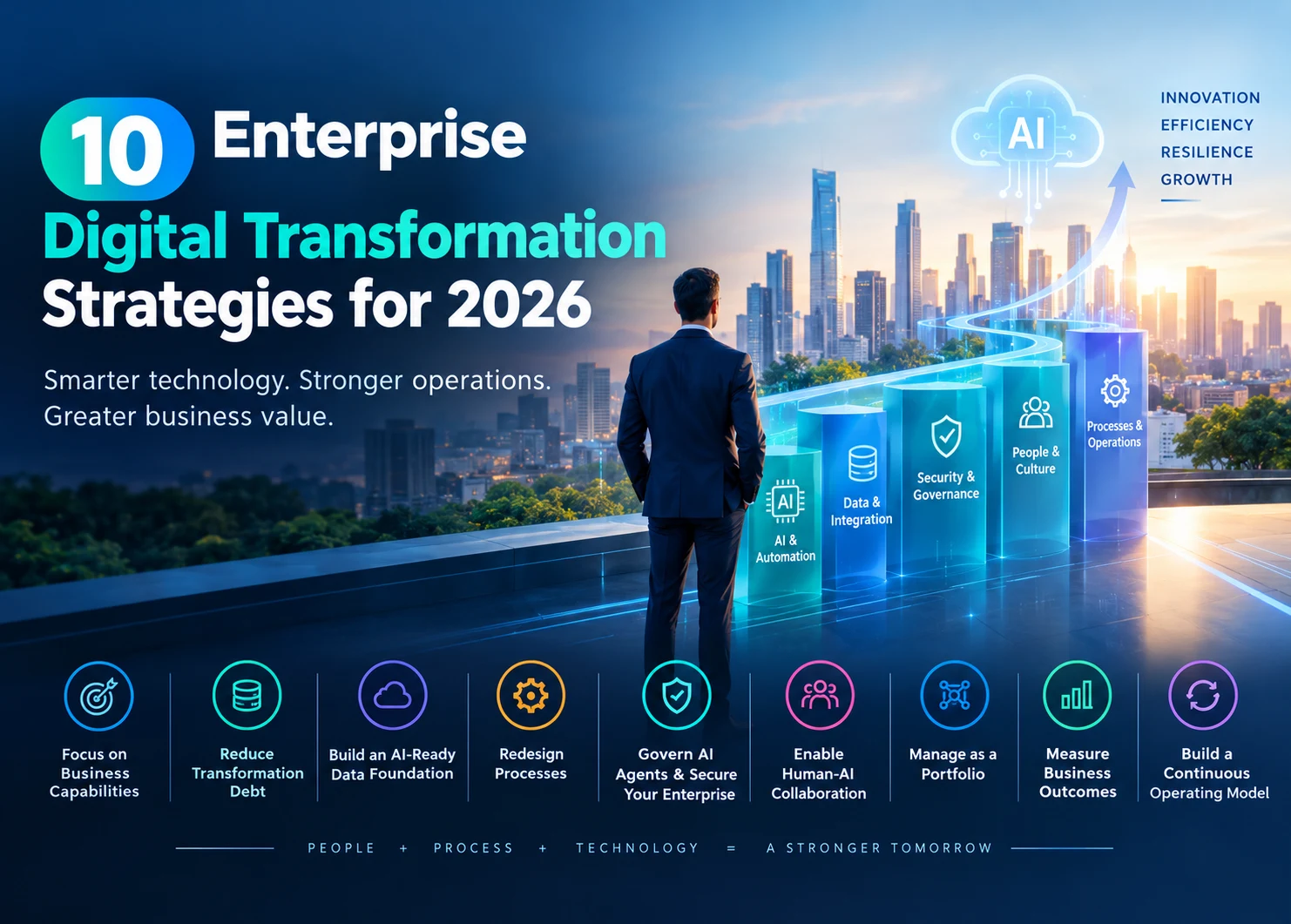

.png)