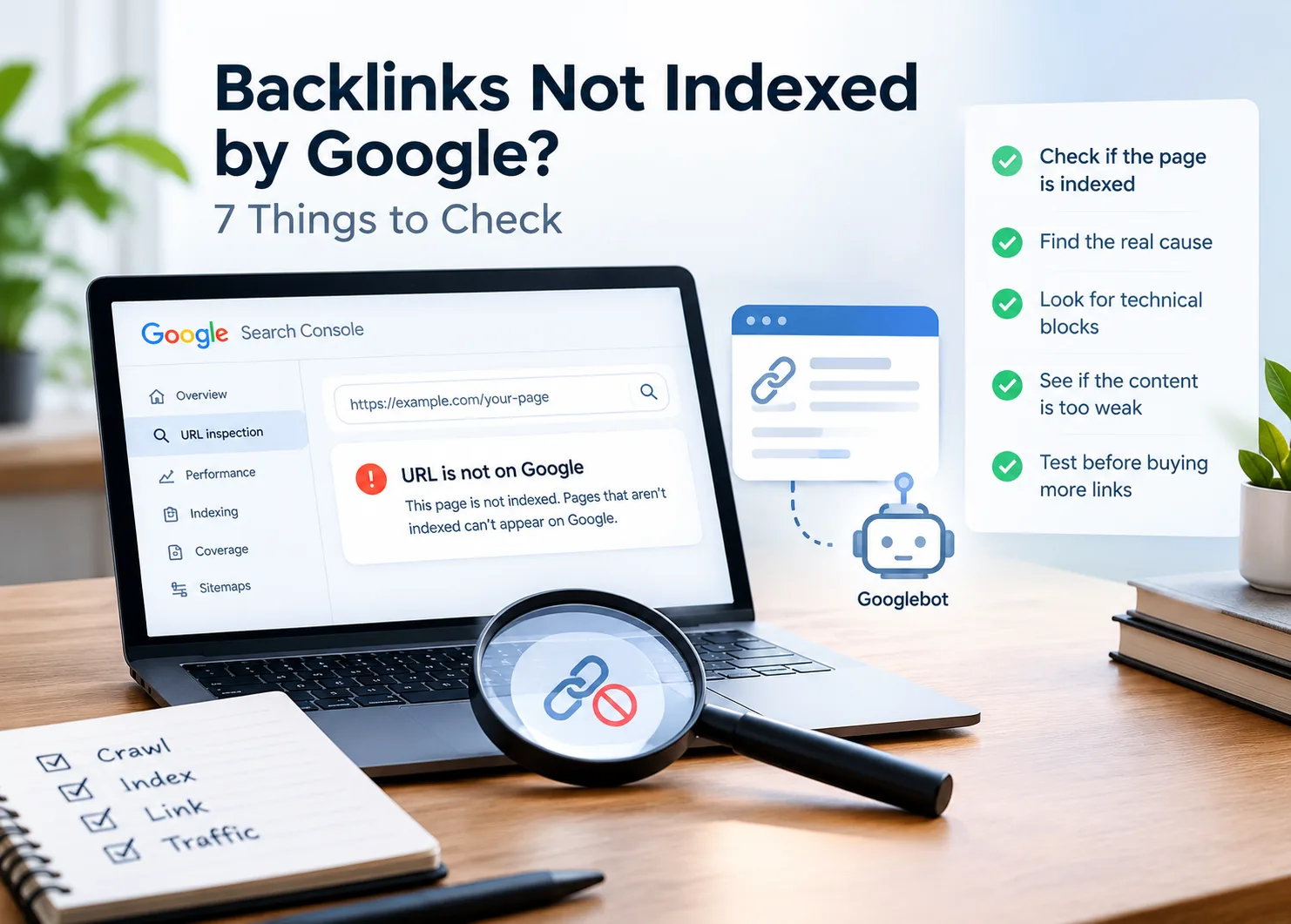
If Google has never crawled a backlink, that link transfers no value at all. You can pay for twenty placements in a month and still see a flat graph, because the crawler simply has not visited the pages that mention you. That gap between "published" and "counted" is where most link budgets quietly leak.
The fix usually starts with diagnosis rather than spending. Walkthroughs from SEO specialists from GritlLaders are a handy reference for how crawl and indexing reports are read in practice, and the checks below follow the same logic: confirm the page exists in the index, find out why it does not, then decide whether more links would even help.
First, Confirm the Link Is Really Missing
Load the page that holds your link and inspect it from the crawler's point of view. Copy the exact URL, paste it into the URL Inspection tool in Search Console (it works for any property you own, so use a page on your own site that the link points to) and, for the donor page, run a site: query with the full address. If the donor URL returns nothing, the link cannot be counted yet.
Two quick habits save hours. Check the date the page went live, because fresh pages on low-traffic sites often wait two to six weeks for a first visit. Then view the source and search for your domain, since a link added through a script may never appear in the raw HTML.
Symptom | Likely cause | First thing to check |
Donor URL absent from site: search | Page never crawled | Is it linked from the donor's own menus or archives? |
Page indexed, link not reported | Link rendered by JavaScript | View source for the anchor tag |
Page crawled, then dropped | Thin or duplicate content | Word count and near-copies elsewhere |
Link carries nofollow or ugc | Policy of the donor site | Rel attribute in the anchor tag |
Whole site missing from results | Noindex tag or robots block | Meta robots and robots.txt |
Blocks You Can Spot in Five Minutes
Start with the cheap culprits. A stray noindex meta tag left from a staging build is the classic one: the page looks perfect in a browser and is invisible to search. A robots.txt rule such as Disallow: /blog/ does the same job at folder level.
Next, look at the canonical tag. If the donor page points its canonical to another address, Google treats your page as a copy and often keeps only the original. Run through this order every time:
- Load the page with a user-agent switcher and confirm it returns status 200.
- Search the source for noindex and for X-Robots-Tag in the headers.
- Read the canonical URL and confirm it matches the page address.
- Check that the anchor tag sits in the body text, not a script block.
- Note the rel value on the link itself.
Anything that fails here is a reason to ask the site owner for a correction, not to buy another placement. Understanding how backlinks work in SEO also means evaluating the relevance of the referring page, the placement of the link, and whether the page can be discovered and indexed by search engines
Weak Pages That Google Chooses to Skip
Sometimes nothing is blocked and the page is still ignored. Google has said many times that it does not index everything it finds, and a crawled-but-not-indexed status in Search Console is common for pages with a few hundred words of generic text and no inbound links of their own.
Picture a guest post on a site with 40 articles, no internal links pointing to it and a sitemap last updated in 2022. The crawler may know the address and still rank it near the bottom of its queue. Such a placement is cheap for a reason.
What to Do Before Buying Another Batch
Treat the next purchase as an experiment with a control group. Spend on a small set, wait the crawl window, and measure how many of those pages reach the index before scaling the order. Ask each seller for the donor URL before payment, not a vague domain name. Then check three numbers: how many of the site's pages are indexed, whether those pages get any organic visits, and whether new posts appear in the index within a fortnight of publication. A site that fails the third test will keep failing it for your link too.
Where a link is stuck, there are a few legitimate nudges that work without any tricks:
- Link to the donor page from a page of your own that is already indexed, such as a news roundup or resource list.
- Include the donor URL in an XML sitemap you control and resubmit it in Search Console.
- Share the page where real people read it, because genuine visits and mentions give crawlers more reasons to return.
- Ask the donor site to add the post to its homepage feed or category archive for a week.
- Recheck after 30 days and replace placements that stay invisible.
Skip mass pinging services and bot networks. Such tactics create clutter, burn budget and often leave traces that hurt more than the absent link would have. Rather than buying more placements automatically, focus on quality backlink building strategies that prioritize relevant publishers, useful content, and genuine editorial relationships.
Read More Blogs On: