Every Google search has a purpose. You might be looking for an answer, trying to find a particular website, comparing products, or ready to make a purchase.
But here's the challenge: two keywords about the same topic can represent completely different user intentions. Targeting them with the wrong content can attract visitors without satisfying what they came for.
That's why understanding the different types of keywords in SEO is essential. It helps you:
- Identify search intent: Understand what users want when they enter a query.
- Choose the right keywords: Look beyond search volume and keyword difficulty.
- Match keywords with pages: Decide whether a query needs a blog, comparison guide, product page, or service page.
- Improve content relevance: Provide answers and experiences that match user expectations.
- Plan for SEO and AI search: Structure content around direct answers and relevant supporting questions.
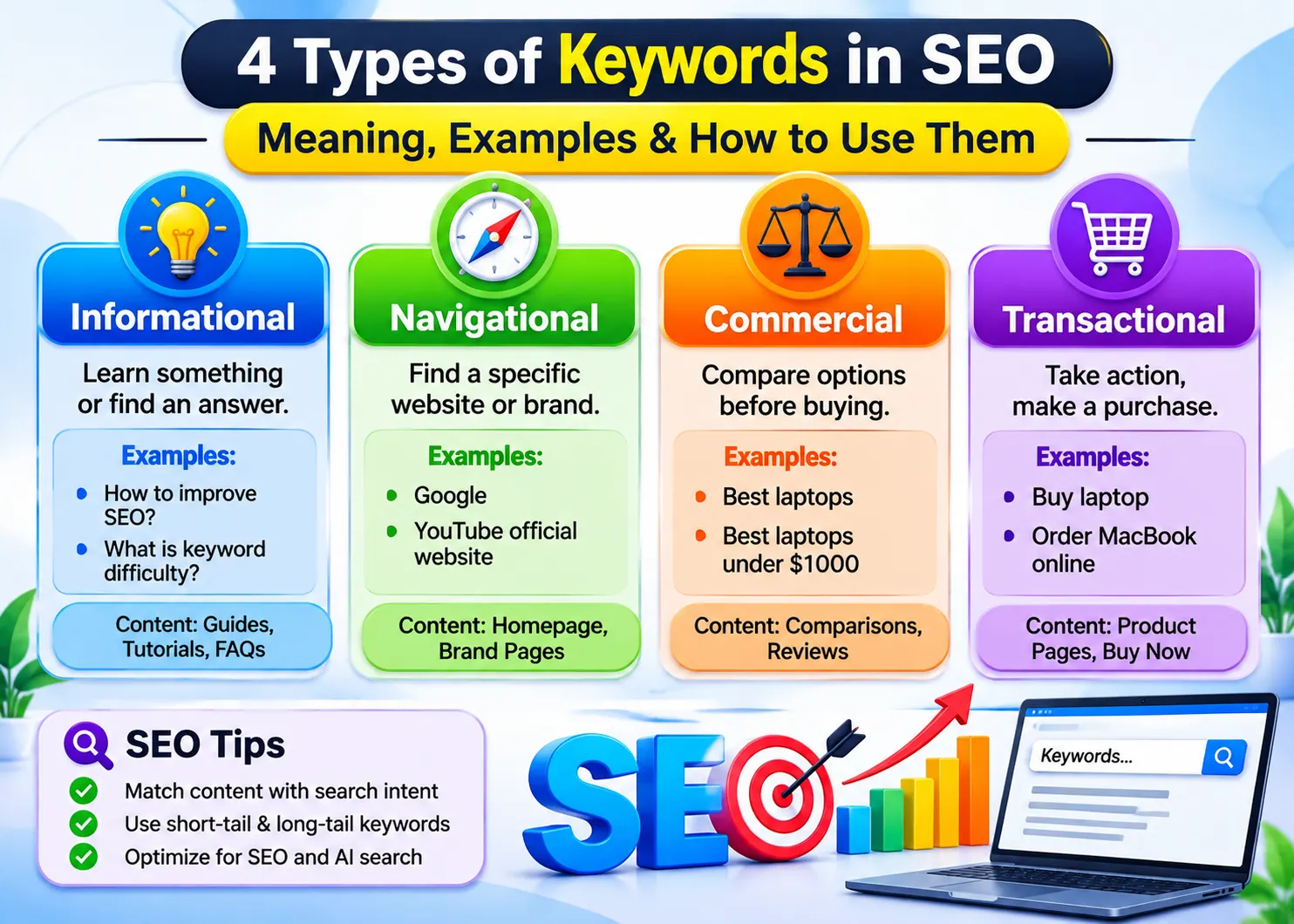
In this guide, we'll explore the four types of keywords—informational, navigational, commercial, and transactional—with practical examples, short-tail and long-tail comparisons, and actionable optimization techniques.
Key Takeaways
- Four keyword types: Informational, navigational, commercial, and transactional—each reflects a different search intent.
- Match content to intent: Use guides for learning, official pages for navigation, comparisons for research, and product or service pages for conversions.
- Short-tail vs long-tail: Both can serve any search intent; keyword length alone doesn't determine intent.
- Analyze search results: Use Google's SERP, Semrush, and Ahrefs to identify intent and choose the right content format.
- Optimize for SEO and AI search: Prioritize clear answers, useful comparisons, accurate information, and credible evidence.
- Focus on outcomes: Target relevant traffic and measure engagement, enquiries, and conversions.
Four Types of SEO Keywords at a Glance
Keyword type | What the user wants | Short-tail / broad keyword | Long-tail / specific keyword | Suitable content |
|---|
Informational | Learn something, understand a topic, or solve a problem | Smartphone features | How much RAM do I need in a smartphone for gaming? | Educational blog posts, how-to guides, tutorials, FAQs |
Navigational | Find a particular brand, website, product, or webpage | Samsung | Samsung Galaxy smartphones official website | Official homepages, branded product pages, store locators |
Commercial | Compare products, examine features, and evaluate options before choosing | Best smartphones | Best smartphones under $500 with good cameras | Product comparisons, detailed reviews, best-of lists, buying guides |
Transactional | Purchase a product, book a service, or complete an action | Buy smartphones | Buy Samsung Galaxy S25 256GB online | Product pages, ecommerce category pages, pricing pages, booking or service pages |
These examples show how searches around the same product category can represent different intentions. A person researching smartphone specifications needs educational content, while someone comparing models needs reviews and product comparisons. A search for a specific brand suggests a destination, whereas a purchase-focused query requires an accessible buying option.
The key distinction: Search intent determines the type of content a query needs. Keyword length and specificity provide additional context, but don't determine intent on their own.
Informational keywords are search queries people use when they want to learn something, understand a concept, or find a solution to a problem. These searches typically indicate a need for information rather than an immediate intention to purchase.
Someone searching for “how much RAM do I need in a smartphone?” First, I want to understand how memory affects performance. Similarly, “how to improve website speed” calls for instructions, while “what is keyword difficulty” calls for a definition.
Informational searches often include what, why, how, when, and where. However, queries such as “smartphone battery life” or “perimenopause symptoms” can also be informational without being phrased as questions.
Broad queries can support different interpretations. More specific questions usually make the information need easier to identify. The following examples illustrate that distinction; they are not presented as volume-verified classifications.
Industry | Short-tail / broad keyword | Long-tail / specific keyword | Suitable content |
|---|
Smartphones | Smartphone features | How much RAM do I need in a smartphone for gaming? | Buying education guide |
Ecommerce | Product descriptions | How to write product descriptions for Shopify | Step-by-step tutorial |
SEO | Keyword research | How to find low-competition keywords for a new website | Practical guide |
AI & technology | AI image generation | How do AI image generators work? | Explainer |
Healthcare | Perimenopause symptoms | What are the early signs of perimenopause in your 40s? | Medical education |
Fitness | Strength training | How to start strength training at home for beginners | Beginner guide |
Skincare | Skin barrier | How to repair a damaged skin barrier | Educational guide |
Finance | Credit score | How is a credit score calculated? | Explainer |
Education | English grammar | How to use present perfect tense correctly | Tutorial |
Cybersecurity | Phishing emails | How to identify a phishing email | Safety guide |
Web development | Website speed | How to improve WordPress website loading speed | Technical tutorial |
Travel | Japan weather | What is the best time to visit Japan for cherry blossoms? | Travel guide |
Home appliances | Air conditioner capacity | What size AC do I need for a 150 sq ft room? | Buying education |
Automotive | Car maintenance | How often should you change engine oil? | Maintenance guide |
Real estate | Home buying process | What documents are required to buy a house? | Checklist |
Food & nutrition | Protein intake | How much protein do adults need per day? | Evidence-based guide |
Informational keywords are relevant to businesses as well as publishers. An air-conditioner retailer, for example, can explain how to select the appropriate cooling capacity before guiding readers toward a product category. The educational answer comes before the sales action.
Want More Long-Tail Keyword Examples?
Looking for more examples? Explore our guide toLong-tail Keyword Examples.
Informational keywords work best on pages designed to explain, instruct, or solve a problem. The required depth depends on the complexity of the question.
Format | When it fits | Example |
|---|
Definition article | A concise explanation is sufficient | What is keyword difficulty? |
How-to tutorial | The user must complete a process | How to create a Shopify store |
Step-by-step guide | Several actions are involved | How to do keyword research |
Troubleshooting guide | The user needs to diagnose a problem | Why is my laptop overheating? |
Educational buying guide | The user needs selection criteria | How to choose running shoes |
Comparison explainer | The user wants conceptual differences | Difference between RAM and storage |
Knowledge base | A product feature needs explanation | How to reset a router |
Short FAQ | A supporting question has a concise answer | How long does a laptop battery last? |
An article answering “what does RAM stand for?” does not need the same depth as a guide to choosing a laptop for video editing. Match the format and detail to the question, not an arbitrary word count.
Informational optimization requires a clear answer, relevant supporting coverage, and accessible evidence. It is not a matter of repeating an exact-match query through headings.
1. Cover the Topic, Not Just One Keyword
Consider an ecommerce store targeting “how to choose running shoes.” Alongside fit and cushioning, the reader may need to understand running surfaces, intended use, and replacement. Group tightly related questions in one guide, and create supporting articles only for distinct topics that need more depth.
Main guide | Supporting topic | Why it helps |
|---|
How to Choose Running Shoes | Running Shoes vs Walking Shoes | Understand product differences |
How to Choose Running Shoes | How Should Running Shoes Fit? | Select a suitable fit |
How to Choose Running Shoes | Types of Running Shoes | Understand available designs |
How to Choose Running Shoes | When to Replace Running Shoes | Identify replacement considerations |
SEO tip: Build topic clusters around actual user questions, not one new URL for every slight variation of a keyword.
2. Provide the Answer Before the Detailed Explanation
For “what is keyword difficulty?”, an opening such as “SEO involves many different factors” delays the answer. A stronger response starts: “Keyword difficulty (KD) is an SEO metric estimating how challenging it may be to rank organically for a search query. Different tools use different methodologies, so their scores can vary.”
The article can then explain how difficulty is calculated, what the estimate omits, and how to evaluate competing pages. A direct answer helps users locate information quickly; it does not guarantee a featured snippet or an AI citation.
3. Structure Clear, Self-Contained Sections
An article on smartphone battery life can separately explain battery capacity, screen brightness, battery health, and background activity. Each section should answer its own question with relevant evidence, without repeating the main definition. Use descriptive headings rather than artificial keyword permutations.
For “how to choose a laptop for video editing,” the reader may need to evaluate RAM, processors, graphics, display color accuracy, and storage. Search Console, relevant SERP questions, research tools, and official documentation can reveal these information needs.
Some AI-search experiences may examine related subtopics, including through query fan-out. Publishers cannot reliably know every internal search issued by an AI system. Cover follow-up questions because they help readers make progress, not because they promise citations.
Information | Best format | Example |
|---|
Definition | Concise paragraph | What is keyword difficulty? |
Process | Numbered steps | How to research keywords |
Comparison | Table | SSD vs HDD |
Requirements | Checklist | Documents needed for registration |
Technical demonstration | Real annotated screenshot | Using keyword filters |
Complex concept | Explanation plus examples | How search intent affects page selection |
Tables support comparison; numbered lists support sequential tasks. Explanatory paragraphs remain important when users need to understand the reasoning behind a recommendation.
6. Provide Original Evidence and Reliable Sources
Use real interface screenshots, verified specifications, documented tests, official documentation, and relevant primary sources. For a keyword tutorial, show which filters were applied and how the SERP was evaluated rather than attaching an unexplained dashboard image.
7. Explain Entities and Terminology Accurately
If a smartphone guide discusses RAM, internal storage, CPU, and GPU, distinguish what each term means. A clear explanation of product and feature relationships helps users interpret the information; repeatedly mentioning brands does not establish expertise.
8. Maintain Accuracy and Technical Accessibility
Check whether instructions, links, and interface screenshots remain current. Ensure essential information is available as text, and that public pages intended to appear in search are accessible. Structured data may clarify eligible page information but does not guarantee AI-search inclusion.
For “how to choose running shoes,” a useful buying guide should explain fit, comfort, support, surfaces, and intended use before linking to relevant product categories. It should not behave like a product catalog under an informational headline.
Page element | Recommended implementation |
|---|
SEO title | How to Choose Running Shoes: Fit, Cushioning & Buying Guide |
H1 | How to Choose the Right Running Shoes |
Opening answer | Explain the key selection factors succinctly |
Main sections | Fit, surfaces, cushioning, support, intended use |
Visuals | Authentic shoe-fit illustrations and product photographs |
Follow-up questions | Sizing, replacement, running versus walking |
Next step | Relevant footwear category after the educational guidance |
- Validate intent first: Broad queries may show commercial or mixed results.
- Answer promptly: Do not bury the solution under introductory filler.
- Demonstrate, do not decorate: Screenshots and tables should clarify real decisions.
- Cover the next useful question: Avoid unrelated FAQ expansion.
- Use credible evidence: Distinguish firsthand tests from published claims.
- Link naturally: Keep the page focused and link out when a related topic needs deeper treatment.
Quick Optimization Checklist: Traditional SEO vs AI Search
Area | Traditional SEO action | AI / answer-engine consideration |
|---|
Keyword research | Check search intent, demand, and SERPs | Research relevant conversational needs |
Topic coverage | Address principal and related subtopics | Keep enough context for follow-up questions |
Direct answer | Answer the main query early | Make individual explanations understandable |
Content structure | Use clear headings and page hierarchy | Use coherent sections and appropriate tables |
Evidence | Cite primary sources and real experience | Make claims and support identifiable |
Internal links | Connect relevant pages | Clarify relationships without duplication |
Technical accessibility | Maintain indexability and usable content | Provide important information in accessible text |
Maintenance | Update instructions and facts | Keep information dependable |
Key takeaway: Informational keywords serve people who need to understand a subject or complete a task. Strong pages answer clearly, explain the reasoning, and support the explanation with relevant evidence.
2. Navigational Keywords: Meaning, Examples & How to Optimize Them
Navigational keywords are search queries people use to find a specific website, brand, product, or webpage they already know about. Their immediate objective is to reach the intended destination, not explore an unfamiliar topic.
Someone searching for “Canva login” usually wants to sign in, while “YouTube Studio” identifies the creator dashboard. A shopper entering “Samsung official website” is seeking a known brand rather than asking Google to compare smartphone manufacturers.
A branded term does not automatically mean navigational intent. “Samsung vs Apple” is comparative, and “Samsung Galaxy review” is primarily commercial.
Examples of Navigational Keywords Across Industries
Industry | Short-tail / broad query | Long-tail / specific query | Expected destination |
|---|
Ecommerce | Amazon | Amazon customer service contact page | Official support resources |
Smartphones | Samsung | Samsung Galaxy smartphones official website | Official product category |
Sportswear | Nike | Nike official running shoes store | Official brand store |
Design software | Canva | Canva account login | Official sign-in |
SEO software | Semrush | Semrush Keyword Magic Tool | Named product tool |
Analytics | Google Analytics | Google Analytics account login | Analytics access |
Video | YouTube | YouTube Studio dashboard | Creator dashboard |
AI software | ChatGPT | ChatGPT official website | Official product |
Professional network | LinkedIn | LinkedIn company page login | Company/account interface |
Ecommerce platform | Shopify | Shopify admin login | Administration |
Payment services | PayPal | PayPal business account login | Business account |
Education | Coursera | Coursera learner dashboard | Learning account |
Travel | Airbnb | Airbnb host login | Host account |
Healthcare | Mayo Clinic | Mayo Clinic appointment website | Official appointments |
Technology | Microsoft | Microsoft 365 account login | Account access |
Web development | WordPress | WordPress plugin directory | Official plugin directory |
These are real brands and known destinations, but the illustrative search phrases are not represented as verified volume measurements. Brand-only queries can have mixed intent.
Curious About Short-Tail and Long-Tail Keywords?
Want to understand the difference? Read our detailed guide onShort-tail vs Long-tail Keywords for practical explanations and examples.
Are All Branded Keywords Navigational?
No. A branded query tells you which brand is mentioned, but its wording and the SERP reveal whether the user wants an official destination, a tutorial, comparison, or subscription.
Query | Likely intent | What the user wants |
|---|
Canva | Primarily navigational, potentially mixed | Find the brand/product |
Canva login | Navigational | Sign in |
How to use Canva | Informational | Learn a task |
Canva vs Adobe Express | Commercial | Compare tools |
Canva Pro pricing | Commercial or transactional | Assess plans or subscribe |
Subscribe to Canva Pro | Transactional | Purchase a subscription |
SEO tip: Do not classify every query containing a brand name as navigational. Review the destination users are trying to reach.
Where Should You Use Navigational Keywords?
User need | Suitable page | What should be accessible |
|---|
Find a business | Homepage | Brand identity and primary navigation |
Access an account | Login page | Sign-in and recovery |
Find a named product | Official product page | Identity, key information, access |
Find a tool | Feature page | Tool purpose and entry point |
Contact a business | Contact page | Accurate contact channels |
Find a location | Location page | Address, directions, hours |
Get help | Support center | Support pathways |
Read documentation | Official knowledge base | Product-specific documentation |
A navigational search typically requires the right destination rather than a longer article. A user searching for an admin login should not have to read a general platform explainer.
How to Optimize Navigational Keywords for SEO
1. Identify the Brand Queries People Use
Start with company names, main product names, abbreviations, common misspellings, and destination-specific combinations such as brand + login, support, contact, or location. Search Console can show branded queries already generating impressions; Ahrefs or Semrush can help assess related variations and intent labels. Validate ambiguous terms against live results.
Group searches by destination. Several variations may lead to one existing official page rather than requiring new URLs.
2. Make the Homepage and Brand Identity Recognizable
Use the official brand name consistently in relevant titles, headings, and visible information. The homepage should clearly identify the organization and offer useful navigation to its main products, services, or account resources. Do not repeat misspellings or every keyword variant unnaturally.
3. Optimize Named Product and Service Pages
Specific query | Expected official destination |
|---|
Shopify admin login | Administrative account access |
Semrush Keyword Magic Tool | Official named tool |
Nike store locator | Official store locator |
Microsoft 365 support | Official support resources |
Samsung Galaxy smartphones | Official product category |
Distinct landing pages make sense for actual products, features, services, or locations that deserve their own destination. They do not make sense merely to capture closely related branded phrases.
4. Improve Internal Navigation and Organic Sitelink Eligibility
Link important destinations logically through the site architecture. Descriptive page titles, headings, anchor text, and menus can help visitors and search engines understand the hierarchy. Google chooses organic sitelinks automatically; publishers cannot force them through special “sitelinks markup.”
Organization or LocalBusiness structured data can describe applicable identity, logo, address, contact, and official profile information when it accurately reflects visible website content. It does not guarantee a knowledge panel, sitelinks, or AI citations.
6. Maintain Accurate Local Business Information
For eligible physical and service-area businesses, keep Google Business Profile and official site information aligned: business name, location or service area, hours, phone number, and website links. Google-generated knowledge panels are not wholly controlled by businesses.
7. Consider Branded PPC Separately
Defensive branded advertising may be useful in competitive situations, but it is an optional paid-search decision, not a requirement of navigational SEO. Evaluate competitor bidding, incremental conversions, and existing organic visibility before investing.
8. Keep Important Destinations Working
Check public page indexability where relevant, redirects, broken internal links, canonical URLs, and mobile access. Secure account content can remain private while the intended official login destination remains usable.
Practical Tips for Navigational Keywords
- Separate branded from navigational: Reviews, alternatives, and pricing searches may have different intent.
- Improve the existing destination first: Do not publish redundant branded pages.
- Use recognizable names: Describe official products and resources accurately.
- Audit branded results: Check which URL actually appears for important destination-specific queries.
- Maintain current local details: Keep contact and location information correct.
- Do not impersonate competitor destinations: A third-party tutorial is not an official login page.
Quick Optimization Checklist: Traditional SEO vs AI Search
Area | Traditional SEO action | AI / answer-engine consideration |
|---|
Keyword research | Identify branded and destination-specific queries | Check accurate recognition of official brands |
Brand identity | Use consistent naming and page titles | Provide factual organization/product information |
Homepage | Clear brand identity and navigation | Explain official services and relationships |
Product/service pages | Accessible named destinations | Identify features and ownership correctly |
Internal links | Connect important official pages | Maintain clear entity/page relationships |
Structured data | Use accurate applicable markup | Do not claim markup guarantees citations |
Local visibility | Maintain eligible Business Profile | Keep location and service facts consistent |
Technical SEO | Check indexability, redirects, mobile access | Keep public destinations usable |
Key takeaway: Navigational SEO makes official destinations easy to recognize and reach. Its focus is accurate branding, clear architecture, and working access—not generating additional pages for every brand variation.
3. Commercial Keywords: Meaning, Examples & How to Optimize Them
Commercial keywords are search queries people use to research, compare, or evaluate products and services before deciding which option to choose. These searches indicate potential purchase interest, but the user still needs information to make an informed decision.
Someone who has learned which smartphone features matter may next search for “iPhone 17 vs iPhone 16.” Someone searching “Sony WH-1000XM6 review” wants to assess a named product, while “Shopify vs WooCommerce” indicates an evaluation of competing ecommerce platforms. In each case, the immediate task is comparison—not checkout.
Words such as best, top, review, versus, alternatives, and pricing can signal commercial intent, but they are clues rather than fixed rules. Confirm the intent against the actual search results.
Examples of Commercial Keywords Across Industries
Industry / product | Short-tail / broad keyword | Long-tail / specific keyword | Suitable content |
|---|
Smartphones | Best iPhones | iPhone 17 vs iPhone 16 | Model comparison |
Smartphones | Samsung vs iPhone | Samsung Galaxy S25 vs iPhone 16 | Head-to-head comparison |
Headphones | Sony headphones review | Sony WH-1000XM6 vs WH-1000XM5 | Product comparison |
Cameras | Canon cameras | Canon EOS R50 review for beginners | Camera review |
Vacuum cleaners | Dyson vacuum review | Dyson V15 Detect vs Dyson V12 Detect Slim | Product comparison |
Running watches | Garmin watches | Garmin Forerunner 265 vs Forerunner 255 | Fitness-watch comparison |
Laptops | MacBook Air review | MacBook Air vs MacBook Pro for students | Buying guide |
Tablets | iPad comparison | iPad Air vs iPad Pro for graphic design | Product comparison |
Gaming consoles | PlayStation consoles | PS5 vs PS5 Pro performance comparison | Console comparison |
Ecommerce platforms | Shopify vs WooCommerce | Shopify vs WooCommerce for small businesses | Platform comparison |
Design software | Canva alternatives | Canva vs Adobe Express for social media design | Software comparison |
SEO software | Ahrefs vs Semrush | Ahrefs vs Semrush for keyword research | Tool comparison |
CRM software | HubSpot vs Salesforce | HubSpot vs Salesforce for small businesses | SaaS comparison |
Website builders | Wix vs Squarespace | Wix vs Squarespace for online portfolios | Platform comparison |
Action cameras | GoPro review | GoPro HERO13 Black vs DJI Osmo Action 5 Pro | Camera comparison |
E-readers | Kindle vs Kobo | Kindle Paperwhite vs Kobo Libra Colour | Product comparison |
These examples span different purchase decisions. A headphone buyer may prioritize comfort, noise cancellation, and microphone performance; a business choosing Shopify or WooCommerce may prioritize customization, maintenance, and total ownership costs. The comparison criteria must reflect the category.
Where Should You Use Commercial Keywords?
Content format | When it fits | Example query |
|---|
Individual review | One named product needs evaluation | Sony WH-1000XM6 review |
Head-to-head comparison | Two named options are being compared | iPhone 17 vs iPhone 16 |
Best-of guide | Readers want a shortlist | Best cameras for beginners |
Alternatives page | Users seek substitutes | Canva alternatives |
Buying guide | Users have requirements but no model selected | Best mirrorless camera for travel |
Software comparison | Platforms or tools are being evaluated | Shopify vs WooCommerce |
Service-provider comparison | Businesses are evaluating suppliers | Best ecommerce SEO agencies |
Pricing comparison | Cost influences the decision | HubSpot vs Salesforce pricing |
For a specific review query, a general category article may be too broad. For a “vs” query, a single-product landing page is typically insufficient. Match the page to the evaluation task.
How to Optimize Commercial Keywords for SEO and AI Search
1. Research and Cluster Keywords by Commercial Intent
Identify review, comparison, alternatives, best-of, pricing, and use-case searches. Use Google results, Semrush, or Ahrefs to understand whether multiple phrases express the same core decision. Do not create thin pages for minor wording changes, but keep materially different tasks separate: “Sony WH-1000XM6 review” and “Sony WH-1000XM6 vs WH-1000XM5” may deserve different pages.
Broad / short-tail-style query | Specific / long-tail-style query | Suitable destination |
|---|
Sony headphones | Sony WH-1000XM6 review for commuting | Individual review |
Sony headphones comparison | Sony WH-1000XM6 vs WH-1000XM5 | Head-to-head comparison |
Best headphones | Best wireless noise-cancelling headphones for travel | Buying guide |
Shopify vs WooCommerce | Shopify vs WooCommerce for small businesses | Platform comparison |
2. Make the Page’s Purpose Clear in On-Page Elements
Use a descriptive title, H1, URL, and opening that identify the comparison. For example, “Sony WH-1000XM6 vs WH-1000XM5: Key Differences Compared” precisely describes the task. Do not repeat the exact keyword mechanically in every heading; there is no mandatory first-100-words rule.
3. Give Readers a Quick Comparison Before Detailed Analysis
Lead with the factors buyers care about. For an iPhone comparison, these may include display, processor, camera, battery, design, software, price, and who each model suits. Populate these factors using confirmed product specifications and tests—not invented winners or unsupported numerical ratings.
4. Choose Category-Specific Evaluation Criteria
Headphones require sound quality, noise cancellation, comfort, microphone and battery analysis. Cameras require lens ecosystem, autofocus, image quality and usability. Ecommerce platforms require setup, flexibility, integrations, maintenance and total cost. A universal product-review template cannot do all of these decisions justice.
Category | Useful comparison factors |
|---|
Headphones | Noise cancellation, sound, call quality, comfort, battery |
Mirrorless cameras | Autofocus, sensor, lenses, video, handling |
Smartphones | Camera, battery, performance, software support, cost |
Ecommerce platforms | Setup, customization, SEO, integrations, total ownership cost |
Service providers | Expertise, scope, documented results, reporting, project fit |
5. Establish Evidence and Disclose the Evaluation Method
Use original testing when available, verified specifications, real screenshots, and credible independent evidence. Explain test conditions and distinguish firsthand observations from manufacturer claims. If no hands-on test occurred, do not label the content a hands-on review.
6. Explain Strengths, Limitations, and Who Each Option Suits
Describe trade-offs rather than declaring a universal winner. A lighter camera may suit beginners better, while another model may be better for advanced controls. A managed platform may suit teams prioritizing simplicity, while another option may better fit developers seeking control.
7. Compare Total Costs, Not Only Advertised Prices
For software, consider subscriptions, extensions, support, development, and maintenance. For products, account for relevant accessories and warranties. Clearly state assumptions and verify current offers before publication.
8. Address Genuine Follow-Up Questions and AI Search
Research People Also Ask, search suggestions, customer questions, and review comments. Include questions that materially influence selection—for example, whether upgrading from Sony WH-1000XM5 to WH-1000XM6 is worthwhile. AI search may explore related subtopics through query fan-out, but the precise internal queries are not generally visible. Concise, supported answers help readers; they do not guarantee an AI citation.
9. Clarify Product Entities and Keep Content Accessible
Use accurate model identifiers, generations, features, and official references. Organize comparisons with descriptive headings and readable tables. Keep important information available in page text, and link to relevant official specifications rather than inventing performance data.
10. Monitor Updates and AI-Search Representation
Check availability, prices, model changes, software plans, and recommendation accuracy. For AI-search audits, record platform, prompt, date, source citations if shown, and notable omissions. Treat individual responses as variable observations, not stable rankings.
Practical Example 1: iPhone 17 vs iPhone 16
For “iPhone 17 vs iPhone 16,” readers want an evidence-led assessment of whether the differences justify choosing one model. Begin with a quick specification comparison, then explain camera, battery, display, performance, software, and value. Do not declare a winner before establishing the criteria.
Page element | Recommended content |
|---|
SEO title / H1 | iPhone 17 vs iPhone 16: Features, Cameras & Value Compared |
Quick comparison | Verified specifications and key differences |
Detailed analysis | Display, cameras, battery, performance and software |
Evidence | Official specifications and relevant independent tests |
Decision guidance | Which model suits different buyers and budgets |
Next step | Relevant official product or retail pages |
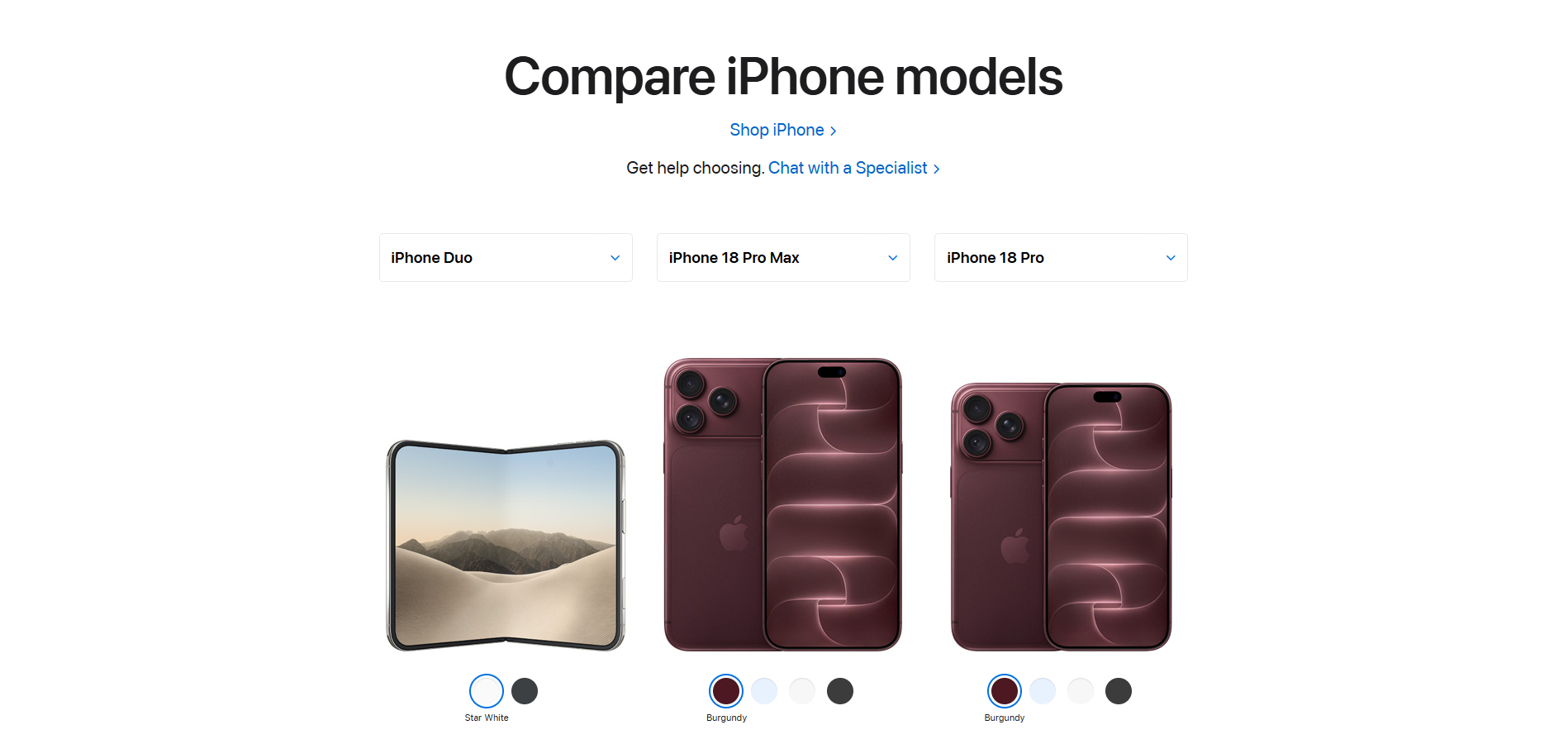
Official real-product reference: Apple iPhone Compare
This is a product comparison reference, not a Google SERP screenshot.
How Do Commercial and Transactional Keywords Differ?
Commercial query | Transactional query | Primary distinction |
|---|
iPhone 17 vs iPhone 16 | Buy iPhone 17 online | Compare vs purchase |
Sony WH-1000XM6 review | Buy Sony WH-1000XM6 | Evaluate vs shop |
Shopify vs WooCommerce | Subscribe to Shopify | Select platform vs subscribe |
Best CRM software | Start CRM free trial | Explore vs register |
Best SEO agencies | Hire SEO agency | Compare providers vs enquire |
Some pricing queries exhibit mixed intent. Confirm whether the SERP favors comparisons, pricing pages, or purchase-ready destinations before selecting the content format.
Practical Tips for Commercial Keywords
- Identify the decision being made, not only the keyword modifier.
- Lead with a comparison summary, followed by meaningful evidence.
- Use real products and current specifications.
- Disclose what was tested and what was researched.
- Explain limitations and recommend by user need.
- Make pricing assumptions explicit.
- Use official references and update changing details.
Quick Optimization Checklist: Traditional SEO vs AI Search
Optimization area | Traditional SEO action | AI / answer-engine consideration |
|---|
Research | Identify review, vs, alternatives and best-of queries | Research meaningful supporting questions |
Clustering | Group by shared evaluation task | Cover related subtopics without repetition |
On-page | Use descriptive titles, H1 and headings | Make the comparison task clear |
Comparisons | Show accurate specs and trade-offs | Keep findings independently understandable |
Evidence | Original testing and verified sources | Support conclusions with identifiable evidence |
Pricing | Verify costs and restrictions | Explain assumptions and terms |
Entities | Use exact model and brand names | Clarify relationships between alternatives |
Technical | Accessible, indexable, readable content | Avoid hiding key information in images |
Maintenance | Update products, features and prices | Review stale or missing facts |
AI audit | Assess search visibility and content gaps | Record actual prompts, sources and dates |
4. Transactional Keywords: Meaning, Examples & How to Optimize Them
Transactional keywords are search queries used when someone intends to complete an action—purchase a product, book a service, start a subscription, register, or request a quote. They often indicate a later stage of the decision journey, though users may still need practical information before acting.
A search for “iPhone 17 vs iPhone 16” suggests comparison. “Buy iPhone 17 online” indicates a purchasing task. Likewise, “Shopify vs WooCommerce” is commercial, while “subscribe to Shopify” is transactional. Modifiers such as buy, order, book, hire, sign up, subscribe, and quote provide clues, but the results still need validation.
Examples of Transactional Keywords Across Industries
Industry / real product | Short-tail / broad keyword | Long-tail / specific keyword | Suitable page |
|---|
Smartphones | Buy iPhone | Buy Apple iPhone 17 online | Product / retail page |
Headphones | Buy Sony headphones | Buy Sony WH-1000XM6 headphones | Product page |
Cameras | Buy Canon camera | Buy Canon EOS R50 mirrorless camera | Product page |
Vacuum cleaners | Buy Dyson vacuum | Buy Dyson V15 Detect vacuum cleaner | Product page |
Running watches | Buy Garmin watch | Buy Garmin Forerunner 265 online | Product page |
Gaming consoles | Buy PlayStation | Buy Sony PlayStation 5 Pro | Product page |
Tablets | Buy iPad | Buy Apple iPad Air online | Product page |
Laptops | Buy MacBook | Buy Apple MacBook Air | Product page |
E-readers | Buy Kindle | Buy Kindle Paperwhite online | Product page |
Action cameras | Buy GoPro | Buy GoPro HERO13 Black | Product page |
Ecommerce software | Shopify subscription | Start Shopify subscription | Pricing / signup |
Design software | Canva Pro subscription | Subscribe to Canva Pro | Subscription page |
CRM software | HubSpot CRM trial | Start HubSpot CRM free trial | Signup page |
SEO software | Semrush subscription | Subscribe to Semrush SEO toolkit | Subscription page |
Web development | Hire Shopify developer | Request Shopify website development quote | Service landing page |
Education | Coursera subscription | Enroll in a Coursera course | Course enrollment page |
Note: Named products and brands are real; query phrases are examples, not measured search-volume data or proof of actual SERP positions.
The action differs by category. A physical product needs available purchase options; software needs plan information and signup; hiring a developer requires service scope, evidence, and an enquiry process. The page should enable the action implied by the query.
Where Should You Use Transactional Keywords?
Page type | When to use it | Example query |
|---|
Individual product | Specific model / variant | Buy Sony WH-1000XM6 |
Product category | Browse a product range | Buy wireless headphones |
Variant / configuration | Specific storage, size, or color | Buy iPhone 17 256GB |
Pricing page | Choose a subscription plan | Shopify subscription |
Signup page | Register or activate a trial | Start HubSpot CRM free trial |
Service landing page | Hire a provider | Hire Shopify developer |
Booking page | Reserve an appointment | Book consultation |
Enrollment page | Register for a course | Enroll in a Coursera course |
A broad shopping query may be best served by a collection page with filters. An exact-model query should usually land on a specific product page. Avoid directing ready-to-buy visitors to a general educational article.
How to Optimize Transactional Keywords for SEO and AI Search
1. Find High-Intent Queries and Map Them to Actions
Research action modifiers—buy, order, subscribe, hire, book, register, quote, and near me—then evaluate real SERPs. “Price” can be commercial or transactional, depending on results. Cluster similar purchasing expressions without forcing category queries and exact-model queries onto the same URL.
Broad / short-tail-style query | Specific / long-tail-style query | Suitable page |
|---|
Buy iPhone | Buy iPhone 17 256GB online | Product or variant page |
Buy Sony headphones | Buy Sony WH-1000XM6 | Product page |
Shopify subscription | Subscribe to Shopify Basic plan | Pricing / signup page |
Hire Shopify developer | Request Shopify development quote | Service page |
2. Optimize Page Titles, URLs, Headings, and the Opening
Identify the actual offering in the title, H1, URL, and opening description. “Sony WH-1000XM6 Wireless Noise-Cancelling Headphones” is more useful than repetitive “buy headphones online” copy. Keyword placement should be natural; there is no requirement to place an exact phrase within the first 100 words.
3. Distinguish Product Pages from Collection Pages
For a broad category query, show a relevant product assortment, sorting/filtering, clear prices and links to product details. For an exact model, show genuine photographs, available configurations, accurate specifications, pricing, availability, delivery, warranty and purchase options.
Factor | Specific product page | Collection page |
|---|
Goal | Purchase a particular product | Browse and choose products |
Typical query | Buy Sony WH-1000XM6 | Buy wireless headphones |
Core content | Model details, variants, offer, stock | Product listings, filters, sorting |
Action | Add to cart or buy | Explore / select product |
4. Present Pricing, Availability, and Purchase Conditions Transparently
Show current prices, shipping costs or options, stock status, returns, warranty, plan restrictions or cancellation terms where relevant. Service pages should explain the scope and how estimates are prepared. Avoid presenting unverified availability or unsupported savings claims.
5. Use Genuine Trust Signals
Relevant product reviews, documented warranties, return policies, security details, service credentials and authentic case studies can help users assess risk. Do not fabricate testimonials, ratings, certifications, or guarantees.
6. Streamline the Conversion Path
Test product selection, add-to-cart, checkout, registrations, service-enquiry forms and confirmations. Fix hidden costs, confusing variant selectors, broken buttons, unnecessary fields and mobile usability issues. Use action-specific CTAs such as “Add to Cart,” “Start Free Trial,” or “Request a Quote.”
7. Add Eligible Product and Offer Structured Data
On appropriate purchasable product pages, accurate Product and Offer data may help Google understand price, availability and other offer properties. Add review information only when genuine and eligible. Follow Google’s merchant-listing or product-snippet requirements as applicable. Schema does not guarantee rich results or AI citations; FAQ markup is not a shortcut to AI visibility.
8. Clarify Product, Brand, and Service Entities
Identify correct manufacturers, model numbers, variants, pricing and seller information in readable content. Clearly distinguish Sony WH-1000XM6 from WH-1000XM5 rather than mixing generations. For software subscriptions, describe actual plan features and conditions.
9. Address Purchase-Stage Questions
Answer real questions about delivery, availability, configuration, warranty, returns, subscriptions and quoting at the relevant point on the page. These details support readers and may be interpreted by AI search systems, but do not write artificial question blocks solely to chase AI citations.
10. Monitor Both Search and Conversion Results
Track relevant impressions, clicks, add-to-cart events, checkout progress, purchases, subscriptions, bookings, form submissions and lead quality. Optionally audit representative AI-search prompts, recording actual platform, date and observed factual gaps instead of treating results as stable rankings.
Practical Tips for Transactional Keywords
- Map broad shopping terms to appropriate collections and exact-model terms to products.
- Use accurate specifications, prices, variants and stock data.
- Keep purchase conditions and policies transparent.
- Feature genuine trust signals, not decorative claims.
- Test checkout, signup and enquiry workflows on mobile.
- Implement relevant schema only when eligible.
- Measure completed actions and lead quality, not just traffic.
Quick Optimization Checklist: Traditional SEO vs AI Search
Optimization area | Traditional SEO action | AI / answer-engine consideration |
|---|
Keyword research | Find buy, order, hire, subscribe and booking searches | Study purchase-related questions |
Broad and specific | Choose category vs model-level targeting | Clarify exact product and variant |
Mapping | Use product, collection, pricing or service URL | Make the supported action explicit |
On-page | Accurate title, H1, URL and descriptions | Clear product naming |
Trust | Reviews, warranty, qualifications, policies | Identify supporting evidence |
Offers | Accurate price, stock and purchase terms | Readable factual product data |
Schema | Eligible Product and Offer markup | Correct machine-readable information |
Conversion | Functional checkout, signup and forms | Clear next steps |
Technical | Crawlable, indexable, mobile-usable pages | Accessible public information |
Measurement | Sales, bookings, enquiries and lead quality | Audit factual gaps without assuming rankings |
Key takeaway: Transactional keywords connect users with an action. Broad and specific queries often require different landing pages, but both need accurate information, transparent conditions, and a reliable conversion path.
How to Identify the Search Intent Behind a Keyword
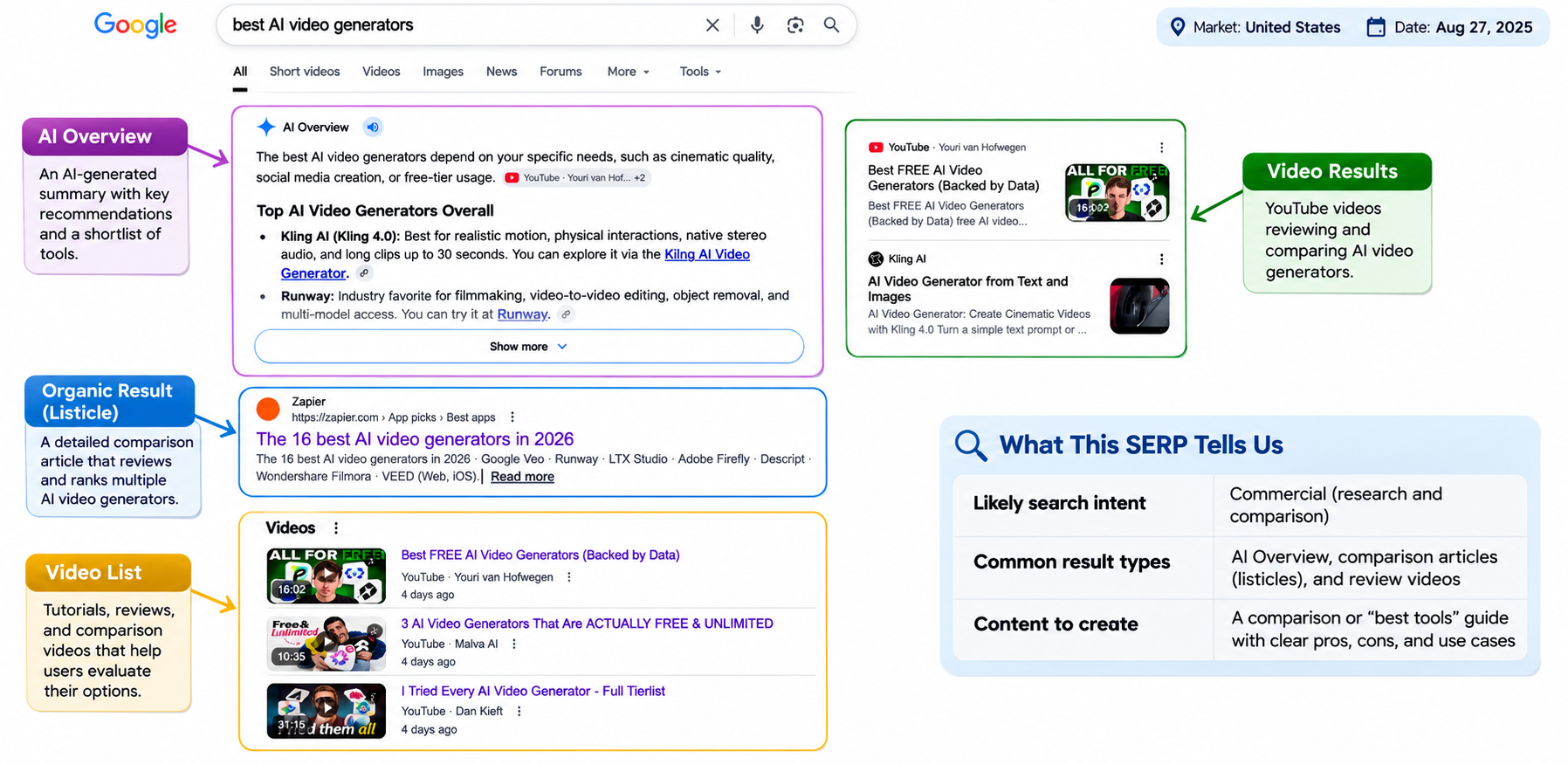
To identify the likely search intent behind a keyword, examine the types of pages Google ranks for that query. Keyword modifiers can suggest intent, but current search results are stronger evidence of the user need being served. Check the target country, device and date when reviewing SERPs.
1. Analyze the SERP: The Three Cs
Review the leading organic results and important search features. The “Three Cs” framework helps reveal the page format that fits the query.
SERP dimension | What to examine | Example |
|---|
Content type | Articles, category pages, product pages, official destinations | A product page vs a tutorial |
Content format | How-to guides, reviews, comparisons, checklists | A “vs” comparison rather than an overview |
Content angle | Beginner, budget, use case, freshness | “Best cameras for beginners” |
If “Sony WH-1000XM6 review” returns mostly product reviews, a purchase-only landing page is unlikely to fully meet that evaluation need. For “buy Sony WH-1000XM6,” product or retailer destinations may be more suitable. Do not treat the top ten results as a fixed algorithmic formula; search results can change.
Original SERP Screenshot: Search-Intent Patterns
2. Recognize Search Intent Clues
Intent | Typical clues | Expected content |
|---|
Informational | How, what, why, guide | Explanations, documentation, tutorials |
Navigational | Official, login, known brand destination | Brand homepage, official account or product page |
Commercial | Review, best, versus, alternatives | Comparisons, product reviews, buying guides |
Transactional | Buy, order, hire, subscribe, book | Product, pricing, booking or service page |
Local dimension | Near me, city, neighborhood | Local pages, maps, eligible business profiles |
Local intent is not a separate fifth category in this article. It can overlap with commercial or transactional searches: “best dentists in Henderson” differs from “book dentist appointment near me,” even though both have a geographic context.
3. Use Semrush to Screen Keyword Intent
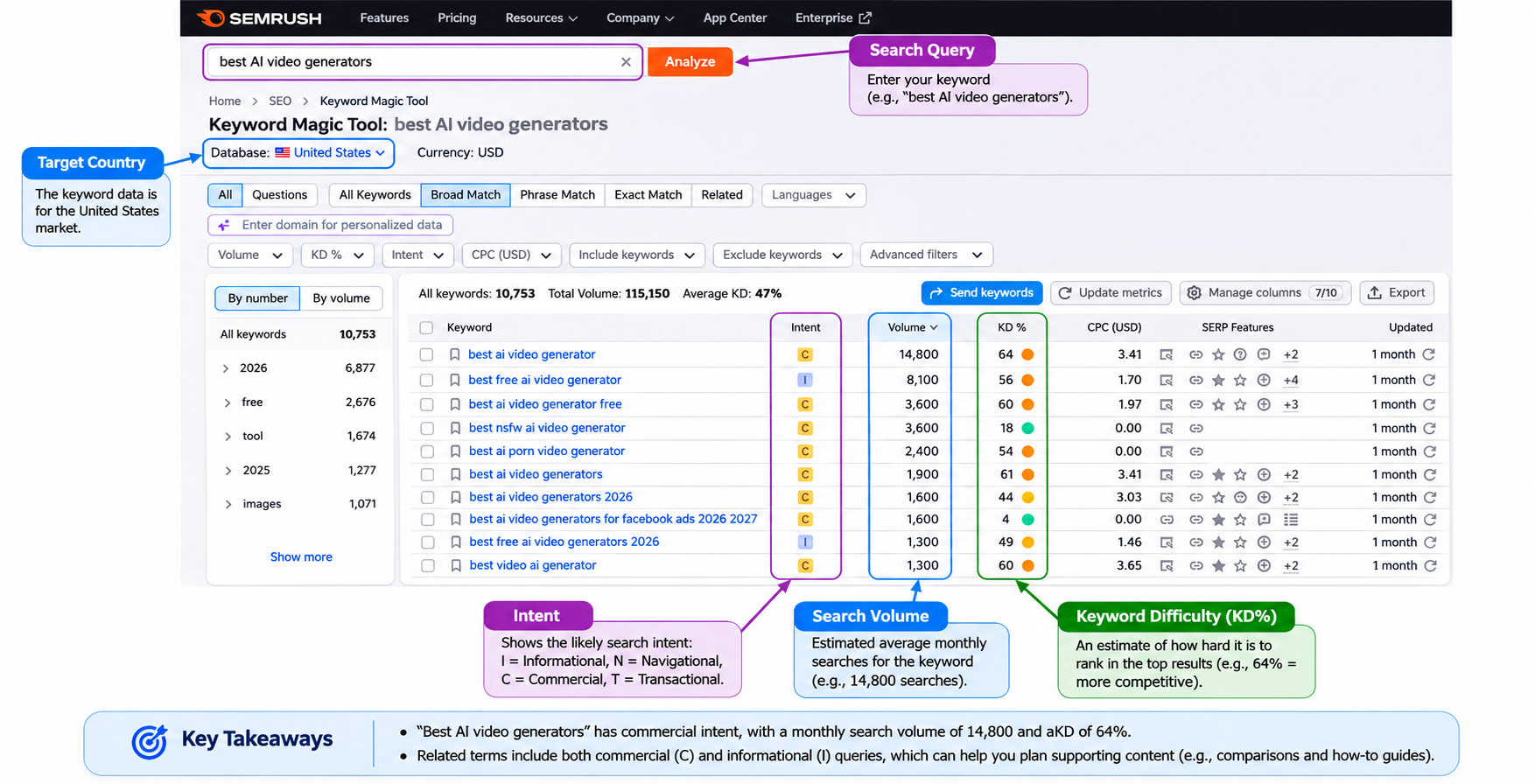
Semrush Keyword Magic Tool offers intent labels (I, N, C and T), related keyword suggestions, and relevant metrics. Enter the seed keyword, choose the target country, review variations and intent filters, then validate important keywords against the real SERP. Some phrases can carry multiple intent signals.
Semrush — Search Intent Guide — https://www.semrush.com/blog/search-intent/
Original Semrush Screenshot: Keyword Research
Want to Find More Long-Tail Keywords?
Want to find specific keyword opportunities? Read our step-by-step guide onHow to Find Long-tail Keywords for practical explanations and examples.
4. Cross-Check With Ahrefs and SERP Overview
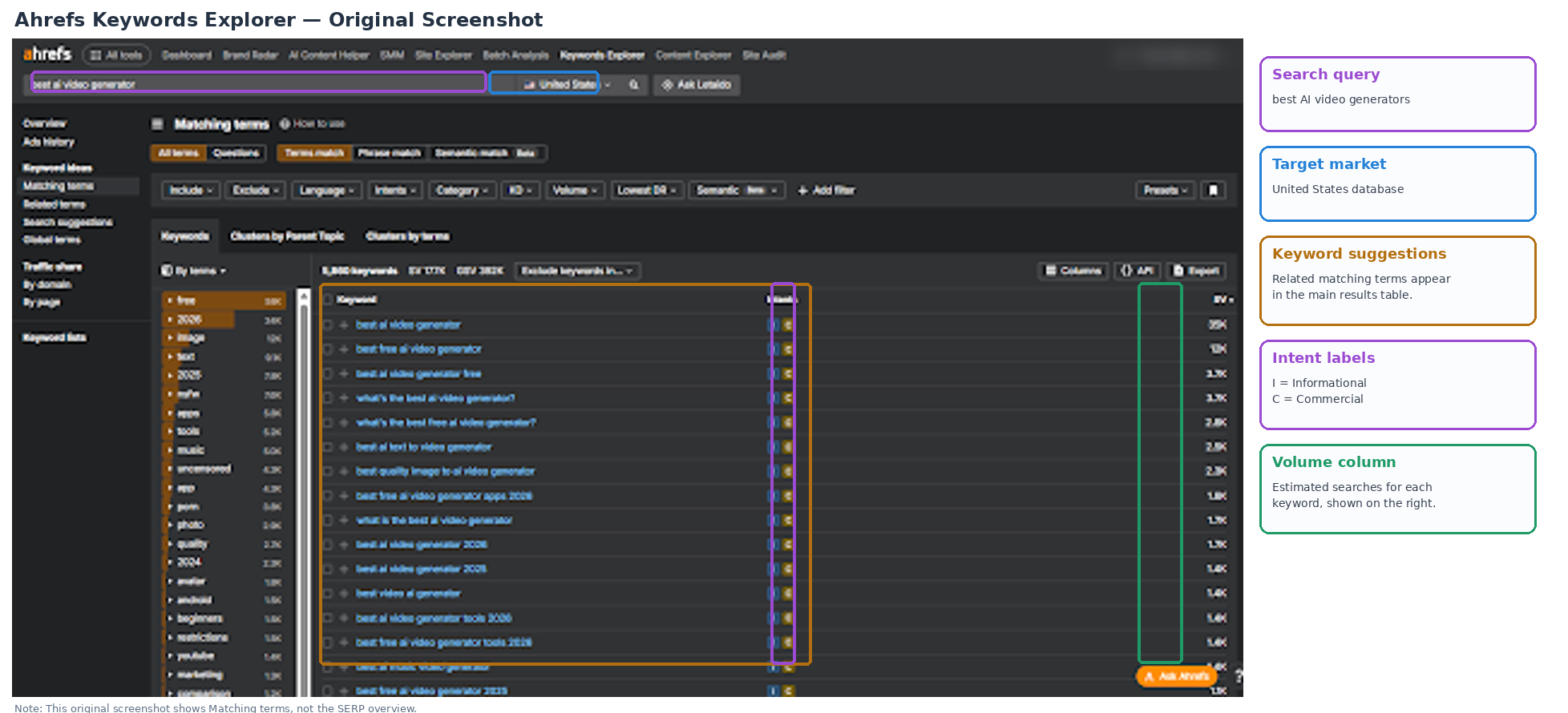
Ahrefs can help explore matching terms and available intent information. For important queries, inspect SERP Overview separately to see which page types are actually ranking. A Matching Terms screenshot should not be labeled as a screenshot of SERP Overview.
Ahrefs — Search Intent Guide — https://ahrefs.com/blog/keyword-intent/
Original Ahrefs Screenshot: Keyword Suggestions
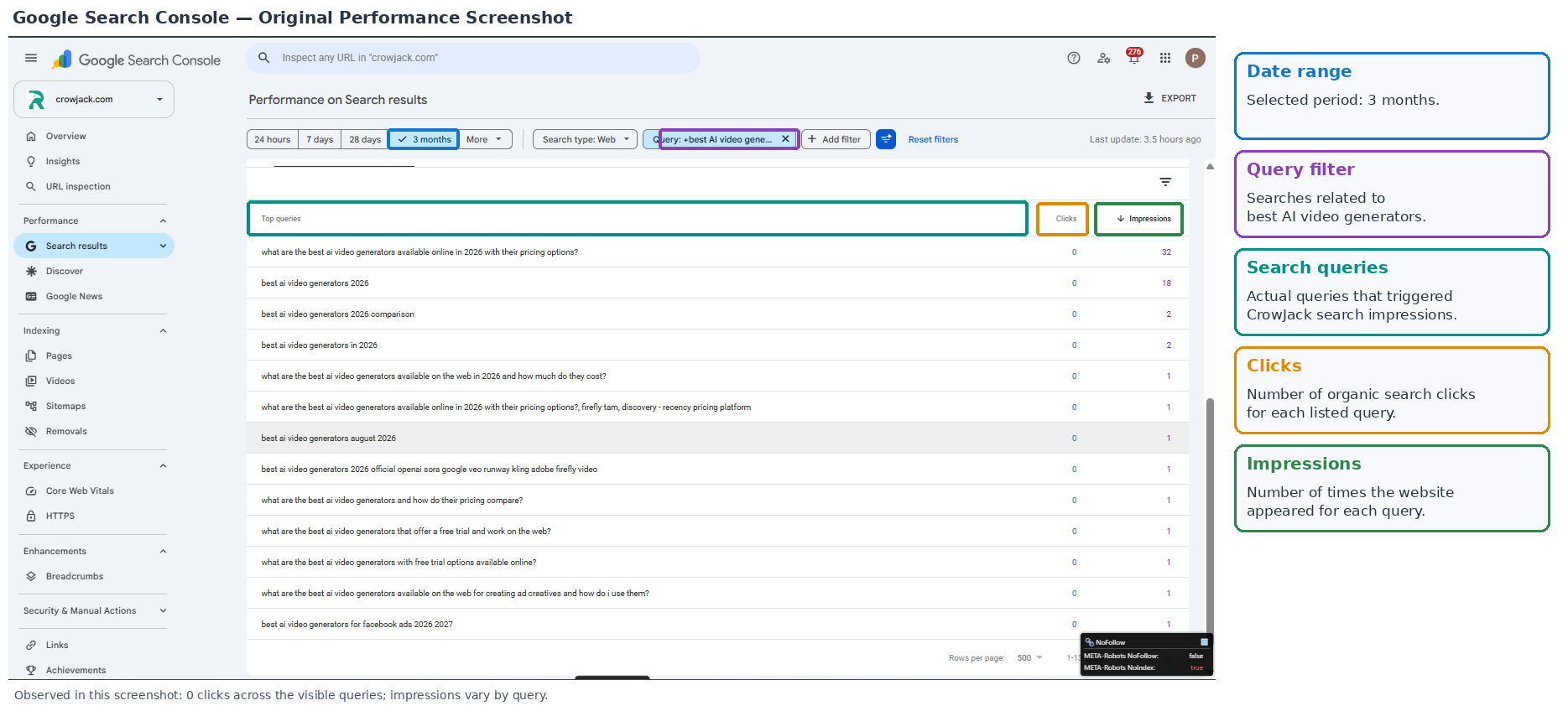
5. Review Existing Queries in Google Search Console
For existing pages, check Google Search Console’s Performance report to identify queries and landing pages. Compare their intent with the page’s actual content; impressions alone do not prove intent alignment.
6. Resolve Mixed-Intent Queries
A phrase like “Sony WH-1000XM6 price” may reflect both comparison and shopping. Determine the dominant need by examining actual results; use supporting sections or links for secondary questions. When two tasks require substantially different experiences, separate pages may be more useful than one unfocused page.
7. Quick Search Intent Checklist
Check | Action |
|---|
Keyword wording | Identify initial user-goal clues |
Top results | Review dominant page types and formats |
Three Cs | Compare content type, format and angle |
Semrush | Review intent label and related variations |
Ahrefs | Inspect keyword data and SERP Overview |
Mixed intent | Identify dominant and secondary needs |
Page choice | Map to existing or needed destination |
Validation | Record country, date and important SERP observations |
Conclusion
Understanding the four types of keywords in SEO helps you move beyond search volume and focus on what people actually want from their searches.
Informational keywords call for helpful explanations; navigational keywords point toward known destinations; commercial keywords support comparisons and purchase decisions; and transactional keywords connect users with products, services and actions.
The important part is not merely identifying the category. It is choosing the right page, offering relevant information and delivering an experience that satisfies the query. Before targeting a keyword, inspect the real SERP, consider its broad or specific wording, and verify that the content supports the user’s immediate goal. The same principle applies to AI-powered discovery: clear answers, accurate facts and credible evidence matter more than assumed optimization shortcuts.
A well-chosen keyword brings the right audience to your page. The right content gives that audience a reason to stay, trust the information and take the next step.
Read More Blogs On: