Keyword selection directly affects which searches a page can compete for, what kind of search intent it can satisfy, and whether the resulting traffic is relevant to the business. A page targeting “running shoes” is competing for a broad topic with multiple possible intents, while a query such as “best running shoes for flat feet under ₹5000” gives a much clearer indication of what the searcher wants.
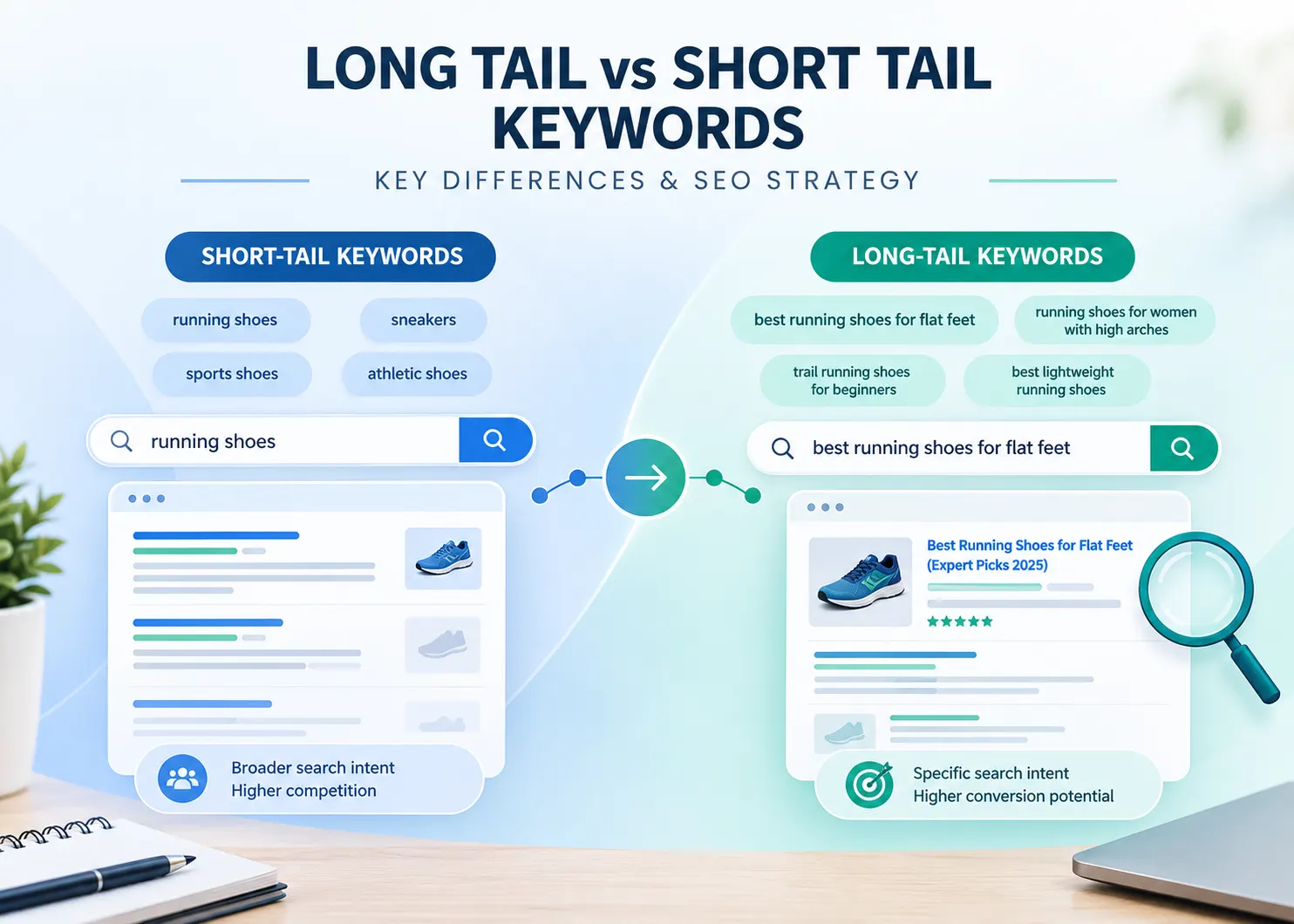
This is the basic distinction between short-tail and long-tail keywords. Short-tail keywords are generally broad phrases such as “running shoes” or “digital marketing”, while long-tail keywords are more specific searches such as “best running shoes for flat feet” or “digital marketing agency for small businesses.” The longer query does not automatically make it easier to rank for, but its additional context can make its search intent easier to identify and target.
Understanding the difference between long-tail vs short-tail keywords helps SEO specialists decide where each type belongs in a site's keyword strategy. The right approach depends on factors such as search intent, competition, topical relevance, existing authority, business objectives, and the type of page being optimized. In this guide, we’ll compare short-tail and long-tail keywords, examine practical examples across different industries, and explain how to find and select them for SEO.
What Are Short-Tail Keywords?
Short-tail keywords are broad search queries, typically consisting of one or two words, that describe a general topic, product category, service, or subject. Examples include “laptops,” “SEO tools,” “winter jackets,” “digital marketing,” and “coffee shops.”
Their defining characteristic is not simply their word count. Short-tail queries usually contain less contextual information, which means the searcher's exact objective may be unclear.
For example, someone searching for “SEO tools” could be looking for:
- A list of SEO software
- Free SEO tools
- Keyword research tools
- Technical SEO software
- Backlink analysis platforms
- Reviews or comparisons
- Pricing information
The query does not specify which of these outcomes the user expects.
How many words are in short-tail keywords?
There is no universal word-count rule, but short-tail keywords commonly contain one or two words. Some three-word queries can also function as short-tail terms when they remain broad.
For example:
Keyword | Type | Why |
SEO | Short-tail | Extremely broad topic |
SEO tools | Short-tail | Product category with multiple possible intents |
keyword research | Short-tail | Broad SEO activity |
keyword research tools | Short-tail | Commercial category, but intent remains broad |
Short-tail keywords often have substantial search demand as they represent broad topics rather than narrowly defined needs. However, search volume alone does not make a keyword valuable. A high-volume query can generate traffic that is difficult to convert if the search intent does not match the website's offering.
Why are short-tail keywords difficult to rank for?
Short-tail queries are generally competitive as many websites want visibility for the same broad topics. Search results may therefore include established publishers, large brands, specialist websites, marketplaces, and authoritative informational resources.
For example, a new website targeting “laptops” is not simply competing against pages selling laptops. Google may need to satisfy several interpretations of the query, so the results can contain product categories, buying guides, reviews, retailers, and informational content.
This makes short-tail keywords particularly useful for broad topic targeting and category-level SEO, but they often require stronger topical coverage and website authority than a highly specific query.
The key point is that short-tail does not mean valuable and long-tail does not mean easy. The usefulness of either keyword depends on the relationship between the query, search intent, competition, the page being optimized, and the site's ability to satisfy that intent.
What Are Long-Tail Keywords?
Long-tail keywords are specific search phrases that contain enough contextual detail to indicate a narrower search need. They often contain three or more words, but word count alone does not determine whether a keyword is long-tail. The important factor is the specificity of the query and the search intent it represents.
For example, “winter jackets” is a broad product-category query, while “women’s waterproof winter jacket for trekking” specifies the product type, audience, attribute, and use case. Likewise, “SEO tools” is broad, whereas “best keyword research tools for small businesses” identifies both the type of solution and its intended audience.
Long-tail keywords can become specific through different modifiers, including:
- Product attributes: “black leather jacket with hood”
- Audience: “SEO tools for ecommerce websites”
- Use case: “winter jacket for hiking in cold weather”
- Location: “digital marketing agency in Jaipur”
- Problem: “how to remove wrinkles from a puffer jacket”
- Commercial intent: “best keyword research tools for SEO”
- Comparison: “long tail keywords vs short tail keywords”
- Question: “how do long tail keywords work in SEO”
The additional context makes the query more precise, which can help an SEO create content that directly addresses the searcher's requirement. For example, a page targeting “digital marketing agency in Jaipur” can focus on location-specific services, while a page targeting “digital marketing” would need to address a much broader topic.
Long-tail keywords are also not automatically low-competition keywords. A specific query can still be difficult to rank for when it has strong commercial value and established websites already target the same intent. Similarly, not every long-tail keyword has enough search demand to justify a dedicated page.
For SEO, the practical value of long-tail keywords comes from their ability to connect specific search intent with specific content. They can be useful for product pages, service pages, comparison pages, buying guides, FAQs, and informational articles where a narrower query can be addressed more precisely.
Why Can Long-Tail Keywords Be Easier to Rank For?
Long-tail keywords can be easier to rank for because they usually target a narrower search intent than broad keywords. Fewer websites may create pages specifically optimized for that exact combination of topic, audience, use case, or problem.
For example, “running shoes” is a broad keyword with many possible interpretations. A more specific query such as “best running shoes for flat feet under ₹5000” gives Google and the content creator much clearer information about what the searcher wants.
Several factors can make a long-tail query less competitive:
- Narrower search intent: The query defines a specific requirement rather than a broad topic.
- Fewer directly competing pages: Fewer pages may target the exact combination of terms and intent.
- Better content-to-query alignment: A dedicated page can address the specific question or use case without covering unrelated topics.
- More specific SERP requirements: The search results may reveal a clear content format, such as a comparison, product list, tutorial, or local service page.
- Lower authority requirements in some cases: A highly relevant page can sometimes compete for a specific query even when the website has less overall authority than sites ranking for broad head terms.
However, long-tail does not mean low competition by definition. A keyword such as “best CRM software for real estate agents” can still be competitive because software companies, review sites, and established publishers may actively target it.
The better SEO approach is therefore to evaluate competition, search intent, relevance, SERP composition, and business value for each keyword rather than assuming that a longer query will automatically be easier to rank for.
Long Tail vs Short Tail Keywords: Key Differences
The main difference between long tail vs short tail keywords is not simply the number of words; it’s about the level of specificity, search intent, context a query provides, etc. Lets see how
Factor | Short-Tail Keywords | Long-Tail Keywords |
Keyword length | Usually 1–2 words, although some broader 3-word queries also behave as short-tail terms | Often 3+ words, but specificity matters more than word count |
Search volume | Generally higher because the query addresses a broader topic | Generally lower for an individual query because the search is more specific |
Competition | Often strong because broad commercial and informational terms attract many competing pages | Can be lower when fewer pages directly satisfy the specific intent, but competitive long-tail terms still exist |
Search intent | Often ambiguous or broad | Usually more defined through product, audience, location, problem, or use-case modifiers |
Conversion potential | Depends heavily on intent; broad traffic may include users at different funnel stages | Can be stronger when the query expresses a specific commercial need, but this is not automatic |
Content use cases | Category pages, pillar content, broad topic pages, major service pages | Product pages, focused landing pages, comparison pages, FAQs, guides, and problem-specific content |
Example | “running shoes” | “best running shoes for flat feet under ₹5000” |
Primary SEO role | Establish broad topical and category coverage | Capture specific searches and address narrower search intent |
What These Differences Mean for SEO
These differences determine which queries to target, what page type to create, how to assess ranking difficulty, and how closely content should match search intent.
Search volume: Short-tail keywords generally have higher individual search volume because they represent broad topics. For example, “running shoes” can generate searches from people researching brands, comparing prices, looking for specific features, or simply browsing products. A long-tail query such as “best running shoes for flat feet under ₹5000” has a narrower audience, so its individual search volume may be lower. However, it can bring traffic that is more closely aligned with a specific product requirement. SEOs should therefore assess search volume alongside relevance and intent, rather than selecting keywords solely because they have the largest numbers.
Competition: Competition should be evaluated at the SERP level, not inferred only from keyword length. A short-tail keyword such as “SEO tools” may have results from established software companies, review websites, publishers, and SEO platforms. A long-tail keyword such as “best SEO tools for ecommerce keyword research” may have fewer directly relevant pages, but it can still be difficult if authoritative websites already cover that exact intent. Useful competitive signals include the authority of ranking domains, content depth, backlink profiles, topical relevance, SERP features, and how closely existing pages satisfy the query.
Search intent: Search intent determines what type of page should rank and what content that page needs to provide. “Running shoes” has broad intent and could support a category page containing multiple products. “Best running shoes for flat feet under ₹5000” has much more defined commercial research intent: the searcher has specified the product, a particular requirement, and a price ceiling. A page targeting the latter should therefore address relevant products, suitability for flat feet, pricing, and comparison criteria rather than providing a generic explanation of running shoes. This is where long tail keywords and short tail keywords require different content-matching decisions.
Conversion potential: A longer keyword can indicate stronger commercial intent when it includes qualifiers that reveal a specific action or buying requirement. Terms such as “buy,” “best,” “price,” “under ₹5,000,” “for small businesses,” “near me,” or a specific product specification can indicate that the user has moved beyond general topic discovery. For example, “CRM software” is broad, while “CRM software for real estate agencies with WhatsApp integration” identifies a specific business requirement. However, keyword length itself does not predict conversion rate. The actual intent, product-market fit, landing page, pricing, and user's position in the buying journey still determine whether that traffic converts.
Content use cases: Short-tail keywords are commonly used for category pages, pillar pages, service hubs, and broad topical resources because they represent a wider subject. Long-tail keywords are often more suitable for product pages, comparison pages, location pages, problem-specific articles, FAQs, and focused landing pages. For example, a website could target “keyword research” with a broad guide while creating supporting content around queries such as “how to find long tail keywords for ecommerce” or “keyword research tools for SaaS websites.” The important consideration is whether each query represents a sufficiently distinct intent to justify a separate page.
Keyword targeting: The distinction between short-tail vs long-tail keywords should ultimately influence how a website builds its keyword architecture. A broad term can serve as the central topic, while specific queries can cover individual subtopics, use cases, and questions. However, this does not mean creating one page for every keyword variation. If several long-tail queries have the same intent and return substantially similar SERPs, they can usually be addressed by one stronger page rather than multiple near-duplicate URLs.
Ultimately, short tail and long tail keywords should be evaluated using search intent, SERP composition, competition, relevance, and business value, not keyword length alone. A website with strong authority may be able to compete for broad terms, while a newer or more specialized site may find opportunities in specific queries where its content can provide a closer match to the searcher's requirement.
How AI Is Changing Long-Tail and Short-Tail Keyword Research
Artificial intelligence is changing how SEO professionals discover keywords, understand search intent, and organize content opportunities. Traditional keyword research relies heavily on keyword databases, search volume, keyword difficulty, and manual SERP analysis. AI-powered tools add another layer by helping marketers identify conversational queries, uncover related subtopics, recognize search intent patterns, and group similar keywords into meaningful clusters.
This is particularly useful when researching long-tail keywords because people often express specific needs through detailed questions rather than short search phrases. AI can help uncover these variations and turn them into practical content ideas. However, AI-generated suggestions should still be validated against real search data and the current search results.
1. Generate More Relevant Keyword Ideas
AI tools can expand a broad seed keyword into a wider range of specific queries based on audience needs, product features, problems, and buying situations.
For example, a seed keyword such as “winter jackets” can generate ideas such as:
- Best winter jackets for trekking in cold weather
- Lightweight winter jackets for travel
- Waterproof winter jackets for women
- How to choose a winter jacket for extreme cold
- Winter jackets with removable hoods
These suggestions can help identify potential long-tail keywords that might otherwise be missed during manual brainstorming. AI can also organize the ideas into informational, commercial, and transactional groups, making it easier to plan content around different stages of the customer journey.
Practical tip: Ask an AI tool to generate keyword variations for a defined audience and use case instead of requesting a generic list of keywords. More context usually produces more relevant ideas.
2. Understand Search Intent More Efficiently
AI can help classify keywords according to what users are trying to accomplish. For example, it can distinguish between someone researching a product category and someone comparing specific products before purchasing.
Consider these queries:
Keyword | Likely search intent |
Winter jackets | Broad product research |
Best winter jackets for trekking | Commercial investigation |
How to choose a winter jacket for trekking | Informational |
Buy a waterproof trekking jacket for women | Transactional |
This classification helps SEO professionals decide whether a keyword belongs on a category page, buying guide, product page, or informational article.
However, AI classifications should be treated as initial recommendations rather than definitive answers. Review the actual search engine results page (SERP) to confirm which content format best matches the query, using a long tail keywords exampleto understand how specific search terms align with user intent.
AI can identify keywords that share a common topic and potentially the same search intent. This helps marketers organize large keyword lists into content clusters instead of creating a separate page for every variation.
For example, the following queries may belong to one content cluster:
- How to find long-tail keywords
- How to find long-tail keywords for SEO
- How to discover long-tail keywords for a new website
- Best ways to research long-tail keywords
If these queries have overlapping SERPs and require substantially the same answer, one comprehensive guide may satisfy them more effectively than several similar articles.
By contrast, a query such as “best keyword research tools” may require a separate comparison page because its commercial intent differs from a how-to guide.
AI-assisted clustering can speed up this process, but SERP comparisons should determine whether keywords belong on the same page.
4. Identify Conversational Queries for AI Search
Search behavior increasingly includes detailed, natural-language questions entered into conversational search experiences and AI assistants. These queries can reveal content opportunities that broad keyword research alone may overlook.
For example, instead of searching only for “SEO tools,” someone might ask:
- Which SEO tools are best for a small business with a limited budget?
- How can I find low-competition keywords for a new website?
- Which keyword research tool helps identify ecommerce search opportunities?
AI can help brainstorm these conversational variations and identify the questions a useful article should answer.
Detailed, self-contained sections can also make content easier for search engines and AI systems to interpret and retrieve. Use descriptive headings, answer each question directly, and provide enough supporting context to make each section useful on its own.
However, including conversational keywords does not guarantee that a page will appear in AI-generated answers. Visibility still depends on relevance, content quality, source credibility, and the retrieval and ranking systems used by each platform.
5. Use AI With Keyword Research Data, Not Instead of It
AI-generated keyword suggestions are useful for expanding a research list, but they do not automatically provide accurate search volume, keyword difficulty, or evidence of actual search demand.
A practical workflow combines AI with established SEO tools:
- Use AI to brainstorm relevant short-tail and long-tail variations.
- Check keyword databases for estimated search volume and difficulty.
- Review Google Search Console to identify queries already generating impressions.
- Analyze competitors to discover relevant keyword gaps.
- Examine the SERP to validate intent and competition.
- Group related queries and map them to suitable pages.
Tools such as Semrush, Google Search Console, and other keyword research platforms can provide the supporting data needed to assess these opportunities.
The key takeaway: AI makes keyword discovery and organization faster, while search data and SERP analysis help determine which keywords deserve priority. The strongest strategy combines AI-assisted research with human judgment, business relevance, and a clear understanding of search intent.
Long-Tail vs Short-Tail Keywords Examples
The difference becomes easier to apply when keywords are compared within the same industry and search context. The examples below pair a broad keyword with a more specific alternative and show how the additional modifiers change the likely search intent.
Ecommerce Keyword Examples
In ecommerce, short-tail keywords generally describe a product category, while long-tail queries can add product attributes, audience, use case, material, size, or price requirements.
Short-Tail Keyword | Long-Tail Keyword | Likely Intent |
winter jackets | women’s waterproof winter jacket for trekking | Product research with a specific use case |
running shoes | running shoes for flat feet under ₹5000 | Product research with fit and price requirements |
laptops | lightweight laptops for graphic design under ₹80000 | Commercial research with performance and budget constraints |
office chairs | ergonomic office chair with lumbar support under ₹15000 | Product research with feature and price requirements |
skincare products | skincare products for oily skin with acne | Product research based on a specific skin concern |
leather bags | women’s leather laptop bag for 15-inch MacBook | Product search with product specification and use case |
For example, “running shoes” does not indicate whether the searcher wants shoes for road running, trail running, flat feet, racing, or casual use. “Running shoes for flat feet under ₹5000” provides two additional constraints, foot type and budget, which allow an ecommerce page to present a much more targeted product selection.
Service Business Keyword Examples
For service businesses, long-tail keywords commonly add location, customer type, service type, urgency, or a specific requirement to a broad service term.
Short-Tail Keyword | Long-Tail Keyword | Likely Intent |
digital marketing agency | digital marketing agency for small businesses in Jaipur | Commercial investigation with location and audience |
dentist | emergency dentist near Jaipur open on Sunday | Local service search with urgency and availability |
tax consultant | GST tax consultant for small businesses in Delhi | Service search with business type and location |
web development | ecommerce web development company for Shopify stores | Commercial research with platform specialization |
wedding photographer | candid wedding photographer in Udaipur | Local service research with style preference |
SEO agency | SaaS SEO agency for B2B software companies | Commercial research with industry specialization |
The broad query “SEO agency” could represent almost any company offering search optimization services. “SaaS SEO agency for B2B software companies” narrows the audience and service requirement, making it more appropriate for a specialized service landing page.
Blog and Informational Keyword Examples
Informational keywords often become long-tail when the searcher adds a specific question, problem, process, comparison, or situation to the broader topic.
Short-Tail Keyword | Long-Tail Keyword | Likely Intent |
long-tail keywords | how to find long-tail keywords for ecommerce SEO | How-to / informational |
puffer jacket care | how to wash a puffer jacket without damaging the filling | Problem-solving / how-to |
keyword research | how to find low-competition keywords for a new website | Practical how-to |
technical SEO | how to fix duplicate title tags in Google Search Console | Specific troubleshooting |
backlink building | how to build backlinks for a SaaS website without guest posting | Strategy / how-to |
content marketing | how to create a content strategy for a small ecommerce website | Planning / how-to |
The query “keyword research” covers a broad subject and could require a comprehensive guide. In contrast, “how to find low-competition keywords for a new website” identifies a specific problem, audience, and desired outcome. A page targeting the long-tail query can therefore focus on practical keyword discovery and evaluation rather than explaining every aspect of keyword research.
The same pattern applies across long tail keywords vs short tail keywords: the broader term establishes the topic, while the more specific query reveals a narrower search requirement. However, these examples should be validated against the actual SERP before creating separate pages. If several long-tail variations return substantially the same results and satisfy the same intent, combining them on one authoritative page may be more effective than creating multiple pages targeting near-identical queries.
How Long Can Keywords Be?
There is no fixed maximum length for an SEO keyword. A keyword can contain a few words or a much longer phrase, but adding words does not automatically make a query a long-tail keyword or make it more valuable. For SEO, specificity, meaning, and search intent matter more than the number of words.
A useful way to think about keyword length is:
- 1–2 words: Often broad, such as “keyword research” or “winter jackets.”
- 3–5 words: Can be either broad or specific depending on the query, such as “best keyword research tools.”
- 6+ words: Often more specific, such as “best keyword research tools for small ecommerce websites.”
- Very long queries: May represent highly specific questions or natural-language searches, such as “how can I find low competition keywords for a new ecommerce website?”
However, these are guidelines, not classification rules. A three-word keyword can be highly specific, while a six-word keyword can still have broad intent.
For example, “best SEO tools for beginners” is five words but has relatively broad commercial intent. On the other hand, “how to fix 404 errors in Google Search Console” is seven words and describes a specific technical problem.
Therefore, when asking how long can keywords be, the practical answer is: as long as necessary to accurately represent a distinct search intent. Do not add words simply to turn a short-tail keyword into a long-tail keyword. Instead, look at what information the searcher is requesting, whether the query represents a distinct intent, and whether the SERP supports creating content specifically for it.
Which Keywords Should You Target for SEO?
There is no universal rule to target only short-tail or only long-tail keywords. The right mix depends on search intent, SERP competition, website authority, business objectives, funnel stage, and the page you want to rank. A practical strategy uses broad terms to establish topical coverage and specific queries to capture clearly defined search needs.
When to Use Short-Tail Keywords
Use short-tail keywords when you need to build visibility around a core topic, product category, or primary service.
They are particularly useful for:
- Category coverage: An ecommerce site can target “winter jackets” on its main category page rather than trying to optimize that page around dozens of unrelated specific queries.
- Broad awareness: Informational websites can target topics such as “keyword research” or “technical SEO” with comprehensive pillar content.
- Topic authority: A broad keyword can act as the central topic around which more specific supporting pages are organized.
- Long-term targeting: Established websites with relevant content and authority may pursue broad keywords as part of their long-term organic growth strategy.
However, check the SERP before assigning a short-tail keyword to a page. If Google predominantly ranks ecommerce category pages for a query, a general informational article may struggle even if it contains the keyword repeatedly.
When to Use Long-Tail Keywords
Use long-tail keywords when the searcher has a specific problem, requirement, audience, location, product attribute, or use case.
For example:
- “keyword research tools” → broad software-category search
- “best keyword research tools for SaaS websites” → specific commercial search
- “how to find low competition keywords for a new website” → specific informational search
Long-tail keywords are particularly useful for focused landing pages, product pages, service pages, comparison content, and problem-specific articles.
They can also be valuable for websites that have limited authority and need to identify queries where their content can provide a highly relevant answer. But competition must still be checked individually; a long-tail keyword with strong commercial value can have powerful competitors.
How to Combine Short-Tail and Long-Tail Keywords
The most practical approach is to use both types at different levels of the site's keyword architecture.
For example, an SEO website could structure its content around:
Core topic:
keyword research
Supporting specific topics:
- how to find long tail keywords
- keyword research for ecommerce websites
- best keyword research tools for SEO
- how to find low competition keywords
- keyword research for a new website
The broad term establishes the site's coverage of the main subject, while the more specific queries address distinct subtopics and search requirements.
This does not mean creating a separate URL for every long-tail variation. If “best keyword research tools” and “top keyword research tools” produce essentially the same SERP and require the same answer, one page can target both naturally. A separate page makes more sense when the queries have materially different intent or require substantially different content.
What Should Influence Your Keyword Choice?
Before targeting either type, evaluate these factors:
Factor | What to Check |
Site authority | Can the website realistically compete with the domains currently ranking? |
Competition | How strong and relevant are the current top-ranking pages? |
Search intent | Does the existing SERP match the type of page you plan to create? |
Business goals | Does the query support awareness, leads, sales, or another measurable objective? |
Funnel stage | Is the searcher discovering a topic, comparing solutions, or ready to take action? |
Relevance | Does the keyword closely describe the website's product, service, or expertise? |
Conversion potential | Can visitors from this query realistically become customers or complete the desired action? |
Content opportunity | Can your page provide information that directly satisfies the query better or more completely? |
The objective is therefore not to choose short tail keywords over long tail keywords, or the reverse. Build the keyword set around distinct search intents, use broad terms where broad coverage is appropriate, and use specific terms where a narrower query represents a meaningful search opportunity.
How to Find Long-Tail and Short-Tail Keywords
Finding useful keywords is not simply a matter of exporting a list with search volume and choosing the largest numbers. Start with a seed topic, expand it into related queries, and learnhow to find long-tail keywords that reflect specific search intents. Then evaluate which terms deserve dedicated content, helping you target more relevant searches rather than competing only for broad, high-volume keywords.
1. Start With Seed Topics
Begin with the main product, service, or subject you want the website to be visible for.
For example, an ecommerce website selling jackets might start with:
Seed topic:winter jackets
Expand that into related categories and specific searches:
- winter jackets for men
- women's winter jackets
- waterproof winter jackets
- winter jackets for trekking
- best winter jackets for extreme cold
- lightweight winter jacket for travel
The seed keyword gives you the broad topic; modifiers reveal potential long-tail searches around audience, product type, feature, location, use case, price, and problem.
Google's own search suggestions can reveal how users extend a broad query.
For example, entering “keyword research” may surface variations around:
- keyword research tools
- keyword research for SEO
- keyword research for beginners
- keyword research for ecommerce
- how to do keyword research
You can also inspect Related Searches at the bottom of relevant Google results. These suggestions are useful for discovering query patterns that may not appear in your initial keyword list.
Do not treat every suggestion as a separate keyword target. First determine whether the query represents a different intent or simply another wording of the same search.
3. Use Google Search Console for Existing Search Data
For an established website, Google Search Console can show queries that are already generating impressions and clicks.
Look for:
- Queries receiving impressions but few clicks
- Specific queries where the page already ranks
- Unexpected long-tail queries
- Query variations generating impressions for the same URL
- Queries where the page has relevant content but weak visibility
For example, if a page targeting “keyword research” receives impressions for “how to find long-tail keywords for SEO,” that query may reveal an additional content opportunity. Before creating a new page, check whether the existing page already satisfies that intent.
Keyword research tools can provide additional data such as search volume, keyword difficulty, related terms, SERP results, competition signals, and keyword variations.
Use these tools to expand the seed list rather than relying on search volume alone.
For each candidate keyword, record at least:
Metric | What to Evaluate |
Search volume | Estimated demand for the query |
Keyword difficulty | How difficult the tool estimates ranking may be |
Search intent | Informational, commercial, transactional, navigational, or local |
SERP results | What page types and competitors currently rank |
Business relevance | Whether the query relates directly to your offering |
Content fit | Whether your existing or planned page can satisfy the query |
5. Use AI to Discover Additional Keyword Variations
AI tools can help expand your seed keyword into specific questions, product searches, comparisons, and problem-based queries. This is useful when your initial keyword list contains only broad terms and does not fully reflect the questions your audience might ask.
For example, if your seed keyword is keyword research, ask an AI assistant to generate variations for beginners, ecommerce websites, SaaS companies, and businesses with limited SEO budgets.
You can use this prompt:
Example AI prompt:
"Act as an SEO keyword research specialist. Starting with the seed keyword 'keyword research', generate 40 relevant keyword ideas for a website targeting small businesses and beginner SEO professionals. Group them into informational, commercial, comparison, and problem-solving queries. Include natural-language questions, specific use cases, and potential long-tail variations. Avoid repetitive keywords and do not invent search volume or keyword difficulty figures."
The resulting ideas might include:
Seed keyword | Potential long-tail variation | Likely intent |
Keyword research | How to do keyword research for a new website | Informational |
Keyword research tools | Best free keyword research tools for small businesses | Commercial |
Keyword difficulty | How to find low-competition keywords for a new website | Problem-solving |
Ecommerce SEO | How to find long-tail keywords for ecommerce products | Informational |
Keyword clustering | How to group keywords by search intent | Informational |
Treat these as candidate keywords rather than confirmed search opportunities. AI can suggest plausible queries that have little or no measurable search demand. Validate promising terms using keyword research tools, Google Search Console, and the actual SERP before prioritizing them.
6. Evaluate Search Demand and Ranking Difficulty
Once you have a list of keyword ideas, compare their estimated search volume, keyword difficulty, relevance, and intent. Avoid choosing a keyword simply because it has the lowest difficulty score or the highest search volume.
For example, an ecommerce website selling trekking jackets might compare these candidate keywords:
Keyword | What to evaluate | Potential page |
Winter jackets | Broad demand, category-level competition, product relevance | Main category page |
Waterproof trekking jackets | Product-specific demand and competing category pages | Relevant product category |
Best winter jackets for trekking in extreme cold | Buying intent, SERP format, and product suitability | Buying guide |
How to choose a jacket for trekking | Informational intent and existing guide coverage | Informational article |
The table illustrates the research process, not verified keyword metrics. Actual volume and competition must be checked for the target market.
When evaluating keyword difficulty, consider the quality of competing pages, their topical relevance, backlink profiles, and the authority of the websites ranking. If a tool offers a domain-specific difficulty estimate, use it as an additional signal rather than a guarantee of ranking success.
7. Identify Keyword Opportunities From Competitors
Competitor analysis can reveal specific queries that your website does not currently target. Identify websites competing for the same audience, then examine their ranking keywords, relevant landing pages, and content structure.
Look for opportunities such as:
- Relevant long-tail keywords for which competitors rank but your website does not.
- Specific questions that competing guides answer more thoroughly than your content.
- Product attributes, audiences, or use cases that your existing pages do not cover.
- Keywords where competing pages appear less relevant or fail to answer the query completely.
For example, if competing ecommerce websites have dedicated pages for waterproof trekking jackets but your website only has a general winter-jacket category, you could investigate whether a more specific category page would satisfy a distinct search intent.
A competitor ranking for a keyword does not automatically make that keyword worth targeting. Confirm that the query matches your products, expertise, and business objectives before adding it to your strategy.
8. Validate and Prioritize Your Final Keyword List
Before assigning keywords to pages, review the evidence gathered during research. A useful keyword is not simply one with search demand; it should also be relevant to your website and appropriate for the content you can create.
Evaluate each keyword against five questions:
- Relevance: Does it closely match your products, services, or expertise?
- Intent: Can you identify what the searcher wants and provide the right page type?
- Competition: Do the current results offer a realistic ranking opportunity for your website?
- Demand: Is there measurable demand, or does the query serve a useful, clearly defined audience need despite limited volume data?
- Business value: Could attracting this audience contribute to sales, leads, engagement, or another meaningful goal?
You can record these findings in a keyword sheet with columns for the keyword, keyword type, estimated search volume, difficulty, search intent, current ranking URL, proposed page, and priority.
For an established website, prioritize relevant queries where existing pages already receive impressions but have room to improve. For a newer website, investigate specific queries where the search intent aligns closely with your offering and the competing results appear achievable.
The final selection should balance realistic ranking opportunities with business value. Low volume does not automatically mean a keyword should be ignored, and high volume does not automatically make a keyword a priority.
Common Keyword Targeting Mistakes
Keyword targeting problems usually come from choosing terms based on volume or length without checking search intent, SERP competition, page relevance, and the relationship between similar queries.
Targeting Search Volume Instead of Search Intent
A high-volume keyword can attract substantial traffic but still be a poor target if the search intent does not match the website or page.
For example, a B2B company selling SEO software may see strong volume for “SEO”, but ranking for that term does not necessarily bring users looking for SEO software. A query such as “SEO software for ecommerce websites” may be more closely aligned with the company's product and target audience.
Assuming Every Long-Tail Keyword Is Easy to Rank For
Long-tail keywords can have lower competition, but length does not determine ranking difficulty.
A query such as “best CRM software for real estate agencies” is long and specific, but it can still attract established SaaS companies, review websites, and high-authority publishers. Always inspect the current SERP and competing pages before treating a long-tail keyword as an easy ranking opportunity.
Creating One Page for Every Keyword Variation
Different wording does not necessarily mean different search intent.
For example:
- best keyword research tools
- top keyword research tools
- best SEO keyword research tools
If these queries return similar pages and require essentially the same answer, creating three separate articles can unnecessarily split authority and create overlapping content.
Group close variations when the intent, SERP, and expected answer are substantially the same.
Forcing Multiple Keywords Into One Page
The opposite problem is targeting too many unrelated keywords on a single URL.
For example, a page targeting “keyword research tools” should not simultaneously attempt to rank for unrelated intents such as:
- how to do keyword research
- what is technical SEO
- how to build backlinks
- SEO audit checklist
These topics may belong to the same broader SEO category, but they represent different questions and require different content. Each should be mapped according to its own search intent.
Ignoring the SERP Before Choosing a Keyword
Keyword tools provide useful metrics, but they do not replace SERP analysis.
Before targeting a keyword, check whether Google is primarily ranking:
- Product pages
- Category pages
- Service pages
- Informational guides
- Comparison articles
- Local business pages
- Videos or other specialized results
If the existing SERP consistently favors product category pages and your planned page is a general blog article, the keyword may not be an appropriate target for that URL.
Using the Same Keyword on Multiple Pages
Assigning the same primary keyword to several pages can create keyword cannibalization, particularly when those pages satisfy the same intent.
For example, publishing separate pages targeting “best keyword research tools,” “top keyword research tools,” and “keyword research tools” can cause overlapping pages to compete for similar searches.
Instead, consolidate overlapping intent where appropriate and give each URL a clearly defined keyword and topic role.
Choosing Keywords That Are Not Relevant to the Business
A keyword can have excellent search volume and low competition but still provide little business value if the website cannot satisfy the underlying need.
For example, a furniture company may receive traffic from searches about “DIY furniture plans.” If the business sells finished furniture rather than plans or woodworking materials, that traffic may have limited commercial relevance.
Keyword selection should therefore consider business relevance, audience fit, and the action you want visitors to take, not rankings alone.
Treating Keyword Difficulty as an Absolute Score
Keyword difficulty is a tool-generated estimate, not a universal measurement of whether a page can rank.
Different platforms calculate difficulty using different datasets and signals. A keyword with a moderate difficulty score can still have highly authoritative competitors, while a keyword with a higher score may be approachable for a highly relevant page on an authoritative website.
Use difficulty as one input alongside SERP analysis, competing domains, backlinks, content quality, topical relevance, and site authority.
Optimizing for the Keyword Instead of the Searcher
Repeating an exact keyword throughout a page does not make the page more relevant. Modern keyword targeting should focus on whether the content comprehensively addresses the meaning and intent behind the query.
For example, a page targeting “how to find long-tail keywords” should explain practical discovery methods, query expansion, intent evaluation, keyword grouping, and validation rather than repeatedly inserting the exact phrase into every section.
The objective is to build pages around distinct search intent and useful topical coverage, not to manufacture keyword frequency.
Conclusion
Long-tail and short-tail keywords serve different roles in an SEO strategy. Short-tail keywords help establish visibility around broad topics, categories, and services, while long-tail keywords target more specific searches with clearer requirements, audiences, problems, or use cases.
The important distinction is not simply keyword length. Effective keyword targeting depends on search intent, SERP competition, website authority, business relevance, and the type of content required to satisfy the query. A high-volume short-tail keyword may be less useful than a lower-volume long-tail keyword when the latter attracts users who closely match the business offering.
Rather than choosing one over the other, build keyword coverage around distinct search intents. Use broad terms for core topic and category coverage, then use specific queries to address narrower needs. Before creating a new page, validate the SERP and group close keyword variations where they represent the same intent.
A strong keyword strategy is ultimately about matching the right query to the right page and the right audience, not simply targeting the keywords with the highest search volume.
.webp)