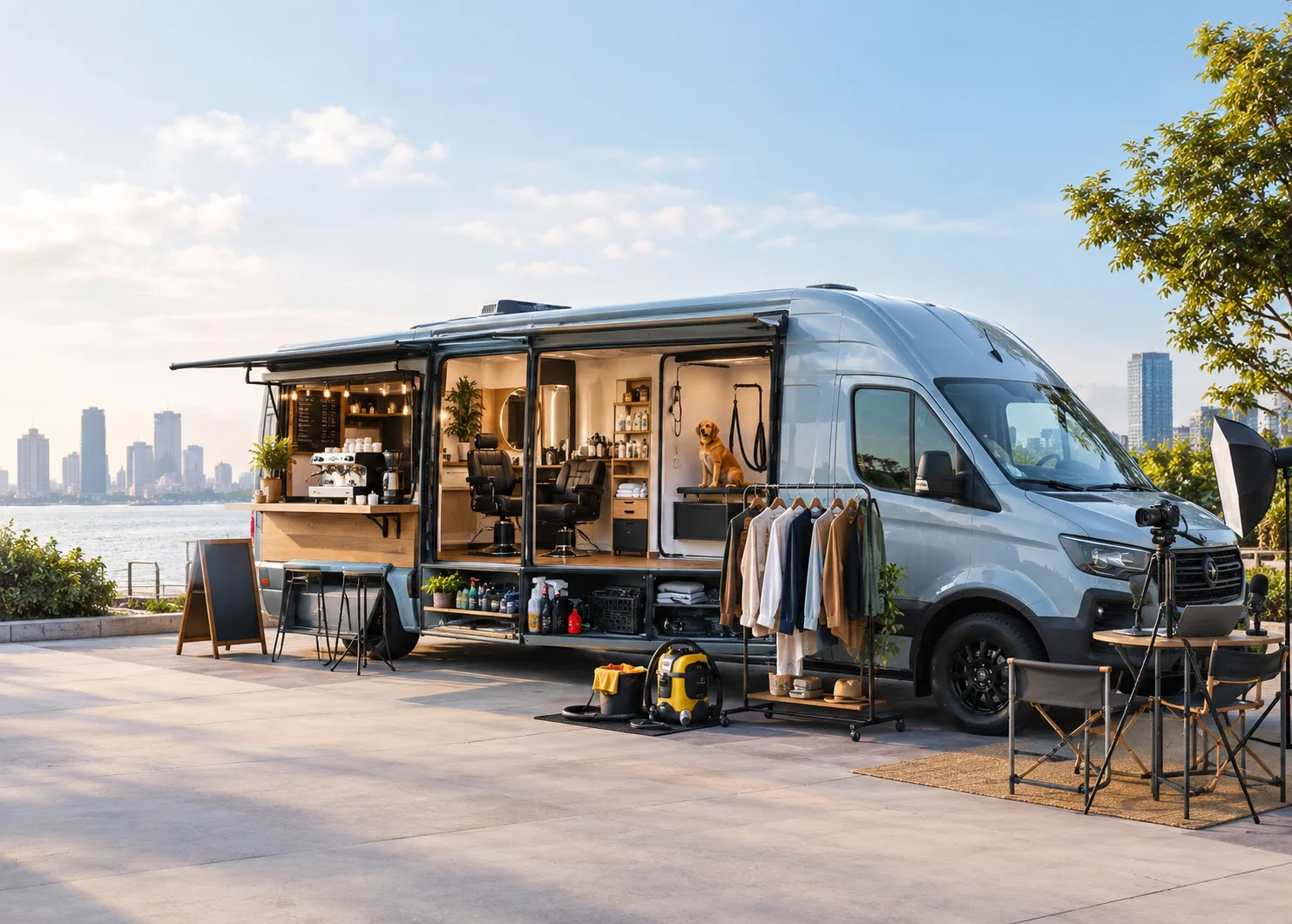
Commercial rents continue to increase, while many customers expect services to come to them instead of visiting a store. These two trends have created new opportunities for mobile businesses. A van business can be a realistic way to enter self-employment in 2026. Modified vans can serve as workshops, shops, and mobile billboards, often at a fraction of the cost of renting a physical shop. In this article, we cover eight businesses you can run from a van, including the equipment needed for each one, estimated startup costs, and how to choose a business that fits your skills and local market.
Business | Typical Startup Range | Key Build Requirements | Licensing Complexity | Best For |
Mobile health or wellness clinic | $100,000-$230,000+ | Exam space, HVAC, power, sink, ADA access | High | Licensed practitioners, nonprofits, clinics expanding reach |
Mobile pet grooming | $60,000-$150,000 | Water tanks, tub, dryer, generator, non-slip floor | Medium | Experienced groomers |
Mobile barbershop or salon | $40,000-$120,000 | Chair, sink, mirrors, climate control | Medium | Licensed barbers and stylists |
Coffee van | $30,000-$100,000 | Espresso machine, power, water, serving hatch | Medium to high | Hospitality people who like events |
Mobile car detailing | $15,000-$50,000 | Water tank, pressure washer, generator, shelving | Low | Hands-on starters with a small budget |
Mobile mechanic | $20,000-$60,000 | Tool storage, compressor, lighting, inverter | Low to medium | Trained technicians |
Mobile boutique | $20,000-$60,000 | Display racks, lighting, fitting area, POS | Low to medium | Makers and resellers |
Mobile photo or podcast studio | $40,000-$90,000 | Soundproofing, lighting grid, power, backdrops | Low | Creators and event photographers |
1. Mobile Health or Wellness Clinic
Mobile clinics are businesses that transport medical care to hard-to-reach locations. Their services can reach rural towns, corporate offices, shelters, and local events. This model benefits both small healthcare organizations and large hospital groups. Physical therapists, dental hygienists, IV therapy providers, occupational health screeners, and immunization services can operate from converted vans. They often contract with employers, schools, and nonprofit organizations to provide their services.
Demand for this kind of service is steady because it removes the biggest barrier to care: getting to the appointment. Prevention work, such as screenings and vaccinations, fits the format especially well since visits are short and easy to run in high volume.
What the Van Needs
Clinic vans require private consultation or examination space, a highly reliable heating and cooling system, a sink with running water, medical-grade storage, and the ability to move equipment without idling the engine. Accessibility features such as wheelchair lifts add to the cost but allow you to serve more patients. Prices increase quickly depending on the equipment level. According to custom mobile clinic costs, most outreach and clinic vehicles range from approximately $100,000 to $230,000. Full-service medical vehicles with dental instruments and diagnostic imaging equipment are among the most expensive options.
Overall Verdict
This is the most capital-intensive business in the article and also the most heavily regulated. This is because they need qualified medical personnel and must comply with health regulations in all areas they serve. On the other hand, the possibility of getting a contract is high. Non-profit organizations can take advantage of grants. And the social purpose is clear. This business is more suitable for existing clinics that want to expand their range of activities than for new entrepreneurs.
2. Mobile Pet Grooming
Mobile pet care is a business that eliminates the hassle of moving anxious or elderly pets. Owners are happy to pay an additional fee for this convenience. The spending base is also big. According to theAmerican Pet Products Association, spending in the U.S. pet industry will reach $158 billion in 2025, and approximately 95 million households own a pet.
What the Van Needs
The grooming van will require fresh and gray water tanks, a raised bathtub, a high-speed dryer, a grooming table, and a generator or large-capacity battery. Since you work all day around water, fur, and grooming products, it is important to have a non-slip, waterproof floor and strong ventilation. Many groomers purchase purpose-built grooming vans instead of customizing the body from scratch. This can increase the price but shorten the setup time.
Overall Verdict
Mobile grooming is best suited for those with grooming experience and an existing local customer base. Since customers typically book appointments every 4 to 8 weeks, earnings are fairly predictable once the schedule fills. The main limitation is capacity because one groomer can only accommodate a limited number of appointments each day.
3. Mobile Barbershop or Beauty Salon
Barbers, beauticians, nail technicians, and estheticians can take their services to offices, weddings, senior living communities, and film sets. Customers can make individual reservations without having to travel, while business owners can avoid paying rental fees for beauty chairs.
What the Van Needs
Basic equipment includes a hydraulic chair, shampoo stand with hot water, mirror, task lighting, and air conditioning to keep customers comfortable all year round. Since customers make appointments in advance, booking management is just as important as the vehicle equipment. By comparing scheduling support options for small businesses before opening, you can avoid double bookings and wasted time between appointments.
Overall Verdict
This business is ideal for qualified professionals who want more control over their fees and hours. Events such as corporate functions or bridal parties can provide full-day bookings. You will need to check whether your state or local board recognizes mobile salons, as some regions have different hygiene or inspection requirements for mobile hair services.
4. Coffee Van
Coffee vans can operate in commuter traffic areas in the morning, at farmers’ markets during the day, and at private events at night. The profit margins for espresso drinks are also healthy. At weddings and corporate events, a fixed travel fee is usually paid regardless of how many drinks are served.
What the Van Needs
A commercial espresso maker, grinder, refrigeration, water system, and electrical equipment are required. Espresso machines consume a lot of electricity, so the van needs a reliable power system. A serving hatch or side windows, awnings, and distinctive branding can also help attract customers from a distance. Food concession rules generally require handwashing facilities and access to a commissary kitchen for cleaning and restocking.
Overall Verdict
Coffee vans are ideal for people who like to interact with customers and find places to sell. The biggest obstacle is permission. Food rules vary depending on the county or city. And some areas limit where mobile sellers can park. Event bookings smooth out revenue from venues on less crowded weekdays.
5. Mobile Car Detailing
Detailing is one of the easiest van businesses to start. A customer books a service, and you clean the vehicle interior or perform paint correction at their home or workplace. The service can be carried out in the customer's driveway or parking lot.
What the Van Needs
Detailing equipment requires a 50- to 100-gallon water tank, a pressure washer, a generator or inverter, vacuum cleaners and extractors, and shelves for chemicals and towels. You can keep costs low by doing some of the work yourself or choosing a basic professional setup for a used cargo van. Water treatment mats and water-free products may be required in some areas due to local regulations that limit drainage runoff.
Overall Verdict
For those with a limited budget who are willing to learn a variety of skills, this can be a practical option. Fleet agreements with car dealers, rental companies, and local businesses can provide a steady workload. Once you learn the skills You can significantly increase the average unit price by introducing additional ceramic coatings or paint correction.
6. Mobile Mechanic
Mobile mechanics can perform many repairs without using a lift. Examples include brakes, batteries, diagnostics, and fluid changes. It's easy for mobile mechanics to get competitive pricing. This is because it reduces the hassle of customers going to the shop and waiting time.
What the Van Needs
The key to having the right equipment in the van is organized tool storage. An air compressor, a powerful inverter, good lighting, and space for placing parts are also important. A shelving and drawer system designed for a work van can make a big difference in how quickly you complete each job. With a diagnostic scanner, jack, and stands, you can handle most common call-outs.
Overall Verdict
This business is ideal for trained mechanics who want to work independently without having to rent a garage. It is also suitable for fleet maintenance, where various companies pay a fee to have their vehicles serviced locally. Liability insurance is essential when working on customer premises.
7. Mobile Boutique
A mobile boutique is a business that turns a van into a small shop selling clothes, jewelry, handmade products, books, plants, and more. Makers and resellers can test the market, join pop-up events, and sell at festivals without having to sign a store rental agreement.
What the Van Needs
The van will need display racks and shelves, attractive interior lighting, a small fitting area if you sell clothes, and a card reader with reliable connectivity. Since the interior design is part of the shopping experience, decoration and layout are especially important for this type of business. Energy requirements are modest compared with food or grooming vehicles.
Overall Verdict
Mobile boutiques are ideal for those who already sell online and want a face-to-face sales channel. Most of our visitors come from social media. This is because customers follow the account to see where the van goes next. This model may be seasonal in colder regions. This is because income depends greatly on the schedule of activities.
8. Mobile Photo or Podcast Studio
This modified van can be used as a mobile photo booth, portrait studio, or soundproof recording space. Photographers can use it at weddings, schools, and corporate events, while podcast vans can be used to record on-site interviews for brands and creators.
What the Van Needs
The main equipment includes soundproofing materials, a lighting grid, backdrops, high-power electrical systems, and secure storage for cameras and audio equipment. The interior can also become part of the final work, so it should look good on camera. The studio van can be used as an office between shoots.
Overall Verdict
This business is ideal for creators who already have a portfolio and want to stand out from the crowd. Event bookings and branded content can provide good income, but the work may be irregular. It can be useful to combine the business with a second source of income, such as renting the van to other creators.
How to Choose the Right Van Business
The right van business depends on three factors: the skills you already have, local demand, and the amount of capital you can invest. A qualified stylist with $50,000 may be better suited to opening a mobile salon than investing in a clinic van, even though a clinic can secure larger contracts. Start with a business that reduces the learning curve by building on your existing experience.
You should then check the demand in your area before purchasing a van. The goal is to determine how many competing businesses are already operating, what they charge, and whether customers are unhappy with wait times or travel distances. Talking with 10 to 15 potential customers can teach you more than any marketing report. You should then check the demand in your area before purchasing a van. The goal is to determine how many competing businesses are already operating, what they charge, and whether customers are unhappy with wait times or travel distances. Understanding your local market and building a stronger online presence can also help you assess how competitors attract customers and where your mobile business could differentiate itself.
Finally, consider how your van will generate income during off-peak periods. Businesses that combine contracts with retail customers, such as a detailing business with a dealer account or a medical clinic with an agreement with an employer, may handle the off-season better than businesses that rely only on walk-up trade.
Licenses, Permits, and Insurance
All van businesses require a general business license, commercial auto insurance, and general liability insurance. Other requirements vary depending on the industry and region. TheU.S. Small Business Administration notes that permitting rules vary based on business activity and location, so many businesses must obtain federal, state, and local approvals.
Food, medical, and beauty businesses face some of the strictest regulations. Coffee vans usually require a health department license and a commissary agreement. Salons must receive board approval for mobile operations, while clinics must comply with medical licensing and privacy rules. Parking and vending permits are separate requirements and can often be the hardest to secure because cities may limit where commercial vehicles can operate.
Permitting costs and time frames should be included in the plan from the beginning. Some business owners have purchased a van and completed the build only to discover that the city would not allow them to operate in their desired area.
How to Finance the Van
Few people pay for a commercial conversion with cash. Common options include equipment loans, leases, SBA-insured loans, and builder financing. Once you understand how equipment finance supports business growth, you can compare these options based on their total costs. Look beyond the monthly payment, as interest rates and fees can make a noticeable difference in the overall cost.
Health and outreach vans have an extra route that most van businesses don't. A study of 811 U.S. programs published in theInternational Journal for Equity in Health found that 52% of mobile clinics receive philanthropic support and 45% receive federal funds, and that the median clinic handles 3,491 visits a year. Those visit numbers are also useful evidence to include in a grant application.
Also check tax treatment with an accountant. Business vehicles and equipment may qualify for accelerated depreciation, which can reduce the effective cost in the first year.
Final Thoughts
Converted vans can reduce startup costs for many businesses, but the right choice still depends on your skills, local market, and budget. Mobile clinics and grooming vans require more investment, but they can serve customers who need specialized services. Detailing and mobile repair businesses have lower startup costs and can grow as demand increases. Whatever concept you choose, plan the van around your business needs, get permits early, and treat the vehicle as the base of your business rather than just a means of transportation.
Read More Blogs On: