Early childhood is a perfect time for major growth. During early years, kids develop physical abilities, along with emotional and cognitive skills. Every single one of these elements impacts their relationship with the world.
Even though conventional early education frequently emphasizes language, creativity, numbers, and so on, more and more educators are becoming aware of how pivotal structured physical activities are, and how they contribute to a balanced learning environment.
When physical activities are properly planned, they can help little ones practice adhering to the rules, develop coordination, manage emotions, etc. These experiences are here to help them become a lot more independent.
As a result, early education centers are focusing on how structured physical routines can influence established teaching methods.
What Needs To Be Said About Development In The Preschool Years?
The toddler and preschool years are packed with major developmental milestones. During this early stage, kids aren't just expanding their vocabulary; their attention spans are stretching, they’re starting to decode complex social vibes, and they're mastering total control over their bodies.
Plus, they’re learning how to deal with frustration and are incredibly eager to do things "all by myself. "The coolest part? These milestones don’t just happen randomly. Namely, physical, mental, and emotional growth are deeply interconnected, constantly impacting each other.
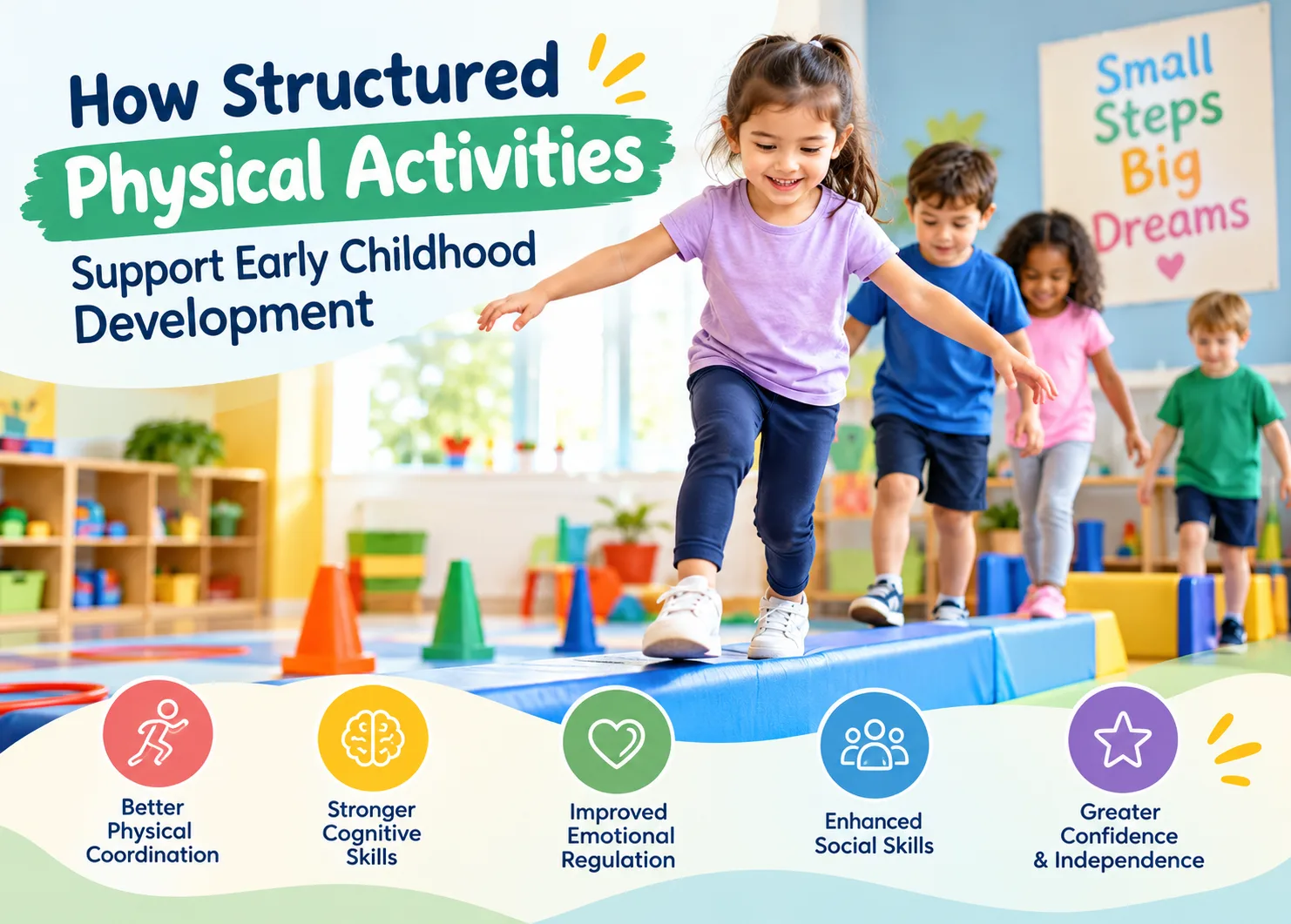
Imagine seeing a child trying to walk across a low balance beam. To make it to the other side, they have to coordinate their body, focus on directions, and prepare themselves for a potential slip. When they finally nail it, that physical win gives their confidence a massive boost, making them way more eager to tackle any big challenge. Providing age-appropriate learning materials and activities can help children build confidence, strengthen essential skills, and benefit from well-chosen student resources.
They get basically the same feeling during group games. Even simple group activities force kids to be good listeners, wait patiently for their turn, respect boundaries and personal space, and read the body language of the other kids.
These social and mental habits are here to help them be a lot more successful in the classroom, be part of group conversations without feeling embarrassed, and share toys during playtime.
The Link Between Swimming And Early Childhood Development
The reality is that swimming is a great example of how structured physical activities can mix concentration, movement, and confidence building. For instance, age-appropriate aquatic programs are intended to show kiddos the concept of water safety and, at the same time, help them feel a lot more confident in uncharted territories.
Depending on the child’s age and the program, activities may include practicing safe entry and exit, understanding basic water movements, becoming more confident in the water, and so on. Parents and educators who are exploring how swim lessons support early childhood development may conclude that the value extends far beyond physical activity alone. Well-designed lessons enable children to practice following sequences, listening, following instructions, etc.
Furthermore, swimming is going to make kids feel as if they truly accomplished something big and honed skills that, in the beginning, seemed too demanding. Speaking of progress, keep in mind that every child is different, and they should never be pressured to be as good, or even better than others.
They should have their own pace, regardless of how “slow” you may think it is. Something that should always come first is safety. Young kids must be supervised around the moment at any given moment, and just because they’ve completed certain lessons, it doesn’t mean that the risk of drowning is non-existent.
Instructions must be provided by someone who is skilled and experienced, and activities must be adapted to children’s age, skills, and confidence.
The Link Between Cognitive Development And Physical Routines
What’s interesting is that structured physical play and traditional classroom learning actually use the same brain power. When kids have any joint physical activity, they have to listen carefully, memorize instructions fast, spot patterns, make instant decisions, and adapt their behavior as the game changes.
This turns playtime into a masterclass for sharpening their focus, building working memory, and mastering self-regulation, all in a high-energy environment that keeps them completely hooked. Take a classic game like "Red Light, Green Light" or any activity where kids move on one specific keyword and freeze on another.
To play without getting caught, they have to focus, keep the rules top of mind, and control their natural impulse to just keep running. It looks like pure fun on the surface, but it's actually an incredible workout that’s going to positively influence their impulse control and listening skills.
Movement games are also a perfect way to introduce early math concepts. Without even realizing they're learning, kids might count their hops, compare who jumped the furthest, spot geometric shapes throughout an obstacle course, or memorize a specific sequence of dance steps.
The main purpose is intentional planning. Physical activities give the biggest educational boost when they are designed with a clear developmental goal in mind, while still remaining genuinely fun and perfectly adapted to the kids' ages and skill levels.
Strengthening Emotional Regulation & Resilience
There’s no doubt that learning something new is great and super-useful, but bear in mind that it can oftentimes be frustrating, too! At the end of the day, we’re talking about extremely young people who still do not have enough experience in terms of disappointment, failure, uncertainty, and many other things that are normal when you’re an adult.
Luckily, that’s why structured physical routines are here. They are a perfect opportunity for the little ones to hone all of these skills. At first, a kid will probably miss catching a ball the first couple of times before they become successful at it.
And then you’ll have a child who will successfully finish a balance activity, but only after several attempts. And that’s totally normal and expected. In these types of situations, it’s of huge importance for parents and educators to continue encouraging children, reminding them that all of the mistakes that were made were part of the learning process. Encouragement and positive feedback can help children stay motivated as they learn new skills, make mistakes, and develop greater confidence through practice.
Early education focuses on recognizing that physical routines can really contribute to so many things, aside from the children’s physical well-being. When done right, they help practice attention, emotional regulation, problem-solving, physical coordination, and cooperation.
Read More Blogs On: