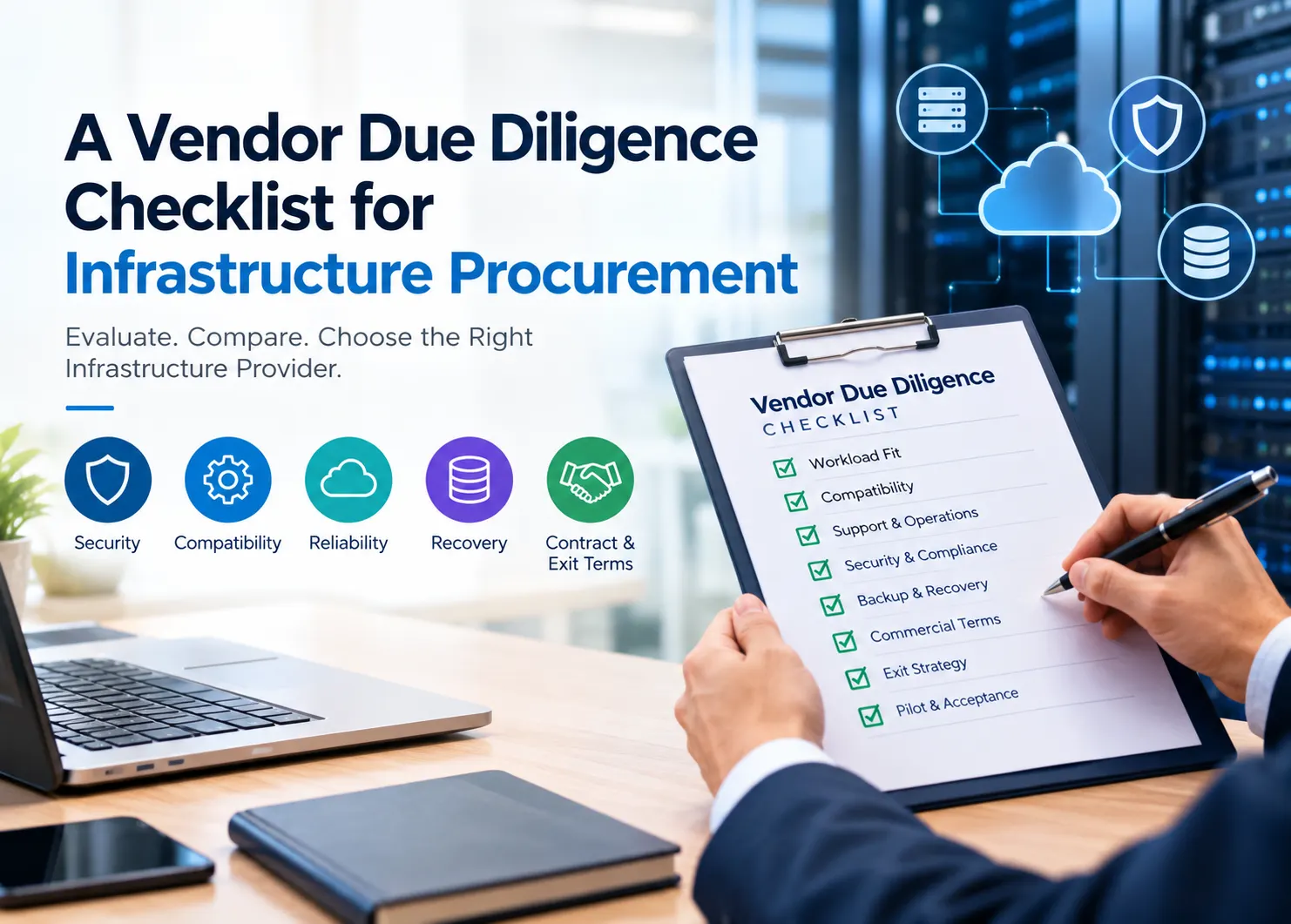
A bulk server disposition is the controlled retirement of a fleet of enterprise servers, handled as a single project and not as a series of individual sales, and its unit of work is a lot, which may be a rack, a row, a pallet run, or on occasion an entire hall. Everything that separates the exercise from listing one machine on a marketplace follows from that definition, because what you are running is not a sales process but a project with an inventory baseline, a data-security work package, a physical de-install window, a freight plan, a receiving audit at the far end, and a settlement that has to reconcile back to the list you began with.
Where the sequence is wrong, the failure surfaces without drama and long after the event, as a single drive that appears on the shipping manifest, fails to appear on the destruction certificate, and is noticed eleven months later by a compliance reviewer for whom that discrepancy is now unresolvable, because the pallet was broken down in a warehouse two states away and the engineer who unracked it has since changed employers. Failures of that shape are rarely failures of sanitization tooling, which is mature, well documented, and rarely the component that breaks; they are failures of sequence, of record keeping, and of the handoffs between the four or five parties who each hold the assets for a few days and each assume that the party before them wrote something down. What follows is a walkthrough of that sequence, stage by stage, set out in the register of a programme plan and not that of a buying guide.
Where Bulk Begins, and What a Packaged Disposition Contains
No formal threshold exists, but the market begins to behave differently at roughly a full rack or a pallet and above. Below that line, single-unit channels usually pay better, since a reseller can list each chassis individually and wait for the right buyer to arrive. Above it, the economics invert, because the cost of handling, listing, and shipping forty separate machines exceeds whatever premium those individual listings might command, and volume buyers become the more sensible route on the strength of their ability to absorb an entire mixed lot in one transaction.
Two definitions are worth pinning down before anything else proceeds.
Bulk IT asset disposition (ITAD) is the packaged service combining documented data sanitization, resale or remarketing of whatever still holds value, certified recycling of whatever does not, and an audit trail covering every serialized asset, all of it delivered at fleet scale rather than device by device.
A surplus enterprise sale is the commercial half of the same arrangement, meaning the transfer of retired hardware to a buyer who pays for it, either outright or on an agreed share of what it eventually fetches. Bulk ITAD without a resale component amounts to disposal, while resale without the ITAD component amounts to a data-security incident that has not yet been discovered.
Most fleets contain both categories at once, since two-generation-old dual-socket servers with populated memory and drive caddies usually carry real residual value, whereas the eight-year-old chassis at the back of the row is scrap with a modest metals recovery attached to it. A sound project plan treats the two as separate work streams that happen to travel on the same truck.
Stage One: The Retirement Decision and the Sign-Offs That Gate It
The decision to retire is not an IT decision on its own, and treating it as one is the single most common reason a disposition stalls halfway through. A multi-layered risk management strategy can help organizations account for the operational, security, financial, and compliance risks involved. Before anything is unracked, four groups have to agree in writing.
Infrastructure or platform ownership confirms that the workloads are genuinely migrated, that nothing is still pinned to a specific box, and that the DNS entries, monitoring checks, and backup jobs pointing at those hosts have been retired too.
Finance confirms that the assets are fully depreciated or that the write-down has been approved, and establishes whether the recovered value books as revenue, as an offset against the refresh, or somewhere else entirely, which matters considerably more than it sounds, because a settlement whose destination nobody has decided will sit unreconciled for a quarter.
Security and compliance confirm what data classification lived on those systems and therefore which sanitization method is acceptable, since a box that held cardholder data and a box that ran a build agent cease to be the same class of asset from this point onward.
Legal or records management confirms that there is no litigation hold in force, no regulatory retention obligation outstanding, and no contractual clause with a customer requiring that media be destroyed in a particular manner or within a particular jurisdiction.
Record all four as a formal gate with named owners and a date against it, not because governance is a pleasant activity, but because in nine months an auditor will ask who authorized the disposal of asset tag 41977, and "the infrastructure team" will not serve as an answer.
Stage Two: Serialized Inventory, and Why the Asset Register Is Usually Wrong
Begin from the physical estate instead of the CMDB, because the asset register serves well as a cross-check and poorly as a baseline. Drives get swapped under warranty, and the record never follows. Memory gets cannibalized during an incident at two in the morning, and chassis get moved between cages during a capacity shuffle while the location field remains exactly as it was.
The inventory pass should produce one row per asset carrying, at minimum, the manufacturer, model, chassis serial, asset tag, rack and U position, CPU count and model, memory configuration, and every drive listed by bay position with its own serial and capacity alongside it. Photograph the front and rear of each rack before anything moves. For a mid-sized hall, the pass takes a couple of days, and those are the highest-return days available anywhere in the project.
Classify next by data risk, since that classification governs the entire sanitization schedule:
- Data-bearing media: hard drives, solid-state drives, NVMe modules, embedded flash, and any tape still sitting in a library. These need documented sanitization and per-serial evidence.
- Configuration-bearing devices: switches, firewalls, load balancers, and out-of-band management controllers. These hold credentials, VLAN and routing configuration, VPN keys, and logs. They rarely get flagged, and they should be.
- Non-data-bearing components: processors, accelerators, and DIMMs retain nothing once power is removed, since volatile memory clears at power loss. These carry value, and they do not need destruction, which is worth knowing before someone shreds a tray of usable DIMMs on precautionary grounds.
Reconcile the physical count against the register and produce a variance list from the difference, and chase every unexplained gap while the machines are still racked and available for inspection, rather than after the truck has left the dock.
Stage Three: Scheduling Sanitization as Its Own Work Package
Sanitization warrants treatment as a scheduled work package in its own right, with a named owner, a defined window, and completion criteria of its own, rather than as a task buried somewhere inside the de-install runbook. AI in business can also support automated security monitoring and risk-management workflows, although it does not replace the need for documented sanitization and verification. Where it lives inside the de-install, it is compressed the moment the de-install runs late, and that compression comes out of verification every time.
The reference standard is NIST Special Publication 800-88 Revision 2, which became final in September 2025 and superseded Revision 1, withdrawn on 26 September 2025, and which retains the three levels of Clear, Purge, and Destroy, each selected against the media type and the confidentiality of the data it carried, while remaining explicit that sanitization must be both verified and documented (NIST SP 800-88 Rev. 2). Method selection is therefore a matter of media physics and data classification rather than of institutional preference.
Magnetic media, meaning spinning hard drives together with LTO and DLT tape, responds to degaussing, and for many classifications a verified overwrite pass will also be acceptable.
Solid-state media behaves differently in every respect that matters here, since degaussing leaves flash contents entirely intact, and since wear leveling and over-provisioning between them mean that a conventional overwrite cannot reliably reach every cell on the device. Solid-state drives require the manufacturer's own secure erase routine (ATA Secure Erase, NVMe Format), or alternatively a cryptographic erase in cases where the drive was encrypted from first use and the key can be destroyed. Anyone who assures you that a degausser handles your SSDs is telling you something untrue.
Decide next where the work happens. On-site sanitization, whether performed by a mobile shredding truck or by a wiping team working inside the cage, ensures that data never crosses your perimeter and allows a witness from your own side to sign off in person, at the cost of a slower schedule, floor space, power, and a higher price. Off-site sanitization at the buyer's facility is faster and cheaper, and it means drives travel populated, which is a trade your security team ought to make explicitly rather than discover after the fact.
A middle path that works well at scale is to pull and sanitize the highest-classification drives on-site, ship the remainder populated under a sealed chain of custody, and make the arrival of the destruction certificate a condition of settlement clearing. The completion criterion does not change with the route: per-serial evidence, not a summary count.
Stage Four: Setting Commercial Terms Before the Truck Is Booked
Agree the commercial structure while the hardware is still racked and countable, because your negotiating position is strongest when the buyer can see exactly what they are getting.
Two structures dominate the market. Under a buyout, which is an outright purchase, the buyer quotes a figure for the lot, takes title on collection, and carries the resale risk from that moment forward, which gives the seller a clean number, a fast close, and a single line to reconcile. Under a consignment, which is a sell-and-split, the buyer remarkets the equipment and returns an agreed percentage of what it actually fetches, usually across several months, which can return more on a fleet of genuinely current hardware while handing the seller months of open exposure and a settlement that has to be chased. For most retirements of two- to five-year-old general-purpose servers, the buyout is the correct call, the exception being a fleet of recent accelerators or high-density nodes where the secondary market moves fast enough that the upside justifies the wait.
Valuation at lot level is built from a submitted inventory list, which means the quality of your Stage Two work sets your recovery directly. Buyers price against model generation, CPU and memory configuration, drive capacity and type, chassis condition, the quantity of matched units, and current demand in a secondary market that moves with supply. Two practical consequences follow from that. Matched quantities are worth more than the same count of mixed models, because they can be resold as a coherent block, and equipment loses value in storage, so hardware left standing for a year while the project waits on a decision is worth materially less than the same hardware quoted at the point of retirement.
Because whole-fleet purchasing demands warehouse capacity, testing throughput, and a documented downstream that few organizations can assemble internally, a distinct segment of the buyback market has specialized in exactly that work instead of in component picking. Where a retirement spans more than one site, or crosses a border, the shortlist narrows again to the small number of counterparties able to run the commercial half and the decommissioning half of the same programme under one contract: Big Data Supply, certified to R2v3 and RIOS, undertaking full data center decommissioning alongside its buyback desk, and serving more than 100 countries out of Santa Ana in California with further operations in Amsterdam and Singapore, will take a multi-region retirement as one engagement, which is what the bulk sale of used servers across three continents requires if the evidence pack at the end is to reconcile as a single document.
Five terms belong in writing before collection is scheduled: who holds title at which point, what form the sanitization evidence takes, what happens to assets arriving dead or missing, the payment window together with whatever event starts the clock running, and who bears the cost of freight and insurance.
Stage Five: The De-install Window
De-install is the stage most likely to overrun, and the reasons it overruns are almost entirely mundane ones of access, scheduling, and building administration.
Book the window with facilities and building management at the outset and not at the end, because loading dock access, freight elevator reservations, after-hours security escorts, and parking for a 53-foot trailer are all arrangements that will be refused on short notice. In a colocation facility, the operator will additionally want a work order, an approved contractor list, and in most cases a certificate of insurance from anyone touching the cage.
Work rack by rack and top down, maintaining labeling discipline the whole way through, so that every chassis carries a label matching its inventory row before it leaves the rack. Cable pulls belong in their own bins, because structured copper and fiber each carry recovery value that is lost the moment they are mixed into general scrap.
Pack for transit, not for storage. Servers should ride on pallets, ideally in their original rails or in foam-blocked layers, wrapped and banded down to the deck, since a pallet of unsecured 2U chassis will arrive with bent ears and cracked bezels, and cosmetic damage moves units down a grade. Rail kits, cage nuts, and mounting hardware belong in labeled boxes on the same pallet as the servers they came from, given that a chassis accompanied by its rails is worth more than one without them.
Every pallet should carry a manifest listing the asset tags and serials aboard it, with one copy taped to the pallet and one copy retained, and every pallet should be numbered. When the receiving audit produces a discrepancy three weeks later, pallet-level manifests are what convert an argument into a five-minute lookup.
Stage Six: Freight and the Insurance Gap Almost Everyone Misses
Interstate motor carriers are liable for actual loss or damage to freight under federal law, but that same statute lets a carrier limit its liability to a value declared in writing by the shipper or set by written agreement (49 U.S.C. 14706). In practice that means a standard bill of lading with no declared value often caps recovery at a per-pound figure that bears no relationship to what a pallet of populated servers is actually worth.
Declare the value accordingly, obtain written confirmation of the coverage, and establish whether the buyer's freight arrangement extends to your shipment or protects only their own liability. Where the buyer is arranging and paying for collection, ask specifically who carries the risk between your dock and their door.
Two further freight controls repay the small effort they cost. Seal the trailer or the individual pallets and record the seal numbers on the bill of lading, so that any tampering in transit becomes visible on arrival. Where the timeline permits it, split high-value lots across more than one shipment, so that a single incident cannot remove the entire recovery at once. For sanitized drives traveling separately from their chassis, some programs use tamper-evident containers carrying their own numbered seals, logged against the pallet manifest.
Stage Seven: Receiving, Audit, and the Variance Report
At the buyer's facility, the lot is received, scanned, and audited, and this is the stage at which the inventory discipline established in Stage Two either repays itself or exacts its price.
A competent receiving process scans every chassis serial and every drive serial against the manifest, grades each unit for cosmetic and functional condition, tests whatever requires testing, and produces a received-inventory report that can be compared line by line against what left your dock. Request that report as a contractual deliverable rather than as a courtesy.
Variances arise on almost every bulk project, whether a drive pulled during a maintenance event two years ago and never logged, a chassis that proves to be a different SKU from the one the register claimed, or a unit that arrives with a cracked backplane. What matters is less the existence of the variance than the existence of a documented process for resolving it, which means a named contact on both sides, a defined window in which exceptions may be raised, agreed forms of evidence such as photographs and scan logs, and a price adjustment mechanism established back in Stage Four rather than negotiated under pressure at this point.
One principle deserves more weight than it usually receives, which is that reconciliation should run against the sanitization record and not against the purchase order. The purchase order records what you were paid for, whereas the sanitization record is what an auditor or a regulator will ask to see, and it remains the only document proving that each specific piece of media was handled. Where a serial appears on your shipped manifest and fails to appear on the destruction certificate, that is an open item regardless of whether the money reconciled cleanly.
Stage Eight: Settlement and the Paperwork You Keep
Payment on a buyout typically follows verification of the received inventory, not collection itself, which means the clock starts only once the buyer has audited the lot, and that lag should be built into the finance timeline rather than papered over with a date nobody on your side controls.
The document set retained at the end is the actual output of the project, and five items belong in it. Maintaining this documentation also supports financial audits and stronger governance, particularly when asset records, settlements, and compliance evidence need to be reviewed later.
- The final serialized inventory, as shipped, with pallet assignments.
- The Certificate of Destruction or Certificate of Sanitization, listing serial numbers and not quantities, with the method used per media type and the date.
- The chain of custody record, showing every transfer of possession with times, signatures, and vehicle or seal references.
- The recycling and downstream documentation for whatever was not resold, including where it went.
- The settlement statement reconciling the received inventory to the payment.
One point about certification is worth understanding before the downstream documentation is filed away. The R2 standard is built as a set of core requirements plus process appendices, and a facility is required to meet only those appendices matching the processes it actually performs (SERI, R2 Standard), which makes "R2 certified" a genuine signal and an incomplete one when it stands alone. Ask which appendices the facility holds, and ask where material travels after it leaves them.
Retain the whole set for as long as your records policy requires for the underlying data, a period usually longer than the finance retention window, and store it somewhere a compliance colleague can locate without asking you, because the person who ran the project will not always be present when the question eventually arrives.
Server retirements almost always surface a second inventory alongside the first, consisting of LTO cartridges in a library, loose tapes in a cabinet, a stack of retired tape drives, and on occasion a decade of backup sets for which no index survives.
Handle that inventory inside the same project, on the same manifest, and with the same serial-level treatment applied to everything else. Because tape is magnetic media, both degaussing and verified overwrite remain available, and a genuine choice therefore exists between destruction and reuse, since cartridges passing a resurfacing and verification process can be sold back into the market rather than shredded, which recovers value while keeping the material out of landfill. A large share of retired tape is never recycled at all, an outcome that goes unremarked in most disposal plans because nobody was ever made accountable for the cabinet. What should not happen under any circumstances is that the tapes are deferred to a later phase, because later phases get cancelled and the cabinet stays full.
Closing Note
The parts of a bulk server disposition that go wrong are rarely technical, since wiping a drive and shredding a platter are both solved problems with mature tooling behind them. What remains unsolved on most projects is the documentary record, meaning who signed off, what the baseline inventory said, what the manifest claimed was aboard pallet nine, and whether anyone ever set the destruction certificate beside the shipping list.
Which suggests that the most useful way to hold the whole exercise in mind is not as a sale at all. A bulk disposition is a construction project that happens to end in a payment instead of a building, having every other feature of one: a defined scope, a baseline survey, a sequence of dependent stages, a set of trades each of whom needs the preceding trade to have finished properly, an inspection at handover, and a snag list nobody enjoys. Underplanning it costs in precisely the way underplanning any project costs, which is to say not at the moment the shortcut is taken but two or three stages downstream, when the de-install meets a loading dock that was never booked, when the receiving audit surfaces sixty drives the register had no record of, or when settlement stalls against a variance that Stage Four should have priced and did not. The payment at the end is the smallest number in the exercise and the one most sensitive to everything decided before it, and a fleet retirement planned as a project returns more, in money and in evidence both, than the same fleet sold as an errand.
Read More Blogs on: