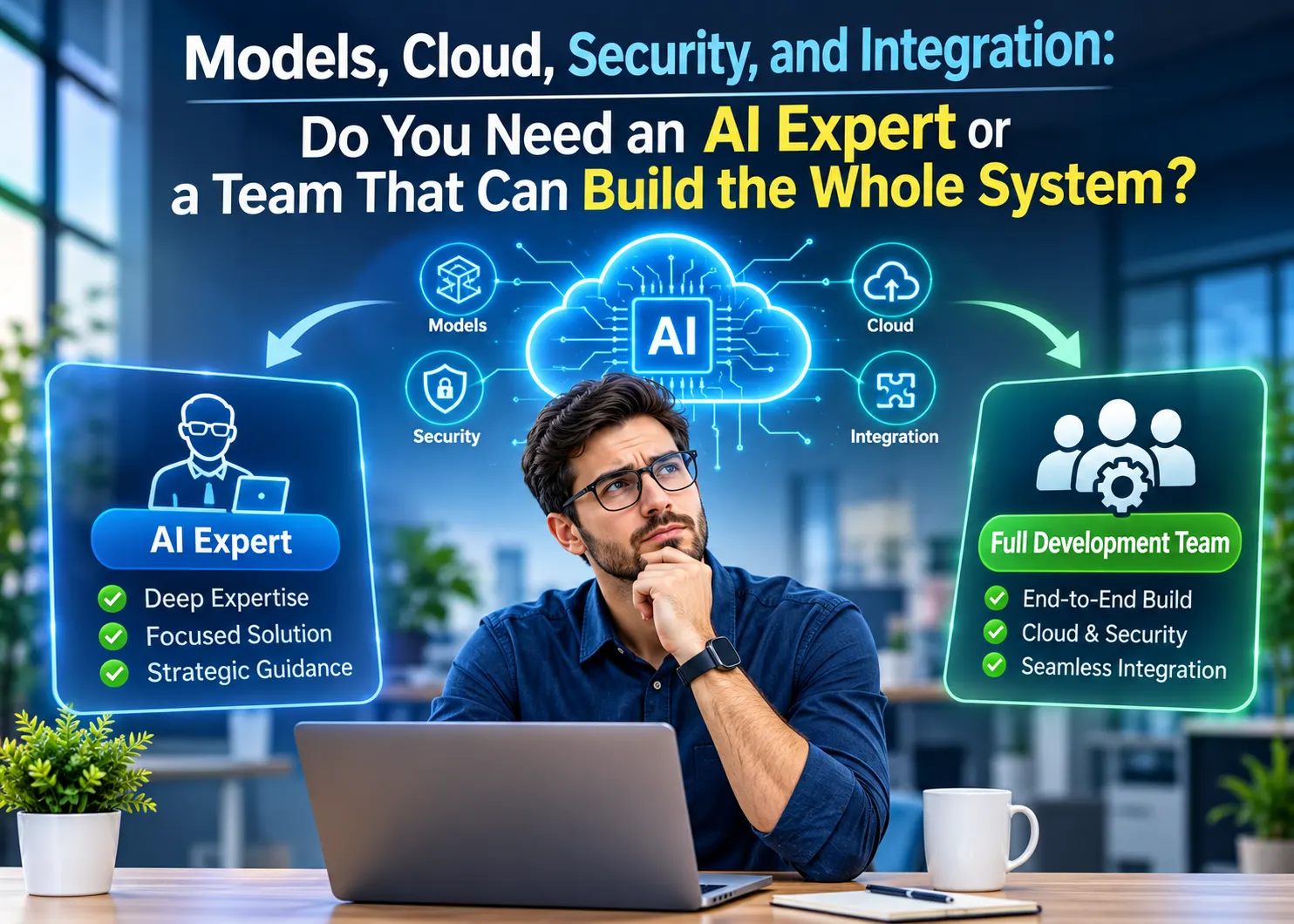
The model tends to steal the spotlight in an AI project. It may classify documents, respond to customers, estimate future demand, or help staff find answers across a maze of internal information. Yet once the system has to work day after day, plenty happens behind the curtain. Data must flow cleanly, interfaces have to make sense, permissions need careful control, and the technical setup must stay on its feet when more users come through the door.
For companies comparing AI development companies, it helps to ask who can carry the project all the way from model work to a working business system. Deep specialists may handle model choice, training, testing, and fine-tuning. Broader teams can also take care of cloud infrastructure, backend development, UX, DevOps, security, and links with enterprise platforms. The right match depends on which part of that chain needs the most attention.
Where Deep Model Expertise Matters Most
Model specialists fit projects where the product depends on difficult research or unusual model behavior. A company building a domain-specific vision system, a speech model for a rare language, or a forecasting engine with unusual data may need people who understand model design at a deep level. Their work can include training strategy, data labeling plans, evaluation methods, model compression, and testing across edge cases.
That focus also matters when small changes in model behavior have a large business effect. A team may need to compare model families, test retrieval methods, reduce incorrect answers, or tune a system for a narrow task. In these cases, an AI development company with deep research and machine learning experience can shorten the path from experiment to a model that meets clear technical targets. Businesses planning custom AI solutions should also understand how AI development can support practical applications, from predictive analytics and chatbots to intelligent business automation
However, many business projects use existing foundation models, managed AI tools, or established machine learning methods. The model still matters, but the work around it starts to shape cost, speed, reliability, and daily use. That shift changes the type of team a project needs.
The Production System Around the Model
A production AI feature is usually one piece of a much bigger machine. It may fetch customer records, send a request through backend software, save the result, log each action, and run permission checks before the answer reaches the user. The steady growth of cloud infrastructure also shows how much modern software delivery, including AI, now depends on shared computing resources.
The surrounding system usually includes several connected areas:
- Cloud and data setup: Teams choose where models run, how data moves, where records live, and how costs are tracked.
- Backend engineering: Services connect the model to databases, business rules, search tools, or internal software.
- User experience: The screens and review steps that help users make sense of AI output and know when to bring a person into the loop.
- DevOps and monitoring: Automated releases, logs, alerts, and testing help teams update software while keeping production stable.
- Security and access: Identity checks, permissions, encryption, data rules, and audit records protect business information.
These areas are tightly linked. A model may perform well in testing and still create delays if the backend sends too much context with every request. A clear interface can also fail if access rules expose data to the wrong users. Therefore, production planning needs technical decisions to line up across the whole system. Building reliable AI automation requires more than selecting a model; businesses must also plan for computing infrastructure, cloud services, storage, and ongoing system integration.
Integration Is Where Enterprise AI Becomes Real
Enterprise AI rarely gets a clean slate. It has to fit into software that already handles finance, sales, HR, support, operations, or document storage, sometimes across systems built years apart. That puts APIs, access rules, identity tools, data formats, and older platform limits right in the middle of the project.
Take an AI support assistant. It may pull customer details from a CRM, check product records in an internal database, search policy files in cloud storage, and then write the final update back to a service desk. Every handoff brings its own rules around access, timing, errors, and data ownership. AI development services need to factor in these connections from the start, since one integration choice can ripple through architecture, testing, and release planning. Successful AI implementation depends on integrating AI models with existing systems, automating workflows, maintaining security, and building solutions that can scale with business needs.
Providers such as N-iX combine AI engineering with cloud, data, software development, and enterprise integration work. That mix supports projects that cross several technical domains and ownership needs to stay clear from design through release.
How to Choose the Right Delivery Model
The decision becomes easier when the project is broken into the work that must happen before and after the model produces an answer. A research-heavy product and an enterprise workflow tool can both use AI, yet they need different delivery skills.
- Is the core challenge model performance? If success depends on new training methods, specialized data, or difficult model evaluation, deep AI research skills should carry more weight.
- How many systems need to connect? Projects that touch several databases, SaaS tools, internal platforms, or identity systems need backend and integration experience.
- What production risks matter most? Sensitive data, regulated records, high traffic, strict uptime goals, or expensive model calls make cloud, security, and operations work central to the plan.
- Who owns the full release path? Clear ownership matters when model code, application code, cloud resources, testing, security review, and support all have to move together.
This is where AI development solutions should be judged as complete production systems rather than isolated model demos. The provider should be able to explain the architecture, identify dependencies, define testing steps, and show how updates will move from development into live use.
Match the Team to the Whole System
The right AI partner depends on where the real complexity sits. Projects built around research, custom training, or demanding model evaluation need specialists who can go deep. If the product has to work across a real company setup, the job spreads into cloud infrastructure, backend development, user experience, security, DevOps, and connections with enterprise platforms.
A practical selection process starts by mapping the full production path from data source to user action. That view shows where the hardest work sits and which skills need to stay under one owner. For many enterprise projects, the strongest setup brings deep AI expertise together with the engineering skills needed to build, connect, secure, launch, and keep the system running.
Read More Blogs On: