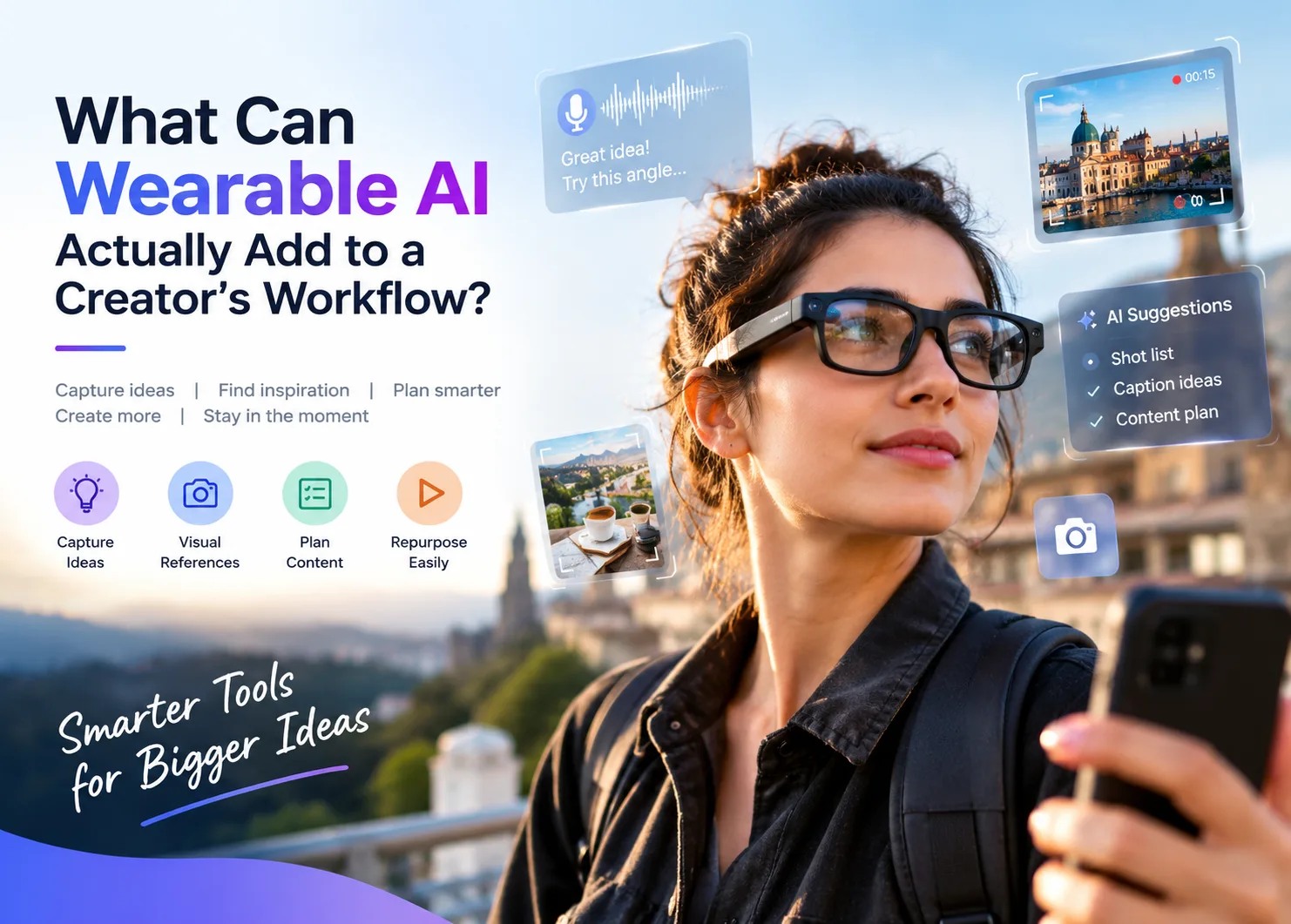
Content creation doesn't start when you hit "post." For most creators, the real work begins way earlier — spotting an idea, saving a few reference shots, messing around with formats, blocking out a scene, filming bits and pieces, and trying to figure out what people actually want to watch.
That process can be fun, but it's also exhausting in a specific way. You're bouncing between your phone, a camera, a notes app, an editing program, a calendar, analytics, and whatever platform you're posting to. And the more apps you're juggling, the easier it is for a good idea to just... slip away before it ever becomes something real.
This is where wearable AI starts to make sense. Not as a replacement for creativity or storytelling — nothing does that — but as a way to catch the small moments where ideas tend to show up and vanish just as fast. If you work in travel, fashion, food, fitness, events, design, education, or lifestyle content, this kind of tool might genuinely change how your day runs.
Catching Ideas Before They Slip Away
Every creator has had this happen: an idea hits at the worst possible time. You're walking through a city, mid-shoot, talking to a client, browsing a store, standing at an event. By the time you actually sit down to write it out, half the details are already gone.
A wearable device can shortcut that. Record a quick voice note, describe what's in front of you, ask it to remember something visual for later — whatever gets the idea down before it fades. And this matters more than it sounds like it should, because so many content ideas are tied to a specific place or moment. The color of a café wall. How a product's displayed on a shelf. The noise of a busy street. None of that comes back the same way once you've moved on.
It's not just about convenience, either — it's about context. Typing "film travel packing tip" into your notes app is fine, but it's nothing compared to talking through the idea out loud while you're actually packing, holding up the items, explaining why it matters in the moment. That raw version tends to hold up better later.
It also helps if you juggle multiple content types. Instead of stopping to decide whether something's a tutorial, a behind-the-scenes clip, or a product review, you can just capture the thought first and sort it out afterward.
Gathering Visual Inspiration Without Breaking Your Flow
Visual inspiration hits constantly if you're paying attention. A food creator clocks how something's plated. A travel creator notices the light hitting a street right before sunset. A fashion creator can't stop looking at how two colors sit next to each other.
Glasses with camera are useful here mainly because they remove the friction of stopping to grab your phone every few minutes. You can shoot quick reference clips from your own point of view while you're walking through a market, setting up a shoot, checking out a venue, or trying something in a real setting.
That said, this only works if you use it with some care. Filming needs to be respectful — especially in private spaces, workplaces, stores, and anywhere people wouldn't expect a camera. And it's worth resisting the urge to just let the device passively record everything. The footage that actually ends up useful still comes down to paying attention: noticing the right moment, understanding why it might matter later.
Planning Content That Still Feels Spontaneous
Content that looks effortless is usually the result of planning most people don't see. Wearable AI can help turn a scattered voice note into a shot list, a caption outline, or a rough filming plan. If you think better out loud than sitting at a desk, this matters more than it might seem.
For anyone building out their channel more seriously, YouTube's own creator resources are worth digging into for the bigger-picture strategy side of things. Wearable AI fits into that picture — but only as support. It works best when there's already a clear content strategy behind it, not as a substitute for one. This is where AI content creation can become useful as a supporting layer, helping creators organize ideas and turn raw observations into content without taking over the creative process.
At the end of the day, you still have to decide what you stand for, who you're actually talking to, and what value you're offering. AI can sort, summarize, and suggest — but it can't hand you a creative identity. That part's still on you.
Speeding Up Research Without Flattening Your Point of View
Research eats up more time than people admit — audience questions, trends, product specs, location details, competitor content, search demand. AI's genuinely useful for getting a fast starting point on most of that.
Wearable tech adds another layer on top: real-world research, captured as it happens. Walking through a museum or a showroom, you can talk through what you're seeing instead of trying to remember it later. A travel creator can log details mid-walking-tour. A fashion creator can note fabrics and styling choices while actually browsing, instead of trying to reconstruct it from memory that evening.
But here's the catch — don't let AI smooth out your point of view. The best content usually comes from someone noticing something nobody else did. Two creators can visit the exact same hotel, eat the exact same meal, and walk away with completely different content, because they paid attention to different things. AI can help you gather more raw material, but your judgment still has to be the thing steering it.
Making Repurposing Actually Work
Content rarely stops at one post. A long video turns into short clips. A behind-the-scenes recording becomes a tutorial. A voice memo turns into a caption. One location visit can spin off a guide, a carousel, a short video, and a newsletter idea, all from the same afternoon.
Wearable AI helps mainly by giving you more raw material to work with in the first place — more clips, more observations, more notes collected throughout the day instead of scrambled together after the fact.
But more footage without a system just becomes clutter. Label things. Group clips by project. Go back through what you've collected regularly instead of letting it pile up. AI can help summarize or sort, sure, but you still need an actual workflow behind it — something as simple as separate folders for ideas, raw footage, usable clips, published work, and stuff you might revisit later. Once that raw material is organized, AI video tools can also help creators turn longer recordings and ideas into different formats for multiple channels.
Privacy Still Matters — Maybe More Than Before
Wearable AI comes with a responsibility that's easy to underestimate. Recording from a device on your face is a lot less obvious to the people around you than pulling out a phone. Be upfront about when you're filming, and be considerate of the people in frame.
This especially applies in offices, client meetings, schools, gyms, restaurants, shops, and anyone's home. When you're not sure, ask. If someone or something shouldn't end up on camera, blur it out or just don't film it.
It's worth thinking about your own limits, too. Just because a device can capture more doesn't mean every moment should become content. Rest, private conversations, time with family, client work — some of that needs to stay off the record, full stop.
Used well, wearable AI is a tool, not a reason to document your entire life. The goal is better content — not more of it for its own sake.
So What Does It Actually Add?
In practice, wearable AI adds speed, context, and flexibility. It helps you catch ideas in the moment, build up a library of visual references, shoot from your own point of view, plan without sitting at a desk, and repurpose more easily because there's simply more to work with.
But it only works if you bring the rest yourself — taste, judgment, ethics, a sense of who you're actually making things for. Without that, it's just another source of files you'll never get around to sorting.
The creators who get the most out of this will probably use it quietly, almost in the background — noticing more, saving better raw material, catching thoughts before they disappear — and then trusting their own judgment to decide what's actually worth sharing.
Wearable AI isn't replacing the creative process. It's just adding a layer to it. For anyone whose work depends on being out in the world and reacting quickly to it, that layer can make things feel a little smoother, a little richer — a little closer to what they were actually trying to capture in the first place.
Read More Blogs On: