A certain degree of risk is the name of the game the world calls ‘choosing a career.’ You make decisions based on what you know at the time and then figure out as you go. Today, the scenario is light-years ahead, if we may say so.
After all, AI has made its grand debut, something that used to be an anticipated thing of the future for the longest time. Deloitte, in its 2026 survey on Gen-Z and Millennials, found that 74% of employees from both generations already use AI regularly for their daily work. Things get into perspective when we account for the fact that the survey covered over 22,500 people across 44 countries.
This has literally transformed the ground underneath today’s working folks into shifting sand. A career that looks secure today may as well be gone tomorrow, thanks to AI. However, it's not as simple as researching which jobs could survive AI disruption.
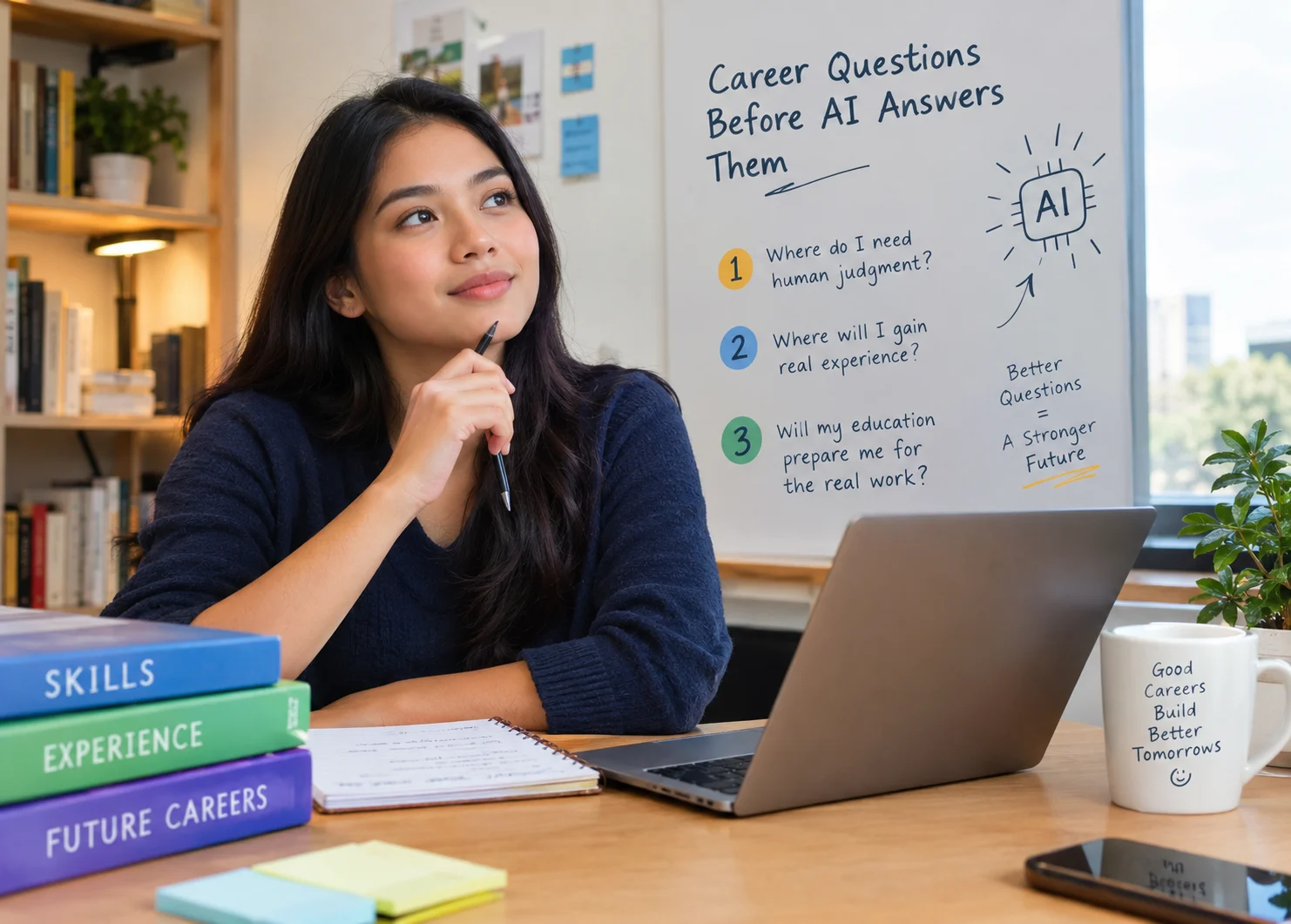
Students and working professionals must ask some crucial questions before AI answers them on their behalf. This article will discuss three such questions worth answering while there is still time.
Which Parts of This Career Depend on Human Judgment?
AI is an attractive choice for a lot of work today, especially since it is capable of processing information and producing answers in seconds. As companies ask themselves which parts of the work AI can handle, job aspirants must flip it on its head.
You need to think in terms of the parts of a career that still rely on human judgment. In many cases, the technology does not have to replace the entire profession, but may support professionals with accuracy and productivity by tackling part of their work.
In a recent report, the Associated Press highlighted how experts still considered skills such as empathy, critical thinking, and ethical judgment as areas where humans get the upper hand. Maria Flynn, President and CEO of a non-profit centered on workforce development, pointed out that “The skills that are most resistant to displacement by AI are the ones that are most distinctly human.”
If the crux of a profession involves building trust or analyzing complex human situations (partly through emotional intelligence), that's a good sign. Take the example of social work. While social workers do use technology to organize information or maintain records, that's not the heart of the profession.
These professionals play a multifaceted role where they must respond to crises, connect people with relevant resources, and advocate on their behalf. The skills required for these are complex in practice, such as the ability to be empathetic yet objective, solve problems with compassion, and communicate effectively.
Hence, considering an advanced educational pathway such as a social work online master’s program is not merely a question of earning a convenient graduate credential. What’s important is whether the education develops the judgment required by the profession. For instance, clinical social workers need a Master’s degree, supervised clinical experience, and state licensure to begin their practice.
On that note, let’s not forget that the online mode of learning has its unique value. It makes education accessible for someone changing careers or balancing work with other responsibilities. In a nutshell, an important test for any career is whether its main part involves skills that only a human can do justice to.
How to Test a Career’s Human Side
- Go through the main duties or daily responsibilities, whether they involve communication, conflict resolution, or ethical judgment.
- Check who is ultimately responsible for making decisions, even if they use AI to help with the process.
- Look for educational programs that develop the human capabilities a job demands.
- Work backward from the role you want: identify the human aspects of the role first, then choose credentials accordingly.
Where Will I Gain Experience That AI Cannot Simply Replicate?
Previously, we discussed understanding which parts of a career still depend on people. Here, let’s look into where you can develop the ability to perform those parts well. Gallup’s 2026 survey of 1,572 US Gen-Zers found that 51% use Generative AI at least every week.
Despite that familiarity, eight in 10 said using AI tools was likely to make it more difficult for them to learn in the future. Strikingly, 42% even believed that AI could do some serious harm to their ability to analyze information. The main dilemma or fear is not with AI’s ability to support learning.
Legitimately, many workers want to know what happens when assistance replaces the process of working something out yourself. Indeed, professional abilities are not built through information alone. Just take our previous example on social work; aspirants must apply their knowledge while responding to the circumstances of real people.
At the end of the day, AI prompts may explain many things and even provide example scenarios. However, unless you get down and dirty in a workplace setting, there is only so much you can learn. When you interact with people, make decisions amid pressure and uncertainty, and take responsibility for your choices, you will have something AI cannot replicate.
On that note, experience is not something to develop only after graduation. The right internships, volunteer opportunities, or supervised projects are designed to develop professional skills while learning.
How to Find Experience That Builds Capability
- Even as a student, consider looking for internships, clinical experiences, and mentorship opportunities.
- Choose situations involving real people that allow you to put your skills into practice.
- Seek feedback from seniors and experienced professionals within your field to understand your strengths and weaknesses.
- Pay attention to what you had to figure out yourself, for those moments reveal the skills you are truly developing.
- Use AI as a learning aid, but ensure you still have opportunities to think and learn from real situations.
Does My Education Prepare Me for the Work Itself or for the Qualification?
While a degree can prove that you completed a specific course, it does not mean you are ready to do the work. In simple terms, your education should give you more than just a credential at the end.
It should help you solve problems and even understand when a theory needs to be questioned. For instance, a teacher needs more than knowledge of certain concepts or theories. Most importantly, they must know how to respond to different students’ needs.
Similarly, a manager needs more than a thorough understanding of business concepts. They also need to communicate effectively, make sound decisions, and handle problems involving other people. Understanding areas such as AI in HR can also help future managers see how AI is changing workforce-related responsibilities. Since Artificial Intelligence can also produce and apply many of the theories you learn in class, where is the distinction?
In other words, do not determine the right education only by the name of the degree or the institution offering it. Look at what you will be expected to do during the program. If there are opportunities to apply concepts to realistic problems, receive feedback, and work through ambiguous situations, you’re good to go.
Reuters reported in April 2026 that the US was experiencing one of the leanest job markets for new college graduates in years. One reason is that AI has started picking up a great deal of entry-level tasks.
Also, labor-force participation among workers aged between 20 and 24 years had fallen more than in any other key working-age group. If some of the basic tasks that once helped people enter a profession and learn on the job are handled by AI, what does genuine preparation for a career mean? Bluntly put, having more than just credentials.
How to Test Whether Your Education Is Preparing You
- Look at the various possibilities you will have after graduating.
- Compare and see if the curriculum will reflect work in the real world.
- Check the kinds of professional requirements you must meet in terms of licensing, certification, and supervised experience.
- Don’t forget to consider what responsibilities will fall under your belt after AI has taken up the routine work.
The AI-Era Career Test
Ask Yourself | Look For |
Does this career need human judgment? | Empathy, ethics, and critical thinking |
Where will I gain real experience? | Internships, placements, and mentorship programs |
Will my education prepare me? | Practical learning, feedback, and job-ready skills |
How will AI fit into the work? | AI as a tool, not a substitute for thinking |
Right now, nobody is asking whether AI will change the career they are considering. The truth is that it will inevitably happen, at least to some degree in every field. What you must consider now is whether you are prepared for that kind of future.
PwC’s latest analysis revealed that AI-exposed junior roles are seven times more likely to require senior skills such as leadership and strategic thinking. Moreover, ‘seniorized’ entry-level roles have grown by 35% since 2019.
Today’s graduates have little to no time for mastering basic tasks. They must come equipped with skills to communicate with others and analyze complex information. So, what do you do? Start right now, right where you are, and take it from there.
Read More Blogs
.png)