Table of Content
- Kiara Miller
- Sep 02,2026
Search committees rarely reject a shortlisted candidate for lacking experience. By the time a name reaches the final round, everyone under consideration has run a business unit, carried a number, and survived a bad year.
What separates the person who receives the offer is narrower and harder to fake. It comes down to a set of working habits, and those habits show up in the way a candidate explains decisions they have already made.
The distance between senior management and executive leadership is a change in the type of problem, not the size of it. A director improves a system somebody else designed. An executive decides which systems should exist at all. That shift punishes careers built on execution alone, and it rewards a small number of abilities that boards test for directly.
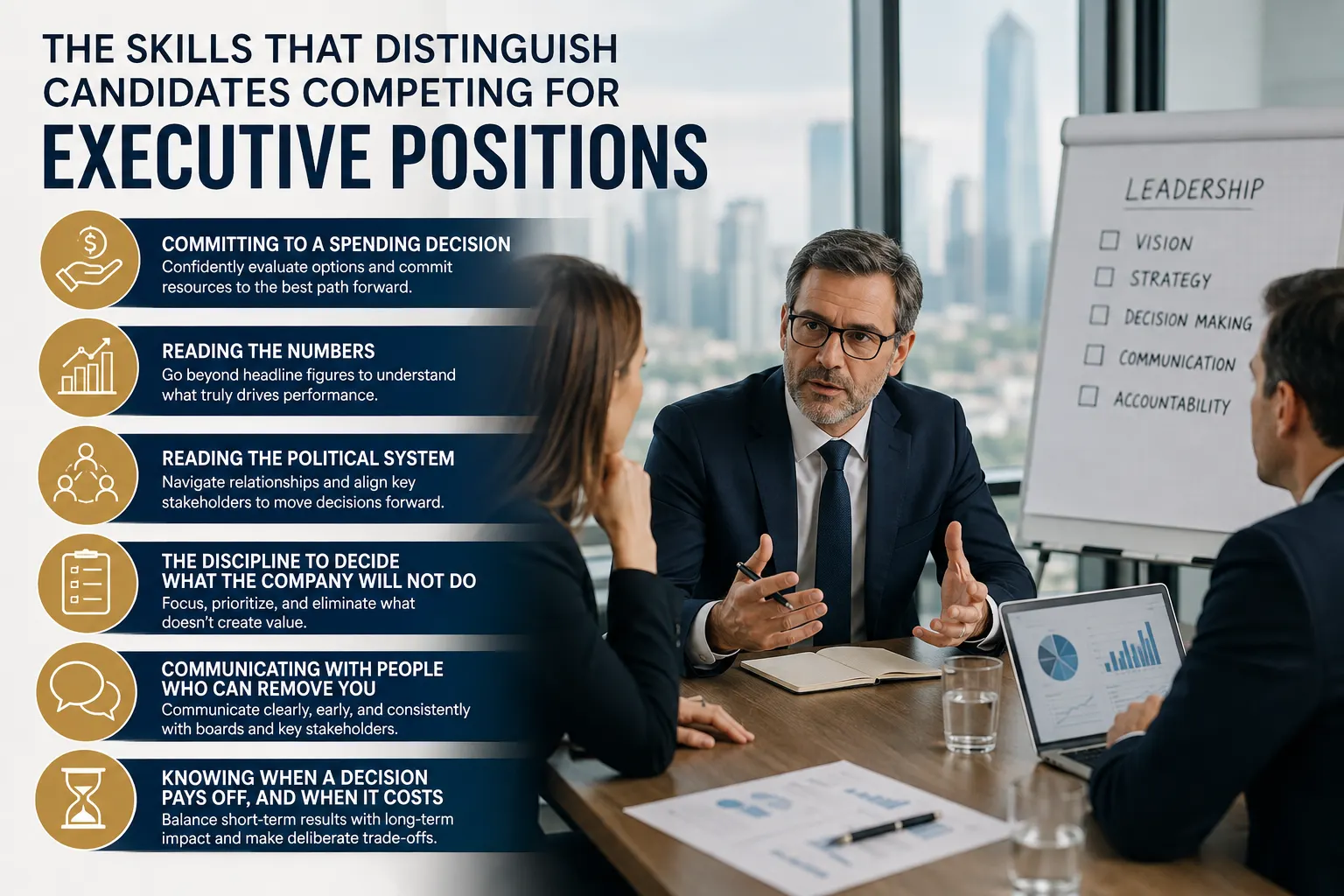
Every executive job is, underneath the title, a job about where money goes. Marketing chiefs choose between brand spend and performance spend. Operations chiefs choose between capacity and automation. The decision is almost never made with complete data, and boards want proof that a candidate can commit anyway.
What convinces them is a candidate who names the two or three options that were genuinely on the table, what each one cost in cash and in flexibility, and why the alternatives were dropped.
Boards speak in cash flow, margin structure, and capital efficiency, and a candidate who reads a P&L but cannot connect it to the balance sheet is exposed quickly. Functional specialists usually acquire the mechanics on the job and stall there, since nothing in a marketing or engineering role forces them to treat finance, operations, and strategy as one connected system.
That is the gap anonline MBA degree is built to close, running managerial accounting, managerial finance, and operations management as parts of a single argument rather than as separate modules.
Three layers of fluency are worth naming. The first is mechanical: how working capital moves, why days sales outstanding matters to a services firm, how depreciation schedules distort operating comparisons across acquisitions. The second is interpretive, meaning the ability to read a unit economics table and identify which line is the real constraint.
The third is communicative, and it is the layer most senior managers underdevelop. An executive has to explain a variance to a board in ninety seconds without a slide.
Strategy fails at implementation, and implementation fails on the people who never agreed with the strategy and were never asked. Executives who last are the ones who can map an organization's real decision network, which almost never matches the org chart.
The skill is unglamorous. It means knowing which regional head has to be brought in early or the rollout stalls. It means recognizing that the finance director and the head of engineering have not spoken candidly in two years, then designing a process that routes around the problem instead of pretending it is absent. Candidates demonstrate it by describing how they built support for something difficult, naming the individuals they had to convince and what each of them needed in return.
Search consultants have shorthand for the opposite trait. They call it the announcement problem: a leader who mistakes broadcasting a decision for securing agreement to it.
Growth-stage companies die of too many priorities far more often than too few. The executive contribution boards value most, and that candidates advertise least, is the willingness to close things down.
Concrete evidence carries weight here. A candidate who discontinued a product line, exited a geography, or shut a channel that was breaking even while consuming disproportionate management attention has a stronger case than one who launched five initiatives.
The follow-up question is what happened to the affected staff and customers, because the handling of a wind-down tells a board what the candidate's culture will look like during the next contraction.
Interviewers also listen for how long the decision took, since a leader who spent three quarters gathering consensus on an obvious exit has revealed something about their tolerance for discomfort. The better answers include a date the candidate set in advance and held to.
Executives report to a board, and board communication is a separate discipline from managing upward to a single supervisor. The audience is part-time, informed by documents rather than proximity, and legally accountable for the company.
The mechanics are learnable. Pre-read materials lead with the decision required instead of building toward it. Bad news travels early and in full, since a board that hears about a problem from a customer rather than from the chief executive stops extending trust permanently.
Figures are presented with identical definitions quarter after quarter, so that trend lines mean something. Candidates who have never presented to a board can still build credibility by describing how they prepared materials for one, which is usually how the capability begins.
The same standard applies between meetings, where a short written update in a bad month is worth more than a polished deck in a good one. Directors remember who called them before the number moved.
The final differentiator, and the hardest to teach, is knowing which clock a decision runs on. Hiring a mediocre candidate to fill an empty seat solves this quarter and costs eighteen months. Deferring maintenance on a platform buys one release cycle and eventually purchases an outage. Cutting training spend improves margin visibly and degrades the leadership bench invisibly.
Candidates who compete well for executive roles hold both horizons in the same sentence. They can state what a choice does to the coming earnings period and what it does to the company's position three years out, then say which consideration they weighted more heavily and why. Boards do not require the safe answer.
They require a deliberate one. A candidate who admits to trading a long-term asset for a short-term result, and can explain the pressure that made it the right call at the time, reads as credible. The one who claims never to have made that trade reads as untested.
Key skills include strategic decision-making, financial understanding, organizational leadership, communication, prioritization, stakeholder management, and the ability to balance short- and long-term outcomes.
Executives make decisions that directly affect spending, profitability, cash flow, capital efficiency, and growth. Strong financial knowledge helps candidates understand the broader business impact of those decisions.
Candidates can share specific examples of difficult decisions, explaining the options considered, resources involved, alternatives rejected, and the outcomes that followed.
Boards need concise, consistent, and transparent information because they oversee the organization's performance and governance. Executive candidates should demonstrate that they can communicate both positive developments and problems clearly.
An online MBA can help experienced professionals strengthen knowledge across areas such as finance, accounting, operations, and strategy, supporting a broader understanding of how different business functions work together.

Creating multiple articles within the same niche often leads to repeated ideas, structures, and keyword overlap. This guide explains how to keep every article unique by defining clear search intent, setting topic boundaries, varying content structures, managing keyword clusters, and using diverse research sources. It also covers practical editorial workflows that help writers and content teams build a well-organized content library where each page serves a distinct purpose, improves SEO performance, and provides genuine value to readers.
Read More
A top-up business degree is an efficient way for diploma holders to earn a bachelor's qualification without starting over. By recognizing previous academic credits, these programs reduce study time while enhancing career prospects, earning potential, and leadership opportunities. Students also develop practical business skills, expand their professional networks, and stay competitive in today's evolving job market. Whether you're aiming for a promotion, a career change, or long-term professional growth, a top-up degree offers a faster path to achieving your goals.
Read More
Growing a roofing business requires more than completing quality projects. Sustainable expansion depends on organized operations, reliable financial management, effective customer relationships, trained crews, and repeatable jobsite processes. This guide explores practical strategies roofing contractors can use to build a stronger and more scalable business. From adopting CRM systems and standardizing workflows to managing cash flow, responding to market demand, and investing in employees, these approaches help contractors improve efficiency, protect profitability, strengthen their reputation, and create a solid foundation for long-term business growth.
Read More
Print branding is an often-overlooked part of a strong brand identity. From business cards and stationery to packaging and signage, physical brand touchpoints influence how customers perceive your business. This article explores why consistent print branding matters, how colour and typography affect recognition, and how businesses can bring offline materials in line with their digital presence. Learn practical ways to audit and improve your printed materials so every customer interaction feels professional, recognisable, and trustworthy.
Read MoreGet into details now? View all posts