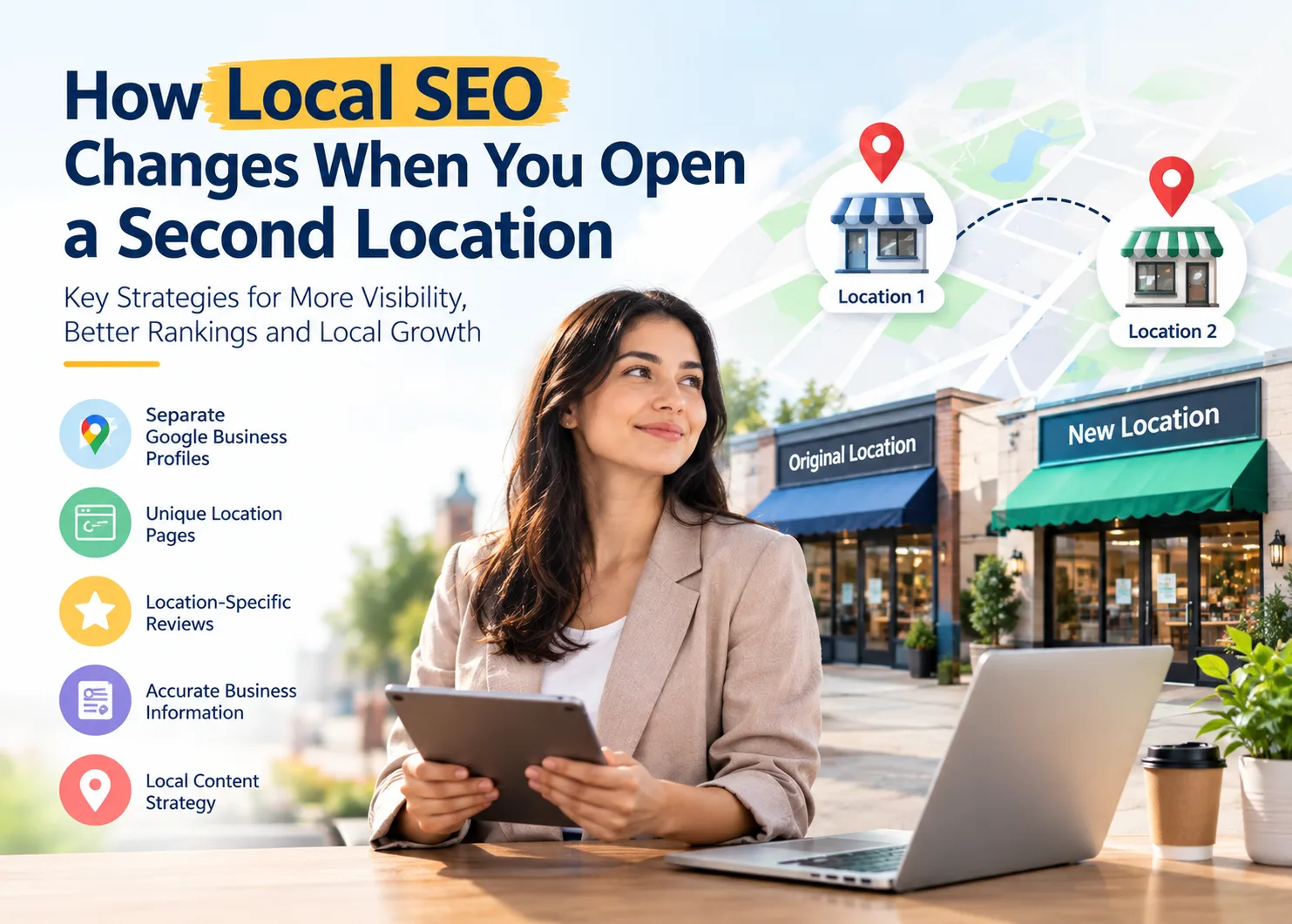
Expanding to a second location is exciting. It usually means things are going well for your business, and that you've joined the roughly 2 million multi-unit establishments in the country. The problem is that expansion can also mean more work for your marketing and SEO team.
This is because the local SEO strategy that got you on the map for your first spot may not work the same way for a new one.
You're not just adding another pin to Google Maps. You're trying to establish visibility in another local market, with its own competitors, search patterns, and nearby customers who may have never heard of your business.
Here is how your local search strategy needs to adapt when you open location number two.
Each Location Needs Its Own Local Presence
Many businesses treat their new location like an extension of the old one. That might make sense from the business's perspective, but not Google's.
A dental practice in Dallas opening a second office in Austin, for example, will need to build visibility for the new location. This is where separate local SEO for dentists might come in.
The practice can't just slap the new address onto its existing Google Business Profile (GBP) and think everything is fine. If the new location is eligible for its own GBP, then it needs to create one for it. Google needs to know these are two distinct physical locations.
Marketing agency Growth Saloon sums it up succinctly: "Sharing one “main” GBP across offices forfeits map-pack rankings." And remember, if both locations operate under the same name, keep it consistent across the profiles. Address, contact information, and hours of service can change, but name consistency is important. It helps search engines understand that they're dealing with the same business, but at different locations. Keeping your brand recognizable across locations also depends on maintaining a consistent business identity, from your messaging and visual presentation to how customers experience the brand. How to Make Your Business Identity Stand Out explores these elements in more detail.
Your Website Needs to Reflect Both Locations
Now, let’s talk about your website. You need to create a page specifically dedicated to your new location, not just add a new address in your website's footer. And this new page? It shouldn't be a copy-and-paste page where you swap just the address.
Google will likely see it as duplicate content. In fact, Google sees substantially similar pages as one content cluster, and chooses only one version, known as a canonical URL, to represent them in Search. This can make it difficult for your new page to establish its own visibility. The solution? Each location page needs real, useful specifics: local landmarks, parking notes, directions, and any services unique to that spot.
One Brand Can Have Different Local Rankings
Your first location's rankings don't automatically carry over to the second. That's because local search is, well, local. Google considers the distance between the searcher and the business, along with relevance and prominence.
Imagine your first dental practice has spent five years building visibility in Dallas. You open a second office in Austin. Your brand may already be well known, but the new office still has to establish its presence in that market. The reviews, local relevance, and other signals don't automatically transfer to the new office.
Bottom line? You may need to build new local signals for location two, even while location one keeps humming along nicely.
Reviews Become More Complicated
Managing reviews at scale is a bit harder because you have to make sure customers are actually sharing their reviews for the appropriate branch.
This is important because reviews play an important role in customers' decision-making. In fact, a 2026 study published in JMSR found that 67% of the 100 online shoppers surveyed read between six and ten reviews before making a purchase decision.
The exact numbers will vary by market and industry, but the broader point is clear: customers pay attention to what other people say about a business.
But mixing feedback up dilutes that social proof, and potential customers may not be able to see what people think about the branch they're considering.
Also, don't assume the strong review total from your original shop will help your new venture. Encourage customers directly at the second location to leave feedback on that specific Google Business Profile link to help it build momentum.
Your Local SEO Strategy Needs to Scale
Opening a second location is often where your casual SEO starts to fall apart. This is when you need to start thinking about working with SEO professionals, not because you can't do it yourself, but because you need a better system. As your business expands, identifying when your current SEO approach needs additional expertise becomes increasingly important. This is also covered in 7 Signs Your Business Needs Professional SEO Help.
You need the right people to handle your different GBPs, local content, photos, and rank tracking, so that you can focus on running and growing your business. The goal isn't really separate strategies for separate locations. It's one scalable framework that can support locations three, four, and more without giving you a headache.
Local SEO for Multiple Locations: Key Points
The table below summarizes what should happen with your local SEO once you open a second location.
Area | What Changes With a Second Location |
Google Business Profile (GBP) | Create and manage a separate GBP for each location. |
Business Website | Add a new page dedicated to your new location. Don’t copy and paste or duplicate pages. |
Business Reviews | Collect and manage customer feedback for each specific location. Don’t mix them up. |
Business Information | Keep addresses, phones, hours, and services accurate, and use the same brand name if that’s how your locations work. |
Local Content | Add genuinely local information that works for your new business location. |
Wrapping Up
Opening a second location is a huge milestone. It's proof that what you are doing is working. But as you're celebrating that milestone, don't get caught off guard and think the same SEO strategy that brought you success will carry over. Your new location is a whole new market with its own competition and opportunities. You have to treat it that way. Hopefully, this guide has shown you how to do that. Get this right, and you’re not just opening a new branch. You’re setting your whole business up for long-term expansion.
Read More Blogs On: