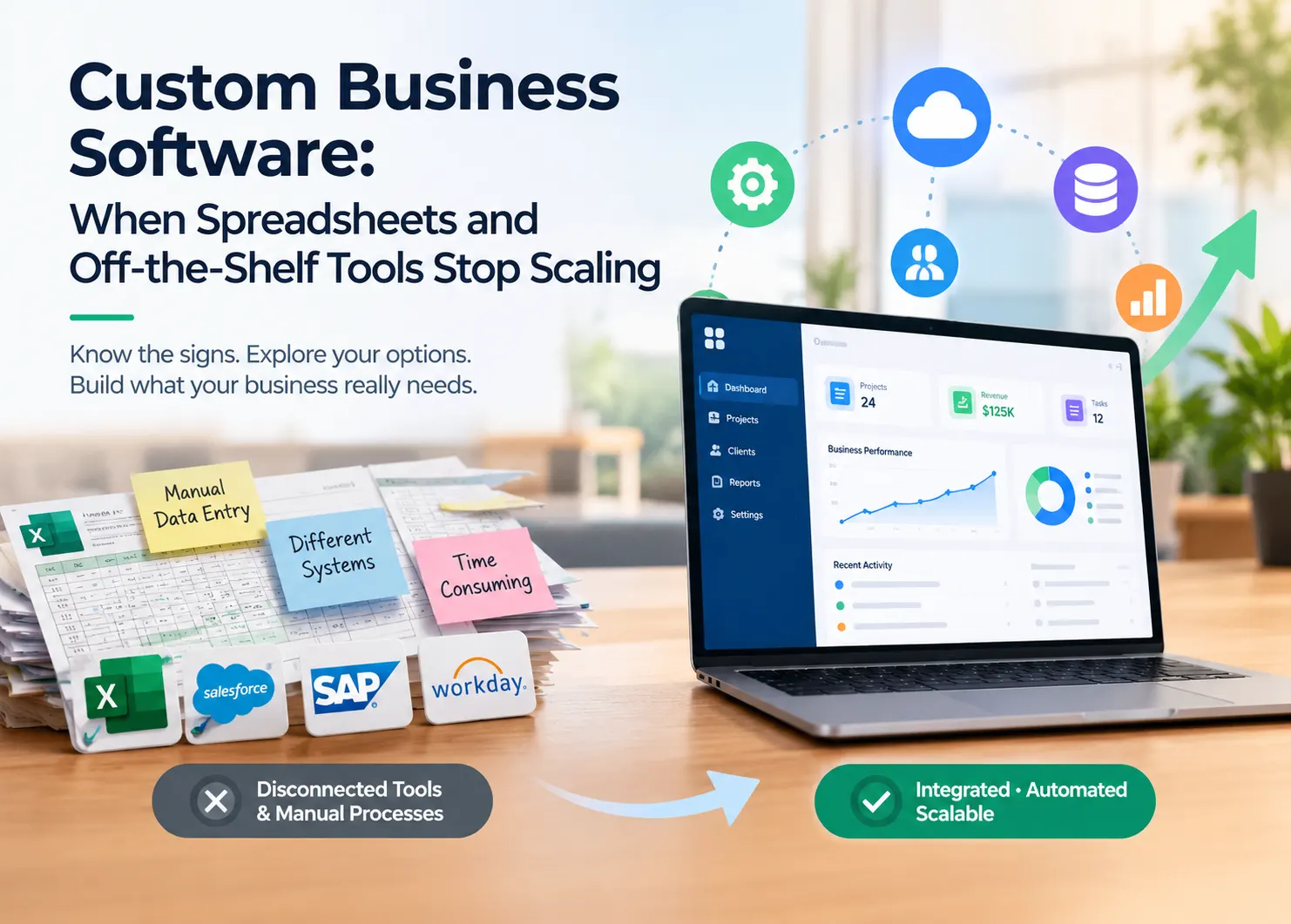
Most growing companies go through a patchwork phase. Sales lives in a CRM, finance has its accounting package, operations uses some project tool. And somewhere in the middle there’s a set of spreadsheets that only two people really understand.
It works for a while. Then it slowly stops working. The monthly report that used to take an hour now takes three days. Numbers in the CRM don’t match the numbers in accounting. Someone goes on vacation, and suddenly nobody knows how to run payroll adjustments.
That’s usually when the question of custom business software comes up. Is it worth it? Sometimes. It really depends on what’s going on inside the business, and there are some fairly clear signs to look for.
Packaged software is designed for a typical customer. If your processes look fairly typical, buying is almost always the smarter move. It’s cheaper, you can start next week, and somebody else fixes the bugs. Trouble starts when the way you work drifts away from that typical customer.
Here’s what that tends to look like in practice.
People on your team spend hours every week exporting data from one system, cleaning it up in Excel and importing it somewhere else. Nobody budgets for this, but you’re paying for it in salaries.
Important business logic sits in spreadsheets. I’ve seen commission rules, pricing formulas and even compliance checks living in a file called something like “pricing_final_v7.xlsx”. There’s no version history and no access control. One wrong edit and nobody notices for a month.
You pay for a big enterprise license just to use a handful of features. Most of your users open two screens and ignore the rest, but you’re billed per seat anyway.
Workarounds have turned into the official process. If training a new hire includes “and here’s the trick to get around what the system won’t let you do,” the tool is running your business instead of the other way round.
And finally, the process itself is your edge. If the way you quote, schedule or route jobs is the reason customers pick you, squeezing it into a generic product slowly wears that advantage down.
Build, buy or something in between
Going custom doesn’t mean writing everything from zero. There are really four options, and they blend into each other.
You can buy a ready-made product. This makes sense when the process is standard and you need it running fast. It’s cheap upfront, but the fit is limited and the vendor decides what gets built next.
You can configure and integrate the tools you already have, so they finally share data. Costs are moderate, though someone has to keep those integrations alive.
You can extend a platform with custom modules when the core system fits but a few key workflows don’t. You get more out of what you already paid for, but you’re tied to that platform’s limits.
Or you can build from scratch. This is the right call when your process is a differentiator or the market simply doesn’t serve it well. It costs the most at the start, but you control everything (including the maintenance bill). Before investing in another platform, businesses should assess their enterprise digital transformation strategies to determine whether system integration, process redesign, or custom development offers the best long-term value.
In reality, a lot of companies mix these. A typical setup: off-the-shelf accounting, a custom-built operations platform for the core workflow, and an integration connecting the two. Nobody gives out prizes for doing it “pure.” The point is to spend custom money where it actually pays back.
Where custom software usually earns its keep
A few areas come up again and again because generic tools handle them badly:
- Operations and workflow management, like field service scheduling, production planning or logistics. Lots of company-specific rules and exceptions.
- Quoting and pricing. Volume tiers, special terms for certain customers, margin rules. Standard CPQ tools often can’t express all of it.
- Client and partner portals where customers or suppliers can serve themselves, built around your actual services and documents.
- Internal data hubs that pull data from several systems into one place, so reports stop depending on manual exports.
- Compliance and audit workflows in industries where record keeping and approvals are strict and mistakes are expensive.
What it really costs
The build is the part everyone sees, but it’s only part of the bill. A realistic budget should include:
- Discovery and design. You need to understand a process well before you can automate it properly.
- Development and testing, usually split into phases.
- Data migration. Pulling years of history out of spreadsheets and old tools is almost always harder than expected.
- Training. People have to learn the new system and, just as important, start trusting it.
- Hosting and infrastructure costs every month.
- Maintenance: security patches, bug fixes, and new features as the business changes.
My advice is to treat maintenance as a yearly line item from day one. Launch isn’t the finish line. Software nobody maintains turns into legacy software a lot faster than people think.
Starting small without risking everything
Where do most of these projects go wrong? Usually they try to do too much at once. Someone sketches a huge system on a whiteboard, everyone gets excited, and a year later it’s still not finished, partly because half the assumptions behind it were never checked.
I’d go the other way. Find the one process that annoys everyone. Maybe it’s how orders get entered, or the weekly report that eats a whole Friday. Fix that first and ignore everything else for now. A structured change management process helps teams prepare for new workflows, communicate changes, train employees, and measure whether the new software is delivering the expected results.
If a tool already does its job, keep it. Connecting to it is usually cheaper than replacing it.
Also, don’t wait for perfect. Give people something rough early. They’ll tell you pretty quickly what’s missing, and that feedback is worth more than any spec document.
One more thing: write down the numbers before you start. How many hours does the process take now? How many mistakes happen in a typical month? Check again a few months after launch. If things got better, you have a solid reason to keep going. If they didn’t, better to find that out now than after spending the whole budget.
Once the first piece is clearly working, take on the next process.
Questions worth answering first
- Which processes cost us the most time, money or risk right now?
- Is our process really unique, or did we just never adjust to standard tools?
- Who inside the company will own this system for the long term?
- What happens to operations if the project runs three months late?
- Do we have money to maintain it after launch, not just to build it?
Custom software isn’t a status symbol, and it’s not automatically better than something you can buy. It’s useful when your processes have outgrown generic tools and when shaping the software around the business brings more value than shaping the business around the software. Figure out where that’s true for you, start small, and let real results decide how far to go.
Read More Blogs On: