Table of Content
- Jessica Robinson
- Aug 10,2026
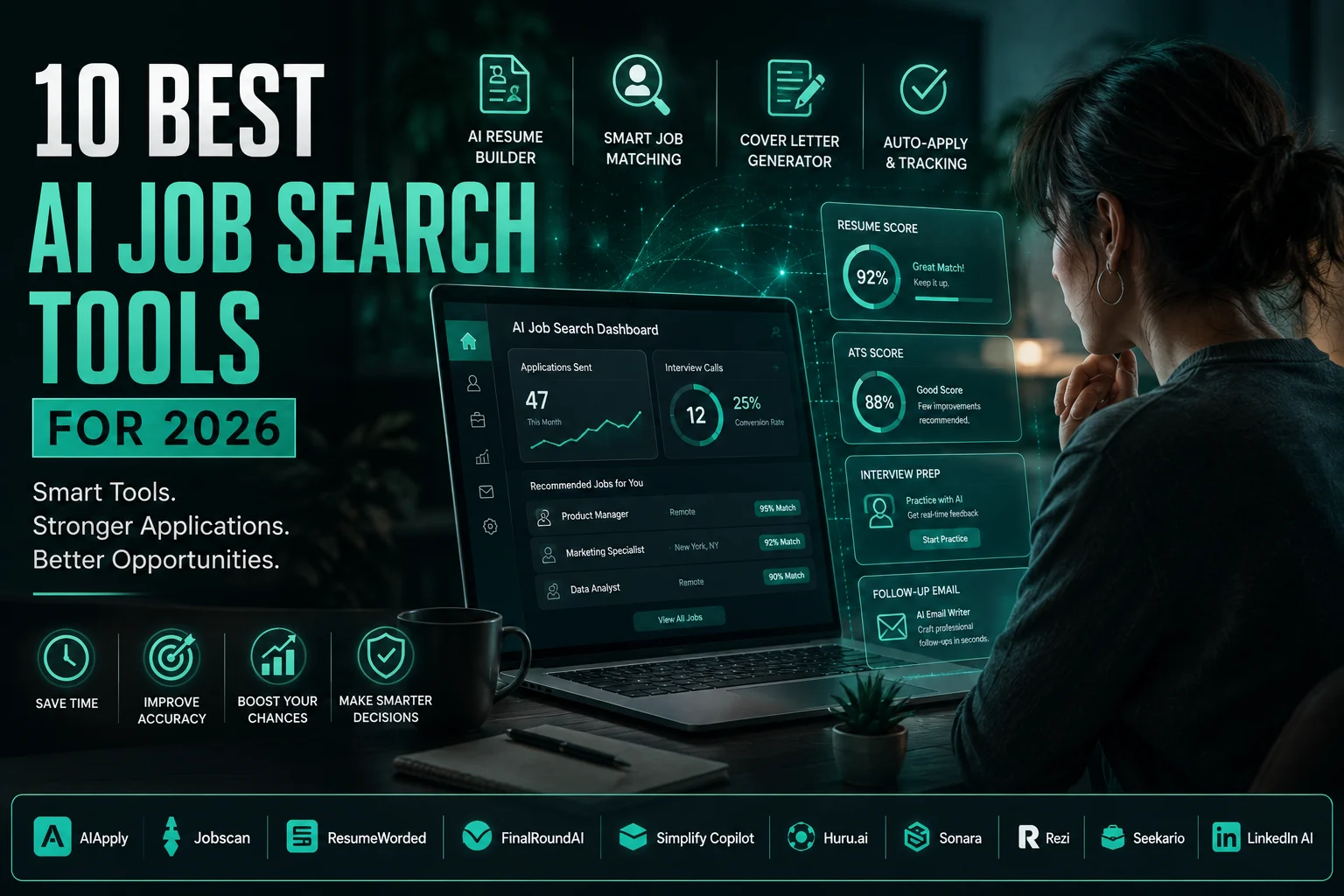
The tool that helps a final-year student land a first internship is rarely the one that helps a marketing director move sideways into a new sector. A student needs help producing a credible resume from thin experience. A mid-career professional already has the material and needs to stop spending four hours a day retyping it into portals. Someone changing industries needs help translating what they did into language a hiring manager in a different field recognizes. Most roundups ignore this and hand every reader the same ranked list, which is why so many people pay for a tool that solves a problem they do not have. The ten tools below cover genuinely different jobs, and the last section maps them to where you actually are.
This guide covers what separates these tools from each other, detailed breakdowns of all ten with pricing, a comparison table, which ones fit which career stage, and the parts of an application that still fall apart without a human.
Nearly every tool in this category claims to use AI, so that word sorts nothing. Four questions do. The first is which stage of the search it touches. Discovery, tailoring, submitting, and interview prep are separate problems, and most tools do one well and gesture at the others. The second is whether it acts on your behalf or hands you output to review. Auto-apply tools submit for you, while builders and scorers produce something you then send yourself, and that difference matters more than any feature list.
The third is what the free tier actually includes, because in this category free often means three uses rather than a working version. The fourth is whether it produces something you can edit, since a tool that generates a locked PDF is worth less than one that gives you text you can rewrite.
AIApply sits at the automation end of the category. It generates a resume and cover letter tailored to a specific posting, then submits the application on your behalf through its browser extension and application agent, so the volume comes off your hands entirely. It also includes mock interview practice and a follow-up email writer, and supports applying in several languages. Pricing starts free, with paid plans covering the auto-apply volume and credits billed on usage.
It fits people running a genuinely high-volume search with well-defined targets. If you know the roles you want and the bottleneck is the hours spent filling identical forms, this removes that bottleneck.
Jobscan built its reputation on a single measurable thing: it compares your resume against a job description and returns a match score with specific keyword and formatting fixes. That number is the closest thing in this category to an objective signal, since it approximates what an applicant tracking system reads. The free tier gives a limited number of scans per month, and Jobscan Premium runs around $49.95 a month for resume building, cover letters, application autofill, tracking, LinkedIn optimization, and interview practice.
Use it when you suspect your resume is being filtered out before a human sees it and you want to know rather than guess.
ResumeWorded scores your resume and your LinkedIn profile against criteria drawn from recruiter feedback, returning line-level suggestions rather than a rewrite. It tells you which bullet points lack a measurable result, which phrasing reads as passive, and where a profile is missing what recruiters search for.
The LinkedIn half is what distinguishes it. Most tools in this category ignore the profile entirely, even though inbound recruiter interest often starts there rather than with an application you sent.
FinalRoundAI concentrates on the interview rather than the application. It simulates realistic interview scenarios, generates role-specific questions, and gives feedback on your answers, which makes it useful for the part of a search where preparation is hardest to do alone.
It earns its place once applications are converting into calls. If nobody is calling yet, the problem sits upstream and a different tool addresses it.
Simplify Copilot is a free browser extension that autofills job applications across boards and company career pages, pulling from a profile you set up once. It does not write anything for you and does not decide where to apply. It removes the retyping.
For a lot of people this is the highest-value free tool in the category, because the tedium it eliminates is the specific thing that causes people to stop applying by Thursday.
Huru.ai runs mock interviews at volume, with a large question bank and feedback on delivery as well as content. It overlaps with FinalRoundAI, and the practical difference is emphasis: Huru leans toward repetition and breadth of question coverage, which suits someone interviewing across several different role types.
Sonara handles matching and automated applying, scanning listings and submitting on your behalf against criteria you define. It sits in the same category as AIApply, with less emphasis on document generation and more on the matching layer that decides which roles are worth an application at all.
Rezi is an AI resume builder with ATS-oriented formatting and content suggestions, built around producing one strong document rather than many quick ones. It suits people whose resume itself is the weak link, particularly early-career candidates assembling a first professional resume from coursework and internships.
Seekario bundles resume tailoring, cover letter generation, application tracking, and interview prep into a single dashboard, aimed at people tired of paying for four separate subscriptions. All-in-one tools trade depth for convenience, and whether that trade works depends on how demanding your weakest stage is.
Worth naming because it is free and already in front of you. LinkedIn's built-in features suggest profile improvements, draft outreach messages, and surface roles matched to your history. It will not outperform a dedicated tool at any single task, and for someone unwilling to pay for anything, it covers more ground than nothing.
Tool | Best for | What it automates | Price |
AIApply | High-volume applying | Tailoring and submitting | Toolkit: starts from $12/week; auto-apply per use |
Jobscan | Diagnosing ATS rejection | Resume-to-posting scoring | Limited free scans; Premium ~$49.95/mo |
ResumeWorded | Resume and LinkedIn feedback | Line-level suggestions | Free tier; paid plans |
FinalRoundAI | Interview preparation | Mock interviews, feedback | Free trial; paid plans |
Simplify Copilot | Removing retyping | Application autofill | Free |
Huru.ai | Interview repetition | Mock interviews at volume | Free tier; paid plans |
Sonara | Matching and auto-applying | Discovery and submission | Paid plans |
Rezi | Building one strong resume | Resume drafting and formatting | Free tier; paid plans |
Seekario | Consolidating subscriptions | Tailoring, tracking, prep | Free tier; paid plans |
LinkedIn AI | Free baseline coverage | Profile and outreach drafting | Included |
Students and first-time applicants have the opposite problem from everyone else, which is too little material rather than too much to manage. Rezi or ResumeWorded helps turn coursework, projects, and internships into something that reads professionally. Simplify Copilot then removes the retyping, and none of it needs to cost anything.
Early-career professionals applying widely benefit most from the volume tools. AIApply or Sonara handles the submission load, and Jobscan tells you whether the resume behind those applications is actually clearing filters.
Mid-career professionals usually apply to fewer, better-matched roles, so the return shifts from volume to conversion. ResumeWorded on the LinkedIn profile matters more here, because senior roles frequently arrive through recruiter search rather than through applications you sent. FinalRoundAI or Huru.ai earns its cost once processes are open.
Career changers face the translation problem, where the same experience needs different framing for a different industry. Jobscan is unusually useful here, since the match score directly measures whether your framing lands in the target field's vocabulary.
Every tool above produces a draft, and a draft is not an application. The parts that decide outcomes are the ones no model can source: the specific reason for this role at this company, the number you actually moved, the project that maps onto what the team is struggling with. Generative tools also invent things, adding a certification you do not hold or inflating a figure you never hit, and a single fabricated detail surfaced in an interview ends the process.
The workflow that holds up is simple. Let the tools handle the mechanical layer, then read every word before it goes out and add what only you could have written. Anyone who finds that final pass hard to do well is usually better served by a professional writer than by a better tool, because the gap is judgment rather than software.
The category has matured past the point where one tool wins. Pick by the stage that is actually failing you: if nobody calls, fix the resume with Jobscan or ResumeWorded. If applying eats your week, automate it with AIApply or Simplify Copilot. If calls do not convert, drill with FinalRoundAI or Huru.ai. Start with free tiers, pay only when you hit a real limit, and keep the final read for yourself.
Start free. Nearly every tool here has a free tier that reveals whether it addresses your actual bottleneck, and the paid jump is worth it only once you hit a specific limit that is costing you.
Only when they send poorly matched applications at volume. Used against a well-defined target list, they save hours without lowering quality. Used to blanket everything, they produce the same low conversion rate faster.
Usually two. One that fixes your weakest stage, and one free autofill tool to remove the retyping. Paying for overlapping features is the most common mistake in this category.
They can usually tell when something was generated wholesale, because generic copy reads generic. They generally cannot tell, and do not care, when AI helped sharpen work that is genuinely yours.
An ATS checks structure and keyword relevance, not authorship, so an AI-assisted resume passes fine if it is readable and matched to the posting. Verify it reflects your real experience before sending.

Explore the best AI tools for students for research in 2026. This comprehensive guide compares leading AI research assistants, academic search tools, literature review platforms, and citation managers, helping you find credible sources, summarise research papers, organise references, and complete academic projects faster, smarter, and with greater confidence.
Read More
Protecting your online accounts starts with choosing the right password manager. With cyber threats becoming more sophisticated, a reliable password manager helps you generate, store, and manage strong passwords securely. In this guide, you'll learn the essential features to look for, including encryption, cloud backup, password generation, multi-device compatibility, and data recovery options, so you can confidently select a solution that keeps your sensitive information safe.
Read More
Discover the 15 best AI video generator tools in 2026, including both free and paid platforms for creators, marketers, businesses, and educators. This comprehensive comparison covers features, pricing, pros, cons, and ideal use cases for leading tools like Google Veo 3, OpenAI Sora, Runway Gen-4, Synthesia, HeyGen, Canva AI Video, and more. Whether you need realistic text-to-video generation, AI avatars, or social media video creation, this guide helps you choose the right AI video generator for your workflow.
Read More
A top-up business degree is an efficient way for diploma holders to earn a bachelor's qualification without starting over. By recognizing previous academic credits, these programs reduce study time while enhancing career prospects, earning potential, and leadership opportunities. Students also develop practical business skills, expand their professional networks, and stay competitive in today's evolving job market. Whether you're aiming for a promotion, a career change, or long-term professional growth, a top-up degree offers a faster path to achieving your goals.
Read MoreGet into details now? View all posts