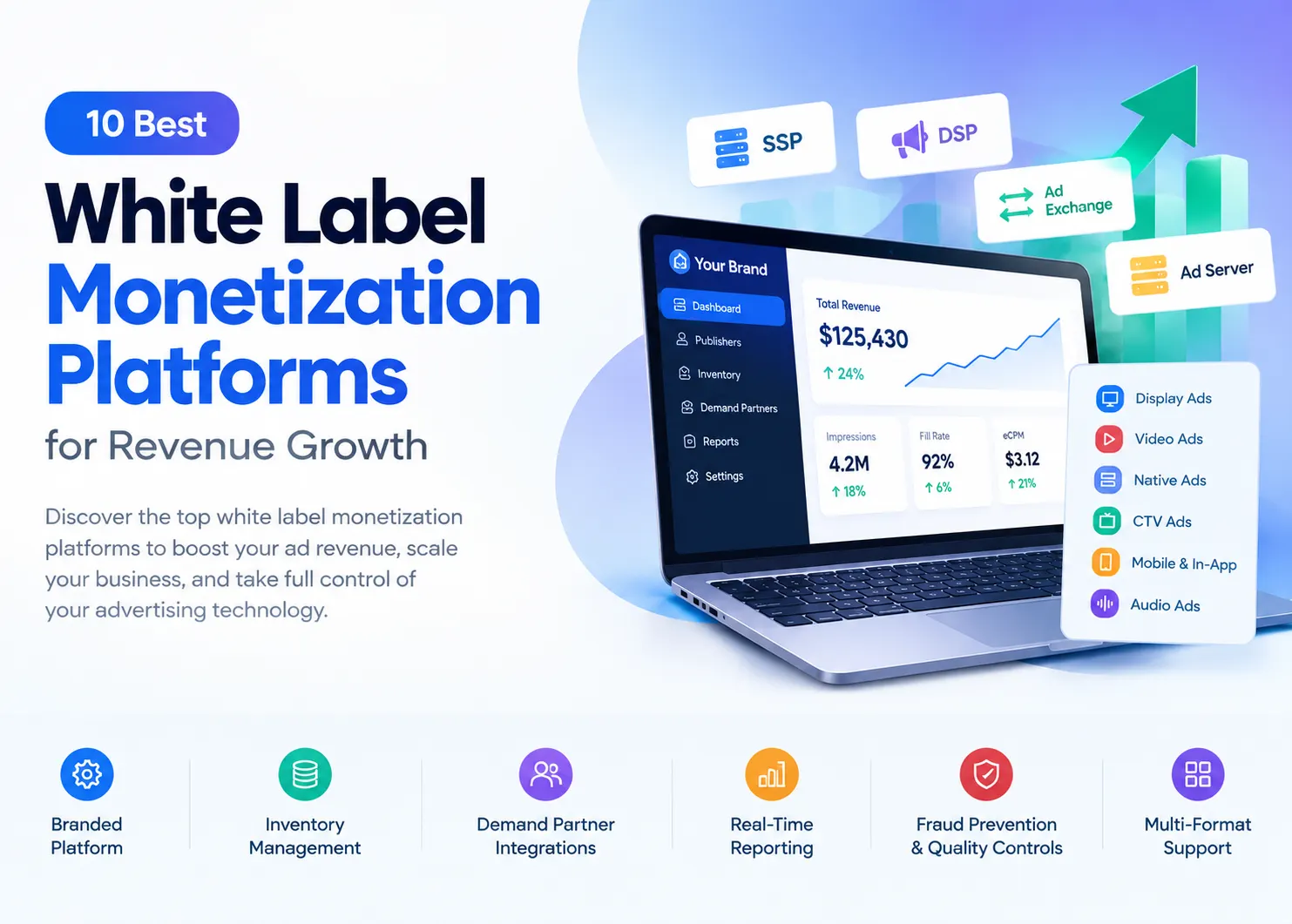
A white label monetization platform lets publishers, ad networks, and media businesses run advertising infrastructure under their own brand while relying on established ad-tech technology. It can bring inventory management, demand access, reporting, quality controls, and programmatic workflows into one operating environment.
The market includes several distinct platform types. Some vendors offer a white label monetization platform for branded marketplaces. Others focus on managed publisher monetization, enterprise SSPs, DSPs, or commerce-media tools.
For a growing ad network, the appeal is clear. Instead of sending publishers and buyers into a vendor’s generic dashboard, the network can operate a branded environment with its own workflows, account structure, reporting views, and marketplace rules. For publishers and media owners, the value may be more focused on inventory monetization, yield management, access to demand, and operational transparency.
A comprehensive branded monetization tool must enable customisation of the publisher account, permissions, workflow, reporting dashboard and role configuration.
When configuring an ad network, it involves delivering a customised experience through a dedicated marketplace interface for the publishers and advertisers. In configuring a media company platform, it involves establishing a unified operational environment for all websites, applications or regional offices.
2. Publisher and Inventory Management
Monetization depends on understanding the nature of available inventory and its performance metrics. Customised platforms need to facilitate structured monetization of publisher inventory, website or application inventory, placement-level inventory, format inventory, device inventory, geolocation-based inventory, content category inventory, and others.
This becomes critical for multi-publisher ad networks since failure to define detailed control options will result in placing premium video placements, standard display ads, mobile applications traffic and connected TV in similar monetization pipelines.
3. Revenue Models
Commercial success will depend on the revenue model enabled. Businesses requiring stacks focused on programmatic monetization via auction will differ from those requiring an entire ecosystem for managing advertisements, including campaign management, proposals and creative management by publishers.
4. Integrations with Demand Partners
While broadness of demand is important, relevancy is crucial. The network must enable connections with relevant demand for the specific media formats, geographic locations, industry verticals and inventory type. The network should provide your business visibility regarding partner performance.
Considerations include standard programmatic integrations, configurable partner access controls, monitoring partner responses and efficient onboarding of new partners. Your chosen network solution should be capable of recognising bid activity, fills and revenue generated by each partner.
5. Reporting and Revenue Analysis in Real Time
An effective reporting infrastructure will assist teams in understanding performance issues rather than simply showing the overall revenue achieved. At least, reporting should facilitate performance metrics by partner, publisher, placement, device, media type/format, geographical region and periods of time.
What constitutes an ideal monetization technology provider is contingent upon which ad formats will be used within the next 12-24 months. Technical considerations differ significantly among web display, native ads, video ads, mobile web placements, in-app advertisements, audio advertising and CTV advertisements. For instance, expanding from web displays to videos and CTV involves more than adding a placement type. Compatible integration, proper reporting, effective auctions, proper delivery and appropriate demand sources are required. There must also be consideration for traffic quality and the prevention of traffic fraud.
7. Traffic Quality and Prevention of Traffic Fraud
Traffic quality controls enable revenue protection, preserve publisher relationships and engender buyer confidence. Examples include traffic filtering controls, domain-level whitelisting/blacklisting capabilities, transparency and visibility tools, third-party anti-fraud solutions and configurable partner policies. Monetization technology can facilitate secure programmatic practices, however, this does not negate the necessity of human oversight. Publishers still desire publisher review capabilities, quality metrics, escalation protocols and restrictions on approved and prohibited supply/demand partners.
The platforms below are grouped by their strongest fit. Not every provider is a like-for-like white-label product, so use this list as a starting point for evaluation rather than a universal ranking.
1. Attekmi
Attekmi is a white-label AdTech infrastructure provider for ad networks, SSPs, publishers, media-trading businesses, and marketplace operators that want to run a branded programmatic environment without developing the full stack from scratch. Its offering combines ad exchange, sell-side, and ad-serving capabilities for operators that demand more control over traffic, partner setup, auction workflows, reporting, and platform identity.
2. AdKernel
AdKernel explicitly positions itself as white-label infrastructure for companies that want to launch and operate their own DSP, SSP, ad exchange, ad server, data platform, or retail-media network. It promotes API-based infrastructure, branded platform operation, and control over customer relationships, commercial model, and data.
3. EXADS
EXADS offers a dedicated white-label SSP, along with a customizable ad server and infrastructure for branded ad networks. Its SSP product supports inventory management, publisher onboarding, DSP and ad-exchange integrations, RTB and header bidding, real-time reporting, multiple ad formats, demand-source controls, and malvertising protection.
The company also positions its platform as fully white-label, including advertiser portals, publisher dashboards, and administration environments branded with the operator’s identity.
Platform.io is a full-stack white-label programmatic platform for ad agencies, networks, and brands building their own media-trading ecosystem. It combines SSP, DSP, DMP, ad-exchange, and header-bidding components in a configurable environment, making it relevant for operators that need more than a branded ad server.
A growing ad network can use Platform.io to manage inventory, connect demand, run auctions, work with audience data, and build a custom monetization or media-buying operation under its own brand.
5. Adtransfer
Adtransfer offers white-label ad-server infrastructure aimed at publishers, ad networks, and operators that want to manage direct campaigns and third-party demand from one branded platform. Its product positioning highlights reporting, optimization tools, integrations, and scalable infrastructure.
It can be relevant for organizations that need a branded platform with a mix of ad-serving, monetization, and integration capabilities, particularly when they want to avoid creating separate systems for direct and programmatic workflows.
6. dJAX Technologies
dJAX Technologies provides white-label ad-server products for publishers, ad networks, agencies, and media businesses. Its solutions cover multiple channels, including display, video, mobile, and digital out-of-home, and can support customized programmatic advertising workflows.
It is a relevant option for operators that want white-label ad-serving infrastructure and broad format support, especially when their platform needs extend across several inventory environments.
7. AdGlare
AdGlare provides a white-label ad server that lets publishers, advertisers, and ad networks run a branded advertising environment. It supports ad serving, targeting, campaign management, multi-publisher workflows, real-time statistics, and API access.
AdGlare is less exchange-centric than some of the other providers in this list. However, it can suit networks that want branded ad-serving functionality, flexible campaign controls, and an accessible platform foundation for a custom advertising operation.
8. Admixer
Admixer provides programmatic advertising technology for publishers, ad networks, agencies, and businesses developing their own advertising platforms. Its RTB Stack is a white-label ad exchange solution that allows operators to create a branded programmatic environment without building the underlying trading infrastructure from scratch. The platform supports OpenRTB integrations, connections with DSPs and SSPs, and configurable tools for managing advertising transactions.
For monetization-focused businesses, Admixer can be relevant when the objective is to connect multiple supply and demand partners through a branded exchange. Its RTB Stack supports different advertising formats, reporting tools, and auction controls, allowing operators to organize programmatic trading around their existing business relationships and technical requirements.
9. Adoppler
Adoppler provides programmatic advertising infrastructure for companies that want to build customized SSP, ad-exchange, DSP, and ad-server products. It is generally relevant to businesses that require greater control over platform logic, data, workflows, and integrations than standard hosted platforms allow.
This type of infrastructure works best for technically capable teams with a clear marketplace model, specialised supply, regional demand relationships, or a differentiated programmatic product vision.
10. RixEngine
RixEngine provides full-stack programmatic advertising infrastructure for businesses looking to develop or expand their advertising operations. Its product portfolio includes RixSaaS for programmatic infrastructure deployment, RixDesk for demand-side advertising, and RixDev for traffic monetization. The company emphasizes API-based connectivity and data-driven technology that can integrate with existing AdTech and MarTech systems.
For advertising networks and monetization businesses, RixEngine can be relevant when the goal is to establish programmatic infrastructure while retaining flexibility over integrations and operational workflows. Its combination of SaaS deployment, media-buying technology, and monetization products may suit companies planning to connect different parts of their advertising business within a broader technical environment.
Adtelligent
Adtelligent provides publisher monetization and ad-revenue-management technology, including tools for pricing models, floor CPM, revenue share, publisher payouts, and margin calculations. Its product set can support ad networks and publishers that need more structured revenue-management and inventory-optimization workflows.
It should be positioned carefully. Adtelligent is relevant to the broader white-label monetization category only where its commercial and implementation model supports a customer-branded operation. Confirm the exact white-label scope, account branding, integration control, and marketplace capabilities before presenting it as a direct equivalent to a white-label SSP or ad exchange.
Custom development gives you full control, but it requires investment in real-time systems, integrations, reporting, security, monitoring, and ongoing maintenance. A white-label platform can shorten time to market while preserving meaningful control over branding, workflows, and commercial operations.
Your decision depends on where you create value. If your edge comes from supply relationships, data, vertical expertise, or partner networks, white-label technology may offer a more practical route than a complete in-house build.
2. SSP, Ad Exchange, and Ad Server Capabilities
These terms describe different platform layers. An SSP manages sell-side inventory and connects it to demand. An exchange facilitates auction-based transactions. An ad server manages delivery, targeting, pacing, and reporting.
Some providers combine these functions. Others specialize in one. Map the capabilities you need before you compare platforms. Choosing the right business technology solutions can help advertising companies connect their systems, streamline workflows, and build infrastructure that supports long-term growth.
3. Branding and Customization Options
Ask whether customization changes the way your business operates or only changes the appearance of the login page. A real white label monetization platform should support configurable accounts, publisher access, reporting views, workflows, partner rules, and marketplace logic.
4. Demand Connectivity and Integration Flexibility
The provider with the highest number of integrations may not be the right choice. Prioritize demand sources that fit your inventory and markets. Then confirm how much control and visibility you retain over those connections.
5. Reporting Transparency and Revenue Control
Request sample dashboards and export files. Your team should be able to analyze revenue by partner, format, publisher, placement, geography, and device. It should also identify latency, errors, weak demand, or poor-performing inventory segments.
Compare platform fees, revenue share, traffic-based pricing, implementation costs, support, integration work, and custom-development charges. A cheap platform can become expensive if it restricts data access, creates manual work, or cannot scale with your business. Before committing to a monetization platform, businesses should account for implementation fees, revenue shares, integration costs, and future scaling expenses as part of a practical financial plan.
7. Scalability and Technical Support
Assess expected traffic, peak-load conditions, format expansion, publisher onboarding, and technical support. A platform that works at launch but fails during growth can cost more than a stronger initial implementation.
1. Best for Ad Networks
Choose a platform with multi-publisher management, flexible demand connectivity, granular reporting, configurable workflows, and strong branding options. White-label infrastructure creates the most value when the network wants to operate a recognizable marketplace instead of reselling access to another platform.
Managed publisher monetization partners may provide a better fit when yield optimization, technical support, and user experience matter more than platform ownership. Focus on transparent reporting, ad-quality controls, demand access, and format support.
A white-label exchange, SSP, or ad-server environment makes sense when branding, workflow ownership, and marketplace differentiation drive your strategy. The platform should reflect your commercial model, not only your visual identity.
Choose a platform based on proven support for web, in-app, video, CTV, native, and audio inventory. Confirm that delivery, reporting, integrations, and quality controls work consistently across every channel you plan to monetize.
5. Best for Custom Programmatic Ecosystems
Businesses with unique data, specialist inventory, or complex partner models should assess configurable white-label solutions before investing in a fully custom build. The right infrastructure provider can balance speed, flexibility, and operational control.
Start with your operating model. Define your inventory, formats, demand strategy, reporting requirements, technical resources, and desired level of ownership. Then choose infrastructure that supports sustainable growth and gives your team a clearer view of how monetization actually works.
Read More Blogs On