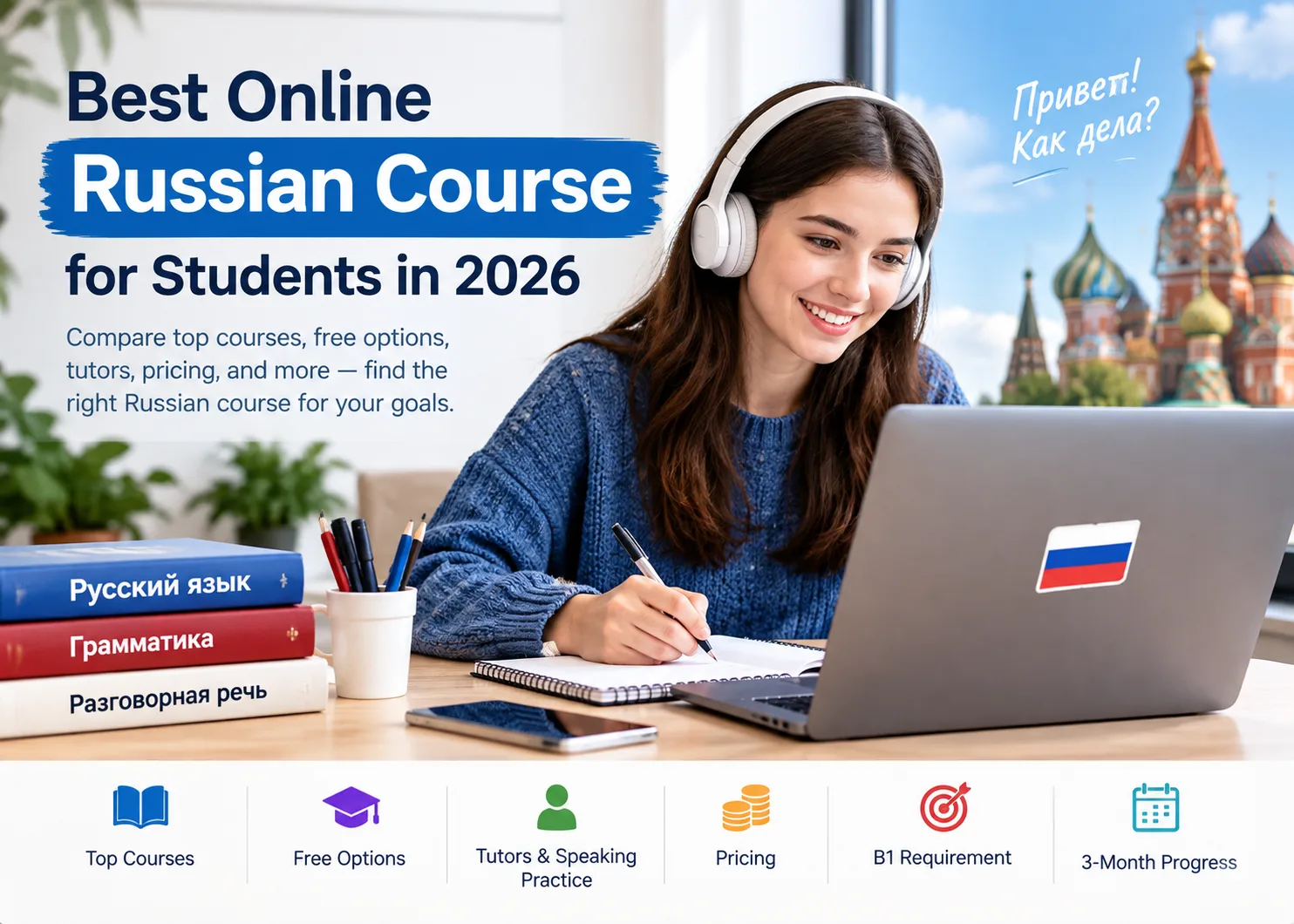
The best online Russian course for a student in 2026 depends on a question most rankings never ask: which language will the course explain Russian in? If you speak Uzbek, Prep.uz is the strongest structured choice: its programme runs three months, every explanation is in Uzbek, and a personal mentor meets you one-to-one twice a week on top of two group conversation lessons. If you study in English, a tutor from Preply or italki gives you the speaking practice an app cannot. If your budget is zero, St Petersburg State University's free course comes in six language versions, Uzbek and English among them.
One warning before the details: a course that never makes you speak out loud is a reading course, whatever its homepage says.
Is there a good free online Russian course for students?
Yes, with one limit. St Petersburg State University's Russian for Life and Work costs nothing, and there is a version of it for each of six first languages: Uzbek, Tajik, English, Chinese, Turkish and Vietnamese.
It was built for people preparing for Russia's work-permit exam, which since January 2026 is taken only on a computer, so, as its name says, it is aimed at everyday life and work rather than lectures and seminars. You watch video lessons and complete tasks whenever you have time; signing up takes only a name and an email. The Pushkin State Russian Language Institute runs another large platform, its Education in Russian portal, which covers A1 to C2 with courses, webinars and tests and counts more than 1.3 million registered participants.
The limit is the one every free course shares: nobody listens to you, so use a free course for structure and find a person for speaking.The limit is the one every free course shares: nobody listens to you, so use a free course for structure and find a person for speaking, while choosing your wider student resources based on your learning needs, budget, and study goals.
Which online Russian course is best for students who speak Uzbek?
Prep.uz, for most students, because it pairs a fixed three-month programme with a personal mentor and explains everything in Uzbek, which removes the double translation step of learning Russian through English.
Your week has four live slots: two one-to-one lessons with your mentor and two group conversation lessons. In between, short video lessons of 5 to 25 minutes each sit in your personal cabinet, with a test after every topic and a list of more than 1,500 core words to memorise. Over the programme that adds up to 24 online conversations with the mentor, and by Prep.uz's own count, not an independent survey, 90 percent of graduates would recommend it to friends and family.
Prep.uz also runs a video grammar course taught by Lola Po'latova, and its page says it was made for school, lyceum and college students, for university applicants preparing for test exams, and for people studying alone. The outline on the Prep.uz course page runs to 28 lessons in 7 sections, with 52 videos and 48 test exercises, and the first section, on nouns and their cases, is free to watch. That is the quickest way to find out whether the teaching style suits you before you book the free consultation.
Two honest limits. Prep.uz publishes no price, so the consultation is where you find out what it costs, and it is no use to a student who cannot follow Uzbek.
If you want a price in writing before you talk to anyone, look at Rustilida.uz, which also teaches in Uzbek: five months, 397,000 to 1,497,000 so'm a month on its own page, with three conversation lessons a week in groups of 15 on the recommended tier, which means less speaking time for each person.
What is the best way for an English-speaking student to practise Russian speaking online?
Book a tutor. On 23 September, Preply listed 1,191 Russian teachers and italki 596. Preply says its average Russian lesson costs $21 an hour, in slots of 25 or 50 minutes, and italki's trial lessons ran from $5 to $25. On italki every tutor carries one of two labels, Professional Teacher or Community Tutor, and that label matters more than the price. A student who needs grammar explained should pay for a professional, while one who mainly needs to stop freezing mid-sentence can do well with a community tutor. The catch with both platforms is structure: nobody hands you a syllabus, so bring one, a free course for the grammar and the tutor for the talking.
Is Duolingo enough to learn Russian?
For the alphabet and a daily habit, it can be. For speaking, no. An app can tell you whether you picked the right word. It cannot hold a conversation that goes somewhere you did not expect. That unexpected turn is the whole skill, and only a person can throw it at you.
How long does it take to learn Russian, and can a student do it in three months?
To a working conversational level, a committed student can make real progress in three months. To B1, the level Russian universities require, no.
Russia's state standard for teaching Russian as a foreign language puts A1 at 100 to 120 academic hours, A2 at 280 to 320 and B1 at 440 to 460, counted in academic hours of 45 minutes. So B1 from zero is about 330 to 345 real hours. Spread across a 15-week semester, that is 22 to 23 hours a week, on top of your actual degree.
Read every three-month promise with that sum in mind.
Prep.uz's wording is the honest version of it: the programme is designed for three months, and a learner who keeps up sees their conversational level grow noticeably. That is a claim about speaking, not about a certificate level, and it is the only kind of three-month claim worth believing from any course.
What level of Russian do you need to study at a Russian university?
B1, proved with the TORFL-I certificate, which Russian speakers call TRKI-1. St Petersburg State University's testing centre states it in one line:
"The B1 level certificate is required for admission to undergraduate programmes at Russian universities." For students who arrive without it, Russian universities run a preparatory year, which can also give them time to clarify how the language requirement fits into the degree path they plan to pursue.
For students who arrive without it, Russian universities run a preparatory year. At St Petersburg State University it lasts 10 months, from 1 September to 30 June, with 1,152 study hours, full-time or online, and the whole first semester is Russian. An online course taken before you apply will not replace that year. What it changes is whether you spend the first semester catching up or getting ahead, and whether you understand your first lecture or only its slides.
How much should a student pay for an online Russian course?
Anything from nothing upward, and the upper end is set by how much of a person's time you buy. The free courses above cost nothing. A Preply tutor averages $21 an hour by the platform's own figure. RussianPod101's plans ran from $4 to $23 a month at regular prices on a two-year subscription, and only the top plan includes a teacher. Rustilida.uz lists 397,000 to 1,497,000 so'm a month, about $34 to $127 at the Central Bank of Uzbekistan rate on 23 September. Prep.uz publishes no price, and its level check and first consultation are free.
The number to compare is cost per hour of speaking, not cost per month. Four live sessions a week inside a course might work out cheaper than the same hours bought from a tutor one by one, or might not, and the only way to know is to ask each provider for the minutes and divide.
Why do students quit online language courses, and will you?
Probably, if nobody expects you anywhere. A 2024 study in the journal Open Praxis looked at 15,805 enrolments in four online courses: 30 percent of those who enrolled never started, and about 30 percent of all enrolments finished. Those were not Russian courses, and a language course could do better or worse. The shape will still look familiar to anyone who has paid for a course in January and opened it twice.
What helps is an appointment with another person: a tutor you have paid for on Thursday, a mentor who will ask why you missed Tuesday, a conversation group that notices an empty square on the call. Pick the course that makes quitting awkward, and the three-month question mostly answers itself.
Read More Blogs On: