Finding the Best AI SEO tool in 2026 is harder than finding one that simply claims to use AI. There are tools for keyword discovery, technical audits, content optimisation, backlink analysis, and almost everything in between—but their capabilities can vary significantly. So, which tools are actually worth using? We tested AI SEO tools across three areas that matter most to day-to-day SEO: keyword research, SEO audits, and backlink analysis. Instead of giving every tool the same generic “AI-powered” label, we looked at what each one actually does and where it performs best.
What This Blog Covers about Best AI SEO Tools in 2026?
This guide goes beyond simply listing AI SEO tools. For each tool, you’ll see:
- What the tool is best for — whether it stands out for keyword research, SEO auditing, or backlink analysis.
- The specific AI and SEO features that make it useful for that task.
- What you can actually do with the tool, from discovering keyword opportunities to identifying technical issues and analysing backlink profiles.
- How the tools differ, so you can choose based on your specific SEO requirements rather than generic AI claims.
- Which tool fits which SEO task, with a clear comparison at the end.
By the end, you’ll have a practical view of what each tool brings to the table and where it fits into your SEO workflow.
We evaluated each tool by category, focusing on its core capabilities, practical outputs, AI features, and usefulness for real SEO workflows.
Category | What We Analysed | Key Evaluation Points | Results You Can Expect |
Keyword Research | How effectively each tool finds, evaluates, and expands keyword opportunities. | Keyword discovery, search volume, keyword difficulty, long-tail suggestions, search intent, competitor gaps, and AI-assisted keyword analysis. | A stronger list of target keywords, new content opportunities, keyword gaps, and clearer direction on which terms to target. |
SEO Audit | How effectively each tool identifies website issues and explains what needs to be fixed. | Technical SEO issues, crawlability, site structure, on-page problems, content issues, issue prioritisation, and AI-generated recommendations. | A clearer list of SEO problems, prioritised fixes, technical insights, and actionable recommendations for improving website health. |
Backlink Analysis | How effectively each tool helps understand and improve a website's backlink profile. | Backlink discovery, referring domains, link quality, anchor text, competitor backlinks, new/lost links, link opportunities, and AI-assisted analysis. | A clearer view of your backlink profile, competitor link opportunities, potentially valuable link prospects, and links that may require further review. |
Keyword research in 2026 is no longer limited to finding high-volume terms and exporting keyword lists. Modern AI SEO tools combine search demand, keyword difficulty, SERP behaviour, search intent, topical relationships, competitor coverage, first-party data and emerging search patterns. The key difference is how the tool turns keyword data into prioritised, SERP-aligned content opportunities.
1. RankYak
RankYak at a Glance
RankYak describes its research system as starting from the website rather than simply producing a generic keyword list. It studies the site's existing coverage and gaps, discovers keywords using live search data, scores them and groups them according to how Google treats the queries.
Feature | What RankYak Actually Does | SEO Value |
Automated keyword discovery | Continuously discovers keywords relevant to the site's niche instead of relying only on manually entered seeds | Keeps the keyword pool expanding without repeated manual research |
Keyword scoring | Evaluates keywords using search volume, Keyword Difficulty and the site's authority | Prioritises keywords according to the site's ability to compete |
SERP-based clustering | Groups keywords when Google returns substantially the same results for them | Helps determine which queries should be covered by one URL |
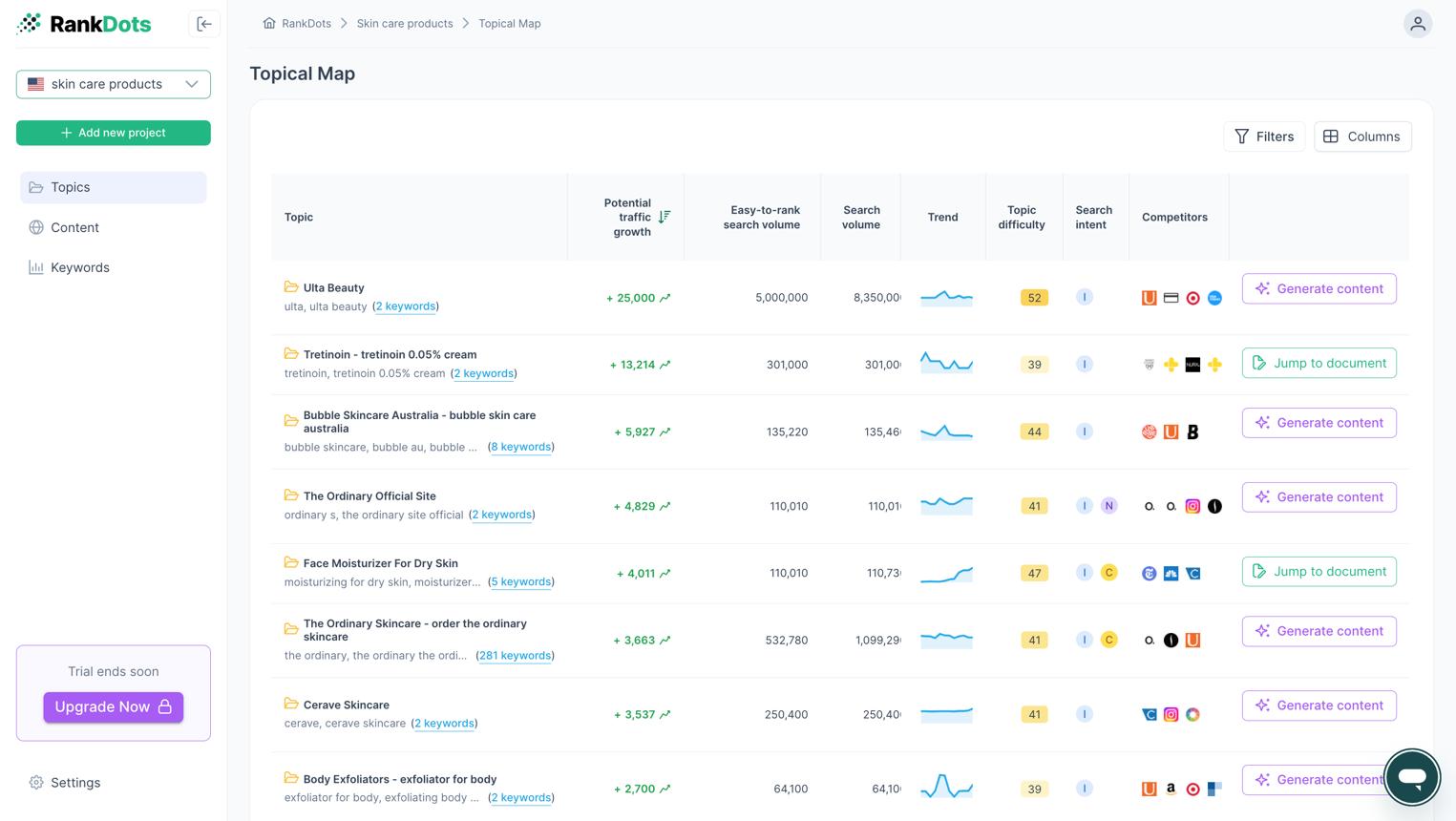
Topical Map | Organises clusters beneath core topics and shows covered, planned and open areas | Reveals topical coverage and content gaps |
Emerging keywords | Detects searches with confirmed demand before conventional volume data fully reflects them | Identifies newer opportunities earlier |
Google Search Console | Uses queries already generating impressions for the site | Connects keyword discovery with first-party search data |
Re-scoring | Re-evaluates keywords as site authority changes | Previously difficult keywords can become viable targets |
Content-plan integration | Approved keywords enter the site's content pool and can be scheduled | Connects research directly to publishing |
Our rating for keyword research | 4.7/5 | Strongest where continuous automation matters |
How RankYak's keyword discovery works
The important technical distinction is site-first research.
A traditional keyword workflow might be: Seed keyword → keyword database → thousands of suggestions → manual filtering
RankYak's model is closer to: Website → niche/topics → keyword discovery → scoring → SERP-based grouping → topical map
The platform identifies core topics for the website and then attaches keyword clusters to those topics. Its own example shows a cluster around “best CRM for startups”, with related terms such as “CRM for startups,” “startup CRM software,” and “CRM for small teams.”
This matters because the objective isn't merely to find more keywords. The objective is to determine which queries represent the same search opportunity.
Keyword scoring is site-specific
RankYak assigns each keyword two core metrics:
- Search volume
- Keyword Difficulty
Its Keyword Difficulty runs from 0–100 and estimates the competitiveness of ranking for that query. RankYak explains that these metrics are used as the raw inputs for planning and prioritisation.
But RankYak also factors your site's authority into its opportunity scoring. That changes the question from:
“How popular is this keyword?”
to:
“How realistic is this keyword for this website?”
For example, assume an SEO website discovers:
Keyword | Volume | Difficulty | Practical interpretation |
AI SEO tools | 12K | 72 | Large demand, highly competitive |
AI SEO tools for agencies | 1.2K | 35 | More specific opportunity |
AI SEO tools for small businesses | 590 | 27 | Lower-volume but potentially more attainable |
A volume-only workflow might prioritise the 12K keyword. RankYak's scoring model is designed to give more weight to winnability, so the second or third keyword can become more attractive for a site without the authority required for the broad term.
The important part: Google determines the cluster
One of RankYak's more technically interesting features is that clustering isn't based purely on lexical similarity.
RankYak says keywords are grouped according to how Google treats their search results. If two keywords return substantially the same results, they can belong to the same cluster and therefore be covered by one article.
For example:
- Keyword A:CRM for startups
- Keyword B:best CRM for startups
- Keyword C:startup CRM software
If the SERPs substantially overlap, treating these as three independent article targets can create unnecessary page duplication.
RankYak instead creates:
One primary topic → supporting keyword variations → one content asset
That gives the SEO team a data-based basis for deciding URL boundaries, which is much more useful than simply grouping keywords because they contain similar words.
Topical Map: from keyword list to site architecture
RankYak's Topical Map places the keyword clusters under broader core topics.
The map can show:
- what the site already covers,
- what content is planned,
- where keyword/topic gaps remain,
- which clusters belong to the same subject area.
For example:
Core topic: AI SEO
- → AI keyword research tools
- → AI SEO audits
- → AI content optimisation
- → AI backlink analysis
- → AI search visibility
- → AI Overviews
The result is not just a keyword list. It becomes a content architecture.
Emerging keyword detection
RankYak also identifies rising searches with confirmed demand that may not yet be represented properly in conventional volume databases.
Consider a new search trend:
AI search visibility tools
If search demand is newly developing, a conventional monthly-volume database may not yet show a meaningful volume estimate.
RankYak's emerging-keyword mechanism can surface the query once demand is confirmed.
SEO outcome: the publisher gets an opportunity to research and potentially publish around a topic while it is still developing rather than waiting for the keyword to become established.
Google Search Console makes the research first-party aware
RankYak can connect Google Search Console so that queries for which the site is already receiving impressions feed into the research system.
Imagine your existing article targets:
AI SEO tools
but Search Console shows impressions for:
best AI SEO tools for agencies
That query is particularly useful because Google is already associating your page with the longer-tail concept.
An SEO could then:
- inspect the query,
- compare its intent with the existing URL,
- determine whether the existing article needs expansion,
- add the query to the appropriate cluster,
- or create a separate page if the SERP indicates distinct intent.
That is a much more actionable use of keyword research than discovering the phrase from a third-party database alone.
AI and automation: what actually happens
For RankYak, I would avoid writing:
“RankYak uses AI to generate thousands of keywords.”
That's too vague.
The stronger explanation is that RankYak automates the research and planning loop:
discover → score → cluster → review → approve → plan → re-research
Research can run automatically, keywords can wait for approval, and automatic approval can be enabled so the pool replenishes itself. Keywords are then eligible for the content plan.
What RankYak delivers
- Input: Website + niche + country/language + optional Search Console data
- Analysis: Keyword discovery → search volume → difficulty → authority/winnability → SERP-based clustering → topic mapping
- Output: Prioritised keywords + SERP-aligned clusters + topical gaps + content opportunities
- Best use: A website that wants keyword research to run continuously and feed directly into its content strategy.
- Website-specific keyword discovery: RankYak starts with the website and its niche rather than relying entirely on a manually entered seed keyword. It analyses the site's subject area and continuously discovers keywords relevant to that domain. This makes the research more contextual than a generic keyword database.
- Authority-aware keyword prioritisation: RankYak evaluates keywords using search volume, Keyword Difficulty and the site's authority. This allows the system to distinguish between a keyword with high theoretical traffic and one that the particular website has a realistic chance of competing for. It also re-scores keywords as the site's authority changes.
- SERP-aligned keyword clustering: Instead of treating every keyword variation as a separate content opportunity, RankYak groups related searches into clusters. For example, variations around CRM for startups can be consolidated into a single content opportunity when they represent the same SERP intent. This reduces unnecessary keyword fragmentation and helps determine the appropriate URL structure.
- AI-assisted emerging keyword discovery: RankYak specifically looks for rising searches with confirmed demand, including opportunities that may not yet have established volume in conventional keyword databases. This is particularly relevant in fast-changing categories such as AI software, where new search terminology can emerge quickly.
- Google Search Console data incorporated into research: Connecting Search Console allows RankYak to use queries for which the site is already receiving impressions. That creates a feedback loop between actual search visibility and new keyword discovery, helping identify queries where an existing page may already have relevance but additional optimisation could be worthwhile.
- Continuous automated research instead of one-time exports: RankYak can keep keyword discovery running in the background. Research passes can be reviewed manually, approved selectively, or configured for automatic approval so the keyword pool continually replenishes. This turns keyword research into an ongoing process rather than a spreadsheet created once every few months.
- Keyword research connects directly to content planning: Its biggest workflow advantage is that approved keywords don't stop at the research screen. They enter the keyword pool and can feed the content calendar, creating a direct path from keyword discovery → prioritisation → content scheduling.
Why this matters in 2026: RankYak's differentiation is less about having the biggest keyword database and more about automating the complete research loop around a specific website: discover → score → cluster → approve → plan → re-discover.
2. Semrush
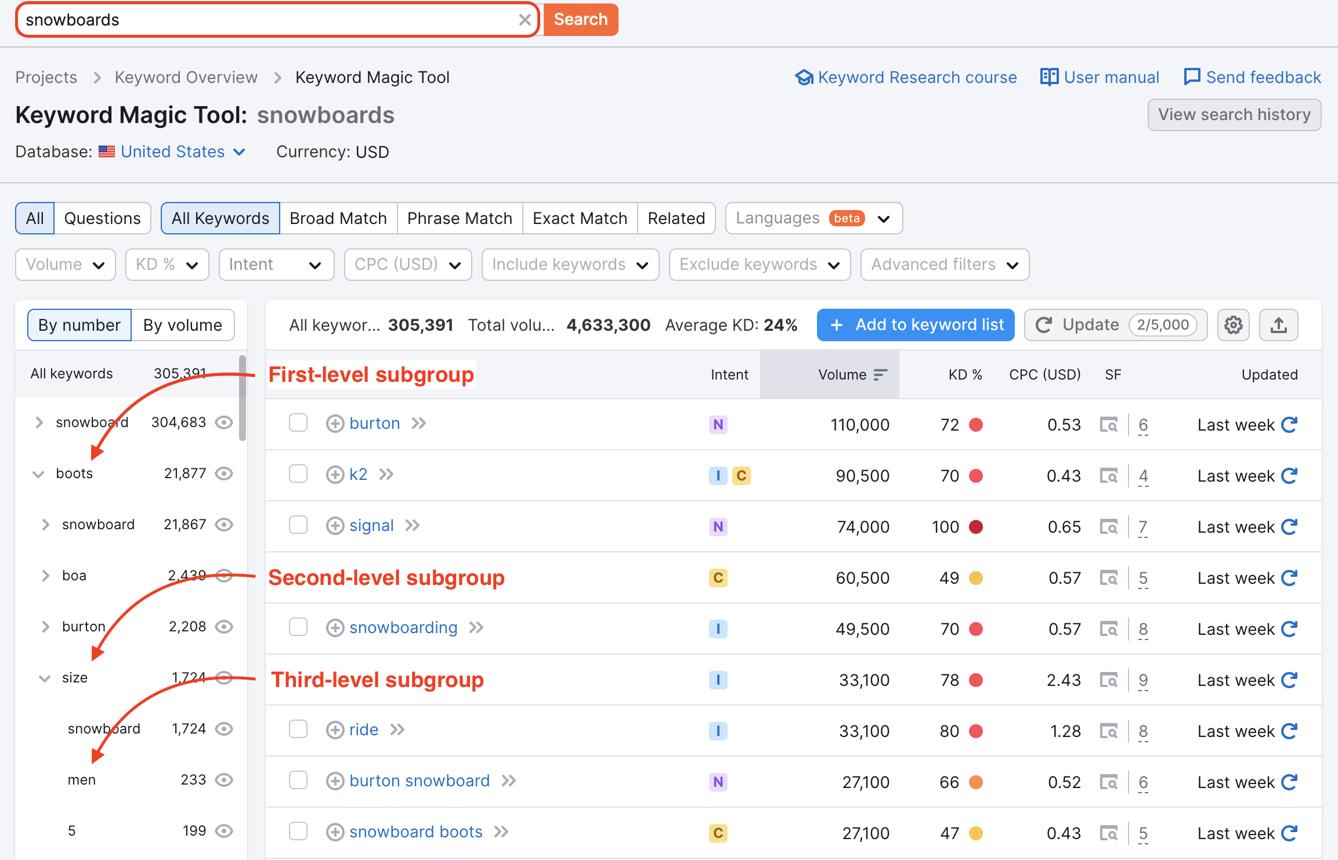
Semrush is a powerful SEO platform offering extensive keyword discovery, search volume estimates, Keyword Difficulty, search intent, and competitor analysis. Its Keyword Magic Tool, AI-powered Personal Keyword Difficulty, and Potential Traffic metrics help marketers identify relevant, achievable opportunities. In 2026, Semrush stands out for combining large-scale keyword research with domain-specific insights and competitive intelligence.
Semrush at a Glance
Feature | What Semrush Actually Does | SEO Value |
Keyword Magic Tool | Expands one seed into a large keyword universe | Finds broad, long-tail and related opportunities |
27.3B+ database | Provides a very large keyword dataset | Useful for large-scale research |
Keyword groups | Automatically organises results into thematic groups | Speeds up topic discovery |
Subgroups | Allows up to three levels of topical drilling | Finds highly specific keyword niches |
Keyword Difficulty | Estimates general ranking competitiveness | Filters unrealistic opportunities |
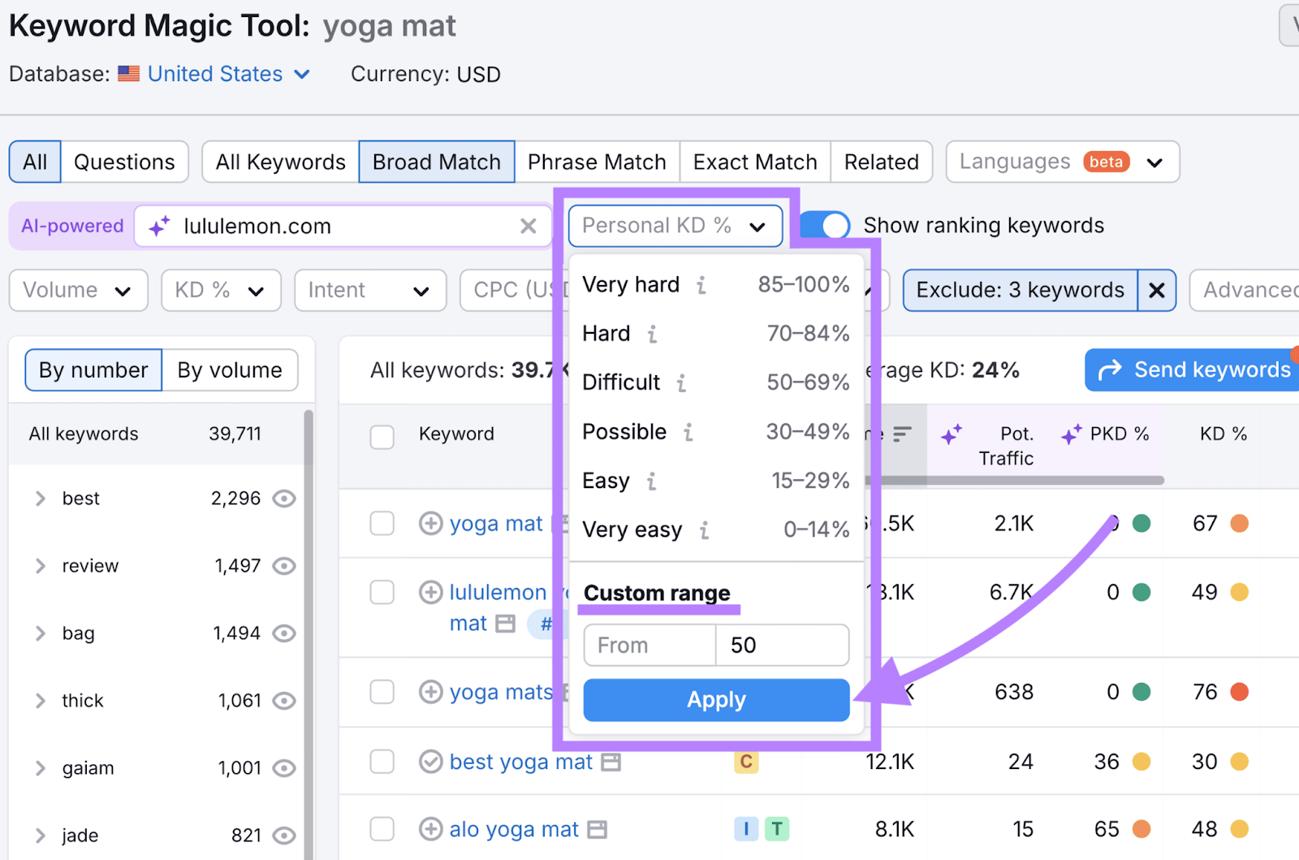
Personal Keyword Difficulty | Uses your specific domain in the difficulty calculation | Estimates difficulty for your site, not an average site |
Potential Traffic | Forecasts potential traffic for the analysed domain | Helps quantify the upside of an opportunity |
Intent | Classifies keywords by search intent | Helps assign appropriate page types |
SERP features | Shows features appearing for the keyword | Identifies SERP layout and visibility opportunities |
Keyword Gap | Compares your rankings with competitors | Finds missing keyword coverage |
Show ranking keywords | Finds queries where your domain already ranks in the top 100 | Identifies optimisation/striking-distance opportunities |
Our rating for keyword research | 4.9/5 | Strongest for scale + competitive research |
Semrush's current Keyword Magic Tool documentation reports a database of more than 27.3 billion keywords and supports keyword grouping, filtering, intent, SERP features and domain-specific AI-powered evaluation.
Enter:
project management software
Semrush doesn't simply return synonyms. It builds a keyword universe and organises it into topic-specific groups.
The groups themselves can be sorted according to:
- number of keywords,
- combined search volume.
You can then drill into subgroups to reach more specific areas of the topic. Semrush supports three levels of subgrouping.
For example:
project management software
- → software
- → free
- → small business
- → tools
- → online
- → teams
Then:
small business
- → for startups
- → for agencies
- → for consultants
- → for remote teams
That hierarchy is useful because it exposes the topic structure hidden inside a single seed keyword.
Filtering is where Semrush becomes technically useful
Suppose the initial research produces 20,000 keywords.
You don't want to manually inspect 20,000 rows.
Semrush lets you combine filters such as:
- minimum/maximum volume,
- KD,
- intent,
- CPC,
- include terms,
- exclude terms,
- word count,
- SERP features,
- competitive density.
A real workflow could therefore be:
Seed:project management software
- Filter 1: Commercial intent
- Filter 2: 4+ words
- Filter 3: KD below 50
- Filter 4: Include small business
- Filter 5: Exclude free
The output becomes a targeted subset such as:
- best project management software for small business
- project management tools for small teams
- project management software for agencies
This is where Semrush changes keyword research from database browsing into query qualification.
Personal Keyword Difficulty is the important AI feature
Traditional KD answers:
“How competitive is this keyword in general?”
Semrush's Personal Keyword Difficulty answers:
“How difficult would it be for this particular domain to reach the top 10?”
Semrush says PKD is calculated using a proprietary AI algorithm that evaluates:
- thematic relevance between the domain and keyword,
- competition within the topic,
- metrics of the domain,
- metrics of competing domains in the SERP.
This is technically much more useful than simply calling the feature “AI-powered.”
For example:
Domain: small SaaS website
Keyword:CRM software
Generic KD might indicate a highly competitive query.
PKD considers whether your domain already has topical relevance and authority around CRM.
That can produce a different prioritisation from generic KD.
Potential Traffic
Semrush's Potential Traffic is another AI-driven metric. It estimates the traffic, visibility and average ranking potential for the specific domain/keyword combination. Its calculation considers factors including:
- Personal Keyword Difficulty,
- Authority Score,
- potential ranking position,
- historical Semrush data,
- current SERP competitors.
So an SEO can compare:
Keyword | PKD | Potential Traffic | Decision |
Broad term | 86% | High | Long-term |
Specific commercial term | 42% | Medium | Immediate target |
Long-tail | 18% | Lower | Quick-win opportunity |
The purpose is not to blindly select the keyword with the largest forecast. It gives the SEO another variable for comparing difficulty against potential return.
Keyword Gap: competitor-driven discovery
Keyword Gap answers a different question: What are competitors ranking for that we aren't?
Suppose:
- Your site: 2,100 ranking keywords
- Competitor A: 6,800
- Competitor B: 5,400
Keyword Gap can identify areas where competitors have visibility but your site doesn't.
An SEO can then classify those terms into:
- Content gap → no relevant page exists
- Optimisation gap → relevant page exists but ranks poorly
- Authority gap → page exists but competitors have stronger signals
This turns competitor keyword research into an action list rather than simply showing competitor rankings.
Existing rankings: don't create a new page unnecessarily
Semrush's Show ranking keywords option identifies terms for which your domain already appears in Google's top 100.
Suppose:
Page:/ai-seo-tools/
already ranks:
- #8 — AI SEO tools
- #19 — best AI SEO tools
- #31 — AI SEO software
That information can change the content strategy.
Instead of creating three new articles, the SEO can investigate whether one existing URL can be strengthened to capture the related queries. This is one of the most useful practical outputs of keyword research because it reduces unnecessary URL creation.
What Semrush delivers
- Input: Seed keyword and/or competitor/domain
- Analysis: Keyword expansion → grouping → difficulty → intent → SERP features → competitor gaps → domain-specific AI evaluation
- Output: Large keyword universe + filtered opportunities + competitor gaps + existing-ranking opportunities + domain-specific difficulty/traffic estimates
- Best use: Large websites, agencies and competitive niches where keyword research needs scale and competitive intelligence.
- Massive keyword dataset for broad discovery: Semrush's Keyword Magic Tool currently draws from a database of approximately 27 billion keywords, allowing SEOs to move from a single seed term into very large sets of related and long-tail queries.
- Three levels of keyword-topic expansion: Semrush doesn't stop at first-level keyword groups. Its Keyword Magic Tool supports up to three levels of subgroups, allowing an SEO to move from a broad topic into increasingly specific niches. For example: project management software → small business → agencies.
- AI-powered Personal Keyword Difficulty: This is one of Semrush's strongest AI-specific keyword features. Personal Keyword Difficulty uses a proprietary AI algorithm to evaluate the relationship between your domain, the keyword, the topic competition and competing domains in the SERP. Therefore, it attempts to answer how difficult this keyword is for this particular website, rather than relying only on industry-wide difficulty.
- Potential Traffic adds an opportunity dimension: Semrush can estimate Potential Traffic for a specific domain and keyword. This gives an SEO another variable beyond search volume: if this domain achieves visibility for the query, what traffic opportunity could it represent?
- Keyword research is connected to existing rankings: The Show ranking keywords functionality identifies terms where the domain already appears in Google's top 100. This makes it possible to identify existing-ranking opportunities rather than automatically creating new pages for every keyword.
- Competitor-driven keyword discovery: Through competitive research such as Keyword Gap, Semrush can identify queries where competing domains have visibility but your domain does not. This changes keyword research from simply asking “what do people search for?” to also asking “where are competitors capturing demand that we currently aren't?”
- Multi-variable filtering for precision: Semrush lets SEOs combine filters for volume, Keyword Difficulty, intent, CPC, included/excluded terms, word count, SERP features and competitive density. This means a 20,000-keyword dataset can be reduced to a tightly defined opportunity set based on actual campaign requirements.
Why this matters in 2026: Semrush's strength is the combination of scale + competitive intelligence + domain-specific AI evaluation. It isn't simply generating more keywords; it provides multiple layers for determining which keywords are relevant, competitive, attainable and potentially valuable.
3. Moz Pro
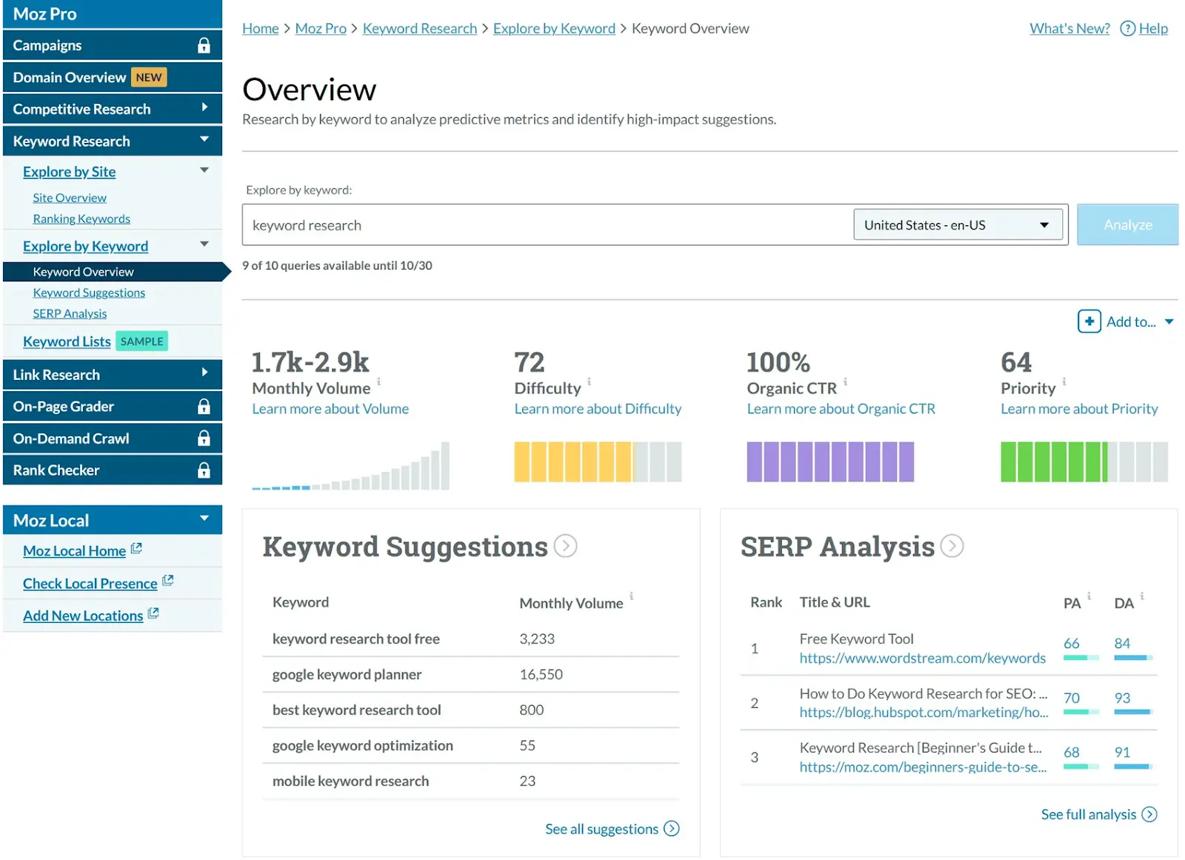
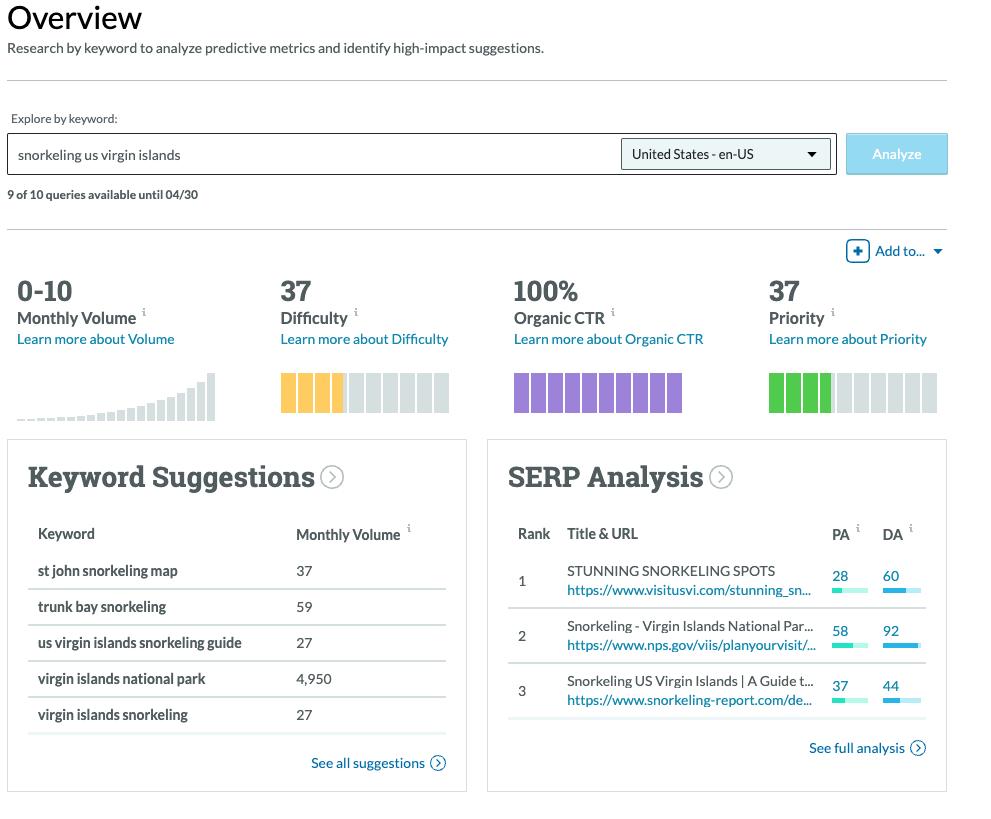
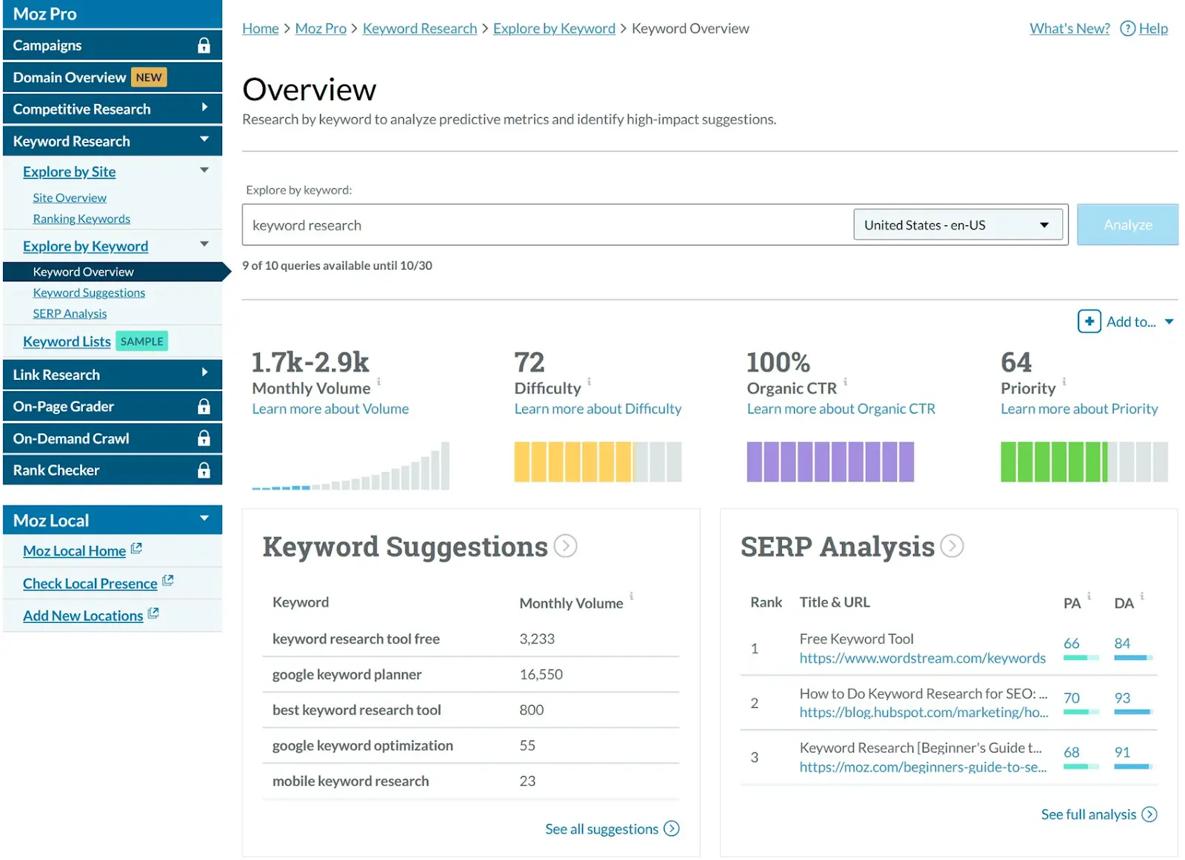
Moz Pro is a comprehensive SEO platform offering keyword suggestions, search volume estimates, Keyword Difficulty, Organic CTR, and Priority scoring. Its SERP Analysis helps marketers evaluate ranking competition and AI Overview presence. In 2026, Moz Pro is particularly useful for identifying achievable keyword opportunities and prioritising content strategies based on search demand and competition.
Moz Pro at a Glance
Feature | What Moz Pro Measures | SEO Decision It Supports |
Keyword Suggestions | Related and relevant keyword opportunities | Expands the initial research set |
Search Volume | Estimated monthly demand | Measures potential search audience |
Keyword Difficulty | Strength of the ranking competition | Determines competitive barrier |
Organic CTR | Estimated share of clicks available to organic results | Adjusts volume for SERP click potential |
Priority | Combined opportunity metric | Helps prioritise keywords |
Search Intent | Intent associated with the query | Helps choose page type |
SERP Analysis | Ranking pages and SERP features | Shows the actual competitive landscape |
AI Overview data | Detects AI Overview presence in supported SERP analysis | Shows whether generative SERP features affect the query |
Keyword Lists | Stores and organises researched terms | Builds campaign-level keyword sets |
Our rating for keyword research | 4.5/5 | Strong for evaluating keyword opportunity |
Keyword Difficulty is tied to the actual SERP
Moz's Keyword Difficulty is more useful when you understand what sits underneath the score. Moz explains that its difficulty metric analyses the strength of the top 10 organic results, incorporating authority signals such as Page Authority and Domain Authority and weighting them according to ranking position.
That means the number represents a competitive environment, not simply a database label.
For example:
Keyword:best accounting software
If the top 10 contain highly authoritative software publishers and established review sites, the difficulty reflects the strength of those pages.
If another keyword:
best accounting software for freelancers
has weaker competing pages that may provide a more realistic entry point.
The SEO decision becomes:
Can my page realistically compete with the pages currently occupying this SERP?
Organic CTR changes how you interpret search volume
This is one of the most useful metrics to explain in your article.
Imagine:
Keyword | Search volume | Organic CTR |
Keyword A | 10,000 | 22% |
Keyword B | 4,000 | 75% |
If you only use volume, Keyword A looks substantially better.
But if Keyword A's SERP contains multiple features that absorb clicks, the amount of traffic available to traditional organic listings can be substantially lower.
So Moz gives the SEO another calculation:
Search demand × organic click opportunity
rather than:
Search demand alone
That is exactly the kind of technical distinction that makes the tool useful in a keyword-research comparison.
Priority
Moz's Priority metric combines keyword opportunity signals into a single score.
The practical workflow becomes:
Volume+lower difficulty+higher organic CTR: → higher Priority
This allows an SEO team to reduce a large keyword dataset into a smaller group of terms worth investigating further.
But the Priority score should still be treated as a screening metric, not an automatic publishing decision. The actual SERP needs to be inspected.
SERP Analysis
This is where Moz's keyword research becomes more
For a query such as:
best AI SEO tools
the SEO can inspect the actual SERP and ask:
- Are the ranking pages listicles?
- Product pages?
- Comparison pages?
- Editorial reviews?
- Forums?
- Brand pages?
- Are AI Overviews present?
- How strong are the ranking domains?
AI Overviews matter in 2026
Moz's current Keyword Explorer documentation includes AI Overviews as a SERP feature. Where detected, SERP Analysis can show information about the AI Overview and URLs included within it.
This is important for modern keyword research because the search landscape can now contain:
Traditional organic results + AI Overview + People Also Ask + other SERP features
Therefore, a keyword's raw volume doesn't tell the whole story.
An SEO researching:
What is SEO, may find huge demand but a SERP heavily occupied by informational features.
A more specific query such as:
SEO strategy for SaaS companies, may have lower volume but a more directly monetisable organic opportunity.
What Moz delivers
- Input: Keyword or keyword set
- Analysis: Demand → difficulty → organic CTR → Priority → SERP competition → SERP features
- Output: A ranked research shortlist with enough SERP context to determine whether a keyword deserves a page, optimisation effort or further investigation.
- Best use: SEO teams that want to qualify opportunities rather than simply generate large keyword lists.
Keyword suggestions for structured discovery: Moz Pro's Keyword Explorer helps SEO professionals expand a seed keyword into related terms and alternative search queries. This allows marketers to discover additional keyword opportunities, identify variations of a topic, and build a broader research dataset before deciding which terms deserve dedicated content.
Keyword Difficulty evaluates real ranking competition: Moz's Keyword Difficulty metric estimates how challenging it may be to rank for a keyword by analysing the competitive strength of the top-ranking organic results. Moz uses authority-related signals, including Domain Authority and Page Authority, to help assess the strength of competing pages. For example, best accounting software may face established software publishers and review websites, while best accounting software for freelancers may present a more attainable opportunity. The key decision is whether your website can realistically compete with the pages already ranking.
Organic CTR reveals the traffic opportunity behind search volume: Search volume alone can make a keyword look more valuable than it actually is. Moz's Organic CTR metric estimates the share of clicks available to organic search results. A query with substantial search demand may offer less organic traffic potential when SERP features occupy prominent positions. This gives SEO teams another way to distinguish keywords with high search volume from those with stronger organic click opportunities.
Priority combines multiple keyword opportunity signals: Moz's Priority score brings together factors such as search volume, Keyword Difficulty and Organic CTR to help identify promising keywords. Instead of reviewing every metric independently across hundreds or thousands of terms, marketers can use Priority to narrow the research set. However, it should be treated as a screening metric rather than an automatic recommendation to publish content.
Search intent helps determine the right content strategy: Understanding what users want from a query is essential when selecting keywords. Moz's keyword research workflow helps marketers investigate search intent and the types of pages appearing for a term. For example, best AI SEO tools may require a comparison article, while buy SEO software suggests a stronger transactional focus. Matching the content format to the underlying search intent helps prevent teams from targeting keywords with the wrong page type.
SERP Analysis connects keyword metrics with actual search results: Moz's SERP Analysis allows SEO professionals to examine ranking pages, competing domains and relevant search engine results page features. This helps answer practical questions: Are the leading results product pages, editorial reviews, listicles or forums? Are established brands dominating the results? Do the ranking pages satisfy the same search intent as the proposed content? These insights help validate keyword opportunities before investing in content production.
AI Overview data adds visibility into generative search features: Moz's Keyword Explorer documentation includes AI Overviews among the SERP features that can be identified in supported analyses. Where the data is available, marketers can investigate AI Overview presence and associated URLs. This matters in 2026 because search visibility is no longer determined by traditional blue links alone. AI-generated summaries, People Also Ask and other SERP features can influence how users discover information and interact with organic results.
Keyword Lists support campaign-level prioritisation: Moz allows marketers to save and organise researched keywords into lists. This makes it easier to group terms by topic, campaign, search intent or content opportunity. Rather than treating keyword research as a one-time export, SEO teams can use these lists to build structured content plans, track research decisions and maintain a shortlist of opportunities for further analysis.
Why this matters in 2026: Moz Pro's strength is its combination of keyword opportunity scoring + organic click potential + competitive SERP analysis. Rather than evaluating keywords solely by search volume, it helps SEO professionals consider how difficult a term may be to rank for, how much organic click opportunity exists, and whether the current search results support the proposed content strategy.
4. Surfer SEO
Surfer SEO is an AI-powered content optimisation platform that helps marketers research keywords, analyse search intent, and create SEO-focused content. Its Content Editor, SERP analysis, and keyword research features support content planning and on-page optimisation. In 2026, Surfer SEO is particularly useful for aligning content with search results, improving topical coverage, and identifying relevant optimisation opportunities.
Surfer SEO at a Glance
Feature | What Surfer Does | SEO Outcome |
SERP-based discovery | Analyses actual ranking pages for the target query | Finds keywords already associated with ranking content |
Competitor keyword extraction | Identifies terms ranking pages use/rank for | Reveals topical coverage competitors already have |
Keyword clustering | Groups terms into actionable clusters | Determines which keywords can share a URL |
Search intent | Assigns intent to clusters | Helps select appropriate page types |
Main Topic Keyword | Establishes the cluster's primary topic | Defines the page's primary target |
Sub-keywords | Provides related terms for the cluster | Expands topical coverage |
Search volume | Uses 12-month average search data | Quantifies demand |
Keyword Difficulty | Provides competitiveness signal | Helps prioritise clusters |
Content Score Benchmark | Uses top-ranking pages' optimisation scores | Establishes an optimisation benchmark |
Topical Map | Maps clusters across the domain | Identifies content gaps |
Content Editor integration | Converts a cluster into an SEO brief | Moves research directly into production |
Our rating for keyword research | 4.8/5 | Strongest for turning keywords into content architecture |
Surfer's current documentation states that Keyword Research analyses the top-performing Google pages for a keyword, identifies the terms they rank for and groups them according to intent into actionable clusters.
SERP analysis is the starting point
Enter:
email marketing software
and choose your target location.
Surfer scans the current ranking pages and analyses the terms those pages rank for.
This is important because the system isn't simply asking:
“What keywords are semantically similar to email marketing software?”
It is asking:
“What queries are represented in the ranking ecosystem around this topic?”
That produces a much more useful dataset for content planning.
Keyword clustering determines page boundaries
Surfer's output creates clusters containing:
- Main Topic Keyword
- Search Intent
- Suggested Sub-keywords
- Content Score Benchmark
Suppose the research produces:
Cluster A — Email marketing software
- email marketing software
- email marketing platform
- email marketing tools
Cluster B — Email marketing automation
- email automation software
- automated email marketing
- email campaign automation
The SEO now has a technical decision to make:
One URL or two?
If the SERPs overlap strongly, they may belong to one page. If Google returns substantially different ranking pages for the two topics, separate URLs may make more sense. That is far more useful than simply saying the keywords are “related.”
Search intent is part of the cluster
Surfer's clustering process incorporates intent.
For example:
- email marketing software
- may be commercial.
- how does email marketing work
- is informational.
- Although both belong to the same broad topical entity, they represent different search jobs.
That means the content architecture could become:
- Pillar: Email Marketing
- Commercial cluster: Email marketing software
- Informational cluster: How email marketing works
- Informational cluster: Email marketing strategy
This prevents a site from trying to satisfy fundamentally different search intents with one page.
Search volume is not used in isolation
Surfer's current documentation states that its search-volume data is sourced from data partners and represents 12-month averages.
The tool also allows filtering by:
- search intent,
- search volume,
- keyword difficulty.
So the SEO can identify:
High-volume + high difficulty
versus:
Medium-volume + lower difficulty
and decide which clusters belong earlier in the content roadmap.
Content Score Benchmark
This is where Surfer bridges keyword research and content optimisation.
Each cluster includes a Content Score Benchmark based on the average optimisation score of top-ranking pages.
This gives the content team an optimisation reference before writing.
Importantly, Surfer's current Content Score itself combines:
The AI Search Score evaluates Facts Coverage and Upfront Intent Alignment for AI-powered search experiences.
I would keep this distinction in your article:
Keyword Research identifies the topic and cluster; Content Editor then evaluates how comprehensively the resulting content addresses traditional and AI-powered search.
That is technically more accurate than calling the entire keyword-research
Topical Map
Surfer can take the clusters and turn them into a domain-level content structure.
For example:
Core topic: AI SEO
- → AI keyword research
- → AI SEO audit
- → AI content optimisation
- → AI backlink analysis
- → AI search visibility
- → AI Overviews
This creates a relationship between:
keyword → cluster → article → pillar → topical coverage
Surfer's documentation specifically recommends using topical coverage and Topical Map to build pillar pages and supporting content.
Content Editor handoff
This is the final step that makes the keyword research operational.
After selecting a cluster, Surfer allows you to click Create Content Editor, which generates a tailored SEO brief from that keyword group.
So the workflow becomes:
Seed keyword
↓
Current SERP
↓
Competitor keyword extraction
↓
Intent classification
↓
Keyword cluster
↓
Primary + supporting terms
↓
Content Score benchmark
↓
Content brief
That is a complete keyword-to-content workflow, rather than a standalone keyword database.
What Surfer actually delivers
- Input: Seed keyword + target location
- Analysis: Current SERP → competitor ranking terms → intent → clustering → volume/difficulty → optimisation benchmark
- Output: SERP-backed keyword clusters + page-level keyword structure + topical roadmap + content brief
- Best use: Content teams that need keyword research to directly determine what pages to create, which keywords belong together and how the resulting content should be structured.
- Keyword discovery is based on actual competitor SERPs: Surfer scans the top-performing Google pages for the target keyword and identifies the terms those pages rank for. That means the keyword suggestions are grounded in the current competitive search landscape rather than being generated purely from semantic relationships.
- SERP-based keyword clustering: Surfer groups related keywords into actionable clusters based on how the terms appear within the competitive search landscape and their intent. This helps determine whether multiple queries should be addressed by one page or developed into separate URLs.
- Intent is built into the cluster structure: Each cluster includes a search-intent classification. This is important because two keywords can be semantically related but require completely different pages. Surfer's clustering therefore provides a stronger basis for separating informational, commercial and navigational content opportunities.
- Main keyword + supporting keyword architecture: Instead of producing an isolated primary keyword, Surfer provides a Main Topic Keyword alongside suggested sub-keywords. This gives writers and SEOs a page-level topical structure before content production begins.
- Competitor content becomes the research dataset: Surfer uses actual competitor ranking data to build keyword recommendations. An SEO can therefore see what topics and terms are represented among pages that already perform in Google for the target query.
- Keyword research connects directly to content optimisation: Each cluster can be sent into Surfer's Content Editor, where the platform creates a tailored SEO brief based on that keyword group. This creates a direct workflow from research → clustering → brief → content optimisation.
- AI Search Score extends the workflow beyond traditional SEO: Surfer's Content Score now includes an AI Search Score, which evaluates content using Facts Coverage and Upfront Intent Alignment for AI-powered search experiences. Importantly, this isn't the same thing as AI keyword generation; it is an additional optimisation layer applied after the keyword/content research stage.
Why this matters in 2026: Surfer's advantage is the tight connection between live SERP data, keyword clustering, content architecture and AI-search optimisation. The research doesn't end with a list of keywords; it can become the structural blueprint for the page that targets them.
Compare the leading AI keyword research tools by features, accuracy, results, pricing, and ratings to identify the right fit for different SEO needs.
Tool | Best Feature | Accuracy / Data Quality | Results / Output | Pricing* | Rating |
RankYak | Site-specific keyword discovery + authority-based scoring | High — uses live search data, site authority, volume and difficulty; also incorporates Search Console data | Personalised keyword pool, topical map, SERP-aligned clusters and content plan | $99/month per site; $990/year | 4.7/5 |
Semrush | Large-scale keyword research + competitor intelligence | Very High — huge keyword database, SERP data, intent, difficulty and domain-specific metrics | Large keyword universe, keyword groups, competitor gaps, ranking opportunities and traffic estimates | From $139/month monthly; $117.33/month billed annually for SEO plan | 4.9/5 |
Moz Pro | Keyword opportunity evaluation using Difficulty + Organic CTR + Priority | High — combines search demand with SERP competition and organic click potential | Prioritised keyword lists, SERP analysis, difficulty estimates and opportunity signals | Check current plan pricing | 4.5/5 |
Surfer SEO | SERP-based keyword clustering + content architecture | High — analyses ranking pages, competitor terms, intent and current SERPs | Keyword clusters, primary/sub-keywords, topical maps and content briefs | From $49/month billed yearly; Standard $99/month | 4.8/5 |
Feature-by-Feature Comparison
Compare keyword research tools across discovery, SERP analysis, clustering, intent, topical mapping, AI-search capabilities, and content-planning workflows.
Capability | RankYak | Semrush | Moz Pro | Surfer SEO |
Keyword discovery | Excellent | Excellent | Very Good | Very Good |
Keyword database scale | Good | Excellent | Very Good | Good |
Site-specific prioritisation | Excellent | Excellent | Good | Good |
Competitor keyword research | Very Good | Excellent | Very Good | Excellent |
SERP-based analysis | Excellent | Excellent | Excellent | Excellent |
Keyword clustering | Excellent | Very Good | Good | Excellent |
Search intent analysis | Very Good | Excellent | Very Good | Excellent |
Emerging keyword discovery | Excellent | Very Good | Good | Good |
Search Console integration | Excellent | Very Good | Good | Good |
Topical mapping | Excellent | Very Good | Good | Excellent |
Content-planning workflow | Excellent | Very Good | Good | Excellent |
AI-search consideration | Excellent | Excellent | Very Good | Excellent |
Best suited to | Automated site-specific research | Large-scale SEO & competitive research | Keyword qualification | Content-led SEO |
SEO auditing in 2026 is no longer limited to crawling a website for broken links, missing meta tags and technical errors. Modern AI SEO audit tools combine technical crawling, content analysis, internal linking, structured data, indexability, page-level signals and AI-driven recommendations. The key difference is how the tool identifies the underlying SEO issue, connects it to affected URLs and turns the audit data into specific actions.
1. Ryze AI
Ryze AI at a Glance
Ryze AI approaches SEO auditing as a continuous analysis-and-remediation system rather than a static crawler report. It connects the website with Google Search Console and other connected data sources, identifies technical SEO problems, striking-distance queries, low-CTR pages and content decay, and then ranks findings according to their potential traffic impact. Its current SEO agent can also propose and apply changes to titles, meta descriptions, schema, internal links and redirects with approval.
Feature | What Ryze AI Actually Does | SEO Value |
Technical SEO audit | Checks crawlability, indexation, canonicals, redirects, structured data, mobile usability and other technical conditions | Identifies implementation problems that can prevent pages from being crawled, indexed or properly interpreted |
Google Search Console integration | Pulls queries, pages, clicks, impressions, CTR and ranking information | Connects technical findings with actual Google search performance |
Striking-distance analysis | Finds queries/pages ranking in positions where relatively small on-page changes may create an opportunity | Prioritises existing URLs instead of automatically creating new content |
Low-CTR detection | Finds pages receiving search impressions but generating disproportionately low clicks | Identifies title/meta optimisation opportunities |
Content-decay detection | Monitors declining organic performance | Finds pages losing traffic that may require updating |
Traffic-impact prioritisation | Ranks audit findings according to estimated traffic potential | Prevents teams from treating every technical error as equally important |
AI search visibility | Checks visibility/citations across AI search environments | Extends the audit beyond conventional Google rankings |
Automated remediation | Can propose and apply titles, metadata, schema, internal links and redirects after approval | Converts findings into production changes |
Continuous monitoring | Re-runs SEO analysis rather than treating the audit as a one-time crawl | Detects new issues and performance deterioration |
Our rating for SEO auditing | 4.8/5 | Strongest where audit, prioritisation and implementation need to operate together |
Ryze's current technical-audit specification includes crawlability, indexation, canonical tags, redirect chains, structured data and mobile usability, while its live SEO audit additionally surfaces striking-distance keywords, low-CTR pages, decaying content, AI visibility and traffic/revenue context.
How Ryze AI's SEO audit works
The important technical distinction is that Ryze does not treat an SEO audit as simply:
Crawler → list of errors → PDF
Its current workflow is closer to:
Website + GSC data → technical crawl → performance analysis → opportunity detection → prioritisation → AI recommendation → approved implementation → monitoring
That means the system can combine technical state with search-performance state.
For example, a conventional crawler might report:
Missing or weak meta description.
Ryze can additionally determine whether the affected URL is receiving significant impressions and whether its CTR is below what would be expected for its position.
That changes the audit question from:
“Does this page have a metadata problem?”
to:
“Is this metadata problem attached to a page where improving the snippet could materially affect organic traffic?”
That distinction is important when an audit contains hundreds or thousands of findings.
Technical SEO checks: what Ryze actually looks for
Ryze's technical SEO auditor checks areas including:
- robots.txt
- XML sitemap availability
- canonical tags
- index status
- noindex
- crawl depth
- internal linking
- orphan pages
- URL structure
- redirect chains
- 404s
- Core Web Vitals
- mobile usability
- HTTPS
- mixed content
- structured data
- hreflang
Its technical audit specification explicitly calls out these checks and produces a technical health score with prioritised issues.
Consider a site with this structure:
Homepage
↓
Category
↓
Product
↓
Variant URL
↓
Redirect
↓
Final product URL
If several URLs create unnecessary redirect hops, the audit can identify those chains rather than simply reporting that every URL eventually resolves successfully.
Likewise, if an important URL has:
<meta name="robots" content="noindex">
the problem isn't that the HTML is malformed.
The problem is that the page is explicitly telling search engines not to index it.
Ryze's audit therefore treats indexation directives as an SEO control rather than a generic HTML issue.
This is one of Ryze's more important technical differences.
The audit can pull actual Search Console data instead of analysing the website independently from its search performance.
Suppose an ecommerce site has this page:
/running-shoes/
Search Console reports:
Metric | Value |
Impressions | 185,000 |
Clicks | 4,200 |
CTR | 2.27% |
Average position | 7.1 |
A purely technical crawler might see:
200 OK → indexable → canonical present → title present
and report no critical issue.
Ryze can identify the page as a low-CTR opportunity because the URL already receives substantial search exposure.
The SEO action then becomes:
- inspect the queries generating impressions,
- identify the dominant search intent,
- compare the current title/meta with the query set,
- determine whether the snippet accurately reflects the page,
- propose a revised title/meta,
- apply it after approval,
- monitor CTR after the change.
The audit therefore uses first-party search data to decide where technical/on-page intervention is worth doing.
Striking-distance analysis: auditing pages that are already close
Ryze's live audit includes striking-distance keywords and pages.
The concept is technically simple:
A page already has Google visibility.
The question is whether it is close enough to a stronger ranking position that an on-page improvement could be worthwhile.
For example:
Query | Position | Impressions | Existing URL |
AI SEO tools | 6 | 18,400 | /ai-seo-tools/ |
best AI SEO tools | 11 | 9,700 | /ai-seo-tools/ |
AI SEO software | 14 | 6,200 | /ai-seo-tools/ |
Instead of automatically producing three new articles, the audit can flag the existing page.
The SEO specialist can then inspect:
- whether the H1 covers the query,
- whether relevant sections exist,
- whether internal links support the page,
- whether title/meta alignment is strong,
- whether competing pages cover subtopics missing from the URL.
That makes the audit URL-specific and query-specific.
Content decay is treated as an SEO audit signal
Ryze also monitors declining organic performance and surfaces decaying content in its audit workflow.
For example:
Month | Organic clicks |
January | 12,400 |
February | 12,100 |
March | 11,600 |
April | 9,800 |
May | 7,900 |
The page may have:
- valid HTML,
- a correct canonical,
- no noindex,
- no broken links,
- a valid sitemap entry.
So a traditional technical audit may not identify a critical problem.
Ryze's performance layer can flag the declining URL and place it into the refresh workflow. This is technically different from detecting a broken page.
The page works.
Its organic search performance is deteriorating.
AI-search visibility becomes another audit layer
Ryze's current SEO platform also tracks visibility in AI search environments including ChatGPT, Perplexity and Google AI Overviews.
This allows an SEO audit to examine another type of search result:
Traditional search
Query → Google SERP → organic URL → click
versus:
AI search
Query → AI-generated answer → cited sources
For example, a brand may rank on page one for:
best CRM software
but not appear among the cited sources in AI-generated answers for the same category.
Ryze's AI visibility analysis can identify that difference and direct the SEO team toward content structure, factual coverage and citation-oriented improvements.
AI does not simply “find SEO problems”
For Ryze, the more technically accurate description is that AI operates as an analysis and remediation layer on top of connected SEO data.
The workflow can be represented as:
Search Console data
↓
Technical/site data
↓
Performance patterns
↓
AI interpretation
↓
Prioritised opportunity
↓
Recommended change
↓
CMS implementation
↓
Post-change monitoring
Ryze's current product specifically states that its agents can apply titles, meta descriptions, schema, internal links and redirects with user approval.
That is substantially different from saying:
“AI analyses your website.”
The important part is what data the agent analyses and what action it can take afterwards.
What Ryze AI delivers- Input: Website + Google Search Console + optional analytics/CMS connections
- Analysis: Technical crawlability → indexation → canonical/redirect structure → structured data → GSC queries → impressions → CTR → rankings → striking-distance pages → content decay → AI-search visibility
- Output: Prioritised technical issues + search-performance opportunities + AI-search findings + proposed fixes + approved production changes
- Best use: A website where the SEO team wants the audit to answer not only “what is wrong?”, but also “which issue is attached to the biggest measurable opportunity, and can we implement the fix?”
1. First-party GSC data is incorporated into the audit
Ryze doesn't isolate technical crawling from search performance. It can use Search Console queries, pages, impressions, clicks and CTR to identify opportunities attached to real Google search exposure.
2. Audit findings are prioritised by traffic potential
Instead of producing an undifferentiated list of technical errors, Ryze ranks findings according to potential traffic impact.
3. It identifies striking-distance URLs
The audit can identify queries where existing pages are already ranking and receiving impressions, allowing the SEO team to optimise an existing asset rather than automatically producing another URL.
4. Content decay is part of the monitoring model
Ryze can identify pages whose organic performance is declining, which catches a type of SEO problem that a static technical crawler cannot detect from HTML alone.
5. AI-search visibility is measured separately
The platform tracks citations/visibility across AI search environments, allowing conventional Google performance and AI-search representation to be analysed as separate dimensions.
6. The agent can implement technical changes
Ryze states that its agents can modify titles, metadata, schema, internal links and redirects after user approval rather than stopping at recommendations.
7. The audit becomes continuous rather than periodic
The live-agent model means technical issues, ranking opportunities and content decay can be monitored continuously rather than waiting for the next scheduled manual audit.
Why this matters in 2026: Ryze's differentiator is not simply that it puts “AI” in front of an SEO audit. Its stronger distinction is the connection between first-party search data, technical auditing, opportunity prioritisation and automated remediation.
2. WordLift AI Audit
WordLift AI Audit at a Glance
WordLift's audit is technically different from a conventional crawler because it evaluates not only traditional SEO elements but also machine readability, semantic HTML, structured data, AI-agent accessibility and emerging agent-discovery interfaces. Its current Audit API analyses site files, Schema.org markup, content structure, token budget, image accessibility, JavaScript rendering and MCP/WebMCP/Agent Skills discovery surfaces, then returns an overall 0–100 score with detailed recommendations.
Feature | What WordLift AI Audit Actually Does | SEO Value |
SEO fundamentals | Checks title, description and H1/page structure | Detects fundamental document-level SEO gaps |
Structured data | Analyses Schema.org, JSON-LD and Microdata | Checks whether entities and page information are machine-readable |
Semantic HTML | Evaluates document structure and semantic markup | Makes the page structure easier for machines to interpret |
JavaScript rendering | Checks content availability when JavaScript is involved | Identifies cases where important content may not be available in the initial document |
Bot accessibility | Examines whether automated agents can access the content | Identifies crawler/agent access restrictions |
robots.txt / llms.txt | Inspects machine-access files | Checks explicit crawler and AI-discovery configuration |
Token budget | Estimates machine-readable content size | Identifies pages with excessive machine-processing payload |
MCP discovery | Checks MCP/WebMCP discovery files and HTML signals | Audits emerging machine-to-machine discovery mechanisms |
Agent Skills discovery | Checks Agent Skills index and SKILL.md | Detects whether agent capabilities can be discovered |
Image accessibility | Checks image accessibility signals | Identifies machine/accessibility gaps around visual content |
AI readiness score | Produces an overall 0–100 audit score | Creates a measurable baseline |
Our rating for SEO auditing | 4.7/5 | Particularly strong for semantic SEO and AI-agent readiness |
How WordLift AI Audit works
The technical distinction here is:
Traditional audit:
URL
↓
HTML
↓
SEO checks
↓
Errors
WordLift AI Audit:
URL
↓
Site files + HTML + structured data + rendering + semantic structure
↓
SEO fundamentals
↓
Machine readability
↓
AI-agent accessibility
↓
Agent discovery surfaces
↓
AI-readiness score + recommendations
The audit therefore treats the webpage as a machine-readable information object, not just a document containing keywords.
Structured data is audited at the entity level
WordLift explicitly analyses Schema.org, JSON-LD and Microdata.
Consider a product page.
The visible HTML may say:
Premium Running Shoes ₹4,999 Available
But structured data can represent those facts as:
{
"@type": "Product",
"name": "Premium Running Shoes",
"offers": {
"@type": "Offer",
"price": "4999",
"priceCurrency": "INR"
}
}
The technical difference is that the second representation explicitly defines:
- the entity type,
- the product name,
- the offer,
- the price,
- the currency.
WordLift's audit therefore checks whether the information is exposed through machine-readable structured data rather than relying entirely on visual text.
Semantic HTML is treated as a machine-interpretation problem
Consider two documents.
Structure A
- <div >AI SEO Tools</div>
- <div >...</div>
- <div >Keyword Research</div>
- <div >...</div>
Structure B
- <h1>AI SEO Tools</h1>
- <p>...</p>
- <h2>Keyword Research</h2>
- <p>...</p>
Both may look almost identical visually.
- They are not identical structurally.
- The second explicitly defines the document hierarchy.
WordLift's audit includes content structure and semantic HTML as part of its AI-readiness analysis.
That matters because AI retrieval systems need to determine:
- What is the main topic?
- Which section answers which question?
- Which text belongs to which heading?
The audit therefore evaluates the underlying structure rather than merely checking whether the page “has content.”
JavaScript rendering: what is actually available to a bot?
WordLift checks JavaScript rendering and bot accessibility.
Suppose the server initially returns:
<div id="app"></div>
<script src="/bundle.js"></script>
The visible article is inserted only after JavaScript executes.
A browser may display the completed page correctly.
But the important technical question is:
What does an automated retrieval system receive before or without executing the site's JavaScript?
That makes JavaScript rendering a machine-accessibility issue.
WordLift's audit therefore looks at whether the meaningful page content can be accessed and interpreted when rendering behaviour differs between systems.
Token budget is explicitly measured
One of the more technically specific parts of WordLift's audit is its token-budget calculation.
The Audit API documentation says it uses Readability and Turndown processing and a characters/4 heuristic to estimate token usage. It also applies a scoring bonus when the estimated token budget is 30,000 tokens or lower.
This is relevant because a webpage can contain a large amount of machine-readable material that isn't necessarily useful to an AI retrieval system:
- navigation,
- repeated footer links,
- UI elements,
- boilerplate,
- duplicated content,
- excessive markup.
A technical audit can therefore ask:
How much of the machine-readable payload is actual information?
That is considerably more specific than simply claiming that WordLift “optimises content for AI.”
AI-agent access is audited through site files
WordLift checks files and discovery surfaces including:
- robots.txt
- llms.txt
- .well-known/
- SKILL.md
as part of the audit.
These files can communicate machine-readable information or discovery instructions outside the normal webpage body.
For example: /.well-known/
may contain machine-discovery resources that an agent can query.
The audit therefore extends beyond:
HTML → Googlebot
into: Website → machine/agent discovery
MCP and WebMCP discovery is checked explicitly
This is one of the most technically unusual elements in WordLift's current audit.
Its API checks:
- <link rel="mcp">
- /.well-known/mcp.json
- /.well-known/mcp/server-card.json
- /.well-known/webmcp/tools.json
It also checks:
- /.well-known/agent-skills/index.json
- /SKILL.md
for Agent Skills discovery.
That means the audit is beginning to evaluate how an AI agent discovers machine-readable capabilities, not just how Google indexes an HTML page.
For an SEO specialist writing in 2026, this is an important distinction.
The audit is moving from:
Search engine optimisation
toward: Search + retrieval + agent accessibility
AI scoring is not simply a single LLM opinion
WordLift returns an overall 0–100 score, but its API documentation explains that the score is constructed from per-criterion scores plus specific post-hoc bonuses for supported machine-discovery features.
For example, its scoring system can add points for:
- <link rel="mcp">
- WebMCP tools.json
- MCP server discovery
- Agent Skills discovery
- lower estimated token budget
This means the audit has explicit technical conditions behind parts of the score rather than presenting an unexplained “AI readiness” number.
What WordLift AI Audit delivers
- Input: URL
- Analysis: SEO fundamentals → Schema.org → JSON-LD/Microdata → semantic HTML → JavaScript rendering → image accessibility → robots/llms files → token budget → MCP/WebMCP → Agent Skills discovery
- Output: 0–100 AI/SEO readiness score + criterion-level findings + technical recommendations
- Best use: Websites where the SEO audit needs to evaluate not only crawlability and traditional metadata, but also structured entities, semantic document structure and emerging AI-agent access mechanisms.
1. It evaluates machine readability as an explicit audit category
The audit examines semantic HTML, content structure, structured data and other machine-readable components rather than reducing SEO to metadata and keywords.
2. It validates Schema.org, JSON-LD and Microdata
The audit checks the structured-data layer through the formats used to communicate entities and page information to machines.
3. It measures token budget
WordLift's audit uses a documented token-estimation process rather than vaguely claiming that pages should be “AI-friendly.”
4. It checks JavaScript-dependent content
The audit explicitly evaluates JavaScript rendering and bot accessibility, which is relevant when important content isn't present in the initial HTML.
5. It audits AI-agent discovery surfaces
MCP, WebMCP and Agent Skills discovery are explicitly included in the current audit specification.
6. It evaluates AI crawler accessibility
The audit examines whether automated agents can reach the content and analyses relevant site-level files.
7. It combines the findings into a measurable score
The 0–100 score provides a baseline that can be compared after technical changes.
Why this matters in 2026: WordLift's strongest differentiation is that it treats semantic structure, structured entities and AI-agent discoverability as technical properties of a website that can be audited, rather than simply adding an “AI” label to a traditional SEO checklist.
3. KrawlOps
KrawlOps at a Glance
KrawlOps is built around a deterministic audit engine rather than using an LLM to decide whether individual technical conditions are present. Its current engine advertises 70+ deterministic rules, 50 industry-specific rulesets and a separate Technical SEO score and AI Search Readiness score. It audits the HTML received by the crawler and checks traditional technical SEO conditions alongside AI-search factors such as AI-bot access, answer schema, entity grounding and passage-level structure.
Feature | What KrawlOps Actually Does | SEO Value |
70+ deterministic rules | Tests fixed technical conditions against crawler-received HTML | Produces reproducible findings |
Technical SEO score | Calculates a technical score from failed checks and warnings | Makes technical health measurable |
AI Search Readiness score | Separately scores AI-search accessibility and structure | Separates conventional SEO from AI-search readiness |
Canonical analysis | Checks canonical declarations | Identifies URL consolidation problems |
Robots/indexation checks | Examines directives controlling crawler access/indexing | Finds accidental blocking |
Hreflang | Validates international targeting signals | Detects locale/return-tag problems |
Redirect analysis | Checks redirect chains and hops | Identifies unnecessary crawl paths |
Schema validation | Checks JSON-LD and answer-oriented schema | Detects missing machine-readable context |
AI crawler access | Checks access for AI/answer-engine crawlers | Identifies AI citation-access restrictions |
Entity grounding | Checks machine-readable entity context | Helps retrieval systems connect content to entities |
Passage chunkability | Evaluates whether content can be segmented logically | Supports AI retrieval and answer extraction |
Niche rulesets | Applies industry-specific rules | Prevents every site being judged against exactly the same checklist |
Our rating for SEO auditing | 4.9/5 | Strongest for deterministic technical + AI-search auditing |
How KrawlOps's audit engine works
The important technical distinction is:
It does not ask an LLM:
“Does this page have good SEO?”
Instead, it asks fixed technical questions.
For example:
Is a canonical present?
YES
Is it self-referencing?
YES
Is robots.txt blocking the crawler?
NO
Is HTTPS enabled?
YES
Is JSON-LD present?
YES
Is the H1 present?
NO
Each condition has a defined result.
KrawlOps explicitly states that the same page audited twice should produce the same findings because its technical rules are deterministic.
That makes the system particularly useful for technical SEO teams that need reproducible audits.
The crawler audits the HTML actually received
KrawlOps's engine is designed around the document the crawler receives rather than what a human sees after all browser-side processing.
This matters for JavaScript applications.
Imagine:
Initial server HTML
↓
<div id="root"></div>
Then JavaScript executes:
React application
↓
Article content inserted
A human sees the finished page. A crawler that doesn't execute the same JavaScript receives something fundamentally different.
KrawlOps therefore checks the server HTML and can identify client-side rendering situations where AI crawlers may receive an empty shell. Its documentation says that page audits can render JavaScript when required and report the difference.
70+ technical conditions are tested individually
KrawlOps currently lists checks covering:
- title tags,
- meta descriptions,
- canonicals,
- robots directives,
- H1 outline,
- viewport,
- hreflang,
- Open Graph,
- Twitter Cards,
- JSON-LD,
- redirect chains,
- HTTPS,
- HSTS,
- mixed content,
- response time,
- lazy loading,
- alt text,
- anchor text,
- link bloat,
- text-to-HTML ratio,
- resource hints,
- sitemap,
- mobile readiness,
- broken links,
- page weight,
- CSS/JS budget,
- heading hierarchy,
- URL quality,
- compression,
- AI bot access,
- answer schema,
- entity grounding,
- content structure,
- answer summaries,
- llms.txt.
The important point is that these aren't presented as one generic “SEO score.” They are separate test conditions that can be traced back to the page.
This is another technically useful distinction. KrawlOps states that a page starts at 100 points.
A failed check subtracts:
- 5 points: A warning subtracts:
- 2 points: The score is floored at zero.
For example:
Finding | Type | Deduction |
Missing H1 | Failure | -5 |
Missing meta description | Failure | -5 |
Long title | Warning | -2 |
Missing alt text | Warning | -2 |
Redirect chain | Failure | -5 |
- Starting score: 100
- Total: -19
- Final technical score: 81/100
That is considerably more transparent than an unexplained proprietary “health score.”
AI Search Readiness is scored separately
KrawlOps separates:
Technical SEO Score
from:
AI Search Readiness Score.
This is important because a page can technically satisfy conventional SEO requirements while still having problems affecting AI retrieval.
The AI layer checks areas including:
- AI crawler access,
- answer-engine structured data,
- entity grounding,
- passage-level chunkability,
- LLM-readable outline,
- llms.txt.
For example:
Technical SEO: 94/100
AI Search Readiness: 61/100
The second score indicates that the page's conventional technical implementation and its AI-search readiness are not necessarily the same thing.
AI crawler access is classified rather than treated as one generic bot
KrawlOps tracks different AI crawlers and distinguishes between crawler purposes. Its documentation specifically differentiates citation-oriented crawlers from training crawlers and control tokens.
That is technically important.
A robots rule affecting:
- GPTBot: does not necessarily have the same practical implication as one affecting:
- Perplexity-User: because the crawlers can have different functions.
KrawlOps therefore attempts to avoid treating every AI crawler block as automatically equivalent to a lost citation opportunity.
That is a much more technically precise approach to AI-search auditing.
Entity grounding and passage chunkability
- KrawlOps's AI-search layer checks entity grounding and passage-level chunkability.
- Consider a page describing a company.
- If the page repeatedly uses: “we,” “our company,” “our platform”
- without clearly identifying the organisation, its relationships, products or named entities, the content can be less explicit from a machine-retrieval perspective.
- Entity grounding attempts to determine whether the page establishes the entities it is talking about.
- Passage chunkability is a different problem.
A useful answer passage might be:
H2: What is AI SEO?
AI SEO refers to...
followed by a self-contained explanation.
That is structurally easier to extract than a paragraph whose meaning depends on five paragraphs of unrelated preceding copy.
Industry-specific rulesets change the audit
KrawlOps currently advertises 50 niche rulesets.
For example:
Shopify: may require ecommerce-specific checks.
Enterprise: may require checks around:
- large-scale indexation,
- parameterised URLs,
- canonical inheritance,
- crawl-budget issues.
International sites: need stronger attention to:
- hreflang,
- locale URLs,
- return tags.
The audit therefore isn't simply:
One checklist
↓
Every website
It can be:
Website type
↓
Relevant ruleset
↓
Technical audit
That makes the findings more contextual.
What KrawlOps delivers- Input: URL or complete website crawl + selected industry ruleset
- Analysis: HTML → crawlability → indexation → canonical → redirects → headings → links → performance → schema → security → AI bot access → entity grounding → passage structure
- Output: Technical SEO score + AI Search Readiness score + URL-level findings + impact-ranked fixes + implementation details
- Best use: Technical SEO teams and agencies that need repeatable, rule-based findings and want to separately evaluate whether pages are technically prepared for AI-search retrieval.
1. Deterministic rules replace subjective AI diagnosis
Each technical condition has a defined pass/fail/warning state, making repeated audits reproducible.
2. It audits crawler-received HTML
The engine focuses on the document a crawler receives, which is especially relevant for JavaScript-heavy websites.
3. Technical SEO and AI Search Readiness are separate
Two scores allow an SEO team to distinguish conventional technical health from AI-search accessibility and structure.
4. AI crawler access is technically differentiated
The system distinguishes crawler categories instead of assuming every AI bot serves the same function.
5. The scoring methodology is published
The 100-point starting score and fixed penalties for failures and warnings make the scoring model inspectable.
6. The audit includes entity and passage-level analysis
The AI layer examines entity grounding and passage structure rather than stopping at robots.txt and schema presence.
7. Industry-specific rulesets change the checks
Its 50 niche rulesets allow technical requirements to differ according to the site's industry or platform.
Why this matters in 2026: KrawlOps is particularly differentiated by treating SEO auditing as a measurement problem. The technical layer is deterministic, the AI-search layer is separately evaluated, and the findings can be traced to specific page conditions rather than generated as broad AI recommendations.
4. ClearAudit
ClearAudit at a Glance
ClearAudit takes a different approach again: it scans the live production website from the outside, combining SEO checks with a much larger security audit. Its current product advertises 40+ SEO factors across seven categories and generates an AI fix prompt that can be passed into coding tools such as Cursor, Claude Code, Lovable and Windsurf.
Feature | What ClearAudit Actually Does | SEO Value |
40+ SEO factors | Audits SEO across seven categories | Detects production-site SEO implementation problems |
Meta tags | Checks titles, descriptions and Open Graph | Finds missing/incorrect search and social metadata |
Robots.txt | Checks robots file presence/configuration | Detects crawler-access configuration problems |
XML sitemap | Checks sitemap presence | Identifies basic URL-discovery infrastructure gaps |
Canonical URLs | Checks canonical configuration | Detects URL consolidation errors |
Heading hierarchy | Analyses heading structure | Identifies document-structure problems |
Image alt text | Checks alt-text coverage | Finds accessibility/image SEO gaps |
Broken links | Tests internal/external links | Identifies dead URLs and crawl/UX failures |
Core Web Vitals indicators | Includes performance-related checks | Surfaces potential page-experience issues |
Mobile signals | Checks mobile responsiveness indicators | Finds mobile implementation problems |
AI fix prompt | Generates stack-aware implementation instructions | Converts findings into developer-ready changes |
Rescan | Performs a second scan after remediation | Verifies whether detected problems changed |
Security audit | Runs 120+ security checks alongside SEO | Finds production issues outside traditional SEO |
Our rating for SEO auditing | 4.4/5 | Strong for live-site diagnosis and AI-assisted implementation |
ClearAudit currently documents 40+ SEO factors covering metadata, robots.txt, sitemap, Core Web Vitals indicators, broken links, heading hierarchy, alt text, canonical configuration and mobile responsiveness, alongside 120+ security checks.
How ClearAudit's SEO audit worksIts workflow is:
Live URL
↓
External production scan
↓
SEO + security checks
↓
Specific findings
↓
AI-generated fix prompt
↓
Developer implementation
↓
Second external scan
This is technically different from an SEO plugin or repository analyser because ClearAudit tests what the deployed website actually returns.
The audit starts with the production environment
Suppose the source repository contains:
- robots.txt
- sitemap.xml
- canonical implementation
- security headers
That doesn't automatically mean production is serving them correctly.
A deployment could return:
https://example.com/robots.txt → 404
or:
https://example.com/sitemap.xml → 404
or the canonical generated by the production template could point to the wrong hostname. ClearAudit's external-scan model is designed to test the deployed site rather than simply trusting the source implementation. That is particularly relevant for websites generated and deployed rapidly through AI coding workflows.
Metadata checks are concrete rather than “on-page SEO” scoring
ClearAudit checks:
- meta titles,
- meta descriptions,
- Open Graph tags.
For example, an audit can identify:
<title></title>
as a missing title rather than simply reporting:
“Improve your on-page SEO.”
Likewise, if the page contains:
<meta property="og:title">
but the canonical page title differs significantly, the SEO specialist can investigate the discrepancy between:
SERP metadata
and:
social-sharing metadata.
The value comes from identifying the actual implementation state.
Canonical configuration is checked on the live page
Consider:
<link rel="canonical"
href="https://example.com/product-a">
on:
https://example.com/product-a?color=blue
A canonical can be technically present but still point to the wrong URL.
The relevant audit question is therefore not simply:
“Does the page have a canonical?”
but:
“What URL is declared as canonical?”
and:
“Is that declaration consistent with the production URL architecture?”
ClearAudit includes canonical configuration in its SEO audit factors.
Robots.txt and sitemap are treated as separate technical components
ClearAudit checks both robots.txt and sitemap presence.
These solve different problems.
robots.txt
Controls crawler access to URL paths.
sitemap.xml
Provides a machine-readable list of URLs that the site considers important for discovery.
For example:
robots.txt
↓
Sitemap: https://example.com/sitemap.xml
and:
sitemap.xml
↓
/products/a
/products/b
/products/c
A technical audit should therefore inspect both components rather than treating “crawlability” as one generic score.
Broken links are tested at the production level
ClearAudit includes broken internal and external links among its SEO checks.
Consider:
/blog/ai-seo-tools/
↓
/tools/rankyak/
↓
404
The problem is concrete:
A live page links to a URL that no longer resolves successfully.
That can create:
- dead-end navigation,
- poor user experience,
- wasted crawl paths,
- outdated internal references.
An audit that actually follows links can identify the affected URL rather than simply advising the site owner to “check internal links.”
Heading hierarchy is analysed structurally
ClearAudit also checks heading hierarchy and structure.
For example:
- H1: AI SEO Tools
- H3: Keyword Research
- H2: SEO Audits
The issue isn't that H3 is “bad.”
The issue is that the document hierarchy jumps from:
H1 → H3
without an H2 establishing the intermediate section.
A more structurally coherent document might be:
- H1: AI SEO Tools
- H2: Keyword Research
- H2: SEO Audits
- H3: Technical SEO Audits
This provides a machine-readable outline of the document.
Image alt-text coverage is explicitly tested
ClearAudit checks image alt-text coverage.
For example:
<img src="/seo-dashboard.png">
versus:
<img
src="/seo-dashboard.png"
alt="Ryze AI SEO audit dashboard showing technical SEO findings">
The second implementation provides text describing the image's information.
This is particularly relevant for pages where images contain meaningful product, diagram or interface information.
ClearAudit includes Core Web Vitals indicators among its SEO factors.
The important distinction is that performance isn't simply:
“Your website is slow.”
The relevant measurements include metrics such as:
- LCP — Largest Contentful Paint
- INP — Interaction to Next Paint
- CLS — Cumulative Layout Shift
These represent different types of page experience.
For example:
High LCP
may indicate that the primary content takes too long to render.
High CLS
can indicate that elements move while the page loads.
An SEO audit can therefore connect technical performance to the actual page experience rather than using a generic speed label.
The AI component generates an implementation prompt
This is ClearAudit's main AI-specific feature.
Instead of simply returning:
“Missing CSP.”
its generated fix prompt can contain implementation-level instructions such as:
- Add a Content-Security-Policy header
- to all production responses.
- Restrict script-src to approved origins.
- Block unauthorized script execution.
- Allow only required script, style,
- image and font sources.
ClearAudit's example fix prompt is explicitly designed for coding environments including Cursor, Claude Code and Lovable, and can contain multiple detected SEO and security issues in one implementation request.
- That creates: Audit finding → code-generation instruction
- rather than: Audit finding → manual interpretation
The stack-aware component matters
ClearAudit positions the fix workflow around stacks such as:
- Lovable,
- Next.js,
- Supabase,
- other AI-assisted application stacks.
That matters because the correct implementation depends on the technology.
For example, a canonical implementation in a Next.js application may belong in:
metadata configuration
rather than manually editing every generated HTML file.
Similarly, a sitemap may be generated through a framework route rather than uploaded as a static file.
An AI fix prompt that knows the stack can therefore provide more implementation-specific instructions than:
“Add a sitemap.”
SEO and security are audited together
ClearAudit's broader technical scope is 120+ security checks + 40+ SEO factors.
That means the same production scan can identify issues such as:
SEO:
- Missing sitemap
- Missing canonical
Security:
- Missing CSP
- Missing HSTS
- CORS misconfiguration
This is useful for AI-generated websites because the same rapid development workflow that creates SEO omissions can also create production security problems.
The tool therefore operates more like a: production website quality audit, than a dedicated enterprise SEO crawler.
What ClearAudit delivers- Input: Live production URL
- Analysis: Metadata → robots.txt → sitemap → canonicals → headings → links → image alt text → mobile signals → Core Web Vitals indicators + security configuration
- Output: SEO/security findings + technical issue list + stack-aware AI fix prompt + second scan for verification
- Best use: AI-built websites, startups and development teams that want an external production audit followed by an AI-generated implementation workflow, rather than a large SEO platform covering keyword research, backlinks and rank tracking.
- It audits the deployed website externally: The audit checks what the live server actually returns rather than assuming the production implementation matches the source code.
- It combines SEO and production security: The same scan covers 40+ SEO factors and 120+ security checks, allowing technical SEO and production security problems to be identified together.
- It checks concrete SEO implementation points: Titles, descriptions, Open Graph, robots.txt, sitemap, canonicals, headings, links, alt text and mobile signals are explicitly part of its SEO audit.
- Its AI output is implementation-oriented: Instead of simply explaining the issue, the AI fix prompt can provide instructions designed for coding tools such as Cursor, Claude Code and Lovable.
- The remediation prompt is stack-aware: The implementation workflow is designed around modern development environments including Next.js, Lovable and Supabase.
- It supports a fix-and-rescan workflow: The second scan allows the team to compare the production state after remediation rather than assuming that generated code solved the detected problem.
- It fits the rapid AI-development workflow: When a website goes from AI-generated code to production quickly, an external scan can test the deployed implementation for SEO and security issues before those omissions become persistent technical debt.
Why this matters in 2026: ClearAudit's strongest differentiation is the production-to-code loop: scan the live website → identify concrete SEO/security failures → generate an implementation prompt → deploy the changes → rescan the live environment.
Compare Ryze AI, WordLift AI Audit, KrawlOps, and ClearAudit across core audit features, accuracy, results, pricing, and overall ratings to see where each tool fits best.
Tool | Best Feature | Accuracy | Results / Output | Pricing | Rating |
Ryze AI | GSC-powered audit + traffic-impact prioritisation | High | Technical issues, striking-distance opportunities, content decay, AI visibility and recommended fixes | Paid plans | 4.8/5 |
WordLift AI Audit | AI-readiness + semantic/structured-data auditing | High | SEO readiness score, structured-data issues, semantic HTML findings, token-budget and AI-agent recommendations | Paid / API-based | 4.7/5 |
KrawlOps | Deterministic technical rules + AI Search Readiness | Very High | Technical SEO score, AI Search Readiness score, URL-level findings and impact-ranked fixes | Paid plans | 4.9/5 |
ClearAudit | Live production audit + AI-generated fixes | High | SEO/security findings, stack-aware implementation prompts and post-fix rescan | Paid plans | 4.4/5 |
Feature Comparison
Compare each tool's core audit features, technical coverage, AI-search capabilities, output quality, and practical SEO use cases side by side.
Feature | Ryze AI | WordLift AI Audit | KrawlOps | ClearAudit |
Technical SEO audit | Excellent | Very Good | Excellent | Very Good |
Google Search Console integration | Excellent | — | — | — |
Indexation & crawlability | Excellent | Very Good | Excellent | Very Good |
Structured data analysis | Excellent | Excellent | Excellent | Good |
AI-search visibility | Excellent | Excellent | Excellent | Good |
AI-agent accessibility | Good | Excellent | Excellent | Good |
Deterministic audit rules | Good | Good | Excellent | Good |
Content decay detection | Excellent | — | — | — |
Striking-distance analysis | Excellent | — | — | — |
Industry-specific rules | Good | — | Excellent | Good |
Automated / AI-assisted fixes | Excellent | Good | Very Good | Excellent |
Security auditing | Good | — | Good | Excellent |
Continuous monitoring | Excellent | Good | Very Good | Good |
Best suited for | SEO + performance optimisation | AI-ready websites | Technical SEO teams & agencies | AI-built production websites |
Backlink analysis in 2026 is no longer limited to counting referring domains and checking a site's authority score. Modern tools increasingly combine backlink graphs, competitor-link gaps, topical relevance, traffic signals, link evidence, AI classification and outreach intelligence. The key difference is what the tool does with the backlink data after finding it.
1. AutoBacklinks.ai
AutoBacklinks.ai at a Glance
AutoBacklinks.ai is less of a traditional backlink database and more of an AI-powered competitor-backlink qualification and outreach system. Its backlink-analysis workflow scans competitors, classifies how their links were acquired, filters opportunities using SEO metrics and then carries qualified prospects into contact discovery and outreach. The platform currently supports competitor backlink scans, guest posts, listicles, product reviews, niche directories and ChatGPT-citation outreach.
Feature | What AutoBacklinks.ai Actually Does | Backlink Analysis Value |
Competitor backlink scanning | Scans competitor domains and retrieves their backlink sources | Shows where competing sites are earning links |
Link-type classification | Classifies backlinks into guest posts, listicles, directories, product reviews and other acquisition types | Separates replicable links from links that are difficult to reproduce |
Domain Rating | Uses DR as one of its prospect qualification signals | Filters low-authority referring domains |
Organic traffic | Uses current monthly organic traffic as a prospect signal | Helps distinguish real publishing sites from low-traffic domains |
Spam filtering | Flags thin sites, link farms and rebuilt/expired-domain patterns | Removes potentially poor-quality prospects |
Topical relevance scoring | AI evaluates whether the referring site fits the target niche | Prevents outreach to irrelevant websites |
Competitor gap analysis | Finds links earned by competitors that may be reproducible | Turns backlink research into a prospect list |
Contact discovery | Finds verified publisher/editor contacts | Moves from backlink source to outreach-ready prospect |
AI prospect qualification | Scores sites using relevance + SEO signals | Reduces manual backlink qualification |
Backlink value evaluation | Estimates whether a backlink offer is fairly priced using authority, traffic, placement and pricing signals | Helps evaluate paid/placement opportunities |
MCP access | Makes campaigns available through Claude, ChatGPT, Cursor and other MCP clients | Allows backlink research to be queried through AI agents |
Our rating for backlink analysis | 4.7/5 | Particularly strong for competitor backlink intelligence that needs to become an outreach pipeline |
AutoBacklinks says its competitor analyzer uses Domain Rating, anchor text, dofollow/nofollow, organic traffic and spam signals when qualifying referring sites.
How AutoBacklinks.ai's backlink analysis works
The important distinction is that AutoBacklinks isn't simply:
Competitor → backlinks → CSV
Its workflow is closer to:
Competitor domain → backlink sources → acquisition-type classification → SEO filtering → relevance scoring → contact discovery → outreach
That makes the tool particularly interesting for replicable backlink analysis.
The central question becomes:
Which competitor backlinks represent opportunities that another website can realistically pursue?
That is different from simply asking:
“How many backlinks does my competitor have?”
Competitor backlink scanning
AutoBacklinks recommends starting with 3–5 genuine search competitors rather than simply choosing companies that operate in the same industry. The idea is to identify domains competing for the same search results and then analyse the backlinks supporting those rankings.
For example, imagine an SEO software company analysing:
- Competitor A → 12,400 backlink sources
- Competitor B → 9,100
- Competitor C → 18,200
The raw numbers are not particularly useful.
The analysis becomes more useful when the links are classified:
Referring source | Link type | Replicable? |
Industry blog | Guest article | Potentially |
Software directory | Directory listing | Potentially |
News publication | Editorial mention | Difficult |
Competitor partnership | Partnership | Usually not directly |
Resource page | Resource link | Potentially |
Job board | Hiring profile | Usually low priority |
AutoBacklinks' classifier is designed specifically to separate links that can potentially be copied from links that arose through relationships, news coverage, partnerships or other circumstances that another company cannot simply reproduce.
That classification is the important analytical layer.
The backlink metrics are used for qualification
AutoBacklinks explicitly identifies several metrics it uses when analysing referring domains:
Domain Rating
DR provides a 0–100 measure of backlink strength.
The system can use a minimum DR threshold so low-authority domains do not automatically enter the outreach pipeline.
For example:
- DR 18 → reject
- DR 27 → review
- DR 54 → qualify
- DR 72 → high-priority
The exact threshold can depend on the campaign.
Organic traffic
A domain with DR 60 but almost no organic traffic is not necessarily equivalent to a DR 60 publication with a substantial search audience. AutoBacklinks therefore uses current monthly organic traffic as another qualification signal.
Anchor text
The analyzer examines the clickable text used by the backlinks and distinguishes patterns such as:
- branded anchors,
- keyword-focused anchors,
- generic anchors,
- potentially paid-looking patterns.
That allows the SEO specialist to inspect how competitors are being linked to, not just where the links originate.
Dofollow vs nofollow
The analyzer identifies whether the backlink is dofollow or nofollow so the backlink profile can be evaluated according to link attributes rather than treating every URL as identical.
AI classifies the reason behind the backlink
This is where AutoBacklinks moves beyond a conventional backlink export.
Suppose a competitor has 2,000 referring sources.
An AI classifier can categorise those sources into:
- Guest posts
- Listicles
- Resource pages
- Product reviews
- Directories
- Editorial/news
- Partnerships
- Job boards
- Other
The SEO specialist can then focus on categories with a realistic replication path.
For example:
Competitor gets a link from:
example.com/best-ai-seo-tools
AutoBacklinks can identify that this resembles a listicle/comparison placement.
The opportunity is therefore:
Could our product also qualify for this page?
rather than:
Competitor has a backlink here.
That distinction makes the data operational.
Relevance filtering prevents a large backlink list from becoming a prospect list
A backlink from a high-DR website isn't automatically a useful outreach target.
Consider:
Website A
- DR 75
- Organic traffic: 220K
- Topic: enterprise accounting
and:
Website B
- DR 51
- Organic traffic: 38K
- Topic: SEO software
For an SEO software company, Website B may be substantially more relevant.
AutoBacklinks says its AI scores prospects against the target site's niche, allowing generic publishers to be filtered before outreach.
The analysis therefore combines:
Authority + traffic + topical relevance + link type + spam signals
instead of relying on DR alone.
Spam and low-quality domain filtering
The analyzer specifically identifies signals associated with:
- thin content,
- link farms,
- expired-domain rebuilds.
These sources are filtered out of the prospecting process.
For example:
- DR 64
- Organic traffic: 90
- 1,800 outbound links
- Thin category pages
- Expired-domain history
A simple backlink database might still present the domain because its DR is relatively high. AutoBacklinks' qualification layer is designed to prevent such a source from becoming an outreach target.
This is one of AutoBacklinks' major workflow differences.
Once a backlink source qualifies:
Backlink source
↓
Relevant page
↓
Publisher
↓
Verified contact
↓
Personalised outreach
The platform says it can find verified email addresses and connect the prospect directly to the outreach workflow.
For example:
Competitor backlink
↓
Resource page
↓
Relevant publisher
↓
Verified editor email
↓
Resource-page pitch
The backlink analysis therefore doesn't terminate at a spreadsheet.
Backlink acquisition types are analysed separately
AutoBacklinks currently supports several link-building categories, including:
- guest posts,
- listicles,
- product reviews,
- niche directories,
- ChatGPT citation outreach,
- competitor backlink scanning.
This allows an SEO team to compare the link acquisition pattern of competitors.
For example:
Competitor | Guest posts | Listicles | Directories | Reviews | Citation pages |
Competitor A | 140 | 34 | 21 | 18 | 9 |
Competitor B | 82 | 71 | 12 | 31 | 14 |
Competitor C | 44 | 18 | 66 | 9 | 3 |
The useful conclusion isn't “Competitor A has the most backlinks.”
It is: Competitor A's profile contains a significant guest-post component, while Competitor B has more listicle and review-based opportunities.
That creates a link acquisition pattern that can be investigated.
AI backlink evaluation
AutoBacklinks also has a backlink evaluation tool designed to estimate the fair value of a backlink offer based on:
- authority,
- traffic,
- placement,
- pricing signals.
The platform states that each evaluation consumes 10 credits.
For example:
- Publisher:
- DR: 68
- Organic traffic: 74K/month
- Placement: Editorial article
- Price requested: $650
The evaluation layer can compare the authority/traffic/placement characteristics with the requested price rather than judging the offer solely from DR.
AI and automation: what actually happens
The strongest description isn't:
“AutoBacklinks uses AI to build backlinks automatically.”
A more technically accurate workflow is:
Scan → classify → qualify → enrich → personalise → outreach → reply classification → deal tracking
The AI is used to:
- classify backlink acquisition types,
- score relevance,
- filter prospects,
- generate page-aware pitches,
- analyse replies,
- identify opportunities.
The platform also exposes the workflow through MCP for AI clients such as Claude, ChatGPT and Cursor.
What AutoBacklinks.ai delivers
- Input: 3–5 competitor domains + target niche
- Analysis: Backlink sources → link type → DR → organic traffic → anchor → dofollow/nofollow → spam signals → topical relevance
- Output: Classified competitor backlink opportunities + qualified referring domains + verified contacts + outreach-ready prospects
- Best use: SEO teams that don't just want to analyse competitor backlinks, but want to identify the subset of competitor links that can realistically become new outreach opportunities.
1. It classifies how competitors earned their backlinks
Instead of presenting thousands of URLs as one dataset, it separates acquisition types such as guest posts, listicles, directories, reviews and other sources.
2. It combines DR with organic traffic
The system does not rely on domain authority alone; current organic traffic is another qualification signal.
3. AI relevance scoring filters generic publishers
Prospects are evaluated against the target niche so high-metric but irrelevant websites can be removed before outreach.
4. Anchor text and link attributes are analysed
The tool distinguishes anchor patterns and dofollow/nofollow status, providing more information than a simple referring-domain count.
5. Spam signals are part of prospect qualification
Thin sites, link farms and rebuilt expired domains can be filtered before they enter the campaign.
A qualified referring domain can move directly into contact discovery rather than requiring a separate enrichment workflow.
7. Competitor backlink intelligence becomes an outreach pipeline
The key advantage is the complete path:
competitor backlink → classification → qualification → contact → personalised outreach → response → acquired link
Why this matters in 2026: AutoBacklinks.ai is strongest when backlink analysis is being used as a prospecting mechanism, not merely as a reporting exercise.
2. CrawlConsole
CrawlConsole at a Glance
CrawlConsole takes a fundamentally different approach. Instead of presenting backlink analysis as a conventional SEO dashboard, it exposes Common Crawl graph data through an agent-queryable backlink intelligence system. Its core concepts are Domain Score, referring domains, competitor link gaps, historical intelligence and page-level evidence.
Feature | What CrawlConsole Actually Does | Backlink Analysis Value |
Common Crawl graph | Derives backlink intelligence from Common Crawl graph data | Provides a large web-scale link graph |
Domain Score | Calculates an authority metric from graph signals | Provides comparative domain-level authority |
Referring domains | Returns domains connected to the target domain | Identifies backlink-source domains |
Backlink edges | Represents connections in the crawl graph | Shows graph relationships between domains |
Host count | Tracks host-level link relationships | Adds another dimension to link-source analysis |
Harmonic centrality | Provides a graph-centrality signal | Identifies domains with stronger network positioning |
Competitor link gap | Finds domains linking to competitors but not the target | Produces competitor prospect lists |
Historical releases | Compares backlink/authority data over time | Helps distinguish persistent changes from crawl fluctuations |
Page-level evidence | Performs separate research to locate exact source pages | Converts a domain-level edge into verified backlink evidence |
Anchor text capture | Records visible anchor text when a live source page is verified | Shows how the target is actually linked |
Target URL capture | Records the specific linked destination | Distinguishes domain-level relationships from page-level links |
MCP/AI agent access | Allows agents such as Claude/Codex to query the backlink dataset | Turns backlink analysis into a conversational research workflow |
Our rating for backlink analysis | 4.9/5 | Particularly strong for evidence-based backlink intelligence |
How CrawlConsole's backlink analysis works
The most important technical distinction is that CrawlConsole separates domain-level backlink intelligence from verified page-level backlink evidence.
That is unusually important.
Many backlink reports make this leap:
Domain A links to Domain B
↓
Domain A/page-x.html links to Domain B/page-y.html
But those are not necessarily equivalent claims.
CrawlConsole explicitly warns that domain-level Common Crawl data does not automatically identify a current source-page URL.
Its workflow therefore becomes:
Domain graph → referring domain → source-page research → live verification → saved evidence
Domain Score is graph-derived
CrawlConsole's Domain Score is derived from Common Crawl graph signals rather than simply copying another SEO provider's authority metric. The domain profile can include:
- Domain Score,
- backlink edges,
- referring domains,
- host count,
- harmonic centrality rank,
- source release information.
This makes Domain Score a graph-based comparative signal.
For example:
Domain A
- Domain Score: 81
- Referring domains: 3,420
- Harmonic centrality: high
Domain B
- Domain Score: 54
- Referring domains: 920
- Harmonic centrality: lower
The score is not presented as a guarantee of rankings or traffic; CrawlConsole specifically describes it as a comparative signal.
That distinction should remain in the article.
Referring-domain analysis
The referring_domains workflow returns domains that link to the target, with link and authority context.
For example:
target.com
├── publisher-a.com
├── publisher-b.com
├── directory-c.com
├── university-d.edu
└── publication-e.com
The output is domain-level.
That means it answers: Which domains appear in the backlink graph?
It does not automatically answer:
Which exact article on publisher-a.com currently links to target.com?
CrawlConsole intentionally separates those questions.
Competitor link gaps
The competitor_link_gap capability identifies domains that link to selected competitors but do not link to the target domain.
Suppose:
Your site:
Competitor:
The gap is:
But CrawlConsole's approach does not stop at generating: Competitor has links from D, E and F.
Those domains become candidates for deeper research.
For example:
Competitor link gap
↓
publisher-d.com
↓
Find relevant source page
↓
Check whether your topic fits
↓
Verify editorial context
↓
Research outreach opportunity
That produces a much more useful competitor-gap workflow.
Historical backlink intelligence
CrawlConsole provides historical backlink and authority information based on different crawl releases.
This matters because backlink datasets can fluctuate.
Imagine:
Period | Referring domains |
Release A | 1,820 |
Release B | 1,846 |
Release C | 1,842 |
Release D | 1,410 |
A single current snapshot could make the decline look dramatic. Historical analysis allows the SEO specialist to ask:
Was this a persistent decline or a temporary crawl/data change?
CrawlConsole explicitly recommends comparing releases and time periods before concluding that a domain experienced meaningful authority movement.
Page-level evidence: where CrawlConsole gets technically interesting
Suppose CrawlConsole identifies:
as a referring domain.
That does not automatically prove:
- https://examplepublisher.com/best-seo-tools/
currently contains the backlink.
CrawlConsole therefore provides a separate page-level evidence workflow.
The workflow is:
Step 1 — Identify referring domains
Use: referring_domains
Step 2 — Create research tasks
Up to 50 source domains can be passed into the backlink research workflow.
Step 3 — Search candidate pages
The system researches likely source URLs.
Step 4 — Open the candidate page
The page is actually inspected.
Step 5 — Confirm the href
The research verifies that the source page contains an href pointing to the target domain.
Step 6 — Capture evidence
The workflow records:
- source page title,
- source URL,
- target URL,
- anchor text,
- surrounding text,
- confidence.
Step 7 — Save the evidence
Confirmed evidence can then be stored and retrieved later.
This distinction is extremely important for technical backlink analysis.
Why the source-page verification matters
Imagine a report says:
- 2,500 domains link to your site.
An SEO manager asks:
- “Show me 50 of the most important backlinks.”
A domain-level dataset can identify the referring domains.
But the manager may actually need:
Source URL
↓
Page title
↓
Anchor
↓
Target URL
↓
Surrounding text
↓
Verification status
That is what CrawlConsole's evidence workflow is designed to provide.
The output becomes suitable for manual review, outreach research and evidence-based reporting.
AI analysis through MCP
CrawlConsole exposes its backlink intelligence through an MCP server, allowing AI agents such as Claude and Codex to query:
- referring domains,
- authority signals,
- competitor link gaps,
- page-level evidence.
This changes the interaction model.
Instead of manually filtering a huge export, an SEO specialist can ask an agent something like:
“Find domains linking to Competitor A and Competitor B but not to our domain. Exclude domains with low authority and show me the strongest candidates.”
The agent can query the backlink dataset and then move into the evidence workflow.
The important AI feature isn't simply text generation.
It is: AI → structured backlink-data retrieval → filtering → evidence research → explanation
What CrawlConsole delivers- Input: Target domain + competitor domains
- Analysis: Common Crawl graph → Domain Score → referring domains → link gaps → historical releases → source-page research → live backlink verification
- Output: Domain-level backlink intelligence + competitor link gaps + verified page-level backlink evidence
- Best use: SEO teams that need to distinguish “this domain appears in the backlink graph” from “this exact page currently contains a verified backlink.”
1. It separates domain-level data from page-level evidence
This prevents a referring-domain relationship from automatically being presented as a verified current page-level backlink.
2. Its backlink graph comes from Common Crawl
CrawlConsole derives backlink intelligence from Common Crawl graph data rather than presenting an unexplained proprietary backlink count.
3. Domain Score uses graph signals
The metric incorporates backlink edges, referring domains, host count and harmonic centrality rather than simply counting links.
4. Competitor link gaps are directly queryable
The system can identify domains linking to competitors but not to the target website.
5. Historical releases provide temporal context
Backlink changes can be compared across crawl releases before interpreting them as genuine authority changes.
6. Exact backlink evidence can be verified
The page-level workflow records source URL, target URL, anchor text and surrounding context after verification.
7. AI agents can query the backlink dataset
MCP integration allows tools such as Claude and Codex to perform backlink research directly against CrawlConsole's structured data.
Why this matters in 2026: CrawlConsole's differentiation is evidence discipline. It distinguishes a graph-level relationship from a verified live backlink and gives AI agents access to the same structured research workflow.
3. LinkIntel
LinkIntel at a Glance
LinkIntel takes an URL-first AI strategy approach. Instead of starting with a massive backlink database, the platform analyses a specific page, extracts its content, identifies the niche and keywords, and then generates backlink tactics scored by difficulty, impact and relevance. It subsequently discovers prospects using search operators and can generate personalised outreach.
Feature | What LinkIntel Actually Does | Backlink Analysis Value |
URL content extraction | Extracts title, meta description, headings and keywords from the target page | Establishes what the backlink campaign is actually promoting |
Niche classification | Determines the page's topical category | Restricts prospect discovery to relevant sources |
47+ ranking signals | Uses content relevance, keyword density, page structure, metadata and niche classification | Creates a multi-signal context for backlink strategy |
Strategy generation | Produces 6–8 backlink strategies for the analysed page | Converts page characteristics into link-acquisition options |
Impact scoring | Scores tactics according to expected impact | Prioritises strategies |
Difficulty scoring | Estimates the difficulty of each tactic | Separates high-impact/hard opportunities from easier opportunities |
Relevance scoring | Scores fit between content and opportunity | Filters generic link prospects |
Search-operator discovery | Uses search operators to identify relevant pages | Finds resource pages, guest-post targets and directories |
Broken-link discovery | Identifies broken-link replacement opportunities | Finds existing pages where replacement may be relevant |
Domain Authority integration | Professional plan includes real backlink data/DA; optional DataForSEO improves link-quality assessment | Adds authority data to prospect qualification |
Competitor analysis | Can analyse competitor URLs and backlink sources | Provides competitor-derived opportunity discovery |
Outreach generation | Creates page-aware emails for each prospect | Moves analysis into execution |
Rank tracking | Tracks target keyword positions over time | Connects backlink acquisition with ranking movement |
Our rating for backlink analysis | 4.6/5 | Strongest for URL-level strategy and backlink opportunity generation |
How LinkIntel's backlink analysis works
The workflow begins with the page that needs backlinks, not simply the domain.
That means:
URL → content extraction → niche classification → backlink strategy → prospect discovery → qualification → outreach → rank tracking
This is important because the backlink requirements for: /ai-seo-tools/
are not necessarily the same as: /pricing/
or:
/blog/technical-seo-audit/
LinkIntel's analysis is therefore page-specific.
URL analysis comes before prospect discovery
When a URL is submitted, LinkIntel says its AI extracts:
- title,
- meta description,
- headings,
- keywords,
- page content,
- structure,
- niche.
For example:
URL: example.com/ai-seo-tools/
Extracted:
- Title → Best AI SEO Tools
- H1 → Best AI SEO Tools in 2026
- Keywords → AI SEO, SEO tools, AI search
- Niche → SEO software
- Content type → Commercial/informational comparison
The system can then determine which backlink acquisition strategies are compatible with that page.
That is more precise than starting with: “Find backlinks for example.com.”
LinkIntel generates strategy types rather than one generic backlink list
The platform says it generates 6–8 personalised backlink strategies, scored by:
- impact,
- difficulty,
- Relevance.
Examples shown by LinkIntel include:
Strategy | Impact | Difficulty | Example score |
Guest posting | High | Medium | 87/100 |
Resource-page links | High | Low | 92/100 |
Broken-link replacement | Medium | Low | 79/100 |
This is useful because an SEO specialist doesn't necessarily want:
1,000 potential backlinks.
They may want:
Which backlink acquisition mechanism fits this specific URL?
Opportunity discovery uses search operators
LinkIntel says it uses intelligent search operators to identify relevant:
- resource pages,
- guest-post opportunities,
- niche directories,
- broken-link opportunities.
For example, for a cybersecurity article, the system could identify pages structurally similar to:
- "cybersecurity resources"
- "security tools"
- "best cybersecurity tools"
- "recommended security software"
The important technical point is that the search isn't simply:
- “Find websites about cybersecurity.”
It is looking for page patterns that have an established reason to link to the target content.
Prospect relevance is scored
LinkIntel provides opportunity examples with relevance scores such as:
- seojournal.com/resources: 92% Match
- marketingblog.io/write-for-us: 88% Match
- digitalstrategy.net/links: 76% Match
This can be interpreted as a qualification layer:
Target content
↓
Potential source
↓
Topical relationship
↓
Page-type relationship
↓
Opportunity score
For example, a generic marketing website may be less relevant than an SEO-specific resource page even if both domains have similar authority metrics.
Broken-link analysis
Broken-link replacement is one of LinkIntel's supported strategies.
The logic is:
Relevant resource page
↓
Existing outbound link
↓
Target URL returns 404
↓
Your content covers the same subject
↓
Contact publisher
↓
Suggest replacement
This is technically different from asking a website owner for an entirely new link.
There is already a linking position.
The SEO opportunity is to identify whether the target content is a suitable replacement.
Domain Authority and external data
LinkIntel's Professional plan includes real backlink data and Domain Authority, while its FAQ says the optional DataForSEO integration can provide Domain Authority, backlink counts and spam metrics for its link-quality assessor.
That allows the opportunity model to combine:
Topical relevance
+
Page type
+
Authority
+
Backlink profile
+
Spam metrics
rather than relying only on the prospect's domain name.
Competitor backlink analysis
LinkIntel can also analyse competitor URLs and provide guidance for identifying where competitors obtain backlinks.
Imagine:
Competitor URL
↓
Content analysis
↓
Backlink sources
↓
Relevant sources
↓
Similar content on your site
↓
Potential replication targets
The important part is that the competitor's backlink is treated as evidence of an existing linking relationship, not proof that the same site will automatically link to another company.
The SEO specialist still needs to evaluate:
- relevance,
- page context,
- content quality,
- editorial fit,
- outreach viability.
LinkIntel connects backlinks with rankings
One particularly useful feature is its keyword rank tracking. The platform allows target keywords to be tracked over time and displays historical ranking positions.
For example:
Keyword | Before campaign | After campaign |
backlink building tool | #19 | #7 |
AI SEO strategy | #12 | #4 |
link quality checker | #24 | #11 |
The numbers above are illustrative; LinkIntel's product demonstrates the concept through its rank-tracking interface.
The important analytical relationship is: Backlink campaign → ranking timeline
Rather than simply: Backlink acquired → therefore ranking improved
That distinction matters because rankings have multiple causes.
Built-in SEO health diagnostics prevent backlink analysis from operating in isolation
LinkIntel also runs an SEO health check on analysed URLs. It can flag issues such as:
- duplicate titles,
- thin content,
- missing metadata,
- missing Open Graph tags,
- HTTPS status,
- mobile viewport configuration.
This matters because building backlinks to a technically weak page can limit the value of the campaign.
For example:
Strong backlinks
↓
Page receives authority
↓
Duplicate title
Thin content
Poor intent alignment
↓
Limited organic performance
The platform therefore checks the target page before recommending that the SEO team invest heavily in link acquisition.
AI and automation: what actually happens
The technical AI workflow is:
Extract page information
↓
Classify niche/content
↓
Evaluate link-building strategies
↓
Score impact/difficulty/relevance
↓
Discover prospects
↓
Generate personalised outreach
↓
Track rankings
The AI is therefore functioning as a strategy-selection and prospect-matching layer, rather than merely generating email copy.
What LinkIntel delivers- Input: Target URL
- Analysis: Page content → keywords → niche → structure → ranking signals → backlink strategy → search-operator discovery → prospect relevance → authority/spam metrics
- Output: Personalised backlink strategies + scored prospects + outreach templates + rank-tracking data
- Best use: SEO teams that want to start with a specific page and determine which backlink acquisition strategies and prospects fit that page.
1. It starts with the target URL
The analysis begins by extracting the actual content, headings, keywords and structure of the page that needs links.
2. It generates multiple backlink strategies
Instead of giving one generic list, it produces 6–8 strategies and scores them by impact, difficulty and relevance.
3. Prospect discovery is page-type aware
Resource pages, guest-post targets, directories and broken-link opportunities are discovered according to the target content.
4. Opportunities receive relevance scoring
Prospects can be evaluated according to how closely they match the target content and niche.
5. External backlink metrics can be incorporated
DataForSEO integration can add Domain Authority, backlink counts and spam metrics to link-quality evaluation.
6. Competitor pages can become research inputs
Competitor URLs can be analysed to identify backlink sources and potential opportunities for similar content.
7. Backlink acquisition can be connected to rank tracking
Target keyword positions can be tracked historically so the SEO team can monitor ranking movement alongside the backlink campaign.
Why this matters in 2026: LinkIntel's differentiation is the URL-to-strategy workflow: it analyses the page first, determines which link-building tactics fit that page, finds corresponding prospects and then tracks ranking performance.
4. SearchSignal
SearchSignal at a Glance
SearchSignal approaches backlink analysis as part of a broader SEO evidence and decision system. Its backlink workspace is designed to combine imported or live backlink data with rankings, audits, competitors and content context. It explicitly keeps different evidence sources distinguishable and makes the same backlink intelligence available to AI agents through MCP or HTTP.
Feature | What SearchSignal Actually Does | Backlink Analysis Value |
Backlink data integration | Brings backlink data into the same project as rankings, audits and content | Prevents backlink analysis from being isolated |
Source-aware evidence | Keeps measured performance, crawl findings, licensed metrics and saved research distinguishable | Shows where each backlink signal originated |
Project-scoped intelligence | Keeps domains, backlink lists, priorities and history attached to the project | Maintains campaign context |
Link-change analysis | Helps identify what changed in the backlink profile | Detects newly acquired/lost links |
Under-supported page analysis | Identifies pages that may lack sufficient link support relative to the rest of the site | Connects backlinks to individual URL priorities |
Link reclamation | Helps identify backlink situations worth recovering | Turns lost/changed links into recovery opportunities |
Competitor context | Combines backlink intelligence with competitor research | Enables comparative link analysis |
Content context | Connects backlink evidence to the content being supported | Evaluates whether links support important pages |
AI-agent access | Exposes the workspace through MCP/HTTP | Allows agents to retrieve the same authorised evidence |
Human review | Keeps the interface available for inspecting agent-derived decisions | Prevents opaque AI-only workflows |
Our rating for backlink analysis | 4.5/5 | Strongest where backlink evidence must be combined with broader SEO project context |
SearchSignal describes its backlink system as bringing imported or live backlink data together with audits, rankings, keyword research, competitors and content context, while keeping measured performance, crawl findings, licensed metrics and saved research distinguishable.
How SearchSignal's backlink analysis works
SearchSignal's key technical distinction is contextual backlink intelligence.
A conventional workflow might be:
Backlink export
↓
Spreadsheet
↓
Manual filtering
SearchSignal's model is closer to:
Backlinks
+
Rankings
+
Audits
+
Keywords
+
Competitors
+
Content
+
History
↓
Contextual backlink analysis
↓
Prioritised action
That matters because the importance of a backlink depends partly on which page it points to and how important that page is to the site's search strategy.
Source-aware backlink evidence
SearchSignal explicitly distinguishes different evidence sources, including:
- measured performance,
- crawl findings,
- licensed metrics,
- saved research.
This is technically useful because backlink datasets are not necessarily equivalent.
For example:
- Source A: Live crawl
- Source B: Imported backlink export
- Source C: Licensed third-party metric
- Source D: Manually verified research
If an SEO report combines these without labelling them, it becomes difficult to understand what has actually been verified.
SearchSignal's source-aware model keeps the provenance attached to the evidence.
Backlinks are connected to page support
One of SearchSignal's stated use cases is identifying pages that are under-supported.
This changes the question from:
“How many backlinks does the domain have?”
to:
“Which important pages do not have enough link support?”
Consider:
URL | Organic importance | Referring domains |
/blog/ai-seo/ | High | 46 |
/ai-seo-tools/ | High | 4 |
/pricing/ | Medium | 11 |
/about/ | Low | 22 |
The page with the largest number of backlinks isn't necessarily the page that needs more links. If /ai-seo-tools/ is an important commercial landing page with only four referring domains, it may deserve investigation. This is a page-level prioritisation problem, not simply a domain-level backlink-count problem.
Link reclamation
SearchSignal also identifies opportunities where backlinks may be worth reclaiming.
A reclamation workflow could look like:
Existing backlink
↓
Source page changes
↓
Link disappears / changes / target changes
↓
Detect change
↓
Evaluate importance
↓
Contact publisher
↓
Request restoration
This is different from acquiring an entirely new backlink.
The website already had a linking relationship.
The SEO task is to determine whether it can be recovered.
Backlink changes are interpreted with project history
Suppose:
- March: 1,250 referring domains
- April: 1,190
- May: 1,214
A raw report may simply show:
-60 referring domains
SearchSignal's project-level approach allows backlink movement to be interpreted alongside:
- ranking changes,
- content changes,
- audits,
- competitor movements,
- historical priorities.
That makes it easier to distinguish a meaningful SEO event from a normal fluctuation in backlink data.
Competitor context is part of the analysis
Backlink intelligence becomes more useful when combined with competitor information.
For example:
Target: 12 referring domains
- Competitor A: 42
- Competitor B: 37
- Competitor C: 31
The useful next question is not simply:
“Get more backlinks.”
It is:
- Which referring domains repeatedly link to competing pages but are absent from the target's backlink profile?
- That is where competitor-gap analysis becomes useful.
- SearchSignal positions its backlink workspace alongside competitors, rankings, audits and content context, allowing these datasets to be used together.
AI does not replace the evidence layer
SearchSignal's AI architecture is particularly relevant here.
It allows the same authorised workspace to be accessed through:
- MCP,
- HTTP,
- Cursor,
- Claude,
- ChatGPT,
- Windsurf,
- VS Code,
- custom agents.
That means an SEO agent could theoretically retrieve backlink evidence from the project while retaining the context attached to the workspace.
For example: “Find our commercially important pages that are under-supported by backlinks, compare them with competitor pages, and identify reclamation opportunities first.”
The important technical point is that the agent isn't supposed to invent backlink information.
It queries the authorised evidence stored in the project.
Human review remains part of the workflow
SearchSignal explicitly describes the interface as remaining available for human inspection while agents perform retrieval, synthesis and handoff.
That creates:
Agent retrieves evidence
↓
Agent synthesises findings
↓
SEO specialist reviews evidence
↓
SEO specialist approves action
Rather than:
AI says “build these backlinks”
↓
Automatically execute
For backlink analysis, this distinction matters because backlink quality is highly contextual.
SearchSignal's backlink analysis is project-scoped
One of its more important architectural features is that domains, audits, lists, priorities and history remain connected inside the workspace.
For an agency managing several clients:
Client A
- ├── backlinks
- ├── rankings
- ├── competitors
- ├── audits
- └── priorities
Client B
- ├── backlinks
- ├── rankings
- ├── competitors
- ├── audits
- └── priorities
This reduces the risk of mixing backlink evidence or competitor data between projects.
It also means an AI agent can work within the context of a particular SEO campaign rather than querying an isolated backlink database.
What SearchSignal delivers- Input: Project domain + backlink data + rankings + competitors + content/audit data
- Analysis: Backlink evidence → page support → backlink changes → competitor context → reclamation opportunities → historical project context
- Output: Contextual backlink evidence + under-supported pages + reclamation opportunities + competitor insights + AI-queryable SEO evidence
- Best use: SEO teams that want backlink analysis integrated into a larger SEO evidence system, rather than operating as an isolated backlink database.
1. Backlinks are analysed alongside rankings and content
SearchSignal connects backlink evidence with audits, rankings, keyword research, competitors and content context.
2. Evidence provenance is preserved
Measured performance, crawl findings, licensed metrics and saved research remain distinguishable, making the source of a backlink signal clearer.
3. It identifies under-supported pages
The system can focus attention on important pages that do not have sufficient backlink support instead of treating domain-wide backlink counts as the only metric.
4. Link reclamation is built into the workflow
Backlink changes can be investigated as potential recovery opportunities rather than treating every link loss as a new acquisition task.
5. Competitor context is attached to the project
Backlink analysis can be interpreted alongside competitor and content information rather than requiring separate spreadsheets.
6. AI agents can access authorised backlink evidence
MCP and HTTP access allow AI clients such as Claude, ChatGPT, Cursor and Windsurf to query the same project data.
7. Human review remains part of the architecture
The system is designed so agents can retrieve and synthesise evidence while the SEO specialist can inspect the underlying information before action is taken.
Why this matters in 2026: SearchSignal's differentiator is not simply AI-generated backlink recommendations. It is the combination of backlink evidence + project context + provenance + AI-agent access + human review.
Backlink analysis tools differ in how they discover, verify, qualify, and contextualise links, making feature-level comparison essential before choosing.
Tool | Best Feature | Accuracy / Data Quality | Results / Output | Pricing* | Rating |
AutoBacklinks.ai | Competitor backlink classification + prospect qualification | High — combines DR, organic traffic, anchor text, dofollow/nofollow, spam signals and topical relevance | Classified backlink opportunities, qualified referring domains, verified contacts and outreach-ready prospects | Check current plan pricing | 4.7/5 |
CrawlConsole | Backlink graph intelligence + page-level evidence verification | High — uses Common Crawl graph data with historical releases and separate source-page verification | Referring domains, competitor link gaps, historical backlink intelligence and verified source-page evidence | Check current plan pricing | 4.9/5 |
LinkIntel | URL-specific backlink strategy + prospect discovery | High — combines page content, niche, relevance, authority and backlink-quality signals | Personalised backlink strategies, scored prospects, broken-link opportunities and outreach templates | Check current plan pricing | 4.6/5 |
SearchSignal | Contextual backlink intelligence + project-wide SEO evidence | High — combines backlink data with rankings, audits, competitors, content and source-aware evidence | Under-supported pages, backlink changes, reclamation opportunities, competitor insights and AI-queryable evidence | Check current plan pricing | 4.5/5 |
Pricing can vary by plan and may change. Where the supplied source material did not provide a current price, pricing should be checked against the tool's latest published plans.
Feature-by-Feature Comparison
Beyond overall ratings, comparing individual capabilities shows how each platform handles competitor gaps, backlink quality, verification, relevance, outreach, and automation.
Capability | AutoBacklinks.ai | CrawlConsole | LinkIntel | SearchSignal |
Competitor backlink analysis | Excellent | Excellent | Very Good | Excellent |
Backlink source discovery | Excellent | Excellent | Very Good | Very Good |
Competitor link gaps | Excellent | Excellent | Very Good | Excellent |
Backlink classification | Excellent | Good | Very Good | Good |
Domain-level analysis | Excellent | Excellent | Very Good | Excellent |
Page-level backlink verification | Good | Excellent | Very Good | Very Good |
Topical relevance analysis | Excellent | Good | Excellent | Excellent |
Authority / quality signals | Excellent | Excellent | Very Good | Very Good |
Spam / low-quality filtering | Excellent | Good | Excellent | Good |
Historical backlink analysis | Good | Excellent | Good | Excellent |
Broken-link opportunities | Good | Good | Excellent | Very Good |
Link reclamation | Good | Good | Good | Excellent |
Contact discovery | Excellent | Good | Excellent | Good |
Outreach workflow | Excellent | Good | Excellent | Good |
AI / MCP access | Excellent | Excellent | Good | Excellent |
Evidence / provenance | Very Good | Excellent | Very Good | Excellent |
Best suited to | Competitor backlink prospecting | Evidence-based backlink intelligence | URL-specific link-building strategy | Project-wide backlink analysis |
Conclusion
AI SEO tools in 2026 are moving beyond isolated SEO tasks such as generating keyword lists, checking technical errors or counting backlinks. The more useful platforms connect data with a specific SEO decision: which keywords are realistic targets, which technical issues are affecting important URLs, and which backlink opportunities are actually worth pursuing.
The tools covered in this guide approach these problems differently. RankYak, Semrush, Moz Pro and Surfer SEO focus on keyword discovery, SERP analysis, clustering and content opportunities. Ryze AI, WordLift AI Audit, KrawlOps and ClearAudit approach SEO auditing through technical crawling, content and site-level diagnostics. For backlink analysis, AutoBacklinks.ai, CrawlConsole, LinkIntel and SearchSignal go beyond backlink counts to examine competitor gaps, link quality, source-page evidence, relevance and acquisition opportunities.
The important takeaway is that there is no single metric that can determine whether an SEO opportunity is valuable. Search volume needs to be considered alongside ranking difficulty and SERP intent. Technical errors need to be connected to the URLs and search visibility they affect. Backlinks need to be evaluated by relevance, source quality, context and actual evidence.
That is where AI can make SEO workflows more efficient: not by replacing SEO analysis, but by processing large datasets, identifying relationships and reducing the manual work required to turn those datasets into actionable decisions. The right tool therefore depends on the specific SEO problem you need to solve, the data you need to analyse and how much automation you want in your workflow.
Read More Blogs On: