It’s a sobering thought: the tool that let a candidate fire off a hundred tailored applications in an afternoon is the same technology they’re now using to fabricate the experience behind those applications. AI hasn’t just made applying faster — it has industrialized resume fraud, widening the gap between what a candidate claims and what a hiring team can actually trust.
Gartner projects that by 2028 one in four candidate profiles worldwide will be fake. That projection feels less like a headline and more like a workday reality when you see that 49% of US business leaders already say they have extended a job offer to someone who misrepresented their qualifications using AI tools, and another 26% suspect it happened but can’t confirm (Checkr).
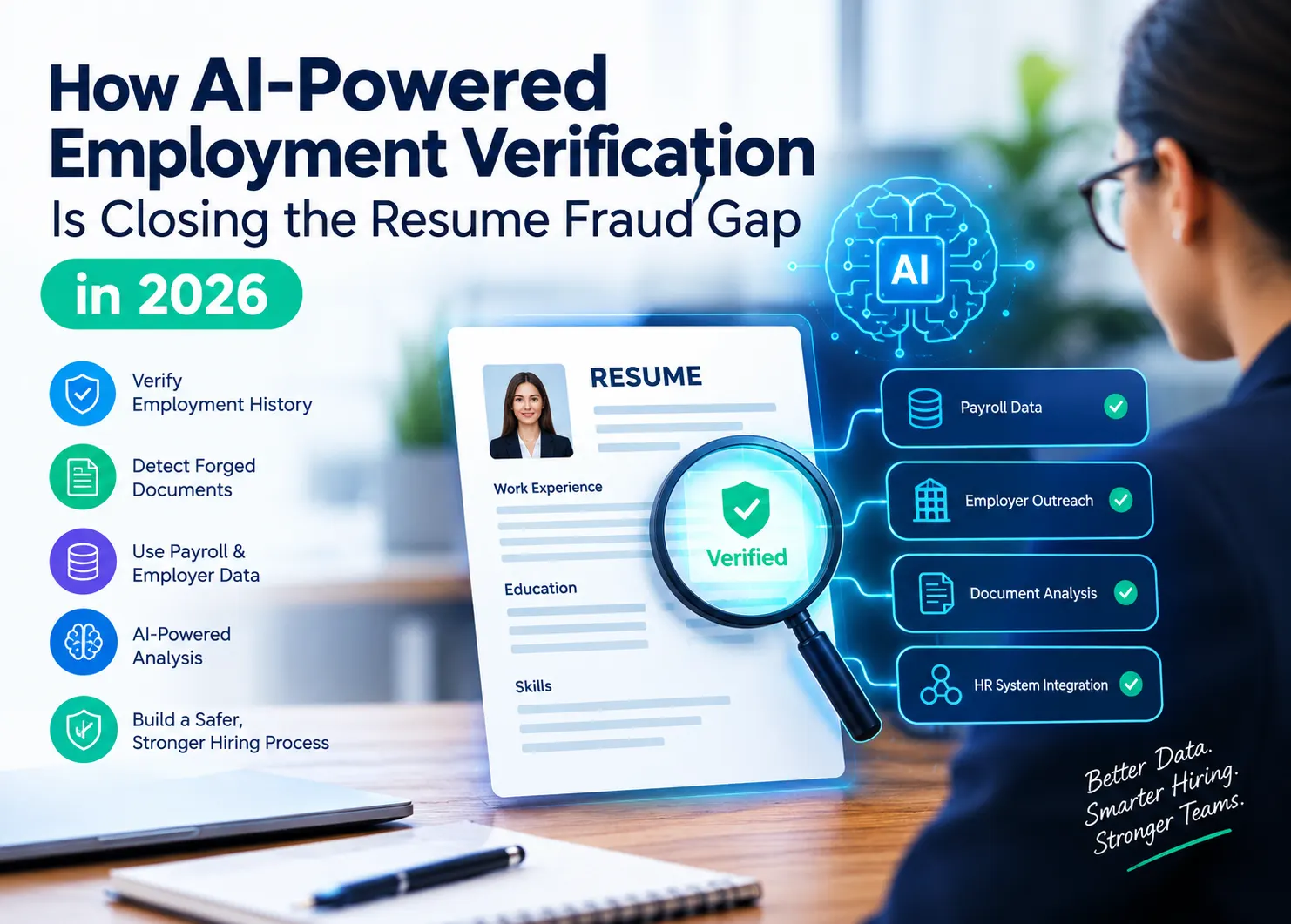
If you catch the fraud only at the interview — or worse, after the hire — it’s already too late. The gap closes when you stop trusting the resume and start verifying the employment record itself, using payroll data, AI-powered document analysis, and direct employer outreach.
The Fraud Landscape in 2026, by the Numbers
AI cheating at the interview stage
The interview stage should detect human applicants, yet AI technology has made interviewing another weak point. In Fabric’s analysis of 19,368 AI-powered interviews conducted from July 2025 to January 2026, 38.5% of all applicants were detected for engaging in AI-cheating activities. More worryingly, 61.1% of these cheating applicants passed the interview with scores exceeding the cut-off point. Had these candidates not been detected for cheating, they would proceed unnoticed. There are substantial differences in the cheating rates among various roles. Technical positions showed cheating rates of 48%, whereas sales roles recorded 12%. This is a fourfold difference between these two types of positions. Fabric attributed the sharp rise of 300% noted at the end of 2025 to stable invisible overlays and viral use of masking applications on social media platforms. According to Gartner, 6% of applicants cheated in interviews by impersonation or proxy recruitment methods.
Discrepancies surface in employment verification
When you go beyond the interview process, the statistics become alarming. According to HireRight’s 2025 Global Benchmark Report, over 75% of organisations globally discovered discrepancies among candidates in the last year through background checks, with education and employment history being the most common types of discrepancies.
In the EMEA region, this issue is much more prevalent, with 90% of companies reporting discrepancies – past employment of 64% and educational discrepancies of 47%, according to People Management’s reporting.
In the same report, one out of six participants stated that their company encountered identification fraud when recruiting employees, whereas 30% were unsure whether they had experienced such situations. Based on the 2026 Benchmark Report conducted by Veremark using 420,000 screenings, the employment verification flag rate is 10.3%. This includes date inconsistencies, exaggerated job titles, or inability to verify employment. Academic credential verifications showed a discrepancy rate of 19%.
This form of deceit is not necessarily committed by individual candidates alone. In July 2025, the FBI released a public service announcement highlighting that North Korean Information Technology staff utilise Americans’ identities alongside artificial intelligence technology to hide their true identity and obtain illegal jobs.
Why Traditional Screening Is Losing Ground
The old resume-screening playbook was already creaky. AI-generated applications have snapped it in half. According to the Checkr survey, 75% of business leaders agree that AI-generated applications make it nearly impossible to determine genuine qualifications before the interview, and 62% agree that traditional resume screening has been made obsolete by the rise of AI.
Seventy-three percent have encountered AI-generated resumes, cover letters, or assessments, with 29% saying it happens frequently. AI-generated resumes that exaggerate or fabricate experience rank as the top AI fraud concern for 36% of leaders.
What’s new in 2026 is the appearance of “detecting AI-driven candidate fraud” as a freestanding challenge, cited by 7% of business leaders — a category that didn’t exist in Checkr’s 2023 survey at all. From recruitment and candidate screening to employee management, AI in human resources is changing how organizations streamline hiring while addressing fairness, accuracy, and operational challenges.
Battling AI fraud in hiring has emerged as an operational stressor at 13%, now rivaling compliance as a pain point. The candidate side adds a layer of irony: Gartner found that 39% of candidates used AI during the application process, yet only 26% trust AI to evaluate them fairly.
If the resume and the interview can both be gamed, the only reliable move is to verify what’s underneath — the actual employment record. That’s exactly where AI-powered employment verification steps in.
Inside AI-Powered Employment Verification
The multi-path approach
Checkr employment verification doesn’t rely on a single method. Instead, it routes each verification request through the fastest reliable path: candidate-led payroll logins, direct database connections, AI-powered document review, or employer outreach — all in one automated flow.
Its Intelligent Orchestration engine, part of Checkr AI, automatically identifies the best verification path for a given request and reroutes when one method isn’t available, so there’s no manual resubmission or stalled process.
AI that catches what humans miss
Two components inside Checkr AI help flag signs of forgery that are easy to miss by eye. The role matcher scans employer data sources and verifies that claimed job titles align with what’s actually on record, catching fabrications and embellishments while deliberately ignoring minor discrepancies, a distinction that prevents good candidates from being sidelined over a date-off-by-one oversight.
The AI Doc Inspector scans every uploaded document — pay stubs, bank statements, offer letters, résumés — for signs of forgery: altered text, font inconsistencies, metadata mismatches, misaligned elements. These are signals a human eye routinely misses, but they’re the frontline of document-level fraud.
Speed, scale, and governance
Speed matters when a role is open and every day costs money. According to Checkr, most verifications complete in under three days, and 16% are delivered instantly. Payroll-connected verification, powered by Argyle’s integration, slashed turnaround from one to four days down to 15–60 seconds, enabling up to 90% customer cost savings.
The platform connects instantly with over 200 ATS and HRIS systems — though that integrations layer is available only for B2B hiring workflows — keeping verification fully embedded in existing processes.
Scale adds another layer of assurance. Checkr serves more than 140,000 employer customers and its platform confirms job titles and dates of employment across both US and international hiring workflows, so the AI models get continuous, varied feedback.
Governance, too, gets a rare stamp: Checkr is the first background check provider to achieve ISO 42001 AI-governance certification, validated by third-party auditor A-Lign, which means its AI use is built against an auditable framework of policies and controls.
What These Systems Actually Catch
The headline win is straightforward: inflated job titles and fabricated work histories — the very things a self-reported résumé can no longer be trusted to disclose — are flagged for review before they become a bad hire.
Background verification data consistently shows employment date discrepancies appear in 15% to 20% of senior-level checks across 160+ countries. Direct verification, as the Veremark data already highlighted, surfaces the mismatched dates and inflated roles that reference checks routinely miss.
When the system flags a title mismatch or an employer that can’t substantiate a tenure, that’s the résumé fraud gap closing in real time, not at the interview stage where a confident cheat can talk through it.
Caveats & Counterpoints
None of this is a silver bullet. Fraud and detection are locked in an arms race, and the invisible overlay tools Fabric documented — the ones that triggered a 3x cheating spike in late 2025 — remind us that no single signal is sufficient.
Verification must be layered, and automated flags still need human review. You want a system that ignores minor discrepancies and only elevates genuine red flags, because false positives can unfairly derail a candidate’s journey.
Privacy, too, deserves a close look. Methods that use payroll logins and document scanning shift verification from employer-to-employer calls to candidate-led consent. That’s a privacy check that can actually improve the candidate experience — but you should demand transparency on how that data is handled and retained.
Certifications are mitigation, not proof. Checkr’s ISO 42001 signals responsible AI use, but certification doesn’t eliminate residual risk. The broader market is moving fast: the global employment screening services market was valued at approximately $6.55 billion in 2025, projected to reach $11.57 billion by 2034, a growth trajectory driven by compliance mandates and AI integration.
Alongside AI-led verification, adjacent approaches like blockchain technology in HR verification have emerged to tackle credential authenticity from a different angle — though the current focus remains strongly on AI-powered, multi-path verification that acts on the employment record itself.
What’s clear is that verification narrows the fraud gap; it doesn’t remove the incentives that produce fraud in the first place. Although AI automation can improve efficiency and consistency, businesses must also account for implementation risks, human oversight, data privacy, and responsible use.
Verification, Not Just Detection
If one in four profiles could be fake by 2028, the gap between claimed and verified reality isn’t a niche concern — it’s the defining integrity challenge of modern hiring. AI-powered employment verification closes that gap not by building a cleverer detector but by checking the record underneath the résumé.
The appetite is clearly there: 71% of business leaders told Checkr they would invest heavily in AI detection tools for the hiring process if proven reliable, including 26% who strongly agree.
If you’re hiring in 2026, your highest-leverage move isn’t to distrust every application — it’s to verify employment through payroll data, AI-powered document analysis, and live employer outreach, rather than taking the résumé or the interview at face value. The closer you get to the source of truth, the smaller the fraud gap becomes.
Read More Blog On: