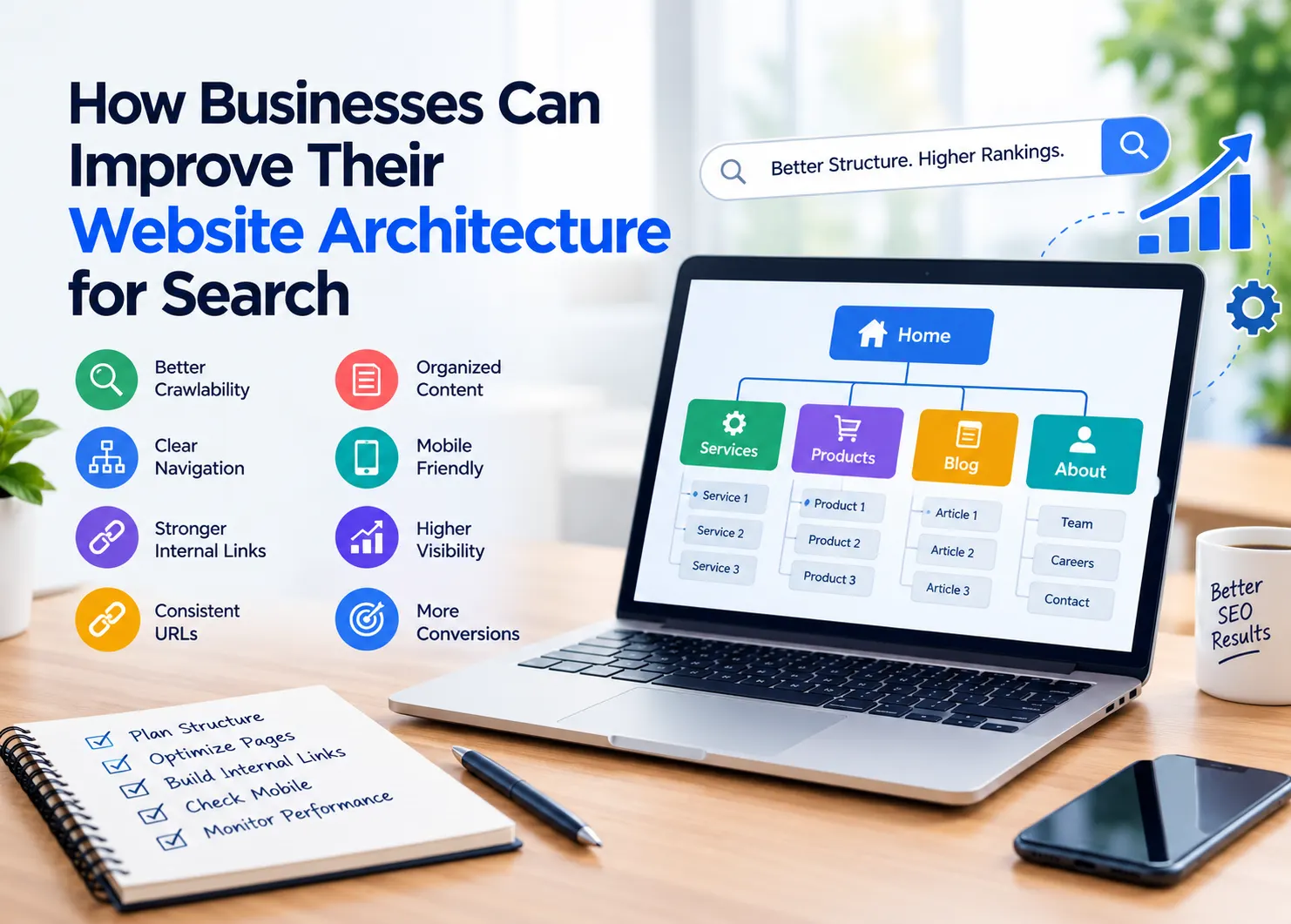
The architecture of a website can influence how simple it will be for search engines to access, interpret, and assess the various pages that constitute a company’s website. In addition to making it easy for people to navigate from one page to another, good website architecture makes the job simpler for the search engines. When significant data is hidden behind superfluous levels or when similar pages work against each other, a website might become more difficult for both the search engine as well as visitors to access. There are a number of ways that businesses can work on improving the website architecture.
Clear Navigation Supports Search Visibility
The site’s navigation should correspond to the hierarchy of its information. Major navigation should lead the user to essential categories, services, products, or resources without forcing him to make multiple clicks on pages not related to what he wants to see. Search engines will also be able to identify the connections between pages and recognize those that are significant for the whole site. Thus, if the navigation system corresponds to the logic of the information structure, chances that important pages will stay isolated will be reduced. Consequently, businesses must look at their menus from two sides – the visitor’s and search engine’s side.
Consistency of navigation is another key aspect that needs to be kept in mind when developing a website. The user does not need to learn new ways of navigating from one page to another every time he or she gets into a new section. Consistent navigation allows the transition from the general content to the specific pages to be much easier for the user. For instance, if a company provides a few different services, the website may start with the general categories and then go on to the particular pages related to them.
Logical Page Hierarchies Improve Organization
Having hierarchy helps in establishing an appropriate place for each of the web pages on the website. The home page usually is the most general one, whereas category, services, products, and support web pages have more specific details. The business owner needs to refrain from adding additional levels in order to make it look more detailed; this way, if a visitor needs to go through many pages before getting to the general service or product page, the hierarchy will not be very straightforward.
Page hierarchy must follow how customers search for information. If a company is selling various product lines, for example, individual products can be put under those product lines rather than having all the products on the same page. A website that offers services, likewise, can have the specialized services listed under the various service areas. In doing this, there will be relevance between the pages but individual pages will still have a target topic of their own. Businesses should conduct reviews from time to time if newly added pages fit the hierarchy of the website.
Internal Links Connect Related Content
Another method for business improvement is the use of internal linking. This allows customers to gain access to more information while giving search engines a clearer idea of how the different sections of your website fit together. For instance, a services page may be internally linked to a case study while an educational page may lead to services or product page. Such linking will not only serve its purpose but should be relevant to the person browsing through the site. Alongside building relevant internal links, businesses should understand how to get high-quality backlinks to strengthen their website’s broader SEO strategy.
Internal link placement and text can also serve to improve structure. Using descriptive anchor text tells the reader what he/she can expect to see once they click on the link. Internal linking from related pages further reinforces the relationship between different topics. Business owners should also be especially aware of critical pages with low internal linking. It is possible to have a page with great content that cannot be discovered because there are no pages linking to it. This kind of analysis might be performed by an SEO company Toronto during a site audit.
URL Structures Should Remain Consistent
The website’s URL should also be consistent with the hierarchy of pages within the website. The shorter the URL, the easier it will be to comprehend what information lies on a particular web page. Consistent URLs will help to organize a large-scale website effectively. It is advised not to create URLs that consist of useless parameters, characters, and changing naming conventions. Once the company has developed its structure of service and product pages, it is recommended to stick to it for any other new page creation.
Consistency is especially critical in cases where websites have several hundred or even thousands of web pages. The regular alteration of the URL structure might lead to maintenance problems as well as to having links, redirections, and duplicate content. Thus, companies intending to redesign their websites need to think about the URL structure before starting any web development. It would not be advisable to change URLs which have already become visible through search engines or gained any external linking.
Content Grouping Helps Search Engines Understand Topics
Clustering of similar material helps increase the relevance of the topics on the website. Firms can cluster their articles, guidelines, FAQs, and other useful materials by their services or categories. This means that different pages will be able to address certain issues but will still be linked to bigger categories of the website. For instance, when a firm offers various kinds of services, it will be able to create materials explaining the common issues that arise when using those particular services.
The organization of the content must be made on the basis of actual relationships and not as an effort to come up with the maximum number of pages. The posting of several articles which are all about almost the same topic will render the site repetitive and can make the pages compete for the same keywords. Prior to writing any new content, companies need to analyze the existing pages to find out if the topic has been covered. In some instances, it would be more sensible to improve the existing page rather than create a new one. Before creating new content clusters, businesses can use keyword research tools for SEO to identify relevant topics, understand search intent, and reduce overlap between existing pages.
Website Depth Should Be Kept Reasonable
The number of clicks it takes to get to an important page can influence whether or not the page is accessible. Companies must be careful about putting an important page down at the bottom of a hierarchy when there is no particular purpose for doing so. The customer searching for an important service must not need to click on several unnecessary categories before reaching the goal. The important pages must also have links to important areas of the website.
Depth of a website should not imply that each individual page on the site can be accessed from the home page. Large websites need to have multiple levels of navigation. The idea behind depth of a website is to develop a structure whereby each level fulfills a certain purpose. Some of the features that will assist the user to know their position on the website include breadcrumb navigation, categorization, internal context links, and good menus.
Duplicate Pages Can Weaken Structure
Duplicated or highly similar pages may complicate website architecture. Firms may create different pages for small variations of services or locations or different keywords, yet fail to add enough value in each one. This way, content becomes redundant and may become unclear what page represents a certain topic. It is recommended to look at the website pages and check for duplicated pages, and decide what action to take in regard to those pages.
Content duplication may even be caused by technical settings and not necessarily intentional content production. The use of varied URL formats, filters, tracking mechanisms, and other website functionalities may result in similar content having several web addresses. Companies need to collaborate with their developers and SEO experts to ensure that the search engines can distinguish between the right versions of the pages. A clear web structure will lead to minimal content duplication and allow focus to be on more useful pages.
Mobile Architecture Requires Careful Planning
The website architecture should function successfully not only on desktop screens but also on mobiles. An intricate navigation system for the desktop site can become hard to use once shrunk into a smaller screen. When users have difficulties in opening categories, navigating through pages, and going back to crucial sections, no matter how efficiently this process works on paper, the architecture will fail. Companies should make sure their navigation works on different screen sizes.
Mobile usability has also made the issue of prioritizing webpages even more critical. The best categories and navigation options must be accessible without requiring visitors to spend much time browsing too many menus. Companies can improve navigability by grouping similar categories together and getting rid of links that do not add much. This is not an excuse for hiding important pages from mobile users. On the contrary, this should help present the most relevant navigation paths without neglecting deeper content.
Technical Organization Supports Crawling
Technical aspects also play their role in the website architecture. Such technical aspects like XML site map, proper redirects, canonical URLs, structure of navigation, and internal linking can be used to enable the search engines to find and understand your website content. All the above factors are highly critical as the website increases in size with old pages, updated versions of old pages, and new content.
It is also important to watch for any potential crawl problems following significant changes on websites. The redesign, change of domain, switching to another content management system, or the reorganization of categories could accidentally cause difficulties for search engines when they attempt to access certain pages. These could be difficult to detect due to the fact that they are not evident to typical visitors. This means that monitoring the technical aspect of architecture is an ongoing task rather than a one-time occurrence.
Website Architecture Should Support Business Goals
It is important that a well-organized site ultimately serves the purpose of guiding users to relevant information and appropriate actions on their part. The crucial commercial pages must not be hidden under piles of information. On the other hand, educational pages can offer great value to those people who are still trying to research the problem. Linking these various kinds of pages will make the site structure work cohesively.
Companies could also measure architecture through web analytics data. Data such as search traffic, page engagement, number of conversions, link building inside the website and others could show if people are able to find relevant pages and navigate the website accordingly. If the website contains a service page with useful information but this page does not attract enough organic traffic, then the place of the page in the website architecture should be reconsidered.
Enhancements to website architecture must involve not only thinking about each separate page, but also about how all of the pages on the website operate together as a whole. Good navigation, hierarchy, relevant internal links, good URLs, proper content organization, sensible depth, and good underlying technology can help make it easier to find and understand information. Companies must continually assess the architecture of their websites as they add more and more pages, services, products, and information to their websites.
Read More Blogs On: