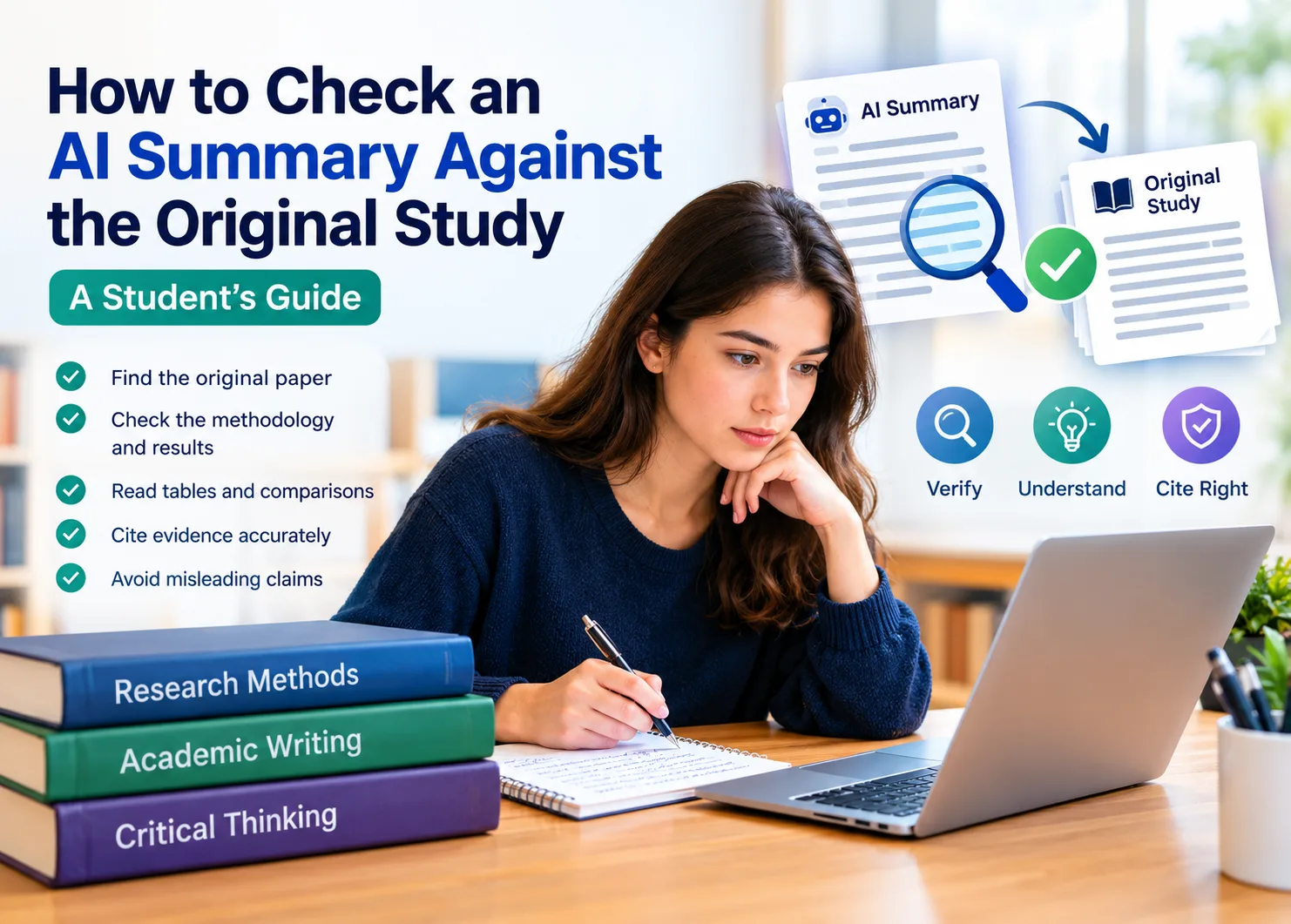
“Students who used AI got better maths scores, so the tool helped them learn.” This sample essay sentence sounds reasonable. Better scores ought to mean better learning. But which scores: answers completed with an AI assistant open, or a later exam taken alone?
You can catch this mistake by finding the task behind a result before using it as evidence. Keep the draft open beside the paper and follow the comparison all the way to the test it describes. The sentence above is a constructed example; the study below is real, and its results give us something specific to correct.
Find the paper behind the sentence
Start with the reference attached to the summary. Hamsa Bastani and his co-authors published a research paper in 2025 about how AI tools can affect students’ learning in mathematics. The paper is called “Generative AI Without Guardrails Can Harm Learning: Evidence From High School Mathematics.” You can search for it on Google Scholar or through your university library. If you can’t access the published version, try finding a copy uploaded by the authors or available in a university repository. Remember to note which version you read because the page numbers might be different. University libraries and reliable academic materials can help students locate credible sources and verify claims using appropriate research resources for students.
Here are some tips before you start reading the paper. If your library cannot provide the publisher’s version of the paper, look for an author manuscript or university library version.Also, note which version you use, as the page numbers may differ from those in the published journal article.A citation you can find again is more useful during revision than a file called “study-final.pdf.”
You might see an AI summary without opening a chatbot. Central Michigan University Libraries’ October 2026 guidance describes summary and research-assistant features inside academic databases. It recommends comparing the summary with the original source because context can be lost. A database summary can help you choose what to read; the original paper is where you verify the sentence you plan to cite.
Place the sample sentence next to the PDF. Underline “better maths scores” and “helped them learn.” These phrases appear similar, making the error hard to notice. Before finalizing your argument, make sure your evidence addresses the question you are investigating, following the principles of how to write a research question. Add one question next to them: what did the researchers measure once the help was removed?
Read the column before the number
Open Sections 2–3 in the author’s manuscript. During maths practice, groups used a basic GPT-4 interface, a guided tutor or books and notes without generative AI. The later exam was closed-book and closed-laptop.
That gives you two questions for your notes: could pupils complete the work with help, and could they do it afterward without help? Keep both in view while you read the results. Otherwise, a promising result from the practice session can end up in a paragraph about independent learning.
Go to Table 1 in the manuscript. Find the GPT Base row, then follow it across the practice and exam columns. The authors report higher practice performance but lower subsequent exam performance than the control group. The same group appears in both comparisons. What changes is the task being measured.
The first half of the sample sentence has picked up a real result. The second half has attached the wrong meaning to it.
It is not necessary for you to reproduce all figures in your undergraduate essay, but you have to understand what the figure entails. Look at the caption for the table and at the explanation provided right after that. Is the number an average, a comparison between two groups, or a statistic? What test does this column refer to? What is given to the other group that is compared with? In case you fail to answer these questions, ignore the number.
Hidden instructions in GPT Tutor included teacher-supplied solutions and common errors along with instructions to provide hints rather than solutions. Exam results of GPT Tutor were statistically the same as control. That does not prove identical learning.
You may add this finding to your evidence note: “Turkish high-school mathematics; basic GPT-4 compared with a books-and-notes control; higher performance during assisted practice, but lower performance on the later unaided exam. Location: Table 1. Supports a distinction between assisted and independent performance, but does not establish outcomes in university essay writing.” Place this under the saved publication details.
Include page number of your own copy of the document. Put the whole quoted material within quotation marks. This will help you distinguish between the quote and the paraphrase in future changes. If your tutor asks you where you found the source, you will know what particular table in the PDF to refer to.
In cases where the title makes it seem like the researchers are very confident about their research but all you can find is the abstract, note "Comparison not checked." Get the full version from your library or manuscript of the author prior to making use of the figures. In cases where the assignment should be submitted even before you have gotten the full version, cite verifiable information.
Put the finding back into your essay
A new sentence might be, “However, in the Turkish high school maths study conducted by Bastani et al., the baseline GPT-4 interface was beneficial to practice, but the students performed worse than the control group in the exam without any assistance.” Add the citation from the appropriate referencing style in your paper.
Look at what changed. Replacing “helped” with “may have helped” would have softened the language without repairing the evidence. The useful revision states the result and keeps the comparison intact. That is why running a draft through a writing program can’t complete the source check for you.
If you use Detecting-AI during draft review, its overall AI score and highlighted AI-like passages concern the text’s writing patterns. They cannot establish authorship or tell you whether “better scores” refers to the right test. Resolve that question in the paper, then revise the sentence with the evidence in view.
The following sentence in your essay should reflect your own analysis. You could suggest that schools need to consider how a study tool shapes student practice before endorsing it. Make this point as an inference, not as an additional experimental finding. It will be obvious to your reader when you are summarizing the findings of the researchers and when you are making conclusions about their findings.
Also read the paragraph around the fixed sentence. For example, perhaps your introduction is going to examine whether AI enhances the writing of university essays.This maths experiment cannot carry that claim by itself. You can narrow the paragraph to the difference between assistance and independent performance, or find research that directly addresses the task your essay discusses. Do this before spending time polishing the transition.
Search the draft for the paper’s author name once you finish the repair. Check every place you use that source, including the conclusion. A careful sentence in the body will not rescue an introduction that still makes the broader claim. Leave a brief revision comment beside any unfinished passage, naming the missing evidence rather than simply writing “needs work.”
While reading the following source, make notes on the relevant facts, such as the people participating in the process, their actions, ways of comparison of the results obtained, and conclusions made by the authors of the study. Never get your personal opinion mixed up with the findings of the research conducted here. In case you don’t understand anything, always consult a librarian or your tutor. Never use claims which are not proven by some facts from the text. In case you have doubts, always make some notes about the questions you need to answer. For instance, did the students use AI while conducting their tasks?
Read More Blogs On: