Why New York Is One of the Most Multilingual Cities in the World
New York City is like a language coral reef, clinging to the Atlantic coast of the United States, overlaid with generations of language. You can get on a downtown subway platform and by the time the train comes by, you have heard Haitian Creole, Mandarin, Wolof, and Puerto Rican Spanish volleyballing in the air. It has been estimated by linguists that there are over 700 languages spoken in the five boroughs today, which is more dense than any other metropolitan area in history. To comprehend how this has occurred, it is necessary to follow people, policies and marketplaces which have interwoven their voices since the seventeenth century.
Table of Contents
Linguistic Coral Reef of New York City
Immigrants have used New York as a landing ground and a testing ground in wave after wave. In the late nineteenth century, Ellis Island received about 12 million new arrivals, with the majority being of Irish, Italian, Eastern European, and Ottoman Empire descent. New waves of immigration came with the 1965 Immigration and Nationality Act, which removed old quotas and opened the floodgates in the Caribbean, South Asia, and mainland China. Recently, the political turmoil in Venezuela, Ukraine, the Middle East, and West Africa has once again skewed the language balance. Every cohort comes with its dialect continuums and literacy traditions, with the layers on top, not overriding older layers.
For many of these newcomers, legal survival hinges on certified paperwork - birth certificates, academic transcripts, or asylum affidavits - that must be rendered flawlessly into English; visit website to see how Rapid Translate markets precisely this service to city residents who cannot risk a mistranslation delaying their immigration case. Although invisible to casual observers, such micro-infrastructures of translation grease the bureaucratic gears that allow the city’s multilingualism to persist rather than collapse under misunderstanding.
A City Built on Successive Tides of Migration
Historians often divide New York’s population growth into distinct epochs - Dutch trading post, British royal port, industrial powerhouse, post-industrial finance hub - yet every stage imported labor and capital through multilingual channels. In the 1700s, Lenape words survived inside Dutch loanwords that themselves slipped into colonial English. By the 1920s, Yiddish theater on the Lower East Side was so popular that English-speaking Manhattanites bought tickets simply to enjoy the music despite missing the jokes. Such examples show that language difference has functioned less as a barrier than as a set of revolving doors through which cultural products enter and exit mainstream awareness.
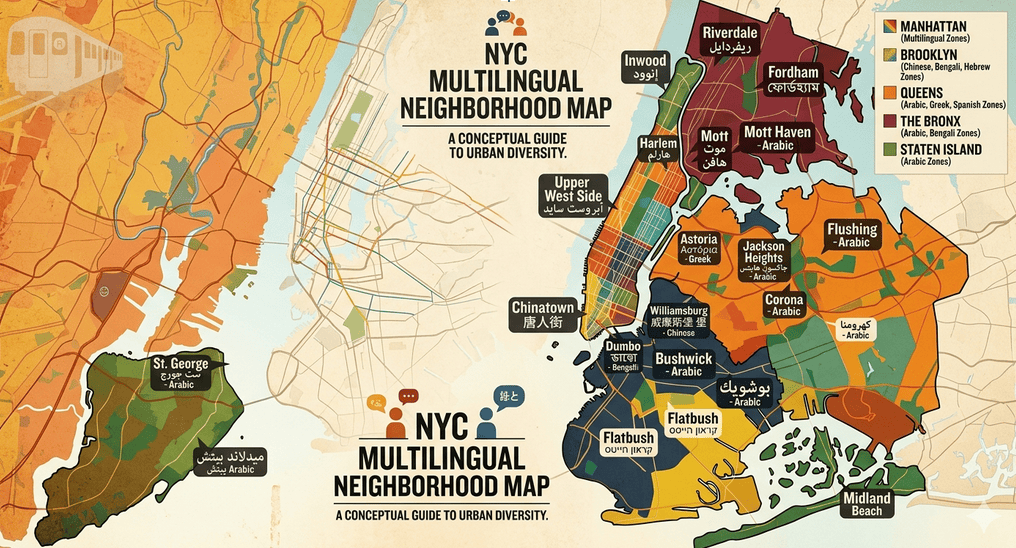
In recent decades, New York City has been getting more and more linguistically diversified. The school system, which operates publicly, records students whose combined language counts exceed 180 home languages, and the Department of Education offers materials in numerous languages, depending on the needs in a community, like Spanish and other highly spoken immigrant languages such as Chinese, Bengali, Arabic, and Urdu. Education and sociolinguistics research indicate that the institutional acknowledgment of home languages can facilitate the inclusion of communities and may also maintain home languages. Multilingualism is a usual practice at universities like CUNY and Columbia, and code-switching between English and heritage languages is a common occurrence in academia.
Neighborhood Linguistic Ecosystems
>Physical geography matters. Patterns of affordable housing and chain-migration agglomerate speech communities within particular census tracts, leading to what sociolinguist Shana Poplack has termed ethnolinguistic vitality. Storefront awnings are overlaid in Brooklyn’s Sunset Park, with simplified Chinese, traditional Chinese, and sometimes Spanish, as a result of a recent wave of Guatemalan migrants who now have to share kitchens with Fujianese cooks. In the Bronx, Albanian can be heard in cafes in Pelham Parkway, and joint mosques connect them to Urdu-speaking Pakistanis. These micro-hoods enable children to study English at school, but also learn a strong home language, a dual competence that is demonstrated to enhance cognitive flexibility and lifetime incomes.
Policy, Education, and the Role of Institutions
The city of New York has built a sound language access system throughout the decades. City agencies under Local Law 30 must include interpretation services in designated languages, as well as translate key documents, so that residents with limited English proficiency can access them. Courts and state hospitals use professional interpreters in a broad spectrum of languages to meet the civil rights mandate, and the usage of interpreters is frequently monitored to evaluate the quality of service and responsibility.
Ethnic media houses, community groups, and the demand of language skills in the global industries by the private sector also help the city to sustain its multilingual ecosystem. Combined, these systems result in multilingual communication being a structural aspect of urban life that facilitates the provision of governmental services as well as economic activity.
Conclusion
The multilingualism of New York City is not a by-product of immigration but an old structural phenomenon that has been the result of centuries of migration waves, economic opportunity, and the adaptation of institutions. It has maintained its language diversity by a high density of neighborhoods and has been solidified by schools, media, and government policy that actively promotes language access. These forces combined make language difference a kind of urban infrastructure instead of fragmentation, so that communication, mobility, and inclusion between communities are possible. Consequently, New York is not only a global city, but also a complex and ever-changing linguistic ecosystem of the world.


