Lifecycle Marketing at Enterprise Scale with Salesforce Marketing Cloud
Enterprises invest millions to centralize data, automate journeys, and personalize at scale.
They buy Salesforce Marketing Cloud agency expertise expecting outcomes, not just installs.
But implementation is the start, not the finish: the platform only becomes a growth engine when it’s actively managed, audited, and evolved.
Most teams treat go-live like a finish line.
The truth: go-live is the starting pistol for continuous optimization.
This post explains why enterprise teams stall, what specialist agencies do differently, and a practical roadmap for sustaining revenue-driving lifecycle programs.
Let’s cut to the chase and learn how Salesforce Marketing Cloud agency can help you in lifecycle marketing at an enterprise level
Table of Contents
The enterprise scaling trap: Why in-house teams stall
Technical success is not the same as operational maturity.
An SFMC instance can be live and still fragment your data, confuse your teams, and quietly leak value through journeys no one is tracking.
Because the distance between a clean build and a truly adaptive system isn’t just technology. It’s people. It’s a process. It’s time.
Enterprise lifecycle marketing requires cross-disciplinary depth.
You need:
- Administrators who understand send architecture.
- Engineers who can model events and APIs.
- Data architects who unify identity across systems.
- Strategists who can turn business goals into Journey Builder logic.
Because most in-house setups start simple and then complexity compounds.
More data sources. More business units. More releases to manage.
What began as a setup quickly becomes a system that demands discipline to scale.
- Common failure modes are predictable.
- Data silos that break personalization rules.
- Unmonitored automations that cause compliance or deliverability problems.
- And teams drowning in tactical requests, unable to design experiments that move long-term KPIs.
When internal teams lack this breadth, ROI stalls. Seasonal campaigns run, but retention and CLV do not improve.
That’s when leadership asks for a partner who treats SFMC like a living system—not a set of tasks.
“Implementation proves you can send. Continuous optimization proves you can grow.”, Enterprise CRM lead
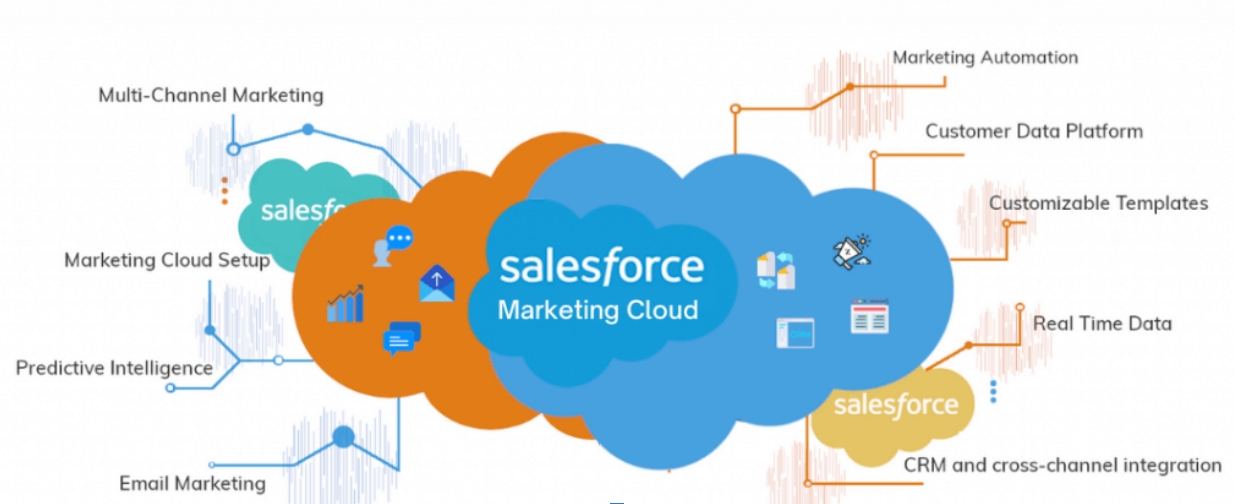
Four pillars of enterprise lifecycle marketing with SFMC
The difference between blasting and compounding is architectural. Agencies build systems that compound.
1. Continuous journey orchestration with Path Optimizer
Journey Builder is a canvas. Path Optimizer is the lab.
Agencies design journeys with built-in variation. Multiple paths. Multiple possibilities.
They measure engagement in real time and let the platform decide what works best. No more rigid A/B cycles. No more guesswork.
Journeys start learning. Adapting. Optimizing themselves with every interaction.
The result? Fewer one-off sends. More intelligent streams tuned to behavior, not assumptions.
And conversion? It moves faster because the journey always knows what to say next.
2. Predictive CLV modeling and prioritization
Short-term revenue metrics lie; lifetime value tells the truth.
Agencies configure Einstein or custom models to predict CLV and lifetime churn risk. Those scores feed journey branches, offer size, and serve cadence decisions—so you treat high-potential customers differently.
Result: allocate budget to retention strategies that maximize profit, not merely immediate orders.
3. Integrating agentic AI for 2026 and beyond
Agentic systems are not sci-fi. They’re operational assistants who propose creative variants, assemble campaign drafts, and flag anomalies.
Agencies wrap those agents in guardrails: tone rules, suppression logic, and business objectives. This preserves brand while scaling personalization through autonomous decisioning.
The agency role moves from builder to governor: they design the intent, review agent proposals, and keep humans in the loop.
4. Unified omnichannel CRM sync
Marketing without a Sales and Service context is half the team shouting into the void.
Agencies enforce one record of truth by syncing Sales Cloud, Service Cloud, and Data Cloud with SFMC. That unified timeline powers truly contextual journeys—transactional, support, and renewal flows that speak with the same voice.
Outcome: lower friction in handoffs, fewer duplicate contacts, and measurable influence on pipeline velocity.
But why do we need managed services in the first place? Why can’t these responsibilities be handled in-house? Let’s find out.
Managed services vs. in-house teams: The ROI breakdown
| Dimension | Outsourced Agency | In-House Team |
| Speed to value | Fast pilots, repeatable patterns | Slower; hires + ramp |
| Breadth of expertise | Cross-discipline bench (dev, data, deliverability) | Narrow, can be siloed |
| Scalability | Elastic resourcing for peaks | Fixed headcount limits |
| Proactivity | Continuous audits, SRE-style monitoring | Reactive, backlog-driven |
| Cost predictability | Fixed retainer, clear SLAs | Variable: salaries, attrition costs |
| Risk & compliance | Built-in governance & audit trails | Risk of single-point failures |
Managed services often reduce issue resolution time by ~64%, cut downtime ~73%, and can lower total ops cost up to 40% versus maintaining a full in-house stack.
Those are averages. Your mileage may vary depending on complexity and change rate.
“Our partners are vital to driving customer success and turning every business into a thriving agentic enterprise,” Jim Steele, Salesforce
Now, let’s build an effective optimization strategy that can last the test of time.
The agency optimization roadmap: Sustaining long-term engagement
A successful engagement is a cadence, not a project. Here is a 4-step strategy to help build long-term relationships and engagement strategies.
Step 1: Regular system audits.
Monthly checks identify broken smart campaigns, deliverability regressions, and aging data transforms. Fix issues before they impact customers.
Step 2: User adoption & training.
Agencies run role-based enablement: marketers, ops, and sales get tailored playbooks. That reduces accidental edits and accelerates autonomous campaign launches.
Step 3: Advanced analytics & attribution.
Implement a 4-layer attribution model: Discovery, Engagement, Acceleration, Expansion. Dashboards tie activity to closed-won, measuring lift from journeys, not just opens.
Step 4: Governance & release management.
Establish change windows, code review for AMPscript or SQL, and a deploy pipeline for content and automation. This reduces regressions when new releases land.
Together, these steps shift SFMC from a point solution to a platform that learns and compounds.
Wrapping up
That brings us to the business end of this article, where it’s fair to say that SFMC’s power is only realized with disciplined stewardship.
A Salesforce Marketing Cloud agency brings the systems thinking, specialized bench, and governance that enterprises need to scale personalized lifecycles.
Start pragmatic. Request a targeted SFMC architecture audit focused on your highest-leverage journey.
Pilot one agent-enabled journey, measure incrementality with a holdout, and scale the pattern across adjacent cohorts.


