If you’re an e-commerce business owner in 2026 looking to implement artificial intelligence (AI) into your operations, you’re headed in the right direction. Implementing AI-powered solutions across major business functions such as production, marketing, and customer service can automate, optimize, and guide business strategies within each department.
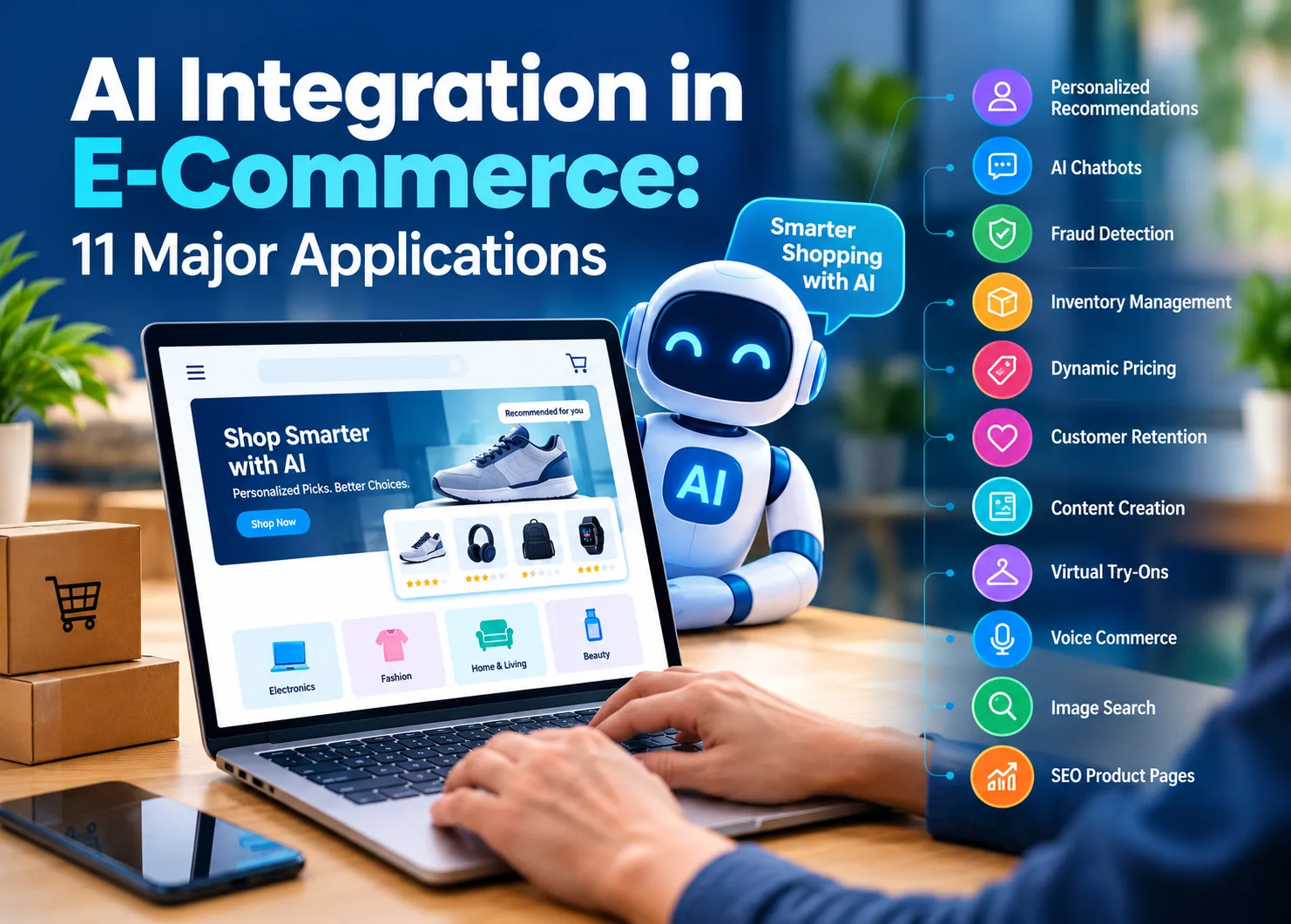
In this article, I’ll explore the top 11 e-commerce applications for AI, the foundation needed, as well as all the benefits this digital transformation can unlock for your business.
Here’s what we’ll cover.
Contents
- AI Integration in E-Commerce: 11 Major Applications 1
- Seamless AI Implementation: The Foundation Required 2
- 11 Major E-Commerce Applications of AI 2
- Personalized Product Recommendations 2
- AI Customer Service Chatbots 3
- Proactive Fraud Detection and Prevention 3
- Inventory Management 3
- Dynamic Pricing 3
- Customer Retention and Lifetime Value Prediction 3
- Generative AI for Content Creation 4
- Virtual Try-Ons 4
- Voice Commerce Support 4
- Image Search Optimization 4
- Search Engine Optimized Product Pages 4
- AI – The Winning Component for E-commerce Brands 5
- Seamless AI Implementation: The Foundation Required
Implementing AI smoothly into your major business functions requires a strong foundation. The key elements of a strong foundation are:
- Fast and Reliable Internet Connectivity: Robust Internet connectivity supports AI tools with real-time cloud processing and efficient data transfers, making it essential for you to explore the best internet providers near you.
- High-Quality, Centralized Data: AI tools constantly learn and improve their performance using data. You need to ensure easy access to customer and inventory data so your AI models have accurate inputs.
- Scalable Cloud Infrastructure: Cloud computing solutions provide the backend processing power needed to withstand high traffic and break down complex data.
- Team Upskilling: Your staff needs to be well trained in handling the AI tools and systems on a daily basis. This requires you to launch training programs to prevent operational bottlenecks later.
Once you’ve sorted these crucial prerequisites, you can implement AI across the diverse applications shared ahead.
11 Major E-Commerce Applications of AI
From personalized product recommendations to content creation, here are all the ways you can implement AI to secure and scale your e-commerce business.
Personalized Product Recommendations
Personalization is tailoring a user’s experience to align with their needs and interests. Streaming platforms such as Netflix apply the concept to show us more of the content we like. As an e-commerce business owner, you can use AI to display personalized products along with other items a user may be looking to purchase. For example, you could display jeans, hats, and sunglasses on a product page for a shirt. AI systems can analyze historic customer data to help you identify and display the right products.
This personalization extends to your marketing campaigns as well, since you can use historical data to segment customers and craft the most effective promotions or retargeting strategies. With a clear insight into personal information such as customer birthdays or anniversaries along with their pain points, spending power, and preferences.
AI Customer Service Chatbots
AI customer service chatbots on your website can handle customer queries, process returns, and generate sales. Using technologies such as natural language processing (NLP), generative AI, and historical customer data, they can mimic human conversations, seamlessly nurture, and convert first-time visitors into lifelong brand advocates.
The automation, convenience, cost-effective, and human-like customer handling that chatbots allow has led to their massive adoption by a huge number of e-commerce businesses. In fact, up to 80% of businesses are expected to use AI chatbot solutions by the end of 2026, and soon we may see these numbers jump to a 100%.
Proactive Fraud Detection and Prevention
By constantly analyzing and extracting relevant insights from large datasets, AI models can make predictions that address your business’s weaknesses and market trends. Cybersecurity is one of the largest beneficiaries of these predictive analytics, as AI systems can pinpoint loopholes in your current operational policies, use data to identify fraudulent customers, and provide actionable strategies to mitigate chargebacks, fake accounts, or payment fraud.
Inventory Management
Cybersecurity is not the only operational department that benefits from AI’s predictive analytics since it can also be used to optimize your inventory levels and supply chain. With real-time information from sensors and RFID tags, AI forecasts rapidly evolving customer preferences, market trends, and seasonal changes. With these insights, AI systems recommend the optimal inventory level of items that are trending and prevent both understocking and wasted inventory.
Dynamic Pricing
Manually updating the prices of all the products you’re selling is an inefficient and stressful process. AI solutions can automate it by constantly analyzing competitors, target audience, inventory levels, and market shifts to dynamically update prices and grow your profit margins. This doesn’t happen overnight since analyzing the data collected from all your online touchpoints requires time. You can also keep complete control of the entire process by defining custom instructions related to your base prices and goals. The automated adjustment can help you stay one step ahead of competitors across all your strategies.
Customer Retention and Lifetime Value Prediction
The most important application of AI’s predictive power is protecting your customer base since they potentially provide the highest lifetime value. AI helps by analyzing their purchase history and frequency, website activity, and customer service interactions to assign a churn risk and future lifetime value score for each customer. You can use this information to reduce cart abandonment, upsell, cross-sell, and create tailored offers along with retargeting campaigns.
Generative AI for Content Creation
Establishing online brand visibility beyond your website and sales points is crucial for getting your business in front of customers. Focusing on social media platforms requires you to post content regularly in order to generate customer engagement.
Generative AI tools such as ChatGPT and Firefly can automate image, video, audio, and text-based content production, allowing you to save on manual labor costs and unlock efficiency. These tools do require a fast and reliable internet connection for quick results, and looking into platforms like LocalCableDeals can help you zero in on the right plan for your business.
Virtual Try-Ons
This application is particularly useful for e-commerce brands operating in the clothing, furniture, home décor, or beauty space. It increases the likelihood of purchases and simultaneously minimizes the likelihood of returns by providing a potential customer an accurate view of whether a product fits their needs.
This AI-powered functionality is supported by computer vision, deep learning, and generative models that digitally place products onto a photo or live video feed a user is sharing. For example, users can record their living room and the technology will place a couch to help them gauge how it will look.
Voice Commerce Support
Voice commerce is the future, with 49% of Americans already using voice search for their shopping related tasks. AI can help brands optimize and secure a competitive edge early on. How it works is through natural language processing that identifies the intent behind conversational long-term queries, instead of keywords.
Brands can use this to rank higher in search results across these queries. For example, if a customer uses voice to search for running shoes, they may say something like, “what’re the best running shoes that won’t hurt my knees?” AI can understand the pain points they’re looking to address, and help brands optimize their product page accordingly. This also makes understanding AI-powered search and online visibility increasingly important as customers change how they discover products and businesses.
Image Search Optimization
Image search is another frequently used method of finding products. In fact, over 1. 5 billion people across the globe use image search as of 2025, with over 100 billion searches the same year. That’s because typing queries and even trying to accurately describe certain items that a user may have seen across their social media feeds or streaming content is difficult. Instead, they can simply screenshot an image and upload it to Google search to find similar items. Brands can use this by uploading images of their products across all different angles to improve the chances of matching with a query.
Search Engine Optimized Product Pages
E-commerce platforms such as Shopify offer AI-powered features that can generate search engine optimized and user-friendly product descriptions, all while staying true a brand’s image. In addition to helping improve search engine rankings, this feature can also significantly boost the chances of users converting once they land on a product page as they may find their pain points addressed. This makes long-tail keyword research particularly useful for identifying the detailed, purchase-focused searches that product pages can target.
The feature can also be used to breathe life into product images and make the more appealing to the consumer. For example, AI can add brand-aligned backgrounds to product images that amplify the chances of audiences purchasing.
AI – The Winning Component for E-commerce Brands
AI has revolutionized the e-commerce industry with the seven growth-focused applications shared above. From personalized product suggestions to content creation, AI enables brands to unlock efficiency, manage budgets and resources, as well as enhance the effectiveness of their strategies with data.
You have the roadmap needed to get started, and it’s now time to put the plan into effect. Act now, and secure the future of the business you’ve worked so hard to build with an early competitive edge.
Read More Blogs On