

“There is no elevator to success, you have to take the stairs”
Zig Ziglar
Overview
Nursing involves continuous learning, clinical decision-making, patient communication, and professional development. Setting clear goals can help nurses and nursing students identify what they need to improve and track their progress over time. However, simply stating a goal such as “improve my communication skills” does not explain what improvement looks like or when it should happen. This is where SMART goals in nursing can help. SMART goals provide a structured approach for creating objectives that are Specific, Measurable, Achievable, Relevant, and Time-Bound. They can be used for clinical skills, patient care, communication, documentation, time management, professional development, and nursing education. Simply put, you need to set SMART Goals and find smart ways to achieve them. In the fitness industry, for instance, platforms like FitBuddprovide personal training software for online training that helps trainers set, track, and achieve measurable goals with their clients — showing how technology can make goal-setting practical and results-driven. In this guide, you will learn what SMART goals mean in nursing, how to write a SMART nursing goal, and how to turn general nursing goals into measurable objectives. You will also find practical nursing SMART goals examples for nursing students, new nurses, experienced nurses, and professional development.
Table of Contents
What are SMART Goals?
SMART goals in nursing are specific objectives that help nurses and nursing students define what they want to achieve, determine how progress will be measured, and establish a realistic deadline. The SMART framework can make nursing goals easier to understand, track, evaluate, and adjust.
The word SMART is an acronym for Specific, Measurable, Achievable, Relevant, and Time-Bound. Each element helps turn a broad intention into a practical nursing goal.
For example, “I want to improve patient communication” is a general nursing goal. A SMART nursing goal would provide a clear action, measurement, and deadline:
“Over the next four weeks, I will use a structured communication approach during at least 90% of applicable patient interactions and request weekly feedback from my clinical supervisor.”
This example demonstrates how SMART nursing goals can transform general intentions into measurable objectives that support professional development and patient-centered care.
What Does SMART Stand for in Nursing?
The SMART meaning in nursing is based on five elements that help nurses create clear and realistic goals. Understanding the SMART acronym in nursing makes it easier to develop objectives for clinical practice, education, patient care, and professional growth
S — Specific
A specific goal clearly states what you want to accomplish. Instead of saying “improve clinical skills,” identify the exact skill you want to develop, such as patient assessment, wound care, medication administration, or documentation.
M — Measurable
A measurable goal includes a way to track progress. You might measure your goal using a percentage, number of completed activities, assessment score, frequency, or supervisor feedback.
A — Achievable
An achievable goal should challenge you without being unrealistic. Consider your current knowledge, available resources, clinical opportunities, experience, and timeframe before setting the goal.
R — Relevant
A relevant goal should connect with your nursing responsibilities, patient-care needs, education, professional development, or long-term career objectives.
T — Time-Bound
A time-bound goal has a specific deadline or timeframe. Setting a date creates accountability and gives you a point at which you can evaluate your progress.
Together, these five elements form the SMART nursing acronym and provide a practical format for developing meaningful nursing goals. If you want to learn more about the framework of SMART Goals with some effective examples, go through our detailed SMART Goals learning guide. Now that you have learned about what exactly the framework of SMART Goals is, the next section will shed light on how you can set SMART nursing goals.
What Is the Difference Between Nursing Goals and SMART Nursing Goals?
A nursing goal describes an outcome or area of improvement that a nurse wants to achieve. However, a general nursing goal may not explain exactly what needs to be done, how success will be measured, or when the goal should be completed.
For example:
General nursing goal: Improve patient education skills.
SMART nursing goal: Over the next 30 days, provide patient education using the approved education checklist for at least 90% of assigned patients and document each education session according to workplace requirements.
The first statement identifies an area for improvement, while the second provides a specific action, measurable target, and deadline. This is why SMART goals for nursing can be more useful when planning professional development or evaluating progress.
A nursing goal can therefore be considered the starting point, while a SMART goal provides a structured way to turn that goal into an actionable and measurable objective.
What Are the Main Goals of Nursing?
The goals of nursing extend beyond completing clinical tasks. Nurses aim to provide safe, effective, patient-centered care while supporting health, recovery, independence, education, and quality of life. Individual nursing goals can vary depending on a nurse's role, experience, specialty, workplace, and professional aspirations.
Common nursing goals include:
- Providing safe and patient-centered care
- Improving clinical knowledge and skills
- Strengthening communication with patients and healthcare teams
- Promoting health and preventing complications
- Improving documentation and clinical decision-making
- Developing leadership and teamwork skills
- Maintaining professional competence
- Continuing education and professional development
These broad nursing goals can be converted into SMART goals by adding specific actions, measurable outcomes, realistic expectations, relevance, and deadlines.
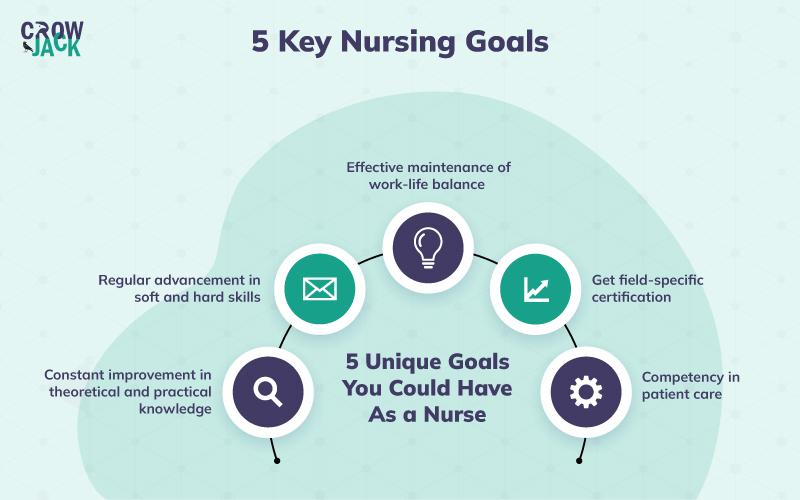
1. Constant improvement in theoretical and practical knowledge
Thanks to all the latest technological advancements, healthcare is a field that changes at a constant pace. Besides, after the pandemic, the human body has also been extra vulnerable to certain infections. This is the reason, your first nursing goal should always be to have a constant improvement in your theoretical and practical knowledge.
As the time and human body change, you never know when you will have a certain case under your observation. Hence, it is essential to constantly keep a check on the improvisations and changing scenarios in your field of study in terms of practical and theoretical aspects.
You can access various nursing courses that can assist you in making constant improvisations in your knowledge. These learning apps or other various online or offline resources can efficiently help you in enhancing your theoretical and practical knowledge of your subject field. Besides, the more knowledge you will have, the more enhancement there will be in your professional career. Alongside professional nursing courses, tools like Promova AI can support continuous learning by helping healthcare professionals improve communication skills, practice medical English, and build confidence when interacting with patients and colleagues in diverse clinical environments. And isn’t that what you want, right? And if your goals are tied to leadership, advanced practice, or education, pursuing a master for nurses can give your learning a clearer direction. It helps you move beyond short courses and build deeper clinical judgment, research skills, and long-term career options.
2. Regular advancement in soft and hard skills
Being in the nursing profession, you might also agree with the fact that it is not a piece of cake. You need to have certain soft and hard skills that make you different from others. In the nursing profession, some of the must-have hard skills are
Advanced cardiovascular life support (ACLS)
Proficiency in EHR
Ventilator care
Emergency and critical care nursing
Besides, some of the soft skills that are crucial for being an efficient nurse in the health care industry are
Cordiality
Emotional intelligence
Positive personality traits
Communication skills
Workplace étiquettes
Time management
With respect to communication skills, the 7Cs of Communication holds immense significance in nursing jobs given the vitality of precise communication while dealing with patients or during surgeries.
Besides, having the above-mentioned hard and soft skills will effectively assist you in finishing your jobs with utmost efficiency.
The more you advance in your soft skills and hard skills, the stronger will be your claim to the top. Eventually, every nurse wants to escalate to the position of a nursing officer and for that, your skill set along with your expertise will be the most important determinant.
3. Effective maintenance of work-life balance
A survey suggests that more than 95 percent of nurses experience burnout situations. Besides, around 91 percent of nurses have thought about quitting their jobs because of the enormous amount of stress. Needless to say, when you are in such a critical profession, it is obvious that you will experience paramount stress. Moreover, this stress can also turn into trauma at times. However, quitting is never an option for achievers. You need to find a way around the stress that comes with this profession and get your work-life balance right.
A perfect work-life balance is not only essential from the stress management perspective but also for your productivity. A disrupted work-life balance and work efficiency cannot co-exist for long. Having said that, meeting the goal of a positive work-life balance will clearly aid your productivity and success.
4. Get field-specific certifications
Being a nurse is good but being a certified nurse is even better. Certification of any industry always tends to provide a validation of your knowledge, skills, and expertise. Hence, it is really essential to get field-specific certifications that will enhance your professional value and credibility.
Hence with regular intervals getting certified validations should also be one of your major goals as a nurse. Clinical certifications will demonstrate your high competence in the highly competitive market of the nursing industry. Field base certifications will provide you better confidence which can add value to your prospects and can also assist you in providing higher salaries.
However, one has to realize that this should be a constant process that you need to get certified validations from esteemed professional institutions that can assist you in enhancing your specialty. Some essential and common nursing certifications are mentioned below.
Wound care certification
Advanced practice nursing certification
Medical surgical nursing certification
Nursing specialty certification
Registered nurse certification
Certified cardiovascular nerves practitioner
You just need to critically analyze the right certification for you and you are ready to enhance your value and knowledge in the highly competitive market.
5. Competency in patient care
People may not remember you as a nurse by your name but will definitely remember how you care for them. But you will only be remembered if you do something worth remembering. Besides, providing patient-centered care can be one of the most significant comparative advantages that you can have. Hence, getting competency in patient care should be another crucial goal for you as a nurse.
To provide patient-centered care, it is essential for you to identify care and respect every patient’s diverse culture, values, preferences, needs, and so forth. For the successful accomplishment of the same, you need to develop personality traits such as empathy and emotional intelligence in the nursing. The reason is when you will have these qualities you will effectively be able to continuously coordinate lessons and communicate with your patients regarding their wellness, healthy lifestyles, and other disease prevention.
This way only you will be able to provide quality service and care for the patient which will not only add value to your prospect but will also enhance the efficiency of the workplace you are working for. Once you will be able to provide quality service to patients it will enhance your competency in the particular field.
How to set SMART nursing goals?
1. Make your goal more specific
Adding specificity to goals will ensure that you see a clear path to improving your professional efficiency. In the nursing profession, specifications matter a lot. One small mistake can lead to serious consequences. Hence, even when setting a goal in order to improve in your nursing profession, it is really essential to add specificity to your goal.
Hence, the very first step that will assist you in setting a SMART nursing goal is that you have added a unique specificity to it. To simplify, you need to note down the exact nursing goal you desire to achieve.
The simple logic behind the same is that the more you'll be specific about your goal, the more specific directions you will be able to give yourself on achieving that goal. In order to make your nursing goal specific, you need to keep four main Ws in mind. Detailed elaboration of all the 4Ws is given below
What- The first W stands for 'what' that simply refers to the agenda you wish to achieve through your goal. For example, as a nurse what is the main goal that you wish to work on? Whether it relates to your professional development or your personal development?
Who- The second W stands for “who” that aligns with all the people concerned people with the who. For example, if you set a goal, you will keep your and every person that will assist you in accomplishing the goal in mind before developing the SMART goal. For example, while setting your nursing goals, can include other doctorate staff members, your colleagues, or your seniors.
When- The specificity of time will assist you in framing your goal more precisely.
Where- In this section, you will focus on specifying the location (if any) involved in the accomplishment process of your goal. For example, you wish to accomplish your goal in your workplace or nursing institutions, etc.
Once you will successfully specify your goal, formulating all the further strategies will get much easier. Besides, after specifying the goal, you are ready to move ahead to the next phase of setting a SMART goal.
2. Make your goals measurable
As discussed above as well, the competition in the nursing workforce is increasing at a rampant pace. Hence, it is really essential to constantly improve yourself in the nursing profession in order to outshine all your competition. But, how, as a nurse, are you supposed to improve, if you can not measure?
Besides, Peter Ducker also once correctly quoted, "you cannot improve if you can't measure". Hence, another crucial step that is really important in setting a SMART nursing goal is to make your goal measurable. This factor will determine whether you were successful in achieving your desired goal or not.
For making a goal measurable, it is really essential to set some of the key performance indicators beforehand that will assist you in measuring the success of your performance in achieving your desired goals. For example, as a nurse, if your main goal is to provide the best service to your patient, then there are some crucial healthcare KPIs that will assist you in measuring the success of your overall performance.
3. Consider the achievability level
In this step, you need to consider the fact that how achievable your set goal is. Moreover, all the factors, skills, or tools that might be needed to make this goal achievable will be discussed in your section. The very important reason for setting an achievable goal is that when successfully achieved, it can boost your confidence and self-esteem. But this does not mean that you need to set the easiest goals for yourself. This implies that you need to make sure that your goal is realistic in every possible sense so that you can achieve it effectively.
For example, you say that you want to become a head nurse as a fresher within the next two months. Although this goal is possible in some ideal circumstances, this goal majorly reflects unrealistic expectations which can lower your morale when not successfully accomplished. Besides, you might need to experience and learn a lot more skills than it takes to be a head nurse.
4. Identify the relevance
As a nurse, setting a goal is crucial, but setting a relevant goal is even more crucial because the relevancy of your nursing goal is directly related to your growth in the nursing profession.
Hence, relevancy is the fourth and crucial phase while setting a SMART nursing goal. The reason is in this section, you need to find a correlation between how your set SMART nursing goal compliments your bigger vision and objectives in the nursing field. To successfully find the relevance of your goal, you need to effectively reflect on your goal using different reflection models to ensure that the relevancy of your SMART Goals significantly aligns with your future vision. For instance, if your long-term vision is to take on a medical directorship role, each SMART Goal you set whether it's about improving communication, gaining administrative exposure, or earning a leadership certification should clearly align with that overarching vision."
Identifying the key relevance of your SMART nursing goals is really essential because this section will ensure whether all your invested efforts will be worthwhile in any way possible in your professional life or not. Besides, you can also check the relevancy of your nursing SMART Goals based on the registered nursing standards of your country.
5. Make your goals time-bound
Time is a really crucial aspect of the healthcare industry. If as a nurse, you are able to do things on time, then only you will be able to succeed in saving the lives of people.
Hence, the last yet critical stage of setting your SMART nursing goal is designating a time frame. It is really essential to make your goal time-bound. It is essential to make your goal time-bound because it helps you keep going and motivated to achieve the goal in the set time frame. Hence, it is really essential to set a time frame for every task to set a realistic time frame to achieve your goal.
Now that we have understood in detail what SMART Goals are, what the key nursing goals are, and how to set SMART Goals, let us now look at some effective examples of nursing SMART Goals taking various scenarios into consideration.
Nursing SMART Goals Examples
The best nursing SMART goals examples connect a nurse's professional development needs with a clear action, measurable target, realistic expectation, and specific timeframe. Instead of setting broad goals such as “become a better nurse” or “improve patient care,” SMART goals explain exactly what needs to improve and how progress will be evaluated.
The following smart goals nursing examples cover common areas of nursing practice, including patient communication, clinical assessment, medication safety, documentation, time management, patient education, leadership, infection prevention, clinical knowledge, teamwork, and professional development.
SMART nursing goal example 1.

Overall objective
Become qualified or develop specialization in pediatrics or children's healthcare. This example is about a nurse who wants to advance their knowledge and professional skills in pediatric nursing.
S — Specific
The goal is specific because it identifies the exact area of professional development: pediatrics or children's healthcare. Instead of saying “I want to improve my nursing knowledge,” the nurse identifies the specialty they want to pursue.
Why it matters: A specific goal gives the nurse a clear direction for professional development and helps them identify the appropriate course, certification, or educational program.
M — Measurable
The example measures progress by completing a professional certification or course and achieving a required examination result.
The original image refers to passing the examination with more than 75% credits.
A stronger version would be:
“I will complete the pediatric nursing certification and achieve at least 75% on the final assessment.”
This gives the nurse a clear way to determine whether the goal has been achieved.
A — Achievable
The nurse plans to use available learning resources, such as online courses and offline study materials, to develop the required knowledge.
This makes the goal achievable because the nurse has identified how they will work toward the goal, rather than simply stating the desired outcome.
R — Relevant
Pediatric education or certification is relevant because it supports the nurse's intended specialization in children's healthcare.
The goal therefore connects directly with the nurse's professional development and future career direction.
T — Time-Bound
The example establishes a deadline for completing the course and progressing toward certification.
A stronger version would specify an exact timeframe, such as:
“I will complete the pediatric nursing course and final assessment within 12 months.”
What this example teaches
This is a good example of a SMART nursing goal for professional specialization. It demonstrates that a nurse can turn a broad career ambition, “I want to work in pediatrics”, into a structured educational goal.
SMART nursing goal example 2.
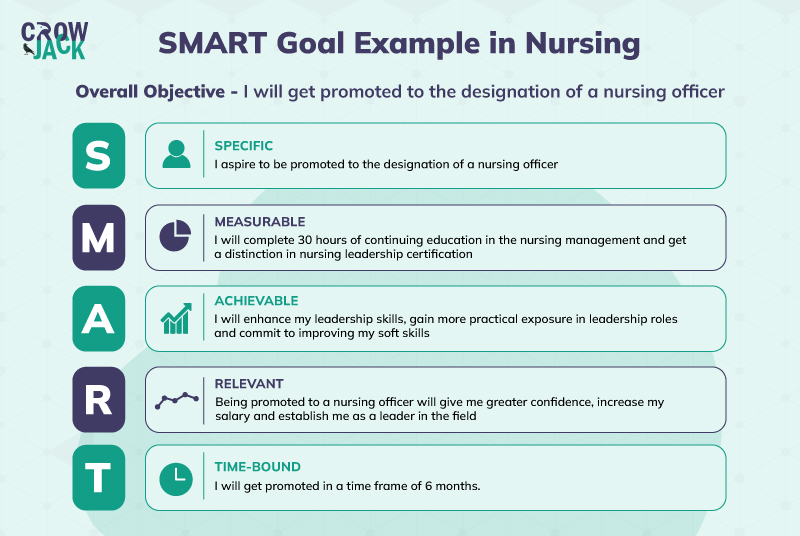
Overall objective
Get promoted to the position of a nursing officer. This example focuses on career advancement and leadership development.
S — Specific
The goal clearly identifies the desired career outcome: promotion to a nursing officer position.
Instead of saying:
“I want to advance my nursing career.”
the nurse identifies the particular position they want to pursue.
M — Measurable
The example proposes completing continuing education in nursing management and obtaining a relevant qualification or certification.
This creates measurable milestones along the way.
For example:
“I will complete 30 hours of continuing education in nursing management and obtain the required leadership certification.”
This allows the nurse to track progress through completed education hours and certification.
A — Achievable
The nurse plans to develop leadership skills and gain practical exposure to leadership responsibilities.
This is important because promotion should not depend only on wanting the position. The nurse needs to develop competencies that support the role.
Possible activities could include:
- Participating in team coordination
- Developing delegation skills
- Taking part in quality-improvement activities
- Supporting junior nurses
- Completing leadership training
- Seeking feedback from senior nurses
R — Relevant
Leadership development is directly connected to the goal of becoming a nursing officer.
The education and practical experience are therefore not random activities—they support the nurse's broader career objective.
T — Time-Bound
The example gives a six-month timeframe for progressing toward the goal.
A more precise version could be:
“Within six months, I will complete the required leadership training, participate in at least three supervised leadership activities, and discuss my progress with my manager.”
What this example teaches
This is a strong example of a professional nursing SMART goal because it connects education + practical experience + career advancement.
One important improvement I'd make to the original image is to avoid implying that completing a course automatically guarantees promotion. Promotion depends on organizational requirements, available positions, qualifications, performance, and other factors.
2. Improve Clinical Assessment Skills
General nursing goal: Become better at performing patient assessments.
Patient assessment is an important nursing competency because accurate observations and documentation can help identify changes in a patient's condition. A SMART goal should focus on a specific assessment activity and establish a way to evaluate improvement.
SMART nursing goal: Within six weeks, I will complete five supervised comprehensive patient assessments using the required assessment framework and review supervisor feedback after each assessment to improve the accuracy and completeness of my findings and documentation.
How this goal can be measured:
The nurse or nursing student can track:
- Number of assessments completed
- Supervisor feedback
- Accuracy of collected information
- Completeness of documentation
- Areas requiring additional practice
This example is particularly suitable for SMART goals for nursing students who are developing assessment competencies during clinical education or placement.
SMART nursing goal example 3.
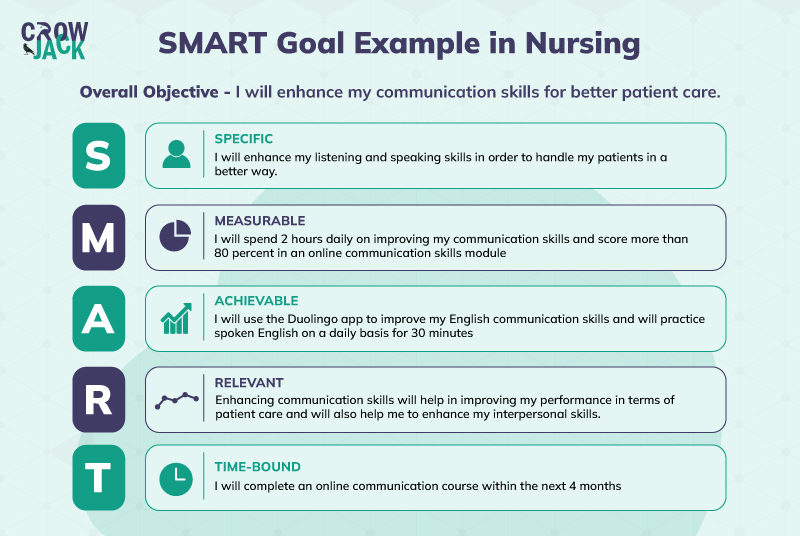
Overall objective
Enhance communication skills to provide better patient care. This example focuses on one of the most important professional skills for nurses: effective communication.
S — Specific
The goal identifies particular communication behaviors, such as:
- Active listening
- Speaking clearly
- Understanding patient concerns
- Communicating appropriately with patients
Instead of simply saying:
“I want to become a better communicator,”
the nurse identifies what aspect of communication needs improvement.
M — Measurable
The example sets aside two hours per day for communication practice and includes a target score on a communication-related assessment.
However, I would improve this measurement.
Two hours every day may not be realistic for every nurse.
A better measurable target could be:
“I will complete two hours of communication training each week and achieve at least 80% on the final assessment.”
This is easier to track and more realistic.
A — Achievable
The nurse plans to use an online course and practice communication skills regularly.
This provides a practical method for achieving the goal.
The nurse could also:
- Practice active listening
- Request feedback from supervisors
- Participate in communication workshops
- Review patient interactions
- Practice professional handovers
R — Relevant
Communication skills are directly relevant to nursing because nurses regularly communicate with:
- Patients
- Families
- Doctors
- Other nurses
- Allied healthcare professionals
Better communication can support clearer information sharing, patient education, teamwork, and patient-centered care.
T — Time-Bound
The example gives a four-month timeframe for completing the communication course.
A clearer version would be:
“I will complete the communication course and achieve at least 80% on the final assessment within four months.”
What this example teaches
This is a useful SMART goal nursing example because it demonstrates how a soft skill such as communication can be turned into a measurable professional development goal.
SMART nursing goal example 4.
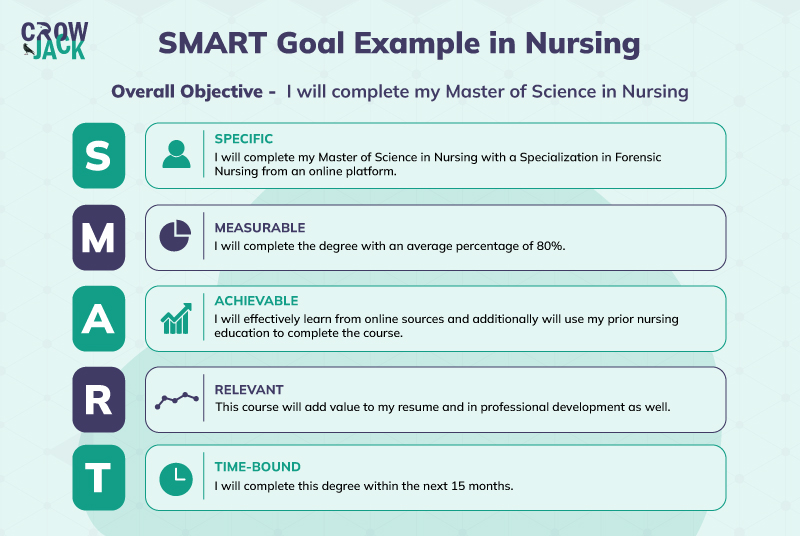
Overall objective
Complete a Master of Science in Nursing. This example focuses on advanced education and long-term career development.
S — Specific
The goal identifies a specific educational qualification: a Master of Science in Nursing, with the example focusing on a particular specialization.
This is much more specific than:
“I want to continue my education.”
The nurse knows exactly what qualification they are working toward.
M — Measurable
The example uses academic performance as a measurement, mentioning completion of the degree with an average of 80%.
A stronger measurable component would be:
“I will successfully complete all required courses and maintain a minimum overall grade of 80%.”
This gives the nurse clear academic milestones.
A — Achievable
The example identifies online learning and previous nursing education as resources that can support the goal.
However, achievability should include more than access to online resources.
The nurse should consider:
- Admission requirements
- Available study time
- Tuition and financial resources
- Course workload
- Clinical requirements
- Family or work responsibilities
- Required academic support
R — Relevant
An advanced nursing degree can support professional development and may be relevant to career paths such as:
- Advanced practice
- Nursing education
- Leadership
- Research
- Clinical specialization
The exact relevance depends on the nurse's career plans.
T — Time-Bound
The example sets a 15-month timeframe. This gives the nurse a deadline and allows them to break the larger objective into smaller academic milestones.
What this example teaches
This is a good example of a long-term professional nursing goal being divided into measurable educational steps.
One thing I would change in the image is the wording “I will complete my Master of Science in Nursing with a specialization in Forensic Nursing from an online platform.” It would be better to say “an accredited online program” if that is what is intended, because “online platform” sounds less like a formal degree program.
SMART nursing goal example 5.
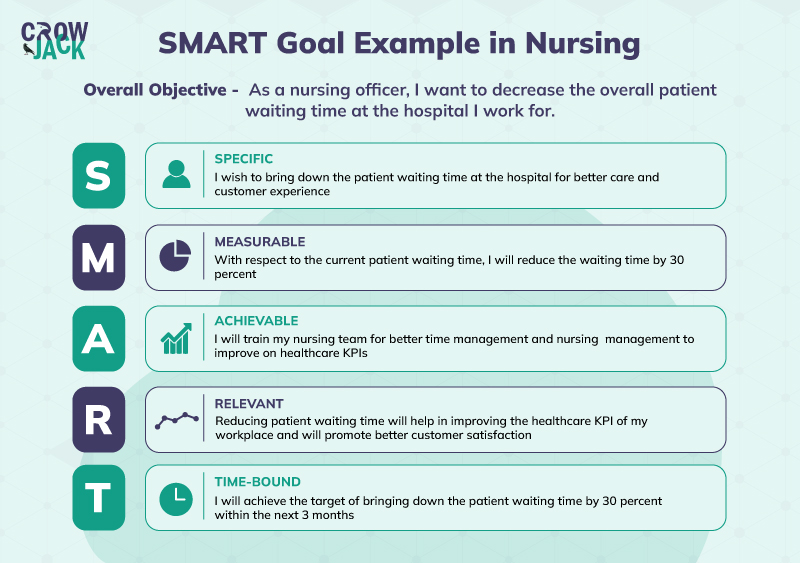
Overall objective
Reduce patient waiting time in the hospital by 30%.
This example is different from the previous four because it focuses on quality improvement and healthcare performance, rather than an individual's education or career progression.
S — Specific
The goal identifies exactly what needs to improve:
Patient waiting time.
This is better than saying:
“Improve hospital efficiency.”
The nurse knows precisely what process they are trying to improve.
M — Measurable
This is one of the strongest measurable components among the five examples.
The target is to:
Reduce waiting time by 30%.
The nurse or healthcare team can compare the baseline waiting time with the waiting time after implementing improvements.
For example:
Before improvement:
Average waiting time = 40 minutes
Target:
30% reduction
Target waiting time:
28 minutes
This makes the goal much easier to evaluate.
A — Achievable
The example proposes using nursing teams and improving time-management practices.
However, because patient waiting time can be influenced by many departments and processes, the goal should not necessarily be assigned to one nurse alone.
Factors could include:
- Patient registration
- Triage
- Staffing
- Appointment scheduling
- Diagnostic services
- Bed availability
- Communication between departments
- Discharge processes
Therefore, this would be stronger as a team-based SMART healthcare goal.
R — Relevant
Reducing unnecessary waiting time can be relevant to:
- Patient experience
- Healthcare efficiency
- Service quality
- Workflow
- Patient satisfaction
This also connects nicely with your keyword SMART goals in healthcare.
T — Time-Bound
The example gives a three-month deadline.
A stronger version would be:
“Within three months, the nursing team will work with relevant departments to reduce average patient waiting time by 30% from the established baseline.”
This makes the timeframe and target much clearer.
What this example teaches
This example demonstrates that SMART nursing goals don't have to focus only on individual nurses. SMART goals can also be used for:
- Quality improvement
- Patient experience
- Workflow improvement
- Team performance
- Healthcare KPIs
SMART Nursing Goal Template
Use the following SMART nursing goal format to turn a general nursing goal into a clear and measurable objective.
Specific: What exactly do I want to improve or accomplish?
Measurable: How will I know that I have achieved it?
Achievable: What skills, resources, support, or opportunities do I need?
Relevant: How does this goal support patient care, education, professional development, or my career?
Time-Bound: When will I complete the goal?
Fill-in-the-Blank SMART Goal
I will [specific action] by [measurable target] using [resources, support, or method] because [relevance], and I will achieve this by [deadline].
Example
I will improve my patient-assessment skills by completing five supervised assessments and receiving feedback on each assessment, because accurate assessment supports safe patient care, and I will achieve this within six weeks.
This smart goal example for nursing demonstrates how each part of the SMART framework contributes to a complete nursing objective.
Common Mistakes When Writing SMART Nursing Goals
Even when nurses understand the SMART acronym, it is easy to create goals that are still too broad or unrealistic. Common mistakes include:
1. Making the goal too vague
“Improve patient care” does not explain what needs to improve or how progress will be measured.
2. Choosing a goal that cannot be measured
If there is no clear indicator of progress, it becomes difficult to determine whether the goal has been achieved.
3. Setting an unrealistic deadline
A SMART goal should be challenging but achievable within the available time and resources.
4. Confusing an activity with an outcome
Completing a course or attending training may support professional development, but the goal should also explain what skill or result the activity is intended to produce.
5. Setting too many goals
Focusing on a small number of meaningful goals can make progress easier to monitor.
6. Forgetting to evaluate the goal
A SMART goal should be reviewed at the end of its timeframe to determine whether it was achieved and whether further development is required.
Conclusion
Effective goal setting can help nurses and nursing students turn areas for improvement into clear and measurable actions. Whether the focus is clinical knowledge, patient communication, documentation, time management, patient education, leadership, or professional development, the SMART framework provides a practical structure for creating realistic nursing objectives.
The key is not simply to set more goals, but to set goals that clearly define what needs to be achieved, how progress will be measured, why the goal matters, and when it should be completed.
Use the SMART nursing goal template and examples in this guide as a starting point, then adapt each goal to your clinical responsibilities, learning needs, workplace requirements, or professional development plan.
FAQs
How can nursing SMART goals help with professional development?
Nursing SMART goals facilitate professional development by guiding nurses to identify areas of improvement, create actionable plans, and track progress. They enable nurses to enhance their skills, knowledge, and competencies, leading to career advancement and improved patient care.
How do nursing SMART goals contribute to patient care and outcomes?
Nursing SMART goals directly impact patient care and outcomes by promoting continuous improvement in nursing practice. When nurses set specific and measurable goals related to patient care, safety, and satisfaction, they can implement targeted interventions that lead to better patient outcomes.


