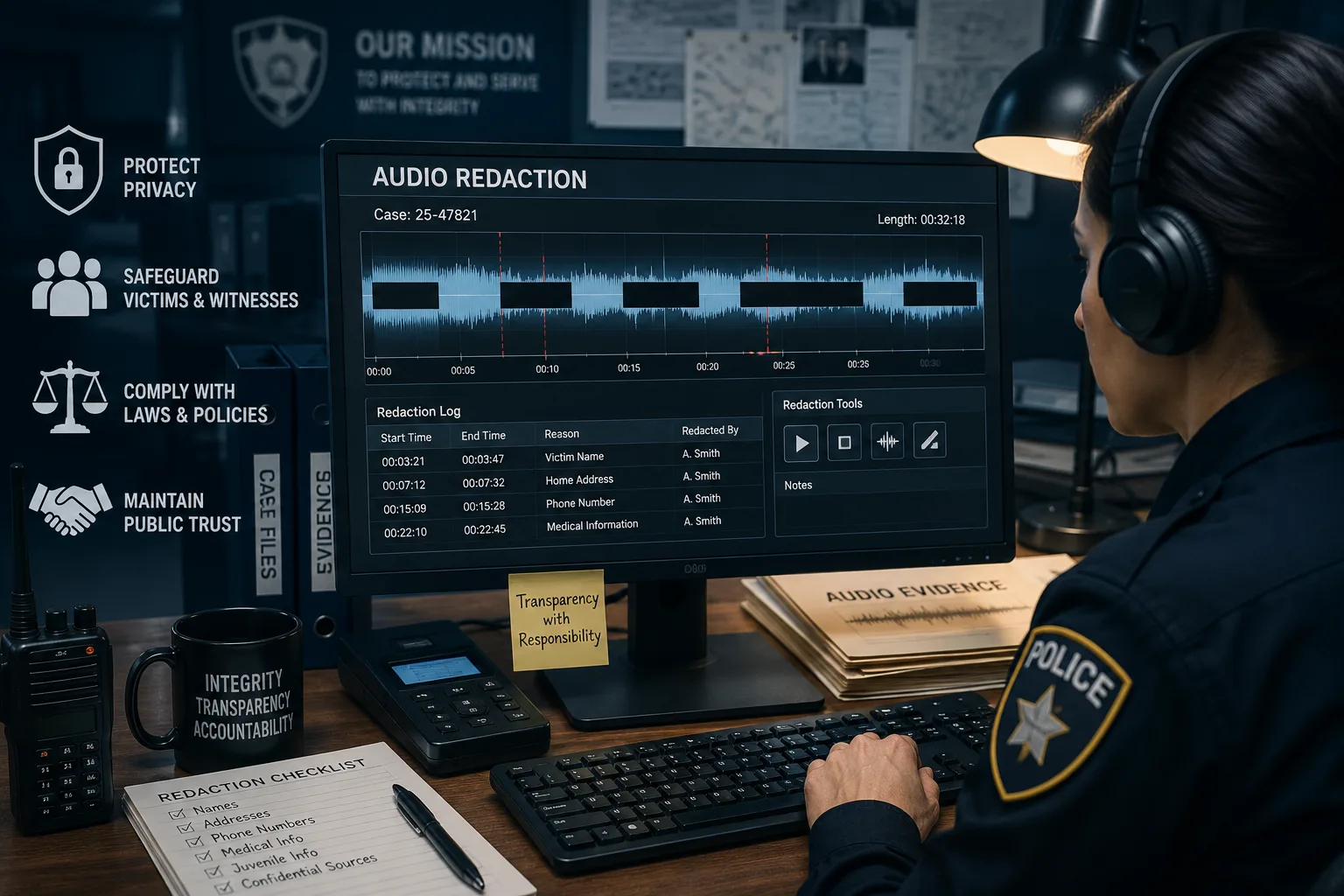
Audio evidence is becoming one of the most crucial evidentiary sources in contemporary law enforcement. Police dispatches, recordings from body-worn mikes, interview room tapes, jail phone recordings, audio surveillance and even recordings submitted by civilians can affect the course of an investigation or even a case in a court of law. But when there is that much audio information to work with, there is one serious issue at hand: how can law enforcement agencies disclose the required information without compromising what needs to stay secret? This is where audio redaction comes into play. Audio redaction in essence is a procedure of determining and eliminating sensitive information from the audio recording prior to its use and release for further purposes.
Why Audio Redaction Matters More Than Ever
It should be remembered that a decade ago, there was not so much digital evidence as there is today. Now, many police departments deal with hours of video and audio recordings daily. In addition, people's demands are higher now than a decade ago. The demand for transparency from the public, journalists, defense attorneys, and other organizations is no longer optional.
Unfortunately, an audio file might contain even more personal information than we expect at first glance. It could consist of such sensitive information as the address of the victim, the identity of a minor, medical information, SSN number, financial data, or information about a confidential informant.
For law enforcement, releasing audio without proper review can create serious consequences:
- Privacy violations
- Compromised investigations
- Risks to victims or witnesses
- Noncompliance with records laws or evidentiary rules
- Damage to public trust
Redaction is not about hiding misconduct or withholding legitimate information. Done properly, it is a safeguard that allows agencies to disclose relevant evidence while limiting unnecessary harm.
What Gets Redacted From Law Enforcement Audio?
Not every recording needs the same treatment. The scope depends on local law, the status of the investigation, and the people involved. Still, certain categories come up repeatedly.
Names, phone numbers, dates of birth, driver’s license numbers, license plates, and home addresses are common candidates for redaction, especially when disclosure serves no public interest.
Agencies may need to mute information that could reveal investigative strategy, expose an undercover officer, identify a confidential source, or prejudice an ongoing case.
This is one of the most sensitive areas. Calls involving domestic violence, sexual assault, mental health crises, or minors often include details that require careful handling under state law, federal privacy standards, or department policy. As departments refine their secure audio evidence processing practices, many are finding that the hard part is not just muting a word or phrase. It is creating a repeatable workflow that balances disclosure, privacy, documentation, and evidentiary integrity without slowing operations to a crawl.
How Audio Redaction Works in Practice
Redaction is popularly understood by the public as a simple beep over a name, but there’s actually more to it.
Step 1: Analyze the File
There needs to be careful listening to the entire file several times over to determine what parts of it require redaction. These include explicit statements as well as context embedded in the form of overtalk or ambient noise.
Step 2: Pinpoint Redaction Areas
The areas that require redaction need to be precisely pinpointed. Too much redaction results in a loss of valuable context, whereas too little redaction will expose the confidential data.
Step 3: Redact the Area
The marked areas are made to be silent or covered in some form of tone or sound.
Step 4: Record the Changes Made
Redaction processes should be supported by records and timestamps and should cite the specific case number where applicable. This will allow the agency to provide justification when the decision to release a certain document is contested.
Step 5: Maintain the Original
It is imperative that the original document is not altered and stored safely. Copies of the document can be released, but only the original is an official record.
The Biggest Challenges Agencies Face
Audio redaction seems easy until one considers the challenges involved when scaled. It would be manageable for a small department with only a handful of requests coming their way. However, a large department with many requests regarding body-worn camera programs, open records, and court orders can be in a challenging situation.
High Volume and Deadline Pressures
It will be tedious listening to recordings in full. A department receiving many requests will find itself with many audio files piling up as backlogs.
Inconsistent Policies
If there are no policies in place, there could be varying judgments regarding what should be redacted. This can be very risky legally speaking and frustrating to requesters.
Complex Audio Environment
Several people speaking in an audio recording, different accents, bad microphone placement, audio radio interference, and even emotional scenes will create difficulties. Confidential information might not always be conveyed clearly and distinctly.
Preservation and Chain of Custody Issues
Any editing done on any evidence file poses certain concerns regarding authenticity and preservation of the file.
What Good Policy Looks Like
Technology is important, but policies matter even more. Audio redaction is handled properly in departments that do several things right.
Written Policies for Common Situations
Employees must not be second-guessing on whether the disclosure of a juvenile name, statement of a victim, or medical information is okay. A written policy is an efficient and error-free solution.
Review Based on Role
Not all recordings need to be reviewed by the same person. Some recordings may need to be reviewed by a lawyer, supervisor, or the investigator of the case.
Audit
A record of who reviewed the file, what information was redacted, the date, and who authorized it is necessary.
Relevant Training
It is important to train people with real-life examples of law enforcement situations. For example, 911 calls that involve children create unique challenges compared to street stops or jail phone calls.
The Broader Purpose of Audio Redaction
Audio redaction, when properly utilized, allows for the achievement of two somewhat opposing purposes: transparency and protection. Firstly, it makes it possible for agencies to make records accessible in a responsible manner rather than withhold the entire record due to fear of any mistakes during disclosure. Secondly, it offers protection to individuals that could be especially sensitive or vulnerable – victims, minors, and even those bystanders who had nothing to do with the case.
This is important because communities tend to trust the disclosure process when they see responsible record disclosure from agencies and not automatic refusal to disclose information. In addition, courts and counsel can enjoy the process of evidence handling as well. Therefore, audio redaction can no longer be considered as a niche technical task. Rather, it becomes an integral part of the general process of handling evidence within law enforcement agencies.