If you've ever launched a product, watched it struggle, and couldn't quite figure out why, the 7 Ps of marketing are probably where the answer lies.
Most marketing guides tell you to focus on your product and your ads. But here's what the data actually show: 96% of marketers report that personalised, holistic customer experiences are not just good products; they drive increased sales. Businesses winning in their markets right now aren't just selling better. They're systematically aligning every touchpoint, from pricing logic to staff training to checkout flow, around a single coherent strategy. And it's compounding every quarter.
This guide covers everything, including:
- What are the 7 Ps of marketing?
- How has the framework evolved?
- Why does it matter for both product & service businesses?
- What does each P mean in practice with real-world examples?
- How to audit your own marketing mix using the model today?
What Are the 7 Ps of Marketing?
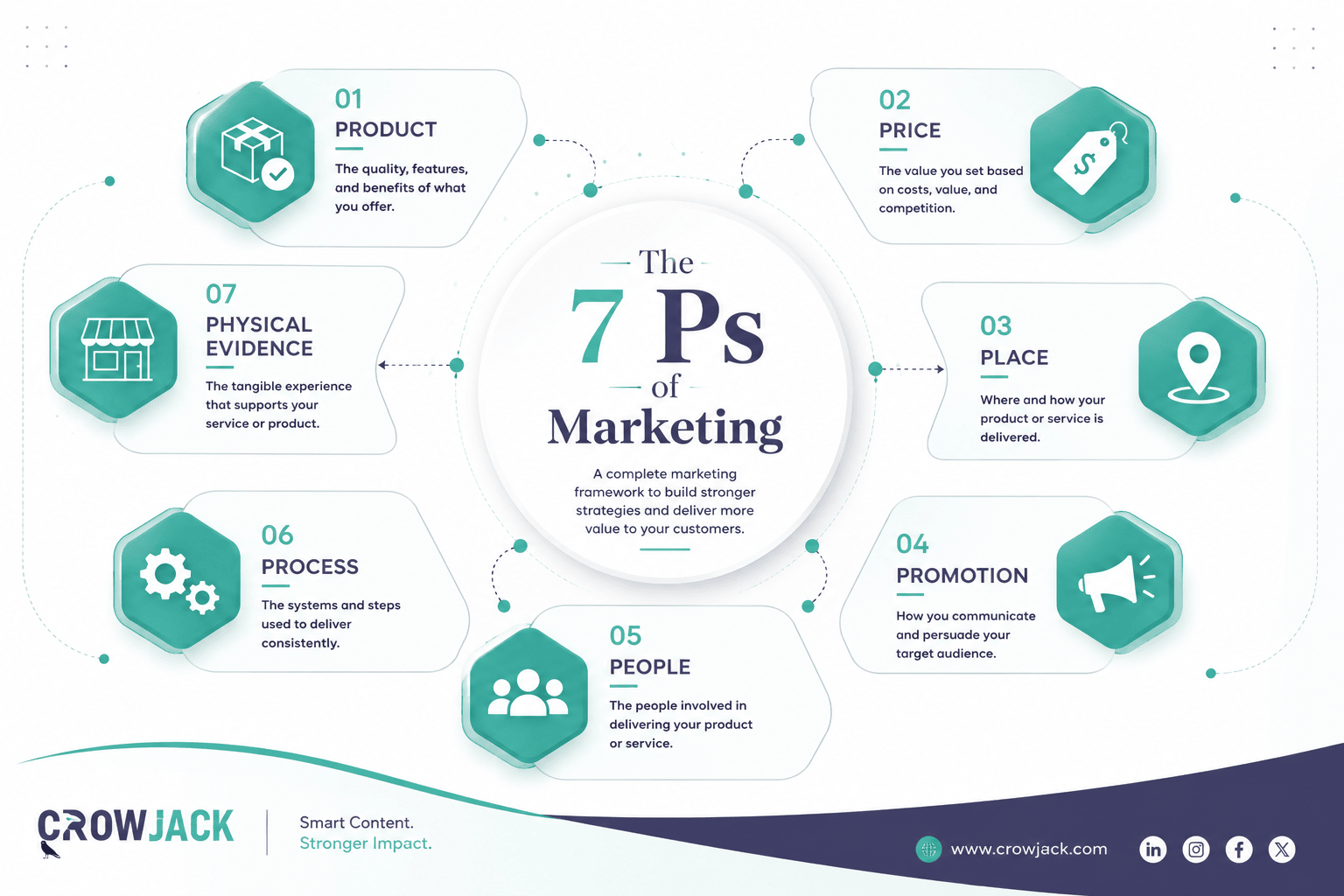
The 7 Ps of marketing, also called the extended marketing mix, are a framework of seven interconnected elements that businesses use to plan, evaluate, and execute their marketing strategy. Together, they cover what you offer, how you price it, where you sell it, how you promote it, who delivers it, how it gets delivered, and what physical cues reinforce your brand's credibility.
Quick definition: The 7 Ps of marketing are Product, Price, Place, Promotion, People, Process, and Physical Evidence. They form a structured model to make sure every aspect of your marketing strategy aligns with what your customers actually need and expect.
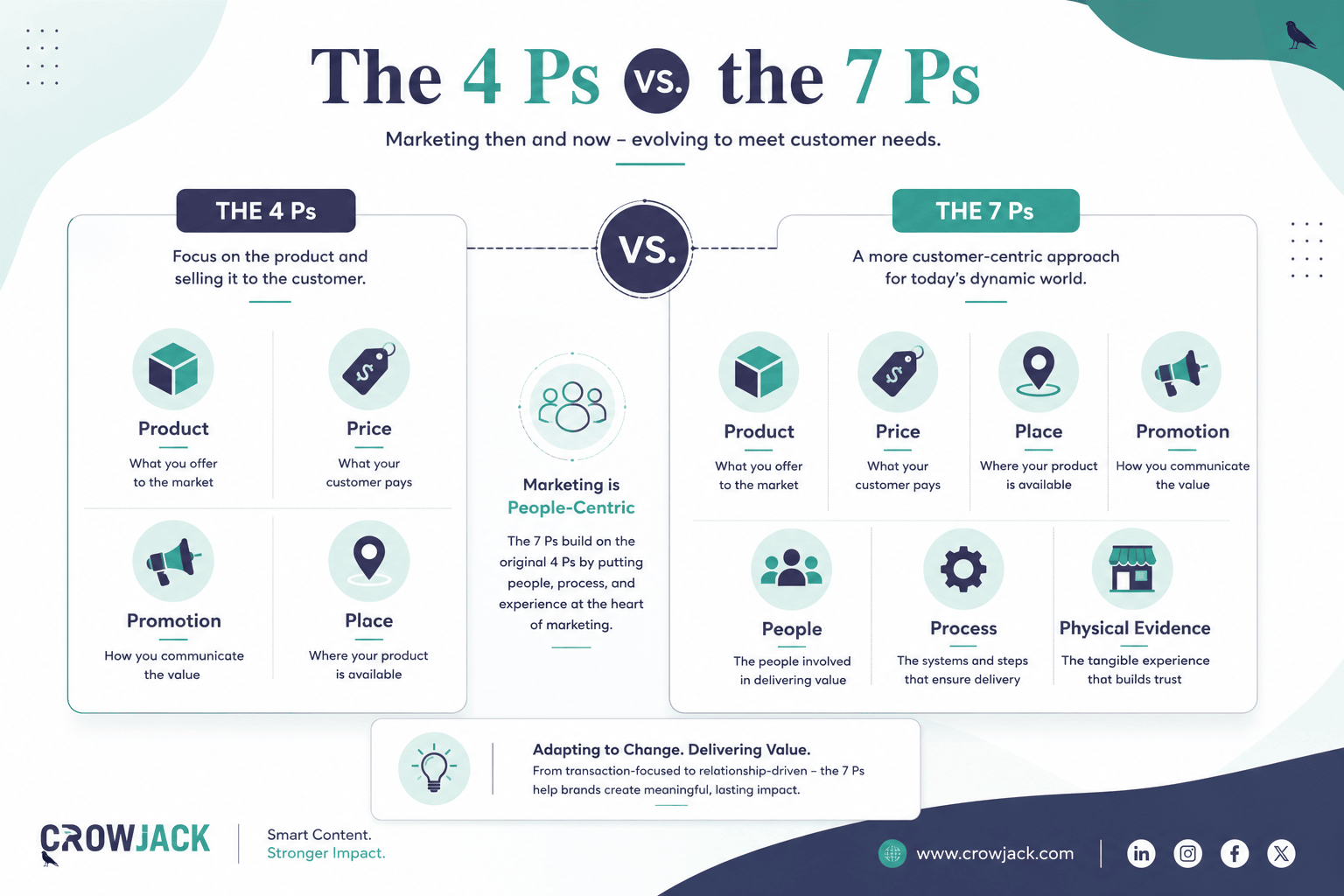
The 7 Ps of marketing mix didn't arrive fully formed. The story starts with E. Jerome McCarthy, who introduced the original 4 Ps framework in his 1960 book Basic Marketing: A Managerial Approach. That model, covering Product, Price, Place, and Promotion, was built for a product-first economy where goods were manufactured, distributed, and advertised.
Then the service economy grew. And the 4 Ps started showing cracks. A model built around physical products couldn't adequately account for an airline, a law firm, or a SaaS company, where the experience of delivery is the product. In 1981, researchers Bernard Booms and Mary Jo Bitner extended the model, adding People, Process, and Physical Evidence. The extended 7 Ps of marketing mix was born, and it's remained the professional standard ever since.
Here's the complete framework at a glance:
P | What It Covers |
Product | What you sell: features, quality, design, lifecycle |
Price | What you charge: strategy, positioning, psychology |
Place | Where and how customers access your offering |
Promotion | How you communicate and create demand |
People | Everyone involved in delivering the customer experience |
Process | The systems and workflows behind your service delivery |
Physical Evidence | Tangible cues that build trust and credibility |
The 4 Ps vs. the 7 Ps - What Changed & Why It Matters
The 4 Ps framework is still taught in marketing courses worldwide. It's not wrong. It's just incomplete for most modern businesses. Here's the core limitation: the original 4 Ps treated marketing as a broadcast problem. Build a product, set a price, put it in stores, and run ads. That model works reasonably well if you're selling fizzy drinks or packaged goods. It breaks down the moment your product is a haircut, a cloud subscription, a consulting engagement, or a hotel stay.
The 7 Ps of service marketing address exactly this gap. The three added elements, namely People, Process, and Physical Evidence, capture what the 4 Ps entirely ignore: the human delivery of value, the operational systems behind it, and the tangible cues customers use to assess quality before they can fully experience it.
Factor | 4 Ps | 7 Ps |
Product & service businesses | Product businesses only | Both |
Customer experience coverage | Partial | Full |
Staff and culture | Not addressed | People P |
Operational delivery | Not addressed | Process P |
Trust signals and credibility | Not addressed | Physical Evidence P |
Best suited for | FMCG, packaged goods | Services, SaaS, B2B, hospitality |
The Key Insight: The 4 Ps tell you what to offer and how to sell it. The 7 Ps of marketing mix tell you how to deliver it in a way that builds lasting loyalty. If your business has any service component, and most businesses do, you need all seven.
Why the 7 Ps of Marketing Are Important - The Data
1. Customer Experience Is Now the Primary Competitive Battlefield
According to HubSpot's State of Marketing Report, 96% of marketers say personalised experiences directly drive increased sales. Customers aren't just evaluating your product anymore. They're evaluating every interaction they have with your brand, from discovering you on Instagram to navigating your returns process. The 7 Ps framework ensures that every one of those interactions is intentional.
The 7 Ps model isn't just a planning tool. It's an audit framework. Companies that regularly evaluate each element of their marketing mix are more adaptable, more customer-focused, and faster to spot misalignments before they become revenue problems. A pricing strategy misaligned with product positioning, or a promotion campaign disconnected from the actual customer experience- these are exactly the gaps the 7 Ps surface.
3. Service Businesses Have No Choice But to Operate at All 7 Levels
Globally, services now account for more than 65% of GDP in most developed economies. Service marketing, where the 7 Ps are its native framework, is no longer a subspecialty. It's the dominant mode. A restaurant, a legal practice, a software company, a healthcare provider: all of them live and die not just on what they offer, but on how it's delivered, by whom, and in what environment.
The Advantages of the 7 Ps Framework
- Provides a complete audit across all marketing dimensions
- Forces alignment between product quality, pricing, and customer experience
- Addresses the service delivery gap that the 4 Ps ignore
- Applicable to startups, SMBs, and global enterprises equally
- Creates a shared strategic language across departments, not just marketing
Explaining the 7 Ps of Marketing: Each One in Depth
Learn the 7 Ps of Marketing with practical examples, strategies, and real-world insights to build stronger brands and drive business growth.
P1: Product: Where Value Begins
Product is the foundation. It refers to everything you offer, including the physical goods, the digital service, the software, or the experience that your customer is ultimately paying for. And it's broader than most people assume.
Your product isn't just the thing itself. It's the quality, the features, the design, the packaging, the branding, the warranty, and any after-purchase support that comes with it. For a service business, the product includes the clarity of your communication, the range of options available, and the consistency of the outcome delivered.
Ask yourself:
- Does our product solve a real problem better than alternatives?
- What are its core features, and what differentiates it from competitors?
- What stage of the product lifecycle is it in: launch, growth, maturity, or decline?
- Are we regularly updating it based on customer feedback?
Real-world example: Apple's product strategy is one of the most studied in business history. Each new iPhone builds on the last, adding features that directly address real user needs rather than feature bloat for its own sake. Apple also maintains a deliberately streamlined product line, avoiding unnecessary variation, which keeps brand identity tight and customer confusion low. The product is so well-engineered that the remaining 6 Ps essentially exist to support and amplify it.
No amount of clever promotion, sharp pricing, or prime placement can compensate for a product that doesn't genuinely deliver value. Product is the starting point. Get this wrong, and the rest of the mix can't save you.
P2: Price: The Signal Your Brand Sends Before a Customer Buys Anything
Pricing is not just a financial decision. It's a positioning decision. The moment a customer sees your price, they form an immediate assumption about your quality, your target audience, and whether your brand is for them. According to Salesforce, high prices are the top reason, cited by 65% of customers, for why they stopped buying from a brand. But too-low pricing destroys perceived value just as effectively.
There are several core pricing strategies, each sending a different signal:
Strategy | What It Signals | Best For |
Premium pricing | Exclusivity, superior quality | Luxury, high-margin products |
Penetration pricing | Accessibility, market share grab | New entrants, competitive markets |
Value-based pricing | Customer outcomes, ROI focus | SaaS, consulting, B2B services |
Competitive pricing | Parity with market standards | Commoditised categories |
Psychological pricing | Perception manipulation (£9.99 vs £10) | Retail, e-commerce |
Real-world example: Starbucks is a textbook case. When it entered a market full of cheaper options, Dunkin' being the obvious one, it didn't compete on price. It used premium pricing to immediately signal premium quality. Over time, customers didn't just accept the higher price. They began associating it with a whole lifestyle. Being a "Starbucks person" became part of the brand's meaning. The price wasn't just a cost. It was a cultural statement.
Pro tip: Your price must be consistent with your other Ps. A premium product sold through discount channels, or a budget product marketed as aspirational, creates cognitive dissonance that customers feel, even if they can't articulate it.
P3: Place: Being Where Your Customers Already Are
Place refers to how and where your product or service is made available. It's not just physical location. It's the entire distribution strategy, which channels you sell through, how easy the purchase experience is, whether your fulfilment is fast and reliable, and whether your digital presence meets customers where they spend their time.
The easier it is for customers to access your product, the higher the likelihood of purchase. Friction at this stage, such as confusing checkout flows, stock-out issues, or limited delivery options, costs sales regardless of how strong the other Ps are.
Distribution channels to consider:
- Physical retail: own stores, partner stores, franchise locations
- E-commerce: own website, marketplaces like Amazon or Flipkart
- Direct-to-consumer (DTC): subscription boxes, direct website sales
- Wholesale and distribution partnerships
- Digital delivery: app stores, SaaS platforms, digital downloads
Real-world example:Nike sells through its own website and flagship stores, through major third-party retailers like Amazon and sports chains, and through brand-owned apps including Nike Run Club and SNKRS. Each channel serves a different segment and a different purchase intent. The app channels drive community and loyalty, while retail distribution drives volume. That multi-channel intelligence is what Place strategy looks like at scale.
Promotion covers everything you do to communicate your offering to the market and persuade customers to take action. It's the most visible of the 7 Ps, and also the one most businesses overinvest in while neglecting the other six.
Promotion includes: paid advertising (search, social, display), content marketing, SEO, email marketing, public relations, social media, influencer partnerships, events, referral programmes, and any form of direct outreach.
The Promotion toolkit - what to combine
Channel | Best For | Typical ROI Signal |
SEO & content | Long-term organic traffic | High (compounding) |
Paid search (PPC) | Immediate intent-based reach | Medium to high |
Social media | Brand building, community | Variable |
Email marketing | Retention, nurture, upsell | Consistently high |
Influencer marketing | Awareness, trust transfer | Growing fast |
PR & earned media | Credibility, brand authority | Difficult to measure |
According to HubSpot, email marketing delivers returns of up to $36 to $50 per $1 spent for top performers, making it one of the highest-ROI channels available. And yet most brands treat it as an afterthought compared to paid social.
Real-world example:Nike's "Just Do It" campaign is one of the most enduring examples of promotion done right. It doesn't sell shoes. It sells a mindset: perseverance, athletic identity, possibility. The product is almost incidental in the advertising. This emotional positioning is why Nike commands a price premium globally across categories ranging from running shoes to golf equipment. Promotion, when executed with clarity of brand purpose, compounds in value year over year.
Pro tip: Promotional activities must have a clear call to action. Whether you want the audience to sign up, book a call, visit your store, or make a purchase, make that next step obvious and remove every obstacle between the intention and the action.
P5: People: The Human Layer That Makes or Breaks Your Brand
People are the P that most product-focused marketing guides skip. It covers everyone involved in delivering your product or service and shaping the customer's experience, from front-line staff to customer success teams, and from founders to freelancers who interact with clients.
Here's what's so counterintuitive about the People P: customers remember experiences, not transactions. They forget what your product did. They don't forget how they were made to feel. A single bad interaction with a poorly trained support rep can undo months of positive brand-building. And a single exceptional interaction, where someone went out of their way, solved a problem fast, or simply treated the customer like a human, can create a customer for life.
What the People P encompasses:
- Hiring: Are you selecting for values alignment, not just skills?
- Training: Do frontline staff actually know how to represent your brand?
- Culture: Is internal culture consistent with how you want customers to experience you?
- Customer success: How do you manage post-purchase relationships?
- Empowerment: Can staff make decisions in the customer's favour without escalating?
Real-world example:The Ritz-Carlton is famous for empowering every single employee, regardless of role, to spend up to $2,000 to resolve a guest's problem without manager approval. That policy isn't just a nice HR gesture. It's a strategic decision that ensures every customer-facing interaction is resolved in favour of the guest, and that the People P operates at the same standard as the rest of the brand's premium positioning.
P6: Process: The Operational Engine Behind Every Promised Experience
Process refers to the systems, workflows, and procedures through which your product or service is created and delivered. In product businesses, it's your supply chain, quality control, and fulfilment infrastructure. In service businesses, it's the sequence of steps a customer goes through from first contact to final delivery, along with everything behind the scenes making that happen reliably.
Process is the P that customers never see but always feel. A slow checkout process, a clunky onboarding flow, an inconsistent service quality, a cumbersome returns experience: all of these are Process failures that no amount of promotional spending can fix.
What strong Process design looks like:
- Standardised service delivery with clear quality benchmarks
- Efficient customer journey from discovery to purchase to onboarding
- Fast, frictionless support and issue resolution
- CRM and automation that enables personalised follow-up at scale
- Post-purchase processes that turn one-time buyers into repeat customers
Real-world example: McDonald's is the global gold standard of process in the physical food service sector. Every location follows standardised procedures for how food is ordered, prepared, served, and delivered. The entire supply chain is vertically integrated to support that process consistency. The result is that a customer in Mumbai and a customer in Manchester can have a near-identical experience, which is a process achievement, not just a product one.
P7: Physical Evidence: The Tangible Proof That Trust Is Warranted
Services are intangible. Customers can't test a legal consultation before they pay for it, or evaluate a haircut before the scissors touch their head. Physical Evidence refers to all the tangible and visible cues that reassure customers, before, during, and after the experience, that your business is credible, consistent, and worth their trust.
Physical Evidence is broader than most people assume. It's not just your store design or your packaging. It's your website, your email templates, your invoices, your uniforms, your customer reviews, your awards, your case studies, your certifications- essentially anything that makes the promise of your brand visible and verifiable.
Physical Evidence Checklist:
Element | Why It Matters |
Store/office environment | Sets quality expectations instantly |
Website design and speed | First digital impression; affects conversion directly |
Branding consistency | Same fonts, colours, tone across all touchpoints |
Packaging | Unboxing experience signals quality |
Customer reviews and ratings | Third-party validation, often more trusted than one's own claims |
Certificates and accreditations | Removes doubt for regulated services |
Case studies and testimonials | Proof of outcomes for B2B buyers |
Real-world example: Apple's physical store design is a masterclass in Physical Evidence. Large tables display only the products, with no clutter and no competing brand noise. Natural materials create warmth without formality. Customers are actively encouraged to touch, test, and explore devices. Every design decision reinforces the brand's positioning as the premium, user-first technology company. Even the unboxing experience, from the tight resistance of the lid to the layered reveal of accessories, is engineered to signal that you've purchased something exceptional.
The 7 Ps of Marketing in Practice - How to Apply the Framework
Step 1: Audit Your Current Mix
Before building a new strategy, honestly evaluate where you currently stand across all seven Ps. Map out what you're doing today against each element. Most businesses will immediately find two or three Ps that are either underdeveloped or actively working against the others.
Questions to stress-test each P:
P | Core Audit Question |
Product | Does it solve the problem better than alternatives? Is it differentiated? |
Price | Is our pricing aligned with our positioning, or is there cognitive dissonance? |
Place | Are we present in every channel our customers use to buy? |
Promotion | Are our channels, message, and CTA consistent and measurable? |
People | Is our team trained to deliver on our brand promise in every interaction? |
Process | Where does the customer experience break down, and why? |
Physical Evidence | What do our touchpoints signal about our quality before the customer buys? |
Step 2: Identify the Misalignments
The 7 Ps are interdependent. A premium Product with budget-looking Physical Evidence sends a mixed signal. Excellent People with a broken process create inconsistent delivery. The power of the framework is in finding where the Ps are working against each other, not just where individual elements are weak.
Step 3: Prioritise and Sequence Changes
You can't fix everything simultaneously. Rank the misalignments by revenue impact and customer experience impact. Typically, Process improvements pay off fastest because friction removal directly drives conversion and retention. People's improvements compound over time. Physical Evidence improvements have an immediate impact on first impressions and trust.
Step 4: Build Cross-Functional Ownership
Here's a mistake most marketing teams make: they treat the 7 Ps as a marketing department exercise. But Process is owned by operations. People are owned by HR. The place may involve the supply chain. Physical Evidence spans design and IT. The 7 Ps framework only delivers its full value when leadership across functions takes ownership of the elements that fall in their domain.
The 7 Ps of Marketing Mix by Business Type
Generic frameworks don't cut it. Here's what the 7 Ps look like across specific business contexts.
1. 7 Ps of Service Marketing
Service businesses, including consulting, healthcare, education, financial services, and hospitality, face a unique challenge: the product is intangible. This is precisely why the extended 7 Ps of service marketing exist. People, Process, and Physical Evidence were added specifically to address the service delivery problem, which is how you consistently deliver quality when the product is a human experience.
For service businesses, the People and Process Ps often matter more than Product and Promotion. The best consulting firm in the world loses clients if its project management is chaotic or its senior staff are difficult to work with.
2. SaaS and Tech Companies
SaaS businesses live inside the 7 Ps framework, whether they know it or not. The Product is the software. Pricing is typically tiered, either value-based or seat-based. Place is the digital distribution network: app stores, direct website, and enterprise partnerships. Promotion is heavily content- and SEO-driven. People include customer success as a core function. Process covers onboarding flows, support ticketing, and renewal management. Physical Evidence is the product UI itself, the website, the case studies, and the G2 or Capterra review profile.
3. E-commerce
For e-commerce, the Place P has become arguably the most competitive battleground. Being on Amazon, having fast shipping, offering hassle-free returns, and appearing where customers search are the distribution decisions that determine whether a product gets discovered and purchased or simply ignored. Physical Evidence shifts heavily toward product photography, unboxing experience, and review volume.
4. Local and SMB Businesses
Local businesses have a natural advantage in the People and Physical Evidence Ps. Personal relationships and visible premises create immediate trust signals that digital-native brands spend years trying to replicate. The opportunity for most local SMBs is in sharpening their Process and Promotion Ps to match that relationship quality at scale.
Common Mistakes Businesses Make with the 7 Ps
Knowing the framework and applying it correctly are different things. Here's where most teams go wrong:
Pouring budget into advertising a product that doesn't genuinely solve customer needs better than alternatives doesn't fix the underlying problem. It accelerates customer disappointment. Fix the Product P before scaling Promotion.
2. Ignoring the Last Three Ps Entirely
Many businesses still use the 7 Ps as if it's the 4 Ps. People, Process, and Physical Evidence get dismissed as "soft" or "operational" concerns. In a service economy, they're often where the most significant competitive advantages and disadvantages actually live.
3. Building Ps in Isolation
A premium brand that uses discount-channel distribution, or a high-quality product sold at a price that signals budget quality, these misalignments are the direct result of Ps being managed in departmental silos rather than as an integrated system.
4. Treating the audit as a one-time exercise
The 7 Ps are a live framework, not a founding document. Markets evolve. Customer expectations shift. What constituted physical evidence of quality in 2020, such as a professional website, now requires social proof, verified reviews, and visible data security practices. The mix needs reviewing at least annually.
Conclusion: The 7 Ps Are a System, Not a Checklist
Checking boxes across seven categories isn't a strategy. Using the 7 Ps as a system, where every element reinforces every other, is. The brands dominating their categories in 2025 aren't winning on product alone, or on advertising spend, or on distribution reach. They're winning because their Product is differentiated, their Price signals the right positioning, their Place strategy removes every point of friction, their Promotion communicateswith clarity and consistency, their People deliver on the brand's promise in every human interaction, their Process makes that delivery reliable and scalable, and their Physical Evidence makes every one of these things visible and verifiable before the customer takes the risk of buying.
That compounding effect, where each P strengthens the others, is the actual value of the framework. It's not a marketing model. It's a business model audit tool.
Start this week: pick two Ps you know are underdeveloped in your current strategy. Map out specifically what's missing and what needs to change. Then build a 90-day plan to address them. The businesses winning in search and in market share are the ones that understood early: the mix is where the real growth lives.


.webp)